An AIO Case Study: AI Share of Voice Rose from 22% to 45%
An agency-reported financial-services case study shows AI share of voice rising from 22% to 45%. Turn its customer-focused media approach into an evidence-based plan.
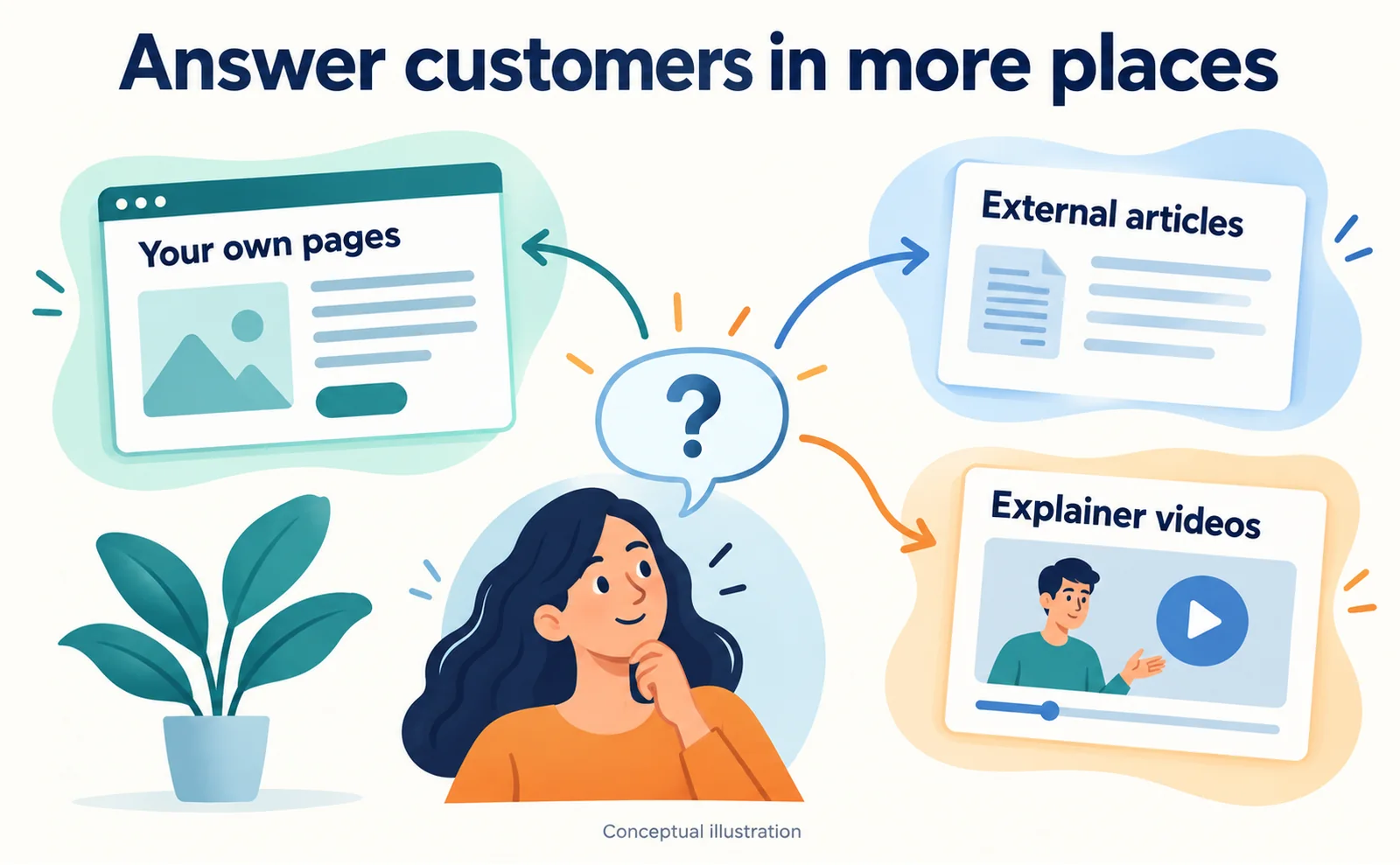
Acceleration Partners reports that a US financial-services client increased its AI share of voice from 22% to 45%. Its campaign combined audience-specific external content and video with existing independent editorial recognition. This is a reported visibility outcome, not a doubling of sales.[1]
The case is useful if your company publishes regularly but rarely appears when potential customers ask AI for advice. AIO, or AI-search optimization, can involve the information available about your business outside your own website as well as the pages you control.
The client is unnamed, and the public case does not disclose the complete measurement setup. Below, we distinguish the published result from our own practical exercise for preparing clearer customer information.
What the published case establishes
The agency describes a partnership with CNET Group, using content for specific audiences such as freelancers and first-time tax filers. It distinguishes independent recognition from disclosed sponsored material. Its reported share-of-voice change is 23 percentage points; the full prompt set and calculation conditions are not public.[1]
Those limits matter. We cannot turn the result into an expected return for a smaller business or conclude that one particular placement caused the increase. Nor can we reconstruct undisclosed campaign operations.
The following steps are our recommendations. They are not presented as tasks the unnamed client performed.
1. Choose a real customer question
Open recent inquiry emails or sales notes. Look for a question that repeatedly delays a decision. Keep the question and business situation, removing names, contact details, and other unnecessary personal information.
For an invoicing service, a newly self-employed customer may need help creating a first invoice. A business with many customers may instead need to track unpaid invoices. These are illustrative scenarios, not findings from the agency's campaign.
Write a short brief before producing content:
| Field | Illustrative entry |
|---|---|
| Reader | Someone preparing a first business invoice |
| Decision | Whether to use a service or prepare it manually |
| Question | Can I include the required information without missing fields? |
| Available evidence | Current interface, instructions, and confirmed feature scope |
| Next destination | The relevant feature page and setup instructions |
Use your own inquiry history to select the real question. Inventing a demographic profile is less useful than knowing the task, constraints, and uncertainty that led someone to contact you.
2. Check whether your page actually answers it
Open the page that sales or support sends to customers. Find the answer to the selected question. If it exists only in a colleague's explanation, the page needs work.
Replace broad praise with verified details. “Easy for beginners” says little about the first task. A more useful explanation identifies what the user enters, what the service produces, and what remains their responsibility.
| Vague copy | A more useful direction, if accurate |
|---|---|
| We provide excellent support | State the contact channel, hours, and response expectations |
| Everything your business needs | List the included tasks and important exclusions |
| Fast setup | Explain the required information and actual setup sequence |
Have the relevant owner confirm pricing and service conditions. Do not invent features to make the example persuasive. A clear limitation can help someone decide just as much as a benefit.
Save the previous text and the publication date. Later, you need to know what changed, not merely that someone “improved the page.”
3. Prepare a factual brief for external coverage
Create a one-page information sheet with the official business name, target customer, task solved, eligibility, evidence, contact person, and supporting public URLs.
If you include a number, state the period, population, and what it counts. If you cannot explain the basis of a satisfaction claim, remove the claim or replace it with a verifiable feature. Obtain permission before sharing customer examples.
This exercise is useful even before commissioning a placement. It lets you respond accurately to an interview request or a partner who wants to describe your service.
Look for publications your customers already consult. Read their relevant coverage and identify an unanswered reader question. A proposal should explain the information you can contribute, not simply request a mention of your brand.
For paid coverage, agree on disclosure, review scope, correction procedures, and measurement. Sponsored content is different from an independent editorial recommendation. Buying a placement does not guarantee an AI citation.
4. Use video when a task benefits from being shown
Choose one concrete operation. In the invoicing example, show preparation, input, and checking the output. Use fictional customer details and avoid displaying real invoices or contacts.
Provide a written description and a relevant page link alongside the video. Keep important limitations and conditions available in text rather than only inside the recording.
Ask a support or sales colleague whether the demonstration answers a question they actually receive. Check that it matches the current product. This gives the video a purpose beyond accumulating views.
Google likewise recommends original, substantiated content that serves readers.[2] For its AI search features, it advises making important information available as text and using useful images or video where appropriate.[3] These are page-quality principles, not a guarantee of the case study’s outcome. A video should therefore have an accompanying page where customers can read the relevant conditions.
5. Measure visibility and customer outcomes separately
Before publication, record your target question, target URL, observation conditions, and comparison period. Keep the question stable. Otherwise, a change in the answer may simply reflect a change in what you asked.
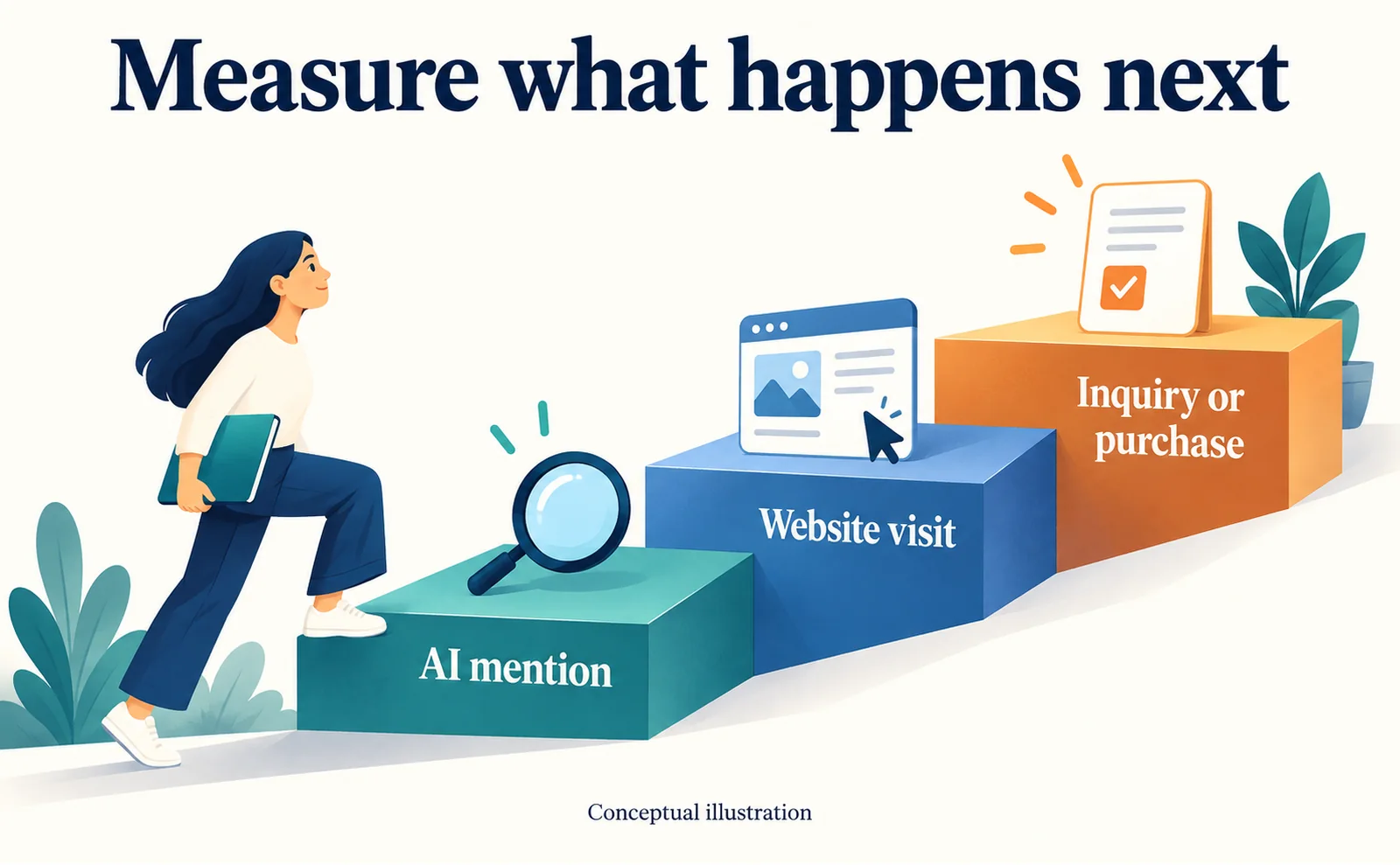
In AI responses, distinguish a name mention, a clickable citation, and an accurate description. On your site, distinguish a visit from a useful inquiry or purchase. One favorable answer is not evidence of a commercial improvement.
| Observation | Next investigation |
|---|---|
| Your name appears with incorrect information | Trace the cited source and check for outdated details |
| A link appears but visits do not grow | Consider whether the answer resolves the need without a visit |
| Visits rise but inquiries do not | Check prices, eligibility, next steps, and form behavior |
| Inquiries rise but are unsuitable | Clarify the intended customer and service boundaries |
AgentSignal users can start with the AIO measurement guide. To observe visits, follow the tracking-tag installation guide. Use the capabilities available in your account; do not treat your own website data as evidence of what happened on a publisher's site.
A useful first deliverable is one customer question with a verified answer, a corrected page, and a factual brief another publisher could check. That is a concrete foundation for an article, interview, or video—and a much stronger instruction than simply asking someone to create more content.
FAQ
- Q. Which company is this?
- The agency describes an unnamed US financial-services business. We do not infer its identity.[1]
- Q. Is this a sales result?
- No. It is reported AI share of voice; the full prompt set and measurement denominator are not public.[1]
- Q. Will paid content guarantee AI citations?
- No. Distinguish advertising from independent coverage and define how you will evaluate results.
Sources
- [1] How a financial services brand doubled its AI share of voice through partnerships (Acceleration Partners) — accessed 2026-09-19
- [2] Creating helpful, reliable, people-first content (Google) — accessed 2026-09-19
- [3] AI features and your website (Google) — accessed 2026-09-19
About the author
Shogo MizushimaCEO of kairos Inc. / AgentSignal Developer
Develops AgentSignal, a tool for measuring AI crawler visits and AI-referred traffic, and diagnosing AIO readiness. Writes about measurement and practical improvements for AI search using observed data.
Related articles
Measurement and site improvement
71,147 AI Answers: Why Customer Context Matters for AIO
A persona study shows why AI recommendations need context. Build comparable customer questions, record mentions and links, then improve pages with verified information.
Published
Case studies and research
Claude and ElevenLabs: connect MCP for images, voice and video
Set up ElevenLabs MCP in Claude, prepare images, footage, narration and music, then finish in Studio. Includes connection commands and output checks.
Published
Case studies and research
Claude and HeyGen: set up MCP to create avatar explainers
Connect Claude and HeyGen through MCP, authenticate, prepare a script and create an avatar explainer. Includes voice, caption and MP4 checks.
Published