71,147 AI Answers: Why Customer Context Matters for AIO
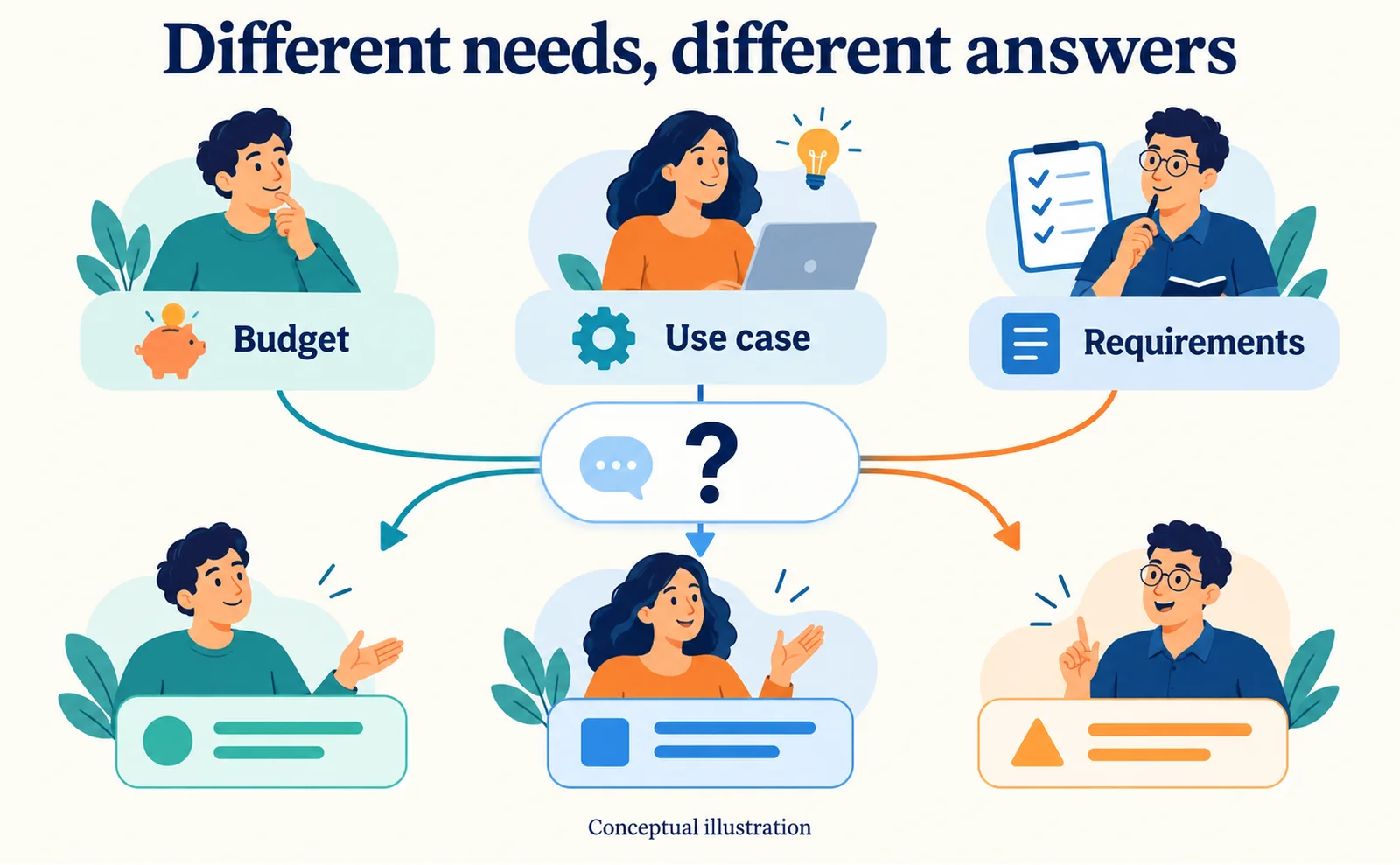
A persona study shows why AI recommendations need context. Build comparable customer questions, record mentions and links, then improve pages with verified information.
When checking whether AI recommends your business, include who the customer is shopping for and what they need. A general recommendation can hide whether your business appears for the customers it actually serves.
Before rewriting a page because a competitor appeared in an answer, inspect the question. A shopper seeking a low price and a shopper seeking a durable everyday tool may ask for the same “best product” while needing different answers.
A study published on September 9, 2026 analyzed 71,147 answers from ChatGPT, Claude and Gemini. Recommendations and cited sources differed when the researchers changed the person described in the prompt.[1]
Below is a short account of the finding followed by an original workflow for applying it. The sample questions and tables are proposed working materials, not observed customer results.
The researchers specified a persona in the question
The study covered clothing, furniture and credit cards over August 11–24, 2026. It added an age, income, occupation or gender condition to the underlying question.[1] A persona is a description of an intended customer. This experiment supplied that description; it did not establish that the AI secretly inferred a user's income.
Answers for different personas shared roughly one quarter of their brand mentions. Repeated answers for the same persona shared roughly two fifths.[1] Both the difference between conditions and variation within a condition matter.
Those overlaps are properties of the collected answers, not the percentage of people who bought different products. This is the research provider's report, not an experiment independently reproduced by AgentSignal.
Start with the conditions customers actually use to choose
For a store selling commuter bags, useful questions might concern wet-weather commuting, laptop storage or a first-job budget. These are hypothetical examples. Build your own list from actual support conversations, sales discussions or store inquiries.
Avoid inventing preferences from age alone. A use case, budget, required feature and unresolved concern are more actionable starting points.
| Customer concern | Condition to test | Information the page needs |
|---|---|---|
| Keeping documents dry | Walking to work in rain | Verified water resistance and limitations |
| An uncomfortable daily load | Carrying a laptop; low bag weight | Product weight and internal dimensions |
| Staying within budget | A stated spending limit | Total price, shipping and additional costs |
Begin with one concern your business can genuinely address. Absence from a question outside your product's capabilities is not automatically a visibility defect.
1. Write a base question and change one condition
Keep the product category stable so the comparison remains understandable.
Base: Which bags should I consider for commuting to an office?
With a use case: I walk to work in the rain and carry paper documents. Which bags should I consider for commuting to an office?
This comparison asks whether a wet-weather use case changes the recommendations. Adding age, price, color and material simultaneously would make the difference harder to interpret.
To test natural discovery, leave your company name and URL out of the question. A response to “recommend my store” belongs in a different record from a customer's unbranded search.
Check any product claims in the answer against the manufacturer's information. An AI's use of the word “waterproof” does not establish that a bag is waterproof.
2. Keep the measurement environment consistent
Choose the AI service before comparing prompts. Keep language, region and search availability as consistent as your environment permits. Otherwise, a change in the environment may be confused with a change caused by the question.
Use a consistent approach to conversation history as well. Where a fresh conversation is available, start each run the same way. Record settings that cannot be controlled or inspected instead of assuming they match.
Save these fields:
| Field | Record |
|---|---|
| Prompt | Exact submitted text |
| Environment | Service, visible model name, language and region |
| Search | Enabled, disabled or unknown |
| Time | Date and time of the comparison |
| Conversation context | Fresh conversation or retained history |
The model is the AI system producing the answer. If its name is not visible in your environment, mark it unknown. Do not infer a model name from the style of the response.
3. Separate mentions, links and accuracy
First, check whether the business or product is named. Next, look for a link that leads to your own page. Then inspect whether the answer describes the product accurately.
A recommendation for a discontinued product is not an unqualified success. Conversely, a supporting link might help a customer investigate the product even when the prose is not an emphatic endorsement.
Use a blank record rather than copying fictional results into a report:
| Question | Name mentioned | Own-page link | Incorrect claims | Saved answer |
|---|---|---|---|---|
| General office commute | Record after measurement | Record after measurement | Record after measurement | Record after measurement |
| Walking in wet weather | Record after measurement | Record after measurement | Record after measurement | Record after measurement |
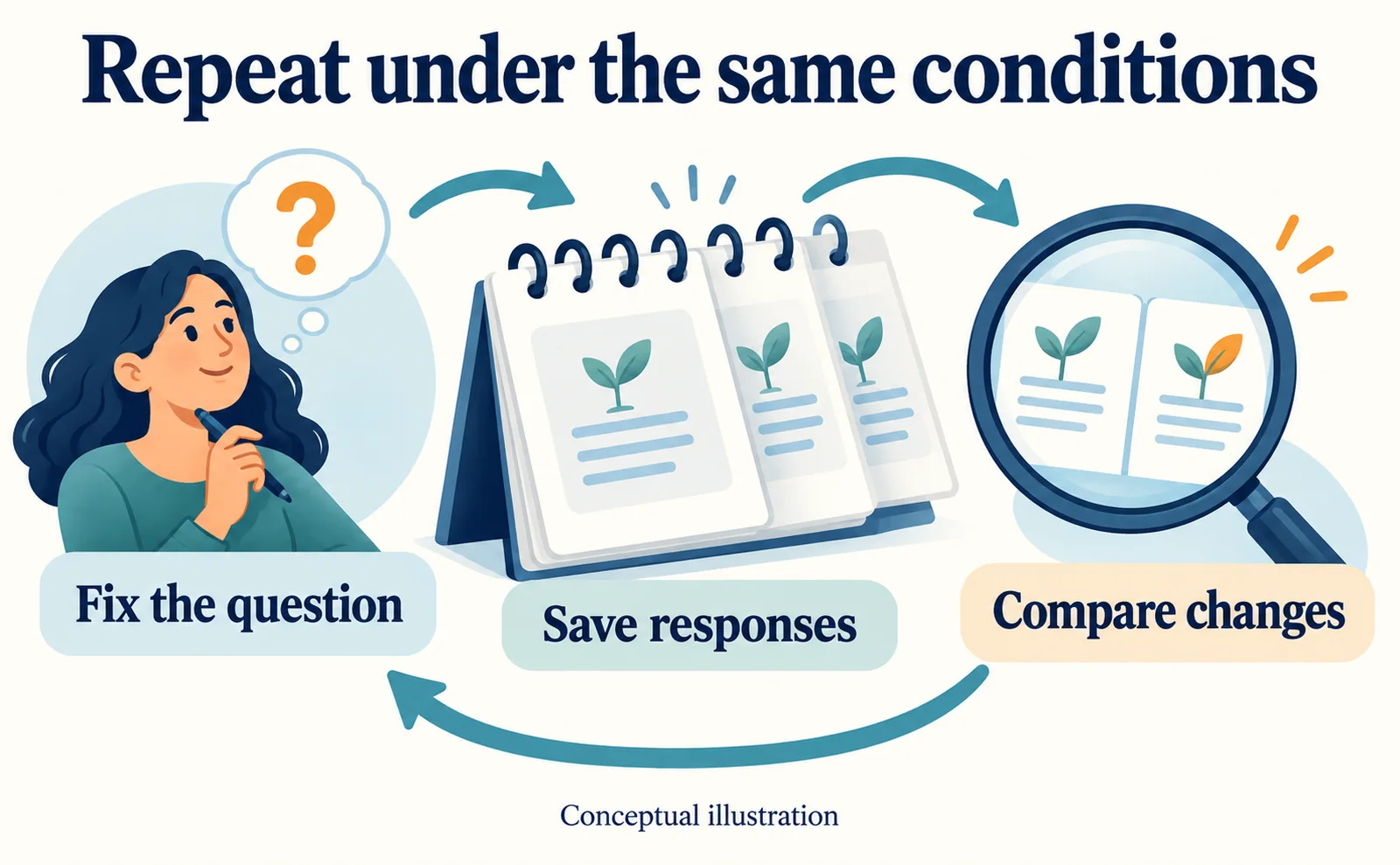
One manual run is useful for testing the question and recording method. It cannot establish daily visibility or market-wide performance. Ongoing comparison needs repeated measurements with saved answers and conditions, so that an isolated appearance does not become a permanent success claim.
4. Use a missing recommendation to investigate the page
Suppose your product appears for the general question but not the wet-weather one. Do not immediately add a weather-resistance claim. Establish whether the product is actually suitable, then check whether the page explains the supporting facts and limitations.
A sentence such as “an everyday bag” does not answer a question about rain. Verified materials, tests and care limitations may give a customer better grounds for choosing.
For a question about weight, an evidence-based description could replace a vague adjective. The following numbers are illustrative and must be replaced with verified product information:
Vague: A lightweight, practical bag.
Specific: The bag weighs 650g and includes an internal pocket for a 13-inch laptop. Check the dimension diagram for the usable pocket size.
The purpose is to answer a buying question with substantiated information. Record what changed and when, then repeat the same measurements. A later difference is a reason to investigate; it does not by itself prove that one sentence caused more citations.
Google recommends original, substantiated content that serves readers.[2] It also explains that established search practices remain relevant to its AI features, including making important information available as text.[3] Use verified product facts to answer the customer’s question rather than inventing claims to attract an AI recommendation.
Follow the customer beyond the answer
AIO refers to work that helps people discover a business through AI answers. Appearing in an answer, receiving a website visit and receiving an inquiry are distinct events.
Use AgentSignal's AIO measurement guide for the available measurement workflow, and the tracking-tag guide to prepare website visit tracking. This article does not claim that AgentSignal automatically configures every persona comparison proposed above.
If customers concerned about budget reach a pricing page and stop, investigate whether additional costs are unclear. If they arrive with a particular use case, check whether the relevant conditions and examples are easy to find. Make those judgments from actual behavior and customer questions, not the AI answer alone.
Start with one question customers regularly ask. Beyond checking whether your name appears, ask whether the information you publish helps that customer choose. That gives the next page improvement a clear purpose.
FAQ
- Q. Did the AI secretly infer users' income?
- No. Researchers explicitly supplied persona attributes in the prompt.[1]
- Q. Are repeated answers identical?
- No. The study also found variation within the same persona condition.[1]
- Q. Where should a business start?
- Choose a real customer concern and compare a base question with one added condition. Save the prompt, environment and answer for repeated measurement.
Sources
- [1] Do Answer Engines customize responses to different personas? (Profound) — accessed 2026-09-19
- [2] Creating helpful, reliable, people-first content (Google) — accessed 2026-09-19
- [3] AI features and your website (Google) — accessed 2026-09-19
About the author
Shogo MizushimaCEO of kairos Inc. / AgentSignal Developer
Develops AgentSignal, a tool for measuring AI crawler visits and AI-referred traffic, and diagnosing AIO readiness. Writes about measurement and practical improvements for AI search using observed data.
Related articles
Case studies and research
An AIO Case Study: AI Share of Voice Rose from 22% to 45%
An agency-reported financial-services case study shows AI share of voice rising from 22% to 45%. Turn its customer-focused media approach into an evidence-based plan.
Published
Measurement and site improvement
What Do Visitors from AI Do? Fix Your Entry Page Based on Their Behavior
People arrive from AI answers, yet enquiries do not follow. Use session recordings to see what happens on the entry page: how to filter recordings to AI referrals, how to use page-wide heatmaps as a supplement, what to fix for each behavior pattern and how to recheck after the change.
Published
Measurement and site improvement
Cloudflare: refuse AI training while keeping search access
Understand Disallow AI Training versus Block, inspect bot policies and robots.txt, account for Bing’s pending support, and verify actual crawl access.
Published