What Is LLMO? How It Differs from SEO and Why Some Say It Is Pointless
LLMO is the work of helping answers from ChatGPT and other AI find and accurately describe your company. Learn how it differs from SEO, why some call it pointless, how E-E-A-T relates, how to measure results and what to do in the first month.
LLMO (large language model optimization) is the work of helping AI answers from services such as ChatGPT and Gemini find your company and products and describe them accurately.
“I asked AI to recommend a service, and it only listed competitors.” Looking into LLMO, you may also find claims that it is pointless. This article covers what LLMO means, how it differs from SEO, why some call it pointless and what you can verify, how to measure results, and what to do in the first month.
What LLMO is: improving how AI answers present your company
LLMO is the work of improving how your company appears and is described in AI-generated answers. An LLM is an AI system that learns from large amounts of text and produces answers.
Semrush, an SEO tool provider, defines LLMO as a marketing tactic that aims to improve a brand’s visibility and portrayal in LLM-generated responses [1].
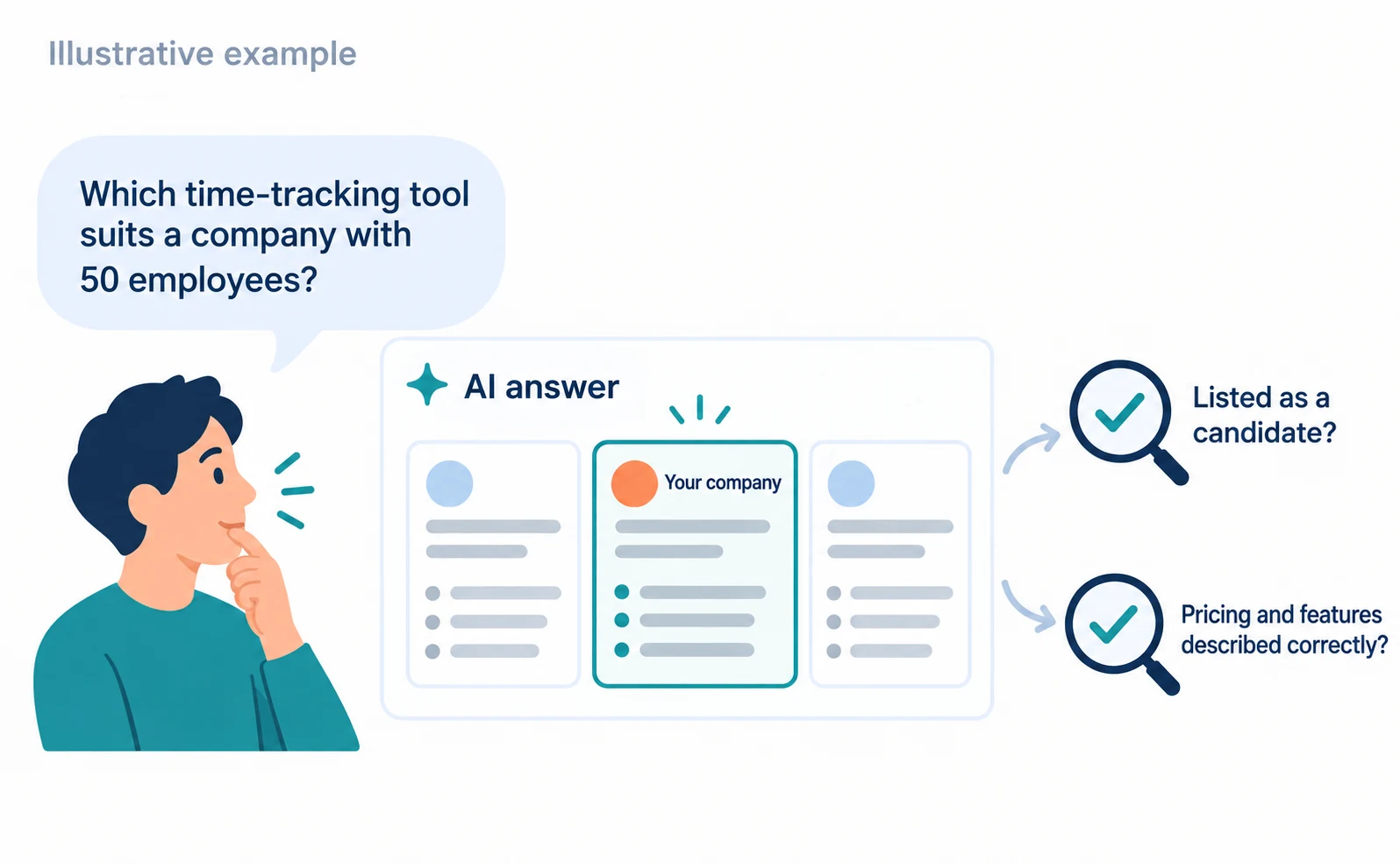
For example, a time-tracking tool provider (a hypothetical example) would check whether a question such as “Which time-tracking tool suits a company with 50 employees?” lists it as a candidate and describes its pricing and features correctly.
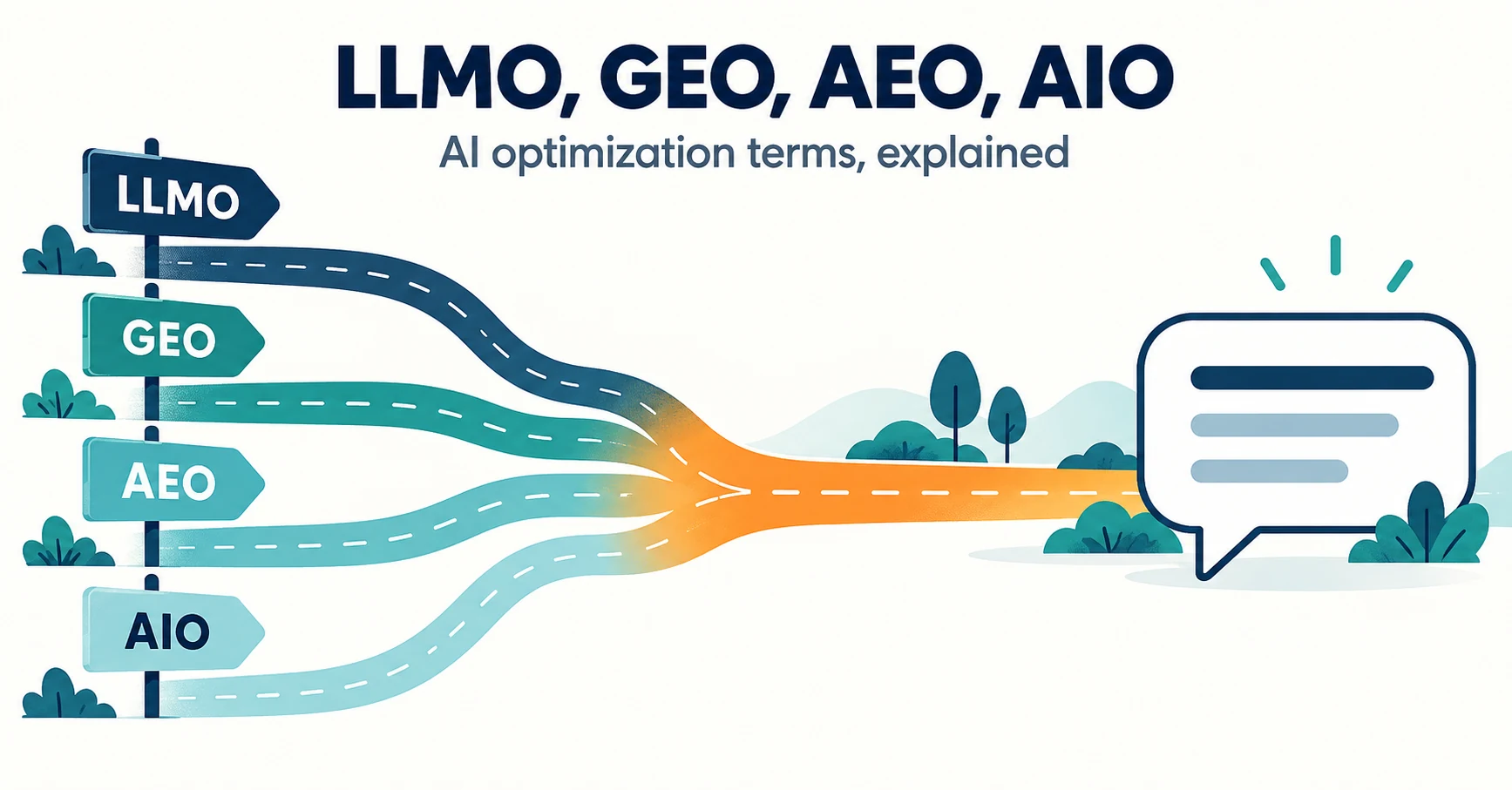
LLMO is sometimes called GEO or AEO. The differences between these labels are explained in LLMO, GEO, AEO and AIO: Understanding AI Optimization Terms.
LLMO vs. SEO: different screens and units of measurement
SEO looks at search results and rankings; LLMO looks at AI answers and cited sources for each question. The screen you check and the unit you count differ.
| Aspect | SEO | LLMO |
|---|---|---|
| Screen checked | Search results page | AI answers |
| Unit counted | Keyword and URL rankings | Name mentions and cited sources per question |
| Main records | Impressions, rankings, clicks | Name mentions, links, accuracy of descriptions |
| Variability | Rankings change with time and conditions | Answers change even for the same question |
The two cannot be separated, however. Google says there are no additional requirements for appearing in AI Overviews or AI Mode and that standard SEO best practices apply [2]. A page must be indexed and eligible to show a snippet [2].
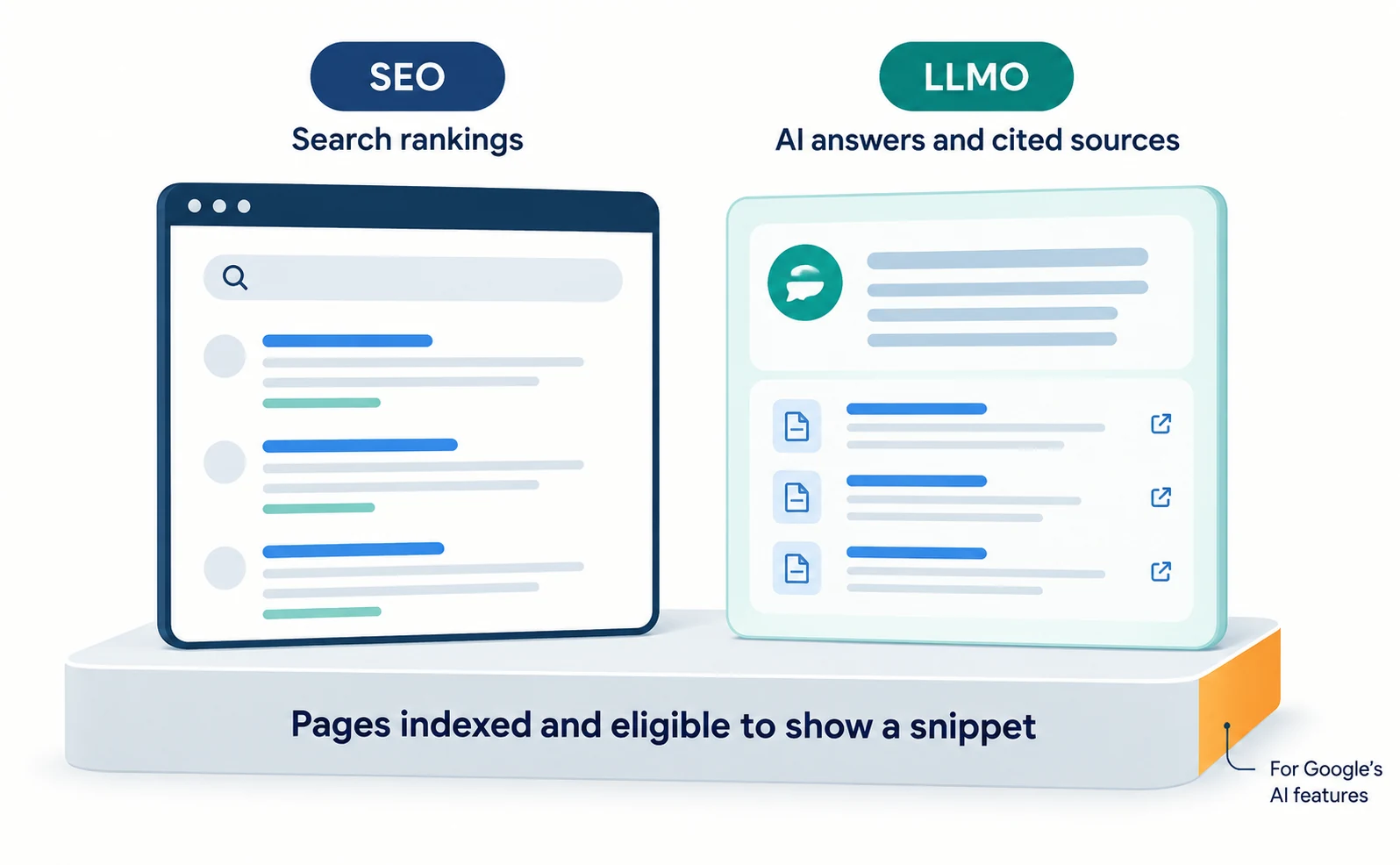
This guidance covers Google’s AI features. Other services such as ChatGPT may not work the same way, so check actual answers.
Why some say LLMO is pointless, and what you can verify
LLMO gets called pointless because unproven tactics and verifiable work are often discussed together. Separating them makes it easier to decide what to do.
Three main reasons are given:
- Google says its AI features need no special optimization beyond SEO basics [2].
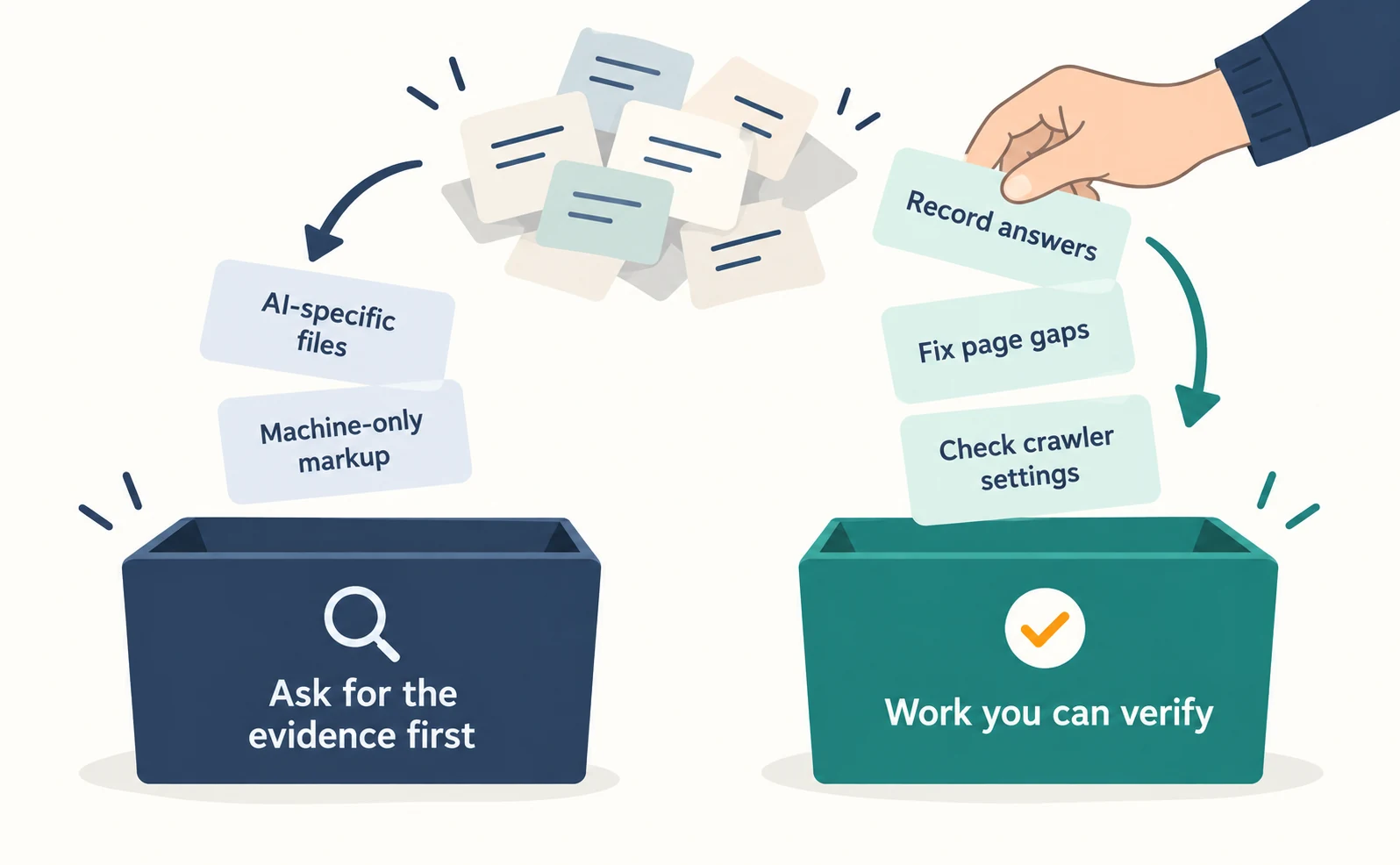
- New AI files or special schema.org markup are described as unnecessary [2].
- AI answers change even for the same question, making results hard to measure.
For structured data, Google also says it describes page content and should not describe information invisible to readers [3]. Adding machine-readable markup alone does not mean AI answers will select you.
The following work, by contrast, produces results you can check:
| Work | What you can verify |
|---|---|
| Recording answers to customer questions | Whether your name and links appear and whether descriptions are accurate |
| Fixing gaps on public pages | Whether answers and conditions are now written on the page |
| Checking crawler settings | Whether search crawlers are blocked |
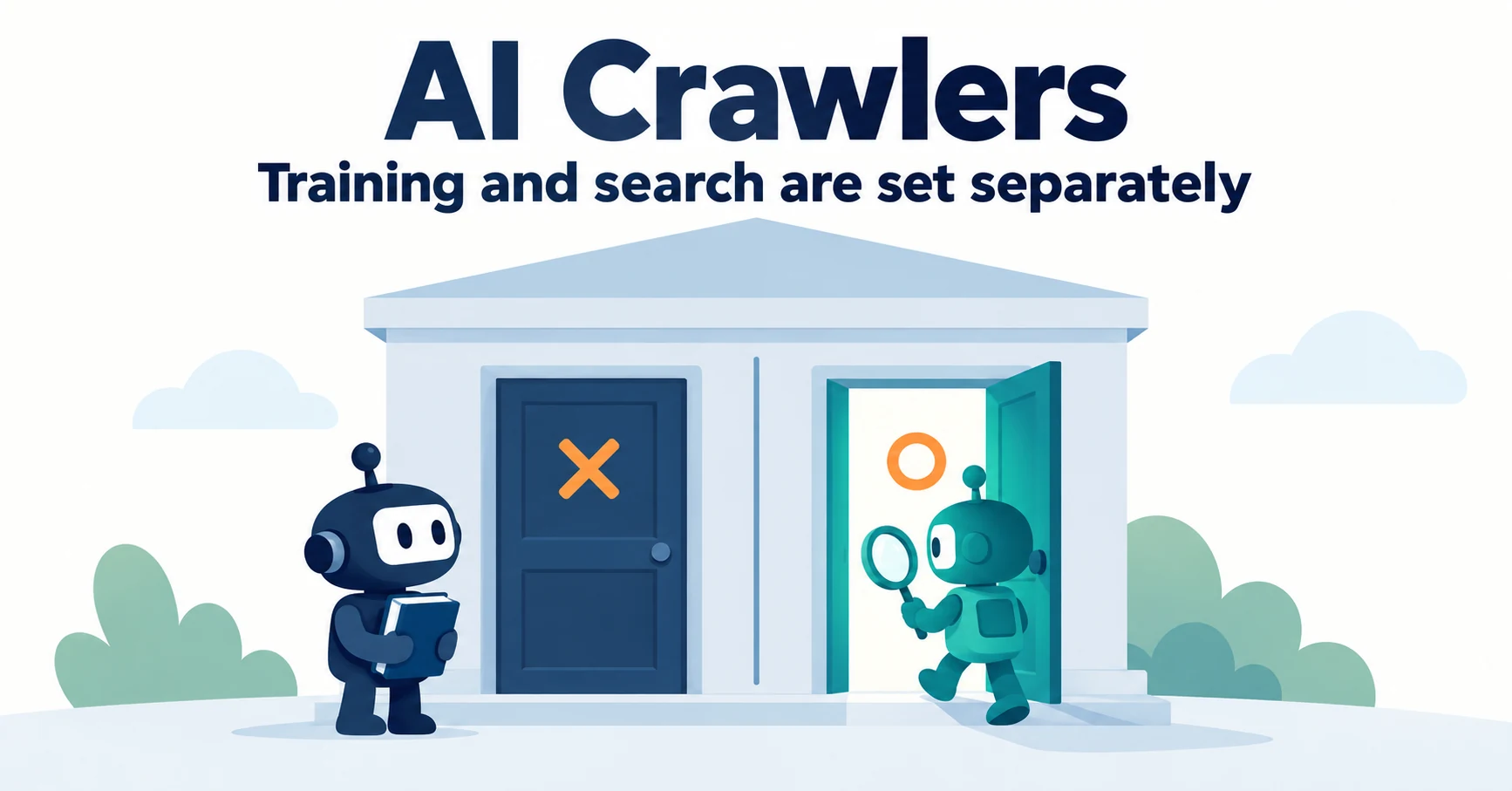
OpenAI says OAI-SearchBot, used for ChatGPT search, and GPTBot, used for training, are configured independently [7]. Whether you blocked search access while intending only to refuse training is something you can verify. See How AI Crawlers Differ for details.
In short, the Google documentation we checked does not require AI-specific files or markup for its AI features. Whatever is proposed, ask for the evidence. Recording answers and fixing pages are tasks you can pursue while checking results.
How E-E-A-T relates to LLMO
Strengthening E-E-A-T helps readers verify information, but it alone does not guarantee AI citations. E-E-A-T stands for experience, expertise, authoritativeness and trustworthiness.
Google says E-E-A-T itself is not a specific ranking factor and that trust is the most important element [4]. It recommends making clear who created content, how and why [4].
That guidance concerns Google Search and does not describe effects on AI citations. Show sources and authors so readers can verify information, and check actual answers to see whether citations change.
Measuring LLMO: AI answers, Bing Citation Share and visits
Measure results by recording answers per question, Bing’s Citation Share and AI-referred visits separately. Combining them into one number hides what changed.
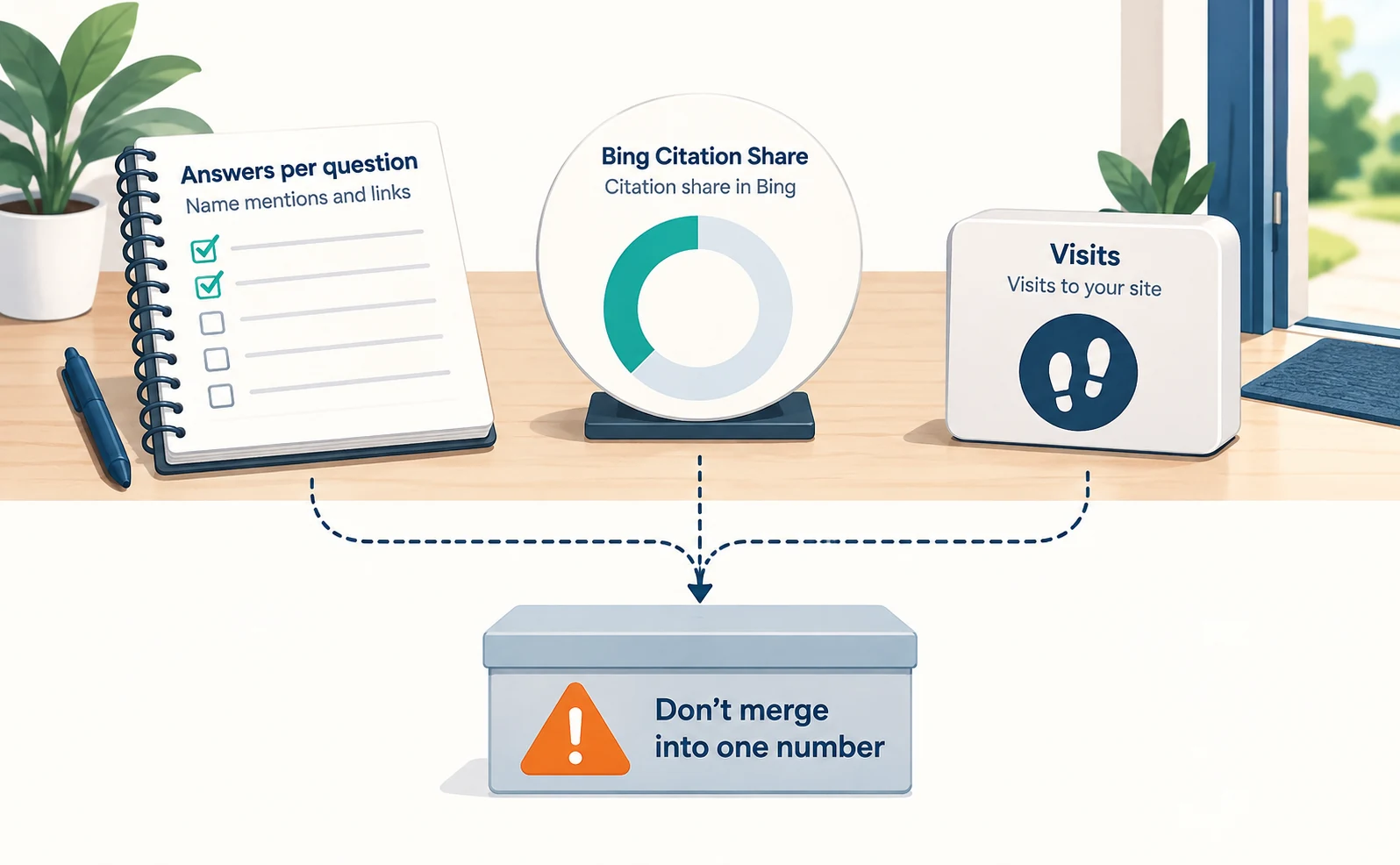
First, answers per question. Ask the same AI each chosen question several times and record separately whether your name appears and whether a link to your pages appears. Keep counts such as “a link appeared in 2 of 5 tests.” Also record the interface or model, whether search was on, and language and region, and start a new conversation each time. Results a tool collects through an API may not match what users see on screen, so note which one you recorded.
Second, Bing’s Citation Share. Launched in preview on June 16, 2026, it shows your site’s share of all citations across all sites for a specific grounding query, the search query the AI uses to find supporting sources [5]. It is separate from the citation rate you count from your own tests. Microsoft describes it as an observational metric, not a ranking or traffic share [5].
Third, site visits. Search Console’s Generative AI report shows impressions in Google’s AI features [6]. Clicks are not among the announced items, so check visits in your analytics. Some visits do not record their referrer, so treat the totals as what could be confirmed.
| Record | What it shows | What it does not show |
|---|---|---|
| Answers per question | Name mentions and links | How many people saw them |
| Citation Share | Citation share in Bing | Visits |
| Generative AI report | Impressions in Google’s AI features | Clicks |
| Analytics | Visits to your site | What the answer said |
The first month of LLMO
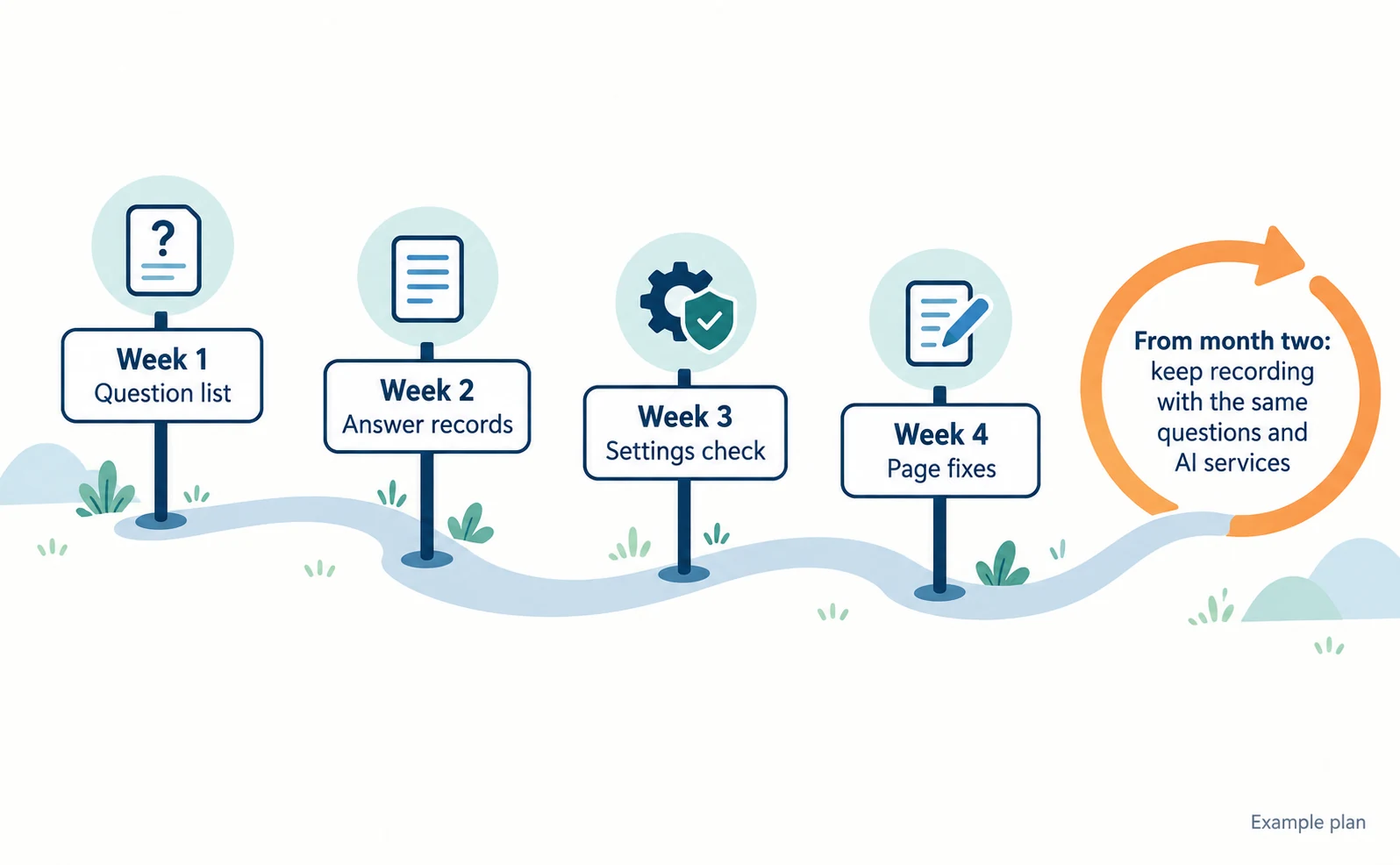
In the first month, move from a question list to recorded answers, settings checks and page fixes. You can start manually without extra tools.
The table below is an example plan we suggest. The number of steps is not mandatory, and it is not a deadline for results.
| Week | Tasks | Output |
|---|---|---|
| Week 1 | Choose 10 customer questions, separating those with and without your company name | Question list |
| Week 2 | Ask each question 3 times in 3 AI services and record name mentions, links, sources and errors | Answer record |
| Week 3 | Ask your web team to check robots.txt for blocked search crawlers | Settings check results |
| Week 4 | Fix 1–2 pages missing answers or conditions and set the next check date | Updated pages and schedule |
From month two, keep recording with the same questions and AI services. Record the date if you change questions or services. Google says recrawling can take several days to several months [2], so do not judge from one result right after a change.
To keep recording answers, see How to Use AI Optimization for AgentSignal’s AI citation rate workflow. Records help you see changes; they do not guarantee inclusion.
FAQ
- Q. Can LLMO replace SEO?
- No. Google says standard SEO best practices apply to AI Overviews and AI Mode too. Keep pages usable in search, then check separately whether you appear in AI answers.
- Q. How long does LLMO take to show results?
- There is no fixed timeline. Google says recrawling pages can take several days to several months. Keep recording with the same questions and AI services to see changes.
Sources
- [1] LLM Optimization: How to Do It (Semrush) — accessed 2026-09-23
- [2] AI features and your website (Google Search Central) — accessed 2026-09-23
- [3] Introduction to structured data markup in Google Search (Google Search Central) — accessed 2026-09-23
- [4] Creating helpful, reliable, people-first content (Google Search Central) — accessed 2026-09-23
- [5] New AI Visibility Insights in Bing Webmaster Tools: Intents, Topics, Citation Share, Compare (Microsoft Bing Blogs) — accessed 2026-09-23
- [6] Introducing Search Generative AI performance reports in Search Console (Google Search Central Blog) — accessed 2026-09-23
- [7] Overview of OpenAI crawlers (OpenAI) — accessed 2026-09-23
About the author
Shogo MizushimaCEO of kairos Inc. / AgentSignal Developer
Develops AgentSignal, a tool for measuring AI crawler visits and AI-referred traffic, and diagnosing AIO readiness. Writes about measurement and practical improvements for AI search using observed data.
Related articles
AIO and AI search
LLMO, GEO, AEO and AIO: Understanding AI Optimization Terms
LLMO, GEO, AEO and AIO are names for work that helps AI answers find your company. Learn what GEO and AEO mean, how GEO differs from local map optimization, where the terms overlap, and how to compare proposals that use different names.
Published
Measurement and site improvement
What Are AI Crawlers? Why Blocking GPTBot Doesn’t Remove You from ChatGPT Search
AI crawlers are programs AI companies use to read public web pages. Learn how GPTBot differs from OAI-SearchBot, how Google-Extended works, why visits can continue after a robots.txt block and how to choose settings by purpose.
Published
AIO and AI search
What Is AIO? Its Two Meanings and Where to Start with AI Optimization
AIO has two meanings: work to get your company featured in AI answers, and Google Search’s AI Overviews. Learn how it relates to SEO, what to confirm in a proposal, what Search Console and Bing reports show, and your first tasks.
Published