AIO case study: Omnilux’s AI-attributed revenue share rose from 1% to 3%
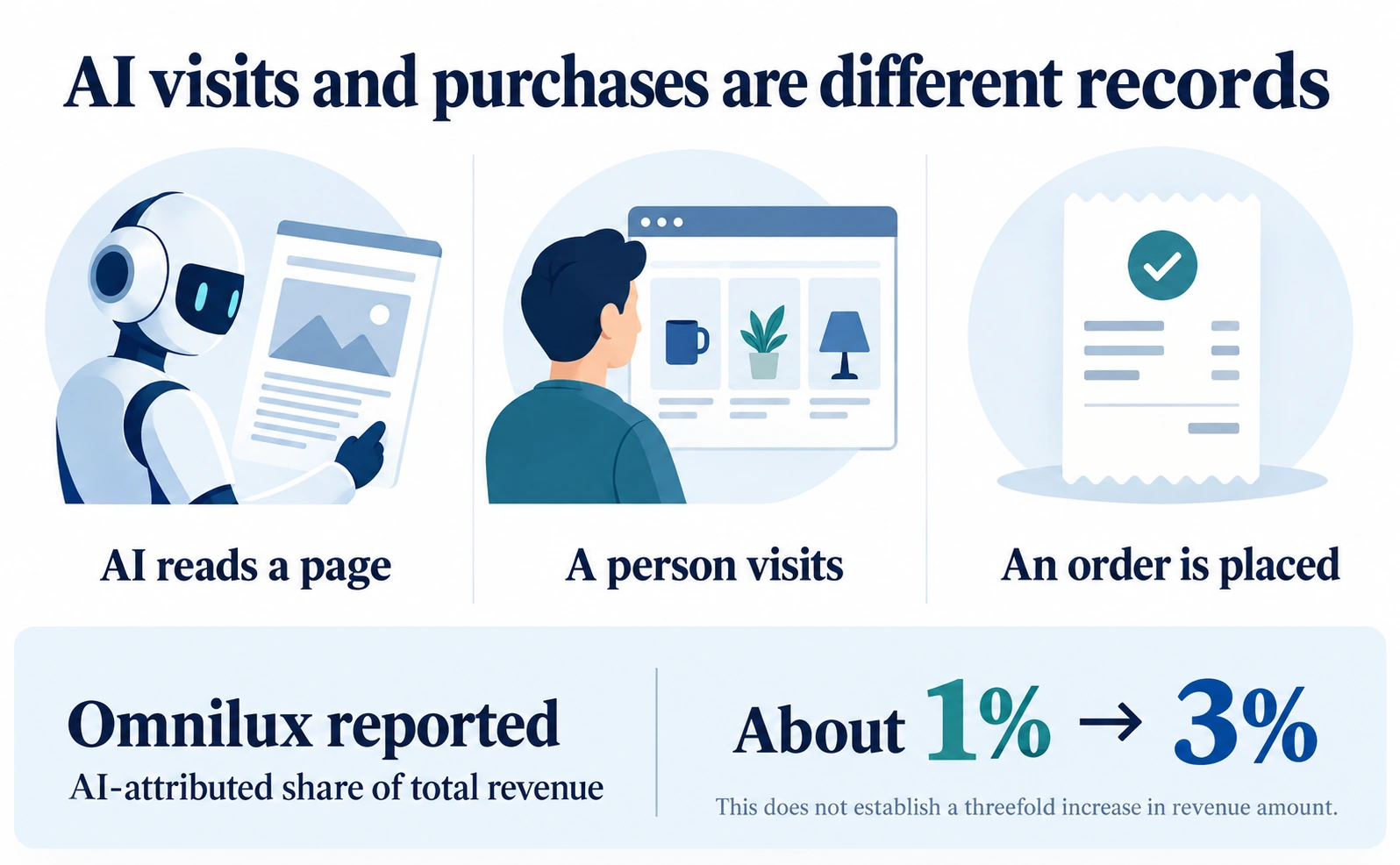
Omnilux used citation and question research in content and PR. Explore its reported AI-attributed revenue share change from about 1% to 3%, while separating AI accesses, human visits and orders.
If AI already recommends your products, what should you change to increase sales from those visits? Skincare-device brand Omnilux investigated the articles AI cited and the questions prospective customers asked, then connected that research to content and media outreach.[1]
Its reported outcome was AI-attributed revenue increasing from about 1% to 3% of total revenue. The useful detail is that recommendation data informed the information the team worked on next.[1]
AIO means improving a business’s presence in AI search and answers. This guide helps an ecommerce marketer identify a page receiving AI referrals and improve one explanation that is missing before a purchase.
Omnilux connected measurement, product content and media outreach
Omnilux sells light-based skincare devices. The provider’s case describes three areas of work.[1]
| Work | What was investigated or changed |
|---|---|
| Access to AI page-visit records | Connected the Shopify store through Nostra, a page-delivery service, to support measurement |
| More useful owned content | Investigated prospective customers’ questions about comparisons and evidence to inform missing content |
| More focused media outreach | Used publications and articles cited by AI, including places where competitors appeared, to prioritize outreach |
In this case, Nostra served pages between the store and visitors, providing access records that made it possible to investigate AI crawlers’ activity.[1]
The case does not publish every before-and-after page or isolate each activity’s effect on revenue. The steps below are a suggested way to choose a page for improvement using records available to your business. They do not require buying the same services.
1. Identify the pages people arriving from AI actually open
Start with customer visits rather than machine-access records. An AI system reading your product page is not the same as a person visiting your store.
If you already use AgentSignal, log in and open AI referrals. Its measurement tag must be installed on your site. Visits from before installation are not added retrospectively.
- Select a date range. For example, use the latest 28 days and an equally long period for a later comparison.
- Look at AI-referred sessions. A session is a group of visit activity, not a purchaser.
- In the measured-URL selector, choose a product page or comparison article. This filters to visits that began on that page.
- Review the AI-provider breakdown and referring sites to see which AI services sent the recorded visits. A referrer describes the page from which a visitor arrived.
Choose a page that receives AI referrals and contains information relevant to a purchase. Start with a main product or its comparison article rather than changing every URL at once.
If no data appears, check the tag, selected dates and page filter. Referral information is not always transmitted, so zero recorded visits does not establish that AI has never mentioned the product.
2. Investigate what customers need to know before choosing
Use inquiry or return records to identify questions that, if answered earlier, could have reduced uncertainty or misunderstanding. Exclude personal information.
Examples of question categories include which variant to choose, whether accessories are needed, eligibility or usage restrictions, and return conditions. Prioritize your own customers’ actual concerns.
To investigate answers over time, open AI analysis projects, enter your site URL and add questions through manual input. Choose the AI services, language/region and number of trials, then check the credit cost before starting.
After completion, open the question’s log to read the recorded response and cited sources. A cited source is a page identified as supporting the answer. Open the product pages, comparisons and external articles it includes.
This does not retrieve the private questions that individual visitors actually typed into an AI service. It tests your selected questions to provide material for improving product explanations.
3. Add the missing explanation to the product page
Open the product page and locate the answer to each selected question. Information you know internally does not help a first-time visitor unless it is available on the page.
| Customer question | What to check | What to add if absent |
|---|---|---|
| Which variant should I choose? | Whether the same criteria can be compared | A table of relevant sizes, uses or included accessories |
| What do I need to start? | Whether included and separately purchased items are clear | Package contents, required extras and their purposes |
| Can I use it? | Whether supported and excluded uses are clear | Verified conditions and precautions |
| Can I return it? | Whether deadlines and opened-item conditions are explained | Actual return conditions and a link to the policy |
“Recommended for beginners” does not explain what a buyer needs to prepare. Replace it with confirmed information about what arrives, what the buyer must supply and the steps before first use.
This is not a process for adding only favorable claims. Put restrictions where people can read them before buying. Do not borrow Omnilux’s product claims for your own products or add effects unsupported by evidence.
4. Distinguish corrections from pitches when external articles are cited
Updating your site does not change an external comparison article. Read the cited page and determine whether there is a factual error or whether your product simply is not featured.
For outdated prices or discontinued products, prepare a current official source and contact the publisher through its published contact channel. Identify the specific outdated statement and its correct replacement.
An article featuring competitors alone is not necessarily wrong. If your product fits its readers, explain why using actual specifications and verified material, and ask the publisher to consider it. That is different from demanding coverage or a positive assessment.
Omnilux’s case says citation research informed its outreach priorities. It does not disclose a complete list of pitches, recipients or placements.[1]
A concrete first task is to read one external article cited by AI and compare its product information with your current official page.
5. Check purchase measurement before interpreting revenue
After improving the page, compare visits and purchases over equally long periods. AgentSignal’s AI-referral screen can show visits, but that screen alone does not report order-level revenue.
Google Analytics 4, or GA4, is a separate service for measuring website activity and purchases. If it is already installed, open Google Analytics, select the site, and navigate through Reports → Acquisition → Traffic acquisition.[2]
Set the table dimension to Session source / medium and search for a source such as chatgpt. Review the matching rows. If purchase data is being sent correctly, purchase-revenue reporting can help investigate the commercial outcome.[2][3]
Without purchase tracking, a displayed zero is not evidence of no sales. If the store has orders but GA4 records no purchases, investigate the measurement configuration first. If the report is missing from navigation, ask an administrator to check its availability.
These figures depend on recorded referral information. They do not identify everyone who discovered a product through AI but later purchased through another route.
Use the 1% to 3% figure without changing what it means
Omnilux’s outcome concerns revenue share. The case does not disclose total revenue amounts or a detailed common comparison period, so it does not establish that AI-attributed revenue in money terms tripled. It is also a provider-published case rather than independent verification.[1]
For your own reporting, keep visit counts, order counts and revenue amounts alongside percentages, using consistent definitions. Record concurrent discounts or advertising changes rather than assigning every increase to edited copy.
Start with a task you can complete: choose one product page receiving AI referrals and fix one unanswered pre-purchase question. That connects citation research to actual product information and outreach work.
FAQ
- Q. What does Omnilux sell?
- Light-based skincare devices. The case concerns AI-related discovery of its Shopify store.[1]
- Q. Does the case establish a threefold increase in revenue amount?
- No. It reports AI-attributed share of total revenue rising from about 1% to 3%. Total revenue amounts are not disclosed.[1]
Sources
- [1] How Omnilux tripled AI-attributed revenue (Profound) — accessed 2026-09-16
- [2] GA4 Traffic acquisition report (Google) — accessed 2026-09-16
- [3] GA4 Set up ecommerce events (Google) — accessed 2026-09-16
About the author
Shogo MizushimaCEO of kairos Inc. / AgentSignal Developer
Develops AgentSignal, a tool for measuring AI crawler visits and AI-referred traffic, and diagnosing AIO readiness. Writes about measurement and practical improvements for AI search using observed data.
Related articles
Case studies and research
Where Do AI Visitors Land? Choosing Pages to Improve from the Ahrefs Case
Ahrefs reported that AI-referred visits land on pages beyond its blog. Learn how to find the landing pages for your own AI traffic and choose which pages to improve first.
Published
Measurement and site improvement
How to Check and Fix Links from AI Answers That Won’t Open
If clicking a link in an AI answer shows “Page not found,” the cause is usually a move, a deletion or an outage. Learn to tell them apart from visit records and response codes, then fix redirects and notices.
Published

Case studies and research
Claude and ElevenLabs: connect MCP for images, voice and video
Set up ElevenLabs MCP in Claude, prepare images, footage, narration and music, then finish in Studio. Includes connection commands and output checks.
Published