AIO case study: Merge reported 7× AI-search demo requests
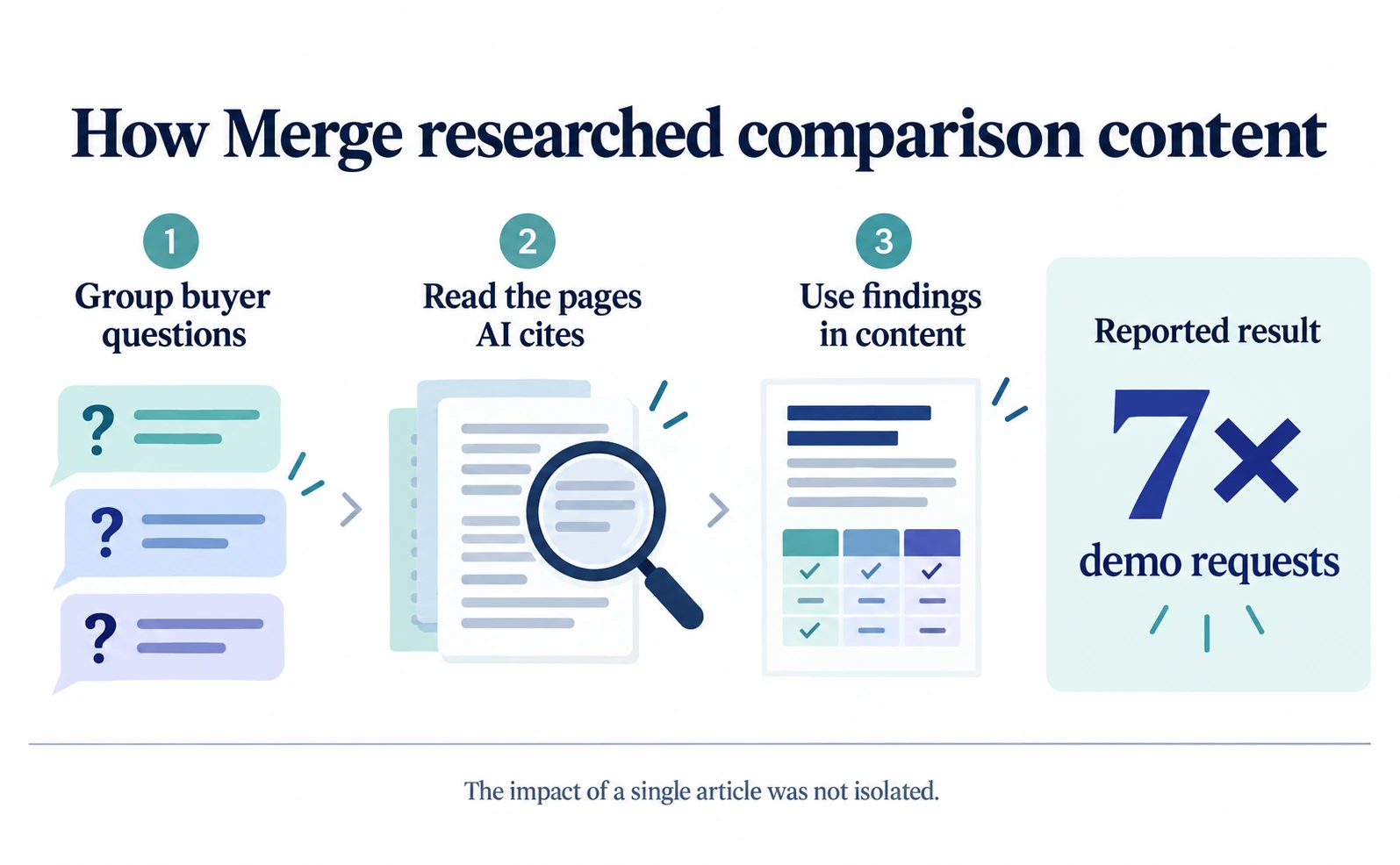
Merge researched buyer questions and AI-cited pages before writing comparison content. Explore the actual linked article and the provider’s reported sevenfold increase in AI-search demo requests.
Before publishing a comparison article, Merge investigated the articles AI was already using as sources. It examined headings, comparison formats and the subjects covered, rather than just counting company names. Its provider later reported seven times as many demo requests from AI search across the wider program.[1]
Merge provides tools for connecting business applications. A demo request asks a specialist to show how a product works. This case is useful for B2B content teams whose articles are not leading to inquiries or sales conversations.
AIO means improving a site’s presence in AI search and answers. Below, we use Merge’s case to work through choosing a buyer question, reading the pages AI cites and improving one comparison article on your own site.
What Merge investigated before writing
The provider’s case, published November 21, 2025, says Merge grouped hundreds of questions by product and topic, benchmarked against seven competitors and investigated the pages cited for individual questions.[1]
Its example concerns unified API platforms. An API is an interface for exchanging information between services; a unified API combines multiple integrations behind a common interface.
Merge studied the headings, list formats and sections of frequently cited articles on that topic before creating its own comparison. That article reportedly received 2,600 AI mentions in one month. The wider program reportedly increased AI-search demo requests sevenfold.[1]
The case does not isolate the effect of this single article. Mentions are also not visits or completed applications.
The published article explains conditions for choosing
The actual comparison article is available. The version checked on September 16, 2026 explains unified APIs before introducing several products and their advantages and limitations.[2]
It discusses application categories, pricing approaches and ways to investigate integration problems. Those are buying criteria, rather than simply a ranking of recommended names.[2]
The useful practice is making the criteria a buyer needs comparable, not copying another article’s headings. The current edition may differ from the version in the case, and Merge’s assessments of competitors are vendor-authored opinions rather than independent findings.
1. Choose five questions that repeatedly arise before a sale
The following is a suggested process for revising one comparison article, informed by Merge’s research. It is not an account of unpublished internal work.
Read recent inquiries and sales notes. Choose five questions repeatedly asked before a contract is signed. Five is a manageable starting point, not a number known to produce a particular outcome.
Preserve the actual wording where possible. “Cost” is vague; “Is there a setup charge as well as the monthly subscription?” identifies the missing explanation.
| Type of question | What to look for in your records |
|---|---|
| Choosing | Which uses or company sizes suit the service |
| Cost | Setup fees, extras and costs as usage grows |
| Switching | Data migration and preparation before starting |
| Scope | Supported and unsupported work |
| After purchase | Who provides support, and what that support covers |
If there are no inquiry records yet, start with questions your sales team routinely explains. Keep actual customer questions distinct from your assumptions.
2. Investigate which pages AI uses to answer them
Existing AgentSignal users can open AI analysis projects. Login and credits are required. Automatic question suggestions are available, but use manual input here to investigate the questions you selected.
- Enter the URL of your site.
- Add each question through Manual. Include questions without your company name to investigate answers given to someone who does not already know you.
- Select the AI services, language/region and number of trials. Review the credit cost before starting.
- After completion, inspect the question-by-model citation matrix and open Logs to read recorded answers and cited sources.
A cited source is a page the AI identifies as supporting its answer. Responses can change, so a single result does not establish that you always—or never—appear. These are observations under the recorded analysis conditions, not reproductions of every consumer AI answer.
Choose a question relevant to what you sell and insufficiently answered on your site. A popular topic that has little to do with a buyer’s decision is a lower priority.
3. Open the sources and compare where each answer appears
Open two or three pages cited for the selected question. This is a starting reading sample, not a performance threshold. Open your own pricing or comparison page alongside them and find its answer to the same question.
The point is not to match word counts or numbers of headings. Ask what a buyer can decide after reading each page.
| Buyer’s question | What to look for in cited pages | What to add to your own page |
|---|---|---|
| What will it cost? | Prices, included work and conditions for extra fees | Confirmed prices and conditions together |
| Can we switch? | Supported data, required preparation and restrictions | Supported migration methods and data that cannot be moved |
| Does it suit us? | Suitable and unsuitable uses | Specific supported work and exclusions |
Use this as an inspection table, not permission to claim features because another company has them. Ask your product team to confirm missing facts before publishing.
4. Replace vague recommendations with decision-making information
Suppose your article says only, “Recommended because it supports a wide range of integrations.” A reader still cannot tell whether their existing application is supported.
Replace the general claim with verified information using the following template. Brackets are fields to fill with your own confirmed facts, not text to publish unchanged:
We support integration with [application]. You can import [types of information]. [Unsupported information] needs to be moved separately. Access requires [plan or additional-fee conditions].
This turns “affordable” or “powerful” into an explanation a buyer can use. If you create a comparison table, research the same fields for each company using official sources and record the source and checking date. Do not infer unpublished prices.
Google’s review guidance similarly recommends decision-relevant comparisons, benefits and drawbacks, and supporting evidence. It emphasizes useful, original information rather than length.[3]
End the article with a link that answers the reader’s next question. A pricing comparison can lead to your actual pricing page; a scope comparison can lead to a product explanation or demo request. The destination must exist and match the question the reader was investigating.
5. Track citations, visits and demo requests separately
Before publication, record the URL and change date. Test the inquiry form through submission in an appropriate test environment; a clickable button alone does not establish a working application process.
After publication, repeat the same questions under the same conditions. AgentSignal can show recorded answers and citation rates. Count actual demo requests separately using form or sales records.
If citations rise without visits, revisit whether the questions match prospective customers’ needs. If visits arrive without inquiries, inspect the explanation of price and eligibility and the application experience.
Merge’s sevenfold figure is a provider-published customer result, not an outcome promised by copying a format. The immediate task is smaller and concrete: choose one question, compare its cited sources with your page, and add one missing answer. You can do that before commissioning another article.
FAQ
- Q. What is a demo request?
- An application to have a product specialist demonstrate the service. It is different from a page visit or an AI mention.
- Q. Can I read the actual comparison article?
- Yes, the comparison is linked in the sources. The page checked on September 16, 2026 is a 2026 edition and may differ from the version in the case.[2]
Sources
- [1] How Merge drove a 7x increase in demo requests from LLMs with Peec AI (Peec AI) — accessed 2026-09-16
- [2] The best unified API platforms in 2026 (Merge) — accessed 2026-09-16
- [3] Write high quality reviews (Google) — accessed 2026-09-16
About the author
Shogo MizushimaCEO of kairos Inc. / AgentSignal Developer
Develops AgentSignal, a tool for measuring AI crawler visits and AI-referred traffic, and diagnosing AIO readiness. Writes about measurement and practical improvements for AI search using observed data.
Related articles
Measurement and site improvement
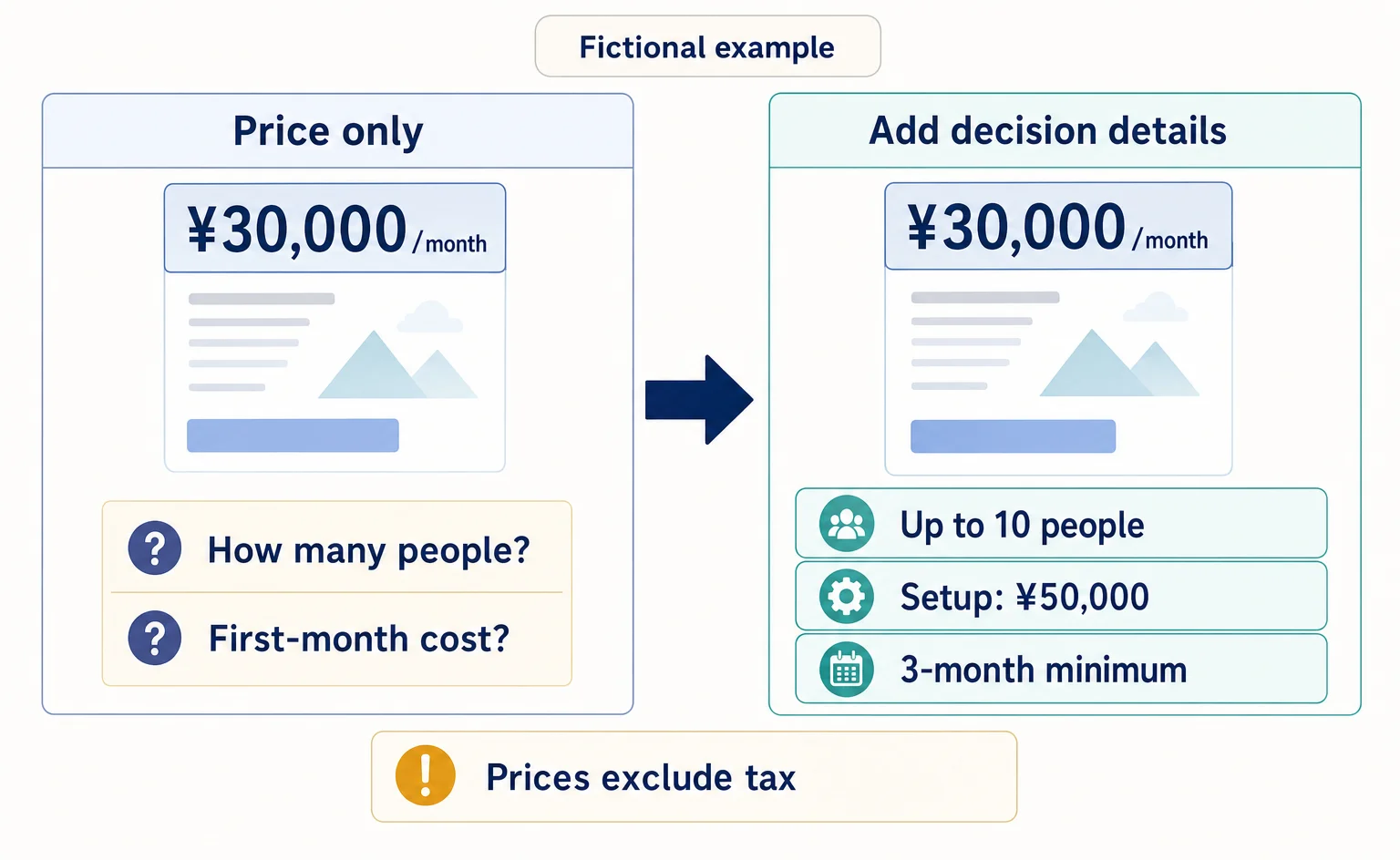
Before Adding More AI-Focused Articles: Five Questions Your Pricing Page Should Answer
Getting visits but few inquiries for your business service? Use this worksheet and a fictional before-and-after example to review what pricing includes, extra charges, cost calculations, contract terms, and what happens after someone applies.
Published
AIO and AI search
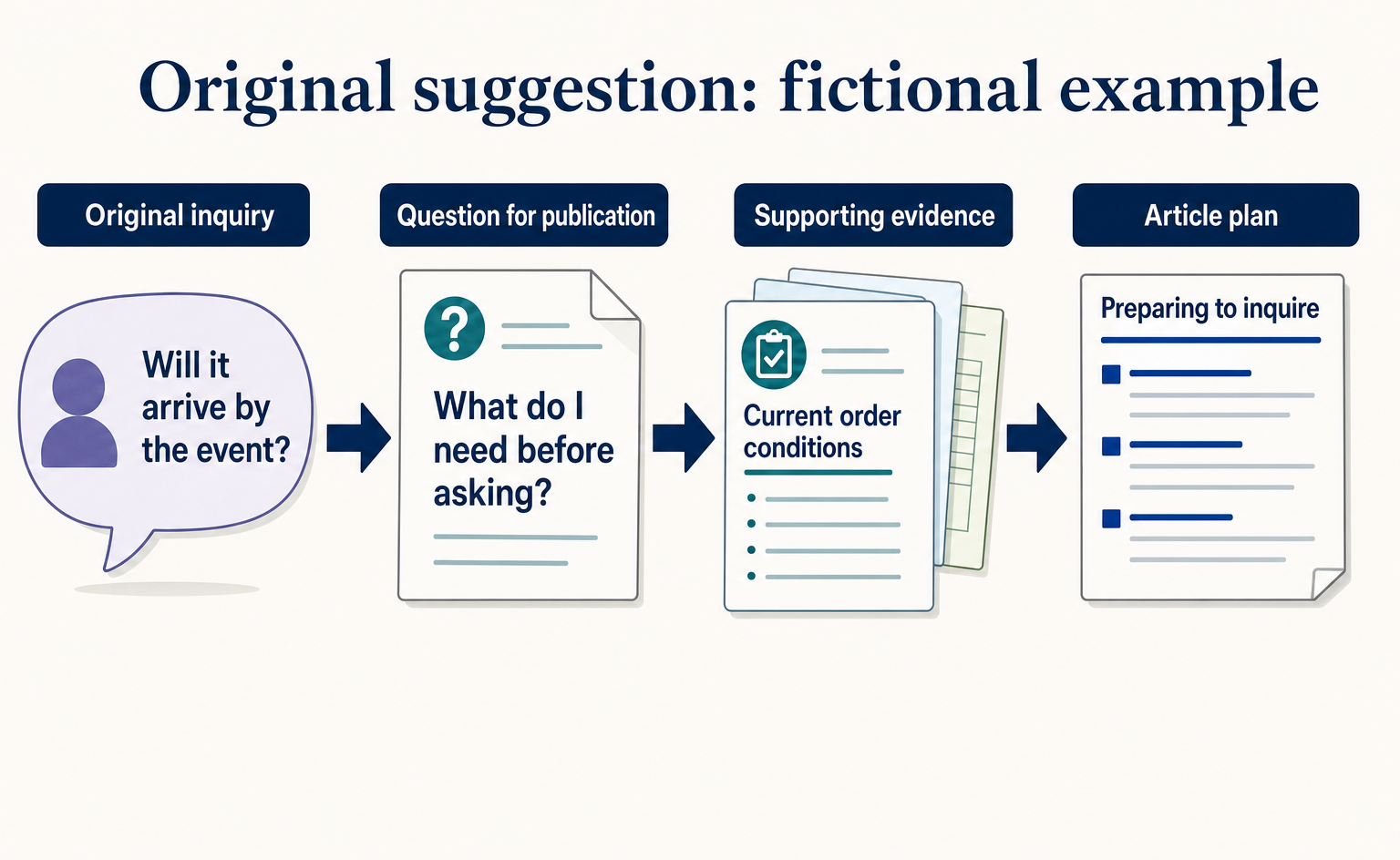
Where to Find Article Ideas Only Your Business Can Write: Start with Customer Inquiries
You do not need original research data to create useful articles. Learn how to turn customer questions, answers, and decision criteria into article plans, with worksheets and fictional before-and-after examples covering anonymization, question grouping, and evidence checks.
Published
Case studies and research
Claude and ElevenLabs: connect MCP for images, voice and video
Set up ElevenLabs MCP in Claude, prepare images, footage, narration and music, then finish in Studio. Includes connection commands and output checks.
Published