Where to Find Article Ideas Only Your Business Can Write: Start with Customer Inquiries
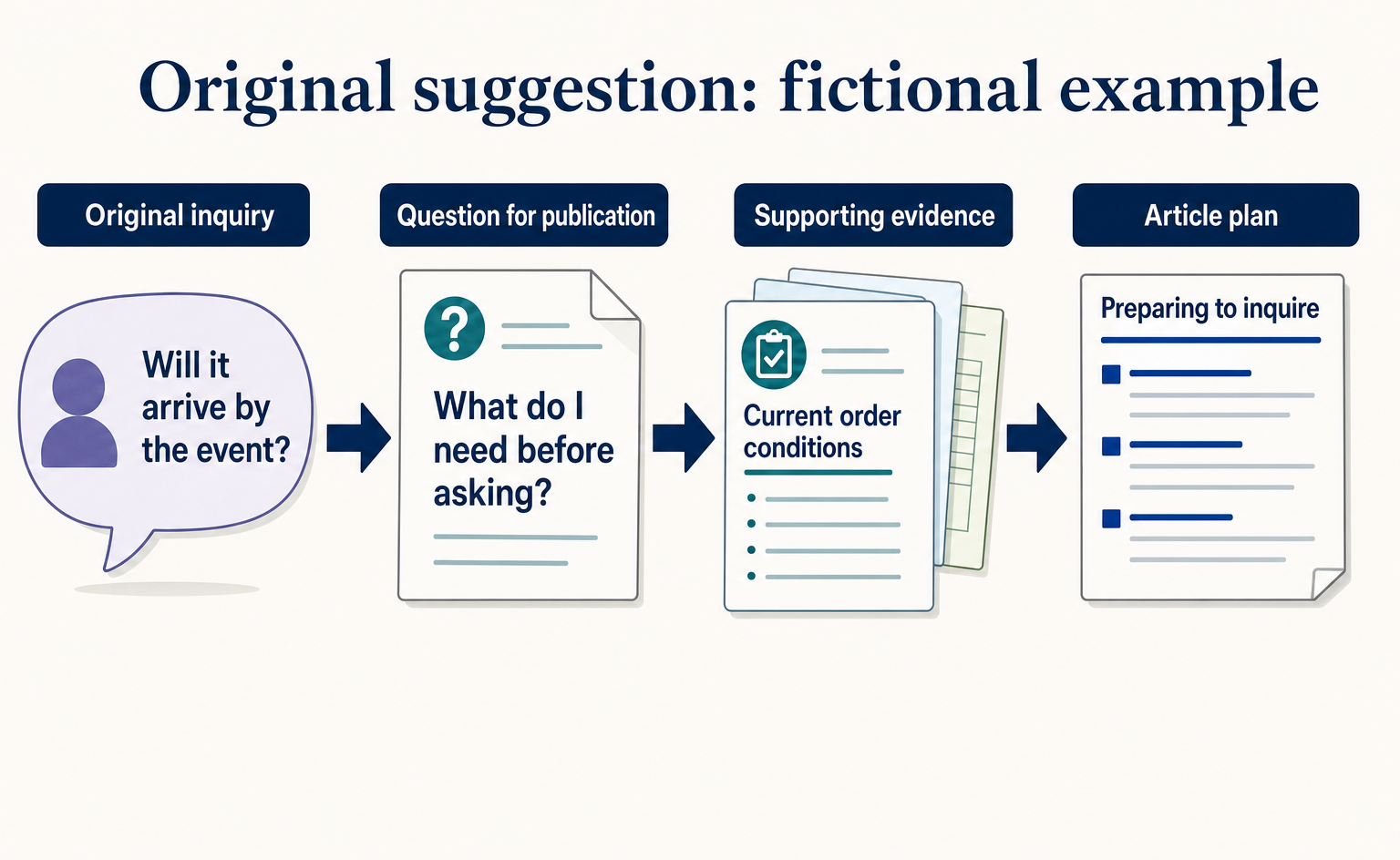
You do not need original research data to create useful articles. Learn how to turn customer questions, answers, and decision criteria into article plans, with worksheets and fictional before-and-after examples covering anonymization, question grouping, and evidence checks.
“We do not have original research data, so we cannot write articles that stand out from our competitors.” If you manage content for a small or medium-sized business and feel this way, your answers to customer inquiries can provide material. Rather than publishing the inquiries themselves, extract the conditions that left customers unsure and the reasons behind decisions your business can explain.
This article shows how to handle inquiry records safely and turn them into an article plan that answers one question. The worksheets help separate what you can write from what needs further checking. The steps, tables, and improvement examples below are AgentSignal’s own editorial suggestions, not mandatory procedures required by Google.
Reference review date: September 15, 2026. The evidence was checked against the text of Google’s official documentation. This article does not draw on an examination of actual customer records or administration screens.
Originality lies less in the question than in the conditions behind the answer
Other businesses may receive the same customer questions. Even so, explaining “what we need to know before we can decide” in light of your own products and order acceptance conditions gives you material beyond general advice. Instead of searching for unusual inquiries, look for the reasons you tend to leave out of everyday answers.
Google lists original information or analysis, value beyond simply rewriting other sources, and clear supporting evidence among the questions used to assess content quality. It does not specifically instruct businesses to create articles from customer inquiries.[1]
For example, consider a fictional company that sells made-to-order personalized bags. In this illustrative scenario, when a customer asks, “Will they arrive in time for our event?”, the sales representative checks not only the requested date but also the quantity and whether the artwork files for printing are ready. The reasons for these checks become material for an article.
All bag-related inquiries, internal documents, and order acceptance conditions below are fictional. They are not examples of a real company’s track record or actual sales terms. When using this approach, replace them with records you are authorized to view and your company’s current product documentation and order acceptance conditions.
1. Turn the inquiry into a question you can publish, rather than copying it
First, check whether you may use the inquiry for content planning. The person responsible for content should open the storage location for inquiry records they are authorized to view internally. If the permitted purpose of use or scope of sharing is unclear, ask the person responsible for managing the records before proceeding.
Prepare a document or spreadsheet approved for internal use as your working file. Do not paste the full original email into it. Instead, rewrite only the conditions needed to make the decision. This method does not require signing up for a dedicated service or sending customer information outside the company.
Here, anonymization means editing out not only names but also information that could allow someone to identify the customer. Review company names, contact details, and order numbers, as well as unusual event names and exact event dates. Do not assume that this alone satisfies legal or contractual conditions for publication; follow your company’s information management rules first.
The first worksheet
The following table is our own editorial suggestion. Fill in the middle column, using the right-hand column as a reference. All entries in the right-hand column are fictional examples, not customer statements taken from external sources.
| Item | Your company’s entry | Fictional example |
|---|---|---|
| Inquiry summary | [Only the details needed for the decision] | Wants to receive personalized bags in time for an event |
| Decision the customer is unsure about | [What they cannot decide] | Whether they can discuss delivery timing before the artwork files are finished |
| Conditions to retain | [Conditions that change the answer] | Requested date, quantity, and artwork readiness |
| Information to remove | [Details not to publish] | Customer name, event name, venue, and contact details |
| Question for publication | [One generalized sentence] | What should I prepare before asking about delivery timing? |
| Permission check | [Reviewer and review status] | Awaiting confirmation from the person responsible for managing the records |
An “inquiry summary” is a short description of the inquiry. For “decision the customer is unsure about,” write what the customer could not decide, rather than a topic label such as “delivery timing.” Separating these two helps you move from a simple list of questions to what the article needs to answer.
Also check that removing information has not changed the meaning of the answer. If order acceptance conditions vary by quantity, quantity must remain as an item to check. However, if there is no need to publish the actual order quantity, you do not need to retain that number.
2. Group the same uncertainties, not just the same words
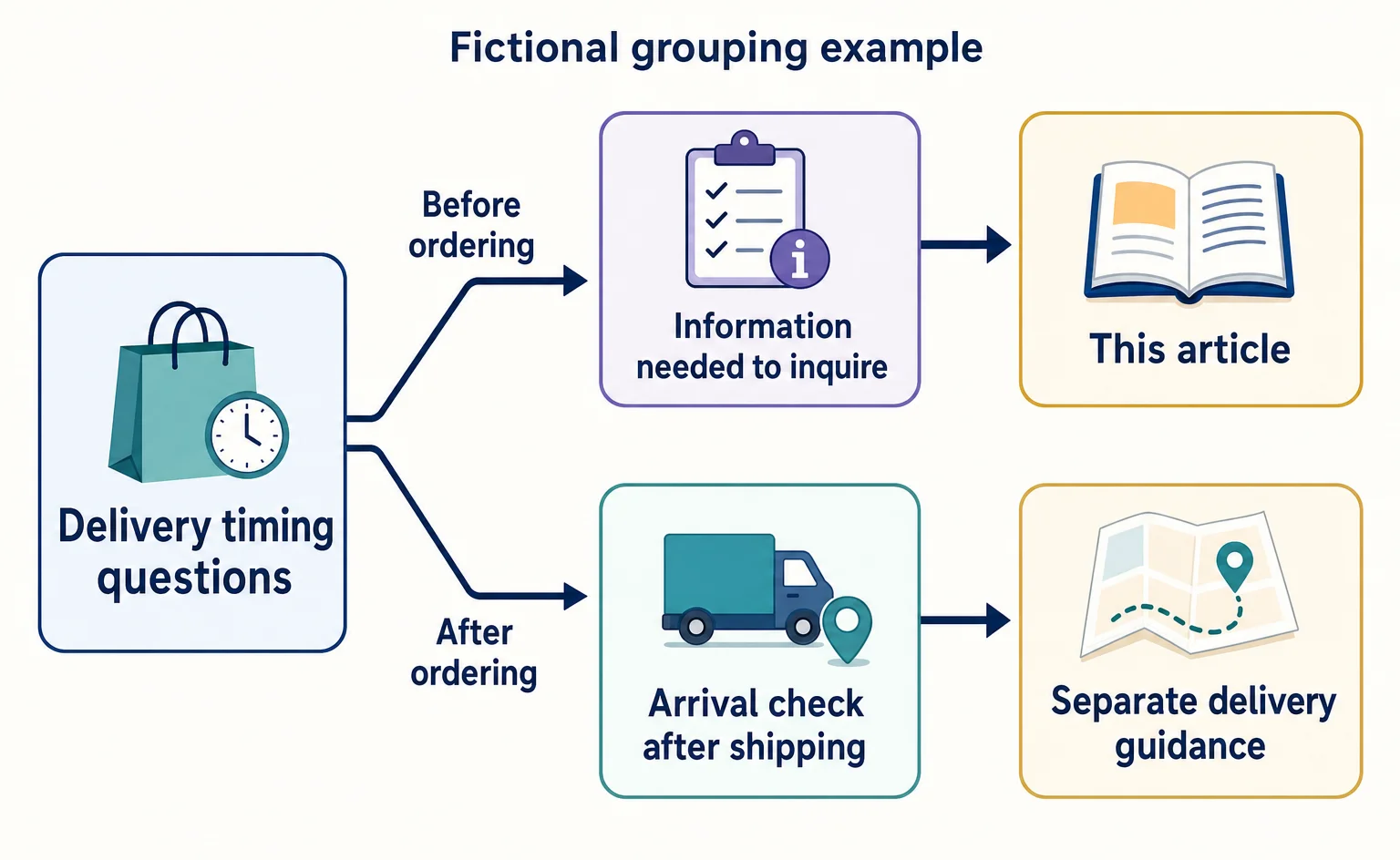
Next, check whether one article can resolve several inquiries. Grouping every inquiry that mentions “delivery timing” mixes preparation before ordering with delivery tracking after ordering. Separate them according to the reader’s current stage and what they want to decide.
The person responsible for content should list only the questions rewritten for publication in the working file. Beside each question, note the stage, such as “before ordering” or “after ordering,” and the decision the reader should be able to make after reading. Do not bring the original customer information back into the grouping table.
The following is another original grouping example using the same fictional bag company.
| Question for publication | Reader’s stage | What the reader can do afterward | Possible placement |
|---|---|---|---|
| What information is needed to discuss delivery timing? | Before ordering | Gather the information needed for the inquiry | This article |
| Can I ask before the artwork files are finished? | Before ordering | Identify which details to mark as not yet confirmed | A section in this article |
| When will a package that has already shipped arrive? | After ordering | Find where to check delivery status | Separate delivery guidance |
The first two questions serve one purpose: preparing to discuss delivery timing. The last question is a check by someone who has already ordered, so it does not belong in the same article. The decision is to separate the guidance readers need, rather than keep adding headings.
Even a single inquiry can remain an article candidate. However, do not call it a “frequently asked question” or “a problem many customers face” unless you have checked the number of inquiries. You can plan an article that answers a specific question without evidence of how often it occurs.
3. Establish what your company can answer and the evidence behind it
Once you have chosen the question, check whether the answer you want to publish matches current conditions. Separate something your company accommodated once in the past from something it can still offer under its normal order acceptance conditions. This check helps prevent finalizing a draft based solely on a staff member’s memory.
The person responsible for content should add the table below to the working file and ask someone who can verify the answers, such as a sales representative, to complete it. “Supporting evidence” means documents used to check whether an answer is correct. In practice, enter your company’s current order acceptance conditions, product specifications, approved guidance, or similar materials.
The document names below are also fictional; their existence has not been verified.
| Answer you want to give | Example supporting evidence | Person who checks it | Example publication decision |
|---|---|---|---|
| Provide the requested date, quantity, and artwork status | Current order acceptance conditions sheet | Sales representative | Publish after checking that these match the required information |
| Customers can make an initial inquiry before the artwork files are finished | Guidance on accepting inquiries | Order processing representative | Publish after confirming what can be discussed at this stage |
| Delivery by the requested date is guaranteed | No supporting evidence | Order processing representative | Do not publish |
| A special arrangement made in the past is normally available | A record of only one case | Person responsible for setting order acceptance conditions | Do not publish as a standard condition |
“You can ask about it” and “we can guarantee delivery by that date” are different answers. Confirming the former does not allow you to promise the latter in the article. For anything you cannot confirm, narrow the conditions of the statement or leave it in the plan as awaiting confirmation.
Sometimes the internal documents themselves cannot be published. In that case, check which conditions may be communicated externally and establish what the draft can explain. You can structure the article around order acceptance conditions and information to check without including an actual customer example.
4. Build one article plan and create a before-and-after answer
At this stage, check whether readers will actually be able to prepare after reading the article. A title such as “Delivery Times for Personalized Bags” does not clearly show what the article helps readers do. Narrow the purpose to gathering the information needed to discuss delivery timing.
The planning worksheet below is also our own editorial suggestion. Its completed example assumes that the fictional company has confirmed the order acceptance conditions described earlier. In a real plan, do not move answers that are still awaiting confirmation into fields for established information.
| Item | Your company’s entry | Fictional completed example |
|---|---|---|
| Reader | [Who will read this, and at what stage] | An event coordinator ordering personalized bags for the first time |
| One question | [The question the article will resolve] | What should I prepare before asking about delivery timing? |
| Action after reading | [What the reader can prepare or decide] | Communicate the requested date, quantity, and artwork status |
| Article’s answer | [An explanation backed by evidence] | Separate confirmed details from unconfirmed details when making the inquiry |
| Proposed headings | [The order needed to explain the answer] | Required information / How to communicate unconfirmed details / The difference between an inquiry and a confirmed delivery date |
| Content to leave out | [What the article cannot answer] | A guaranteed delivery date for an individual order |
| Pre-publication check | [Reviewer and unresolved points] | The order processing representative checks that the content matches the order acceptance conditions |
Writing down the “action after reading” makes gaps in the explanation easier to find. In this example, if readers still cannot draft an inquiry, add more explanation of the information they need to prepare. Keep company introductions and product benefits to what is needed for that task.
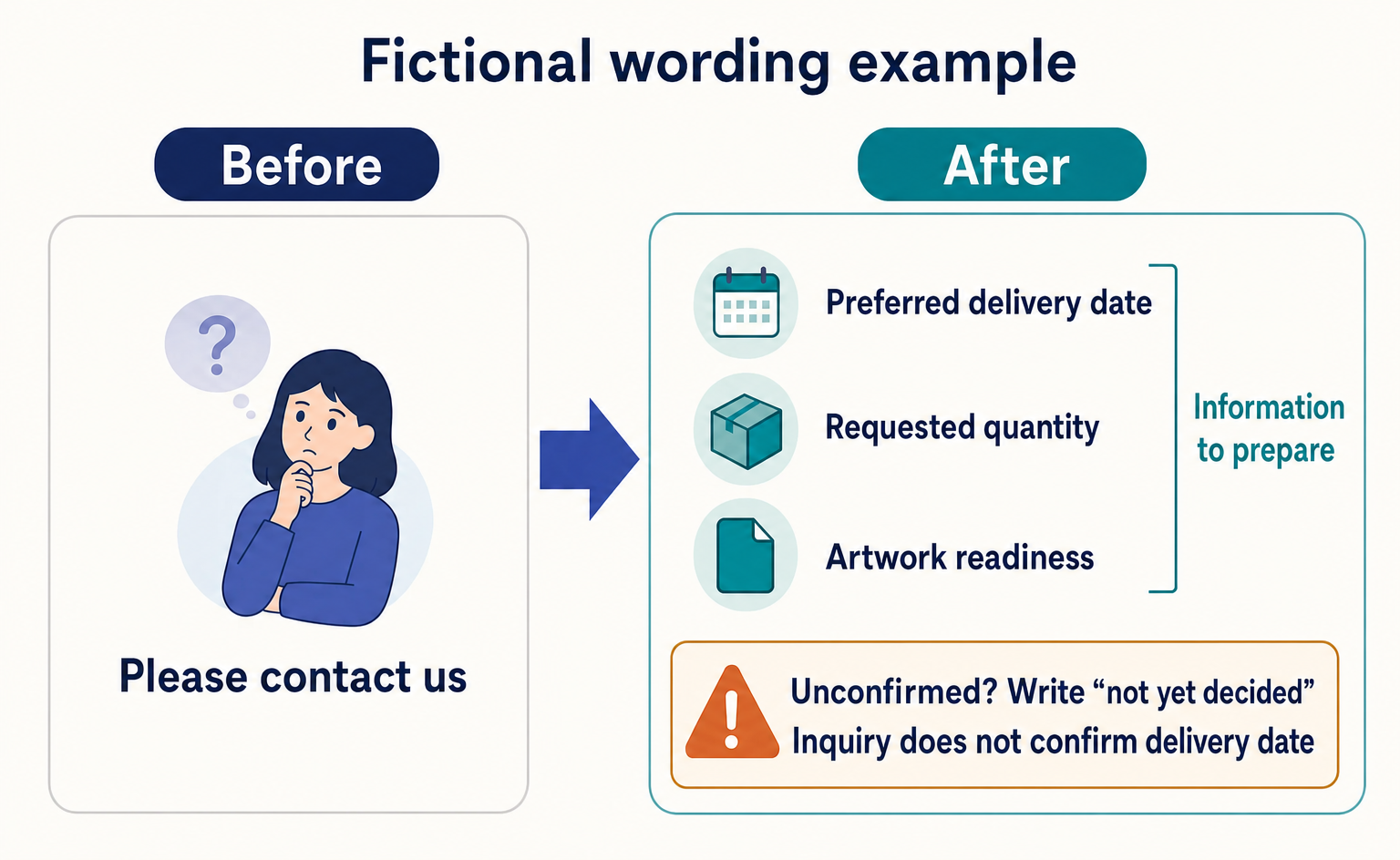
An illustrative before-and-after example
The following is an original fictional writing example, not an actual page revision. The order acceptance conditions in the improved version apply only within this illustration.
Before
Delivery times vary by product and quantity. Please contact us for details.
This text does not tell readers what to prepare before getting in touch. It communicates that timing varies with the conditions, but leaves out the information needed to start the conversation.
After
When asking about delivery timing, please tell us your preferred delivery date, requested quantity, and whether your artwork files for printing are ready. You can inquire with an estimated quantity. Mark any unconfirmed details as “not yet decided.”
A representative will review the details and let you know if any additional information is needed. Accepting your inquiry does not confirm a delivery date.
The improved version separates the information readers should prepare from what happens after the inquiry. It also explains when they can write “not yet decided.” Before using this wording in practice, confirm that your company can accept inquiries while those details remain unconfirmed.
5. Decide whether to create a new article or add to an existing page
The final check is whether a new article is really needed. The person responsible for content should read the site’s article list and the relevant product information page. If a page already answers this question, first consider expanding its explanation.
In the bag example, if adding a few lines of required information to the product page would enable readers to prepare, revising that page is an option. If readers also need instructions for communicating each unconfirmed item and sample entries, consider a standalone guidance article. This decision helps avoid creating more articles that answer the same question under different titles.
Before publication, we suggest asking someone inside the company who is unfamiliar with handling these inquiries to read the draft and explain “what to prepare” and “what is not yet confirmed.” Google also recommends seeking an honest assessment from trusted people who are unaffiliated with the site, in addition to conducting your own assessment.[1]
After publication, record which page changed and the date of the change. If you need to give the same explanation in a later inquiry, retain the question in accordance with company rules and review what the article may be missing. Do not treat a single response as proof of the article’s effect; review it using a consistent review period and scope.
The first task is not to analyze a large volume of inquiries. It is to choose one question from records you are allowed to use and check how much you can answer under current conditions. When the question, answer, and supporting evidence connect, you can move beyond rewriting general advice and plan an article that explains your company’s decision-making.
Official guides for your own checks
Google’s AI search guidance covers eligibility[2], while its Search Console guide explains reviewing Search impressions and clicks[3]. Use these to decide where to check the response after publishing an article based on customer questions.
FAQ
- Q. Can we plan articles without original research data?
- This article suggests using the conditions behind your answers to customer inquiries and the reasons for your decisions as material. Google’s documentation also lists original information and analysis as assessment criteria, but it does not require this method.[1]
- Q. Is this worksheet an official Google procedure?
- No. The worksheets and fictional examples are AgentSignal’s own editorial suggestions. The official Google documentation is cited as the basis for the approach of assessing whether content is useful to readers.[1]
Sources
- [1] Creating Helpful, Reliable, People-First Content | Google Search Central | Documentation | Google for Developers (Google) — accessed 2026-09-15
- [2] AI Features and Your Website | Google Search Central | Documentation | Google for Developers (Google) — accessed 2026-09-15
- [3] How To Use Search Console | Google Search Central | Documentation | Google for Developers (Google) — accessed 2026-09-15
About the author
Shogo MizushimaCEO of kairos Inc. / AgentSignal Developer
Develops AgentSignal, a tool for measuring AI crawler visits and AI-referred traffic, and diagnosing AIO readiness. Writes about measurement and practical improvements for AI search using observed data.
Related articles
AIO and AI search
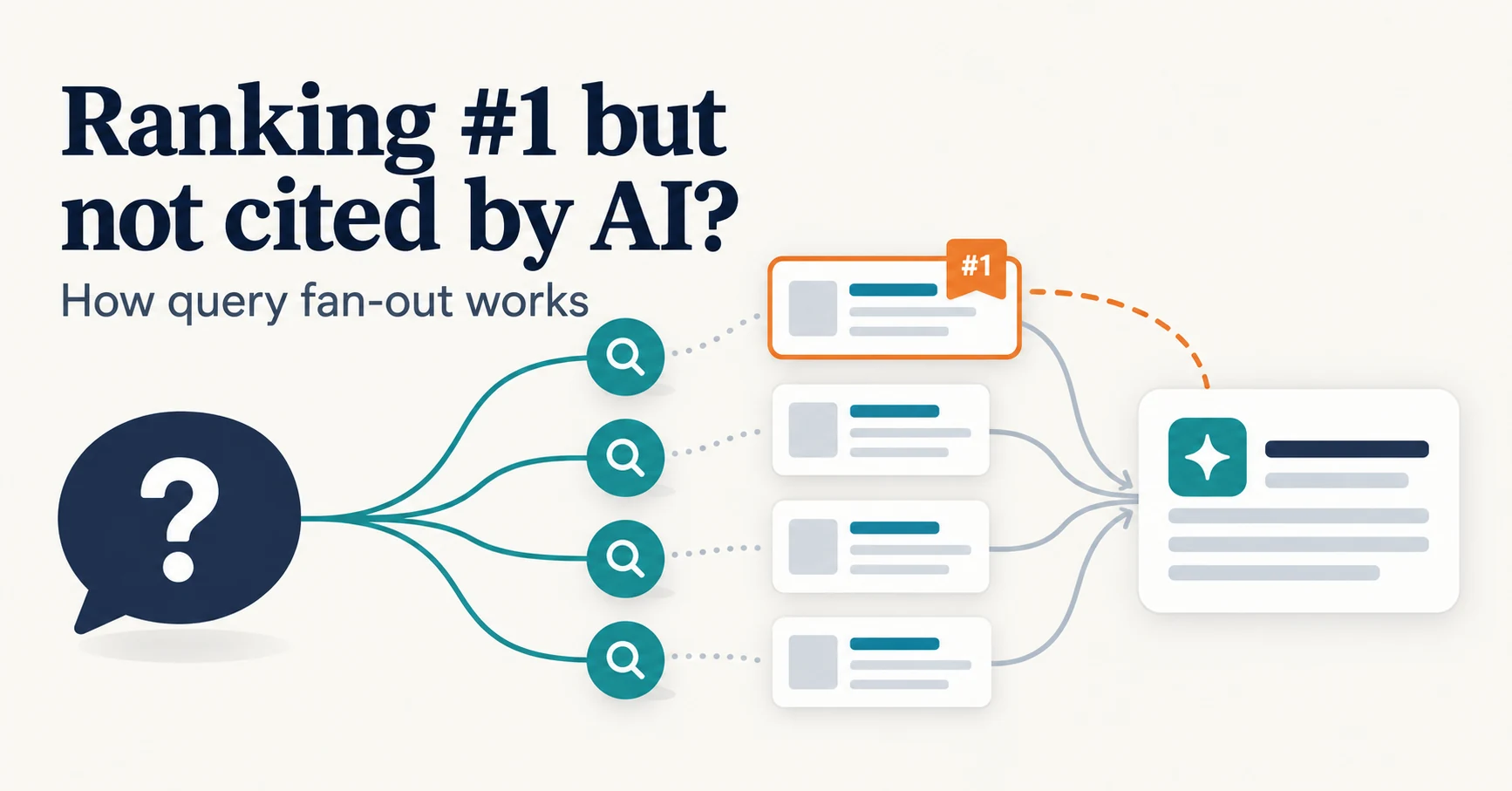
Ranking First but Not Cited by AI? How Query Fan-Out Works
Query fan-out is a technique in which AI may run several related searches to answer one question. Learn why a first-place page may not be cited, which related questions your pages should answer, and what you can observe in Search Console and Bing.
Published
AIO and AI search
What Is LLMO? How It Differs from SEO and Why Some Say It Is Pointless
LLMO is the work of helping answers from ChatGPT and other AI find and accurately describe your company. Learn how it differs from SEO, why some call it pointless, how E-E-A-T relates, how to measure results and what to do in the first month.
Published
AIO and AI search
Airbyte reported a $100,000 ChatGPT-originated deal: the content changes behind its AIO work
Airbyte reported one $100,000 contract originating from ChatGPT. The team analyzed over 500 prompts and revised content into direct answers, lists, and steps.
Published