Go Fish Digital’s GEO Case: Four Decisions Before Adding Articles

What do Go Fish Digital’s reported 83.33% increase and 25x figure actually measure? This article explains the numbers, then shows how to organize buyer questions, record a baseline, and add answers to pages, using a fictional pricing page.
Before adding articles, Go Fish Digital decided four things: which questions to target, a baseline to compare against, key pages with answers and evidence, and how to handle follow-up questions. The reported numbers are not revenue growth or before-and-after multiples.
If more articles are not bringing more inquiries, what is missing may be answers buyers need to decide, not article count. After reviewing the case, this article uses a fictional cleaning company to show how to apply the same approach.
What Go Fish Digital’s GEO Case Reported, and Under What Conditions
The reported 83.33% is an increase in monthly conversions from AI referrals. The 25x compares conversion rates between AI referrals and traditional search. Neither shows revenue growth.
Go Fish Digital is a US agency that helps companies get found in search and AI answers. GEO refers to work aimed at being recommended in generative AI answers. The company published a case study about its own site on September 24, 2025[1].
Over roughly three months, it lists four areas of work[1]:
- Mapping the questions buyers ask AI.
- Recording a baseline of AI-referred visits and related data.
- Building five to eight key pages with evidence and statistics.
- Building pages that answer related follow-up questions.
It reports a 43% increase in monthly AI-referred visits and an 83.33% increase in monthly conversions from AI referrals. It also says AI-referred conversions happened at a 25x higher rate than traditional search[1].
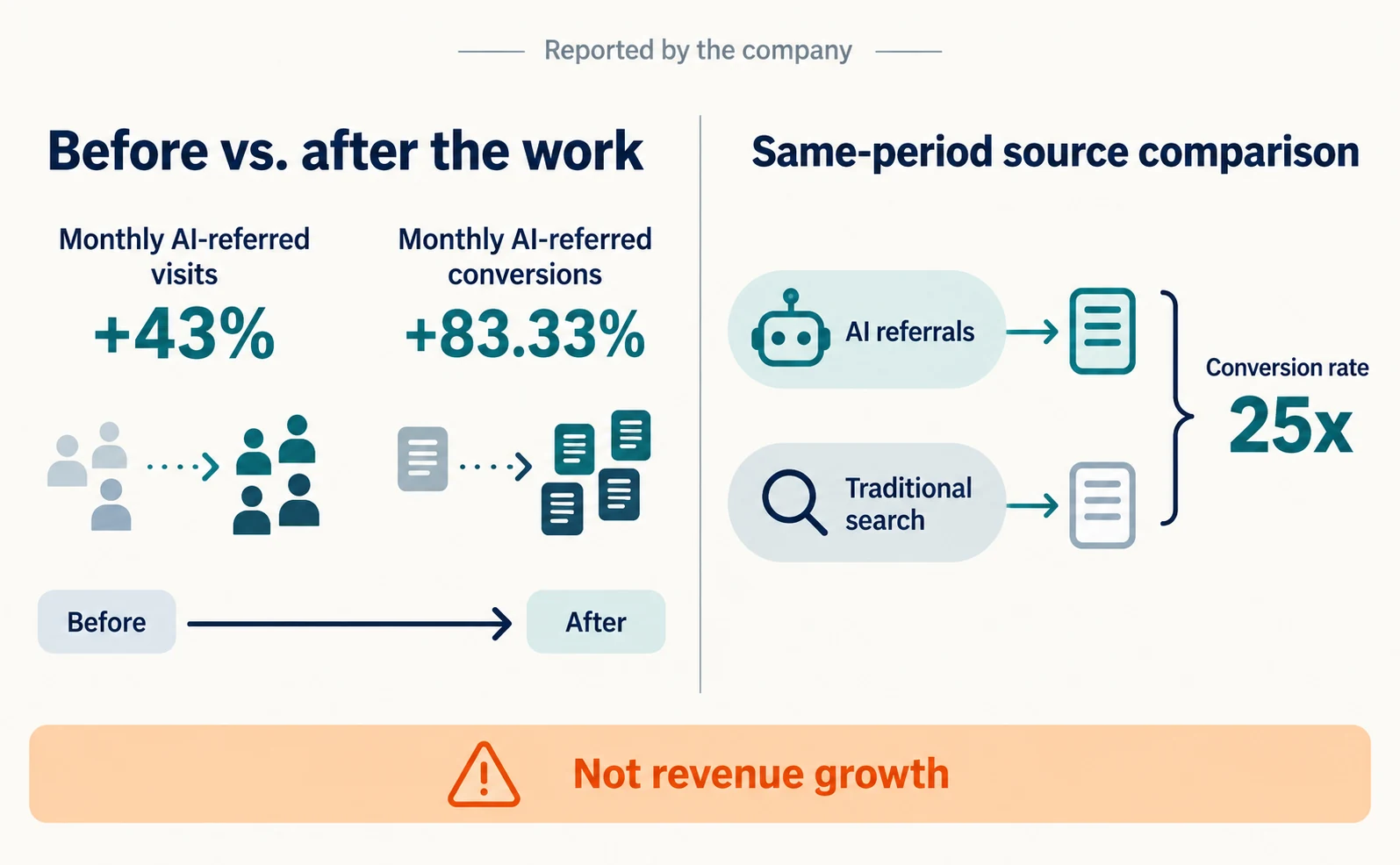
The case does not say what counted as one conversion or give the underlying counts. The company also notes that it already had a strong reputation, expertise, and external mentions before starting[1]. Whether a company with a limited track record would see similar results cannot be judged from this case.
This is a past case study, not current news. The tables and examples below are our own illustrative suggestions, not reproductions of materials the company used.
Write Buyer Questions Before Article Titles
Start not with article titles but with questions prospective buyers cannot yet answer. Framing them as questions helps you identify the materials needed.
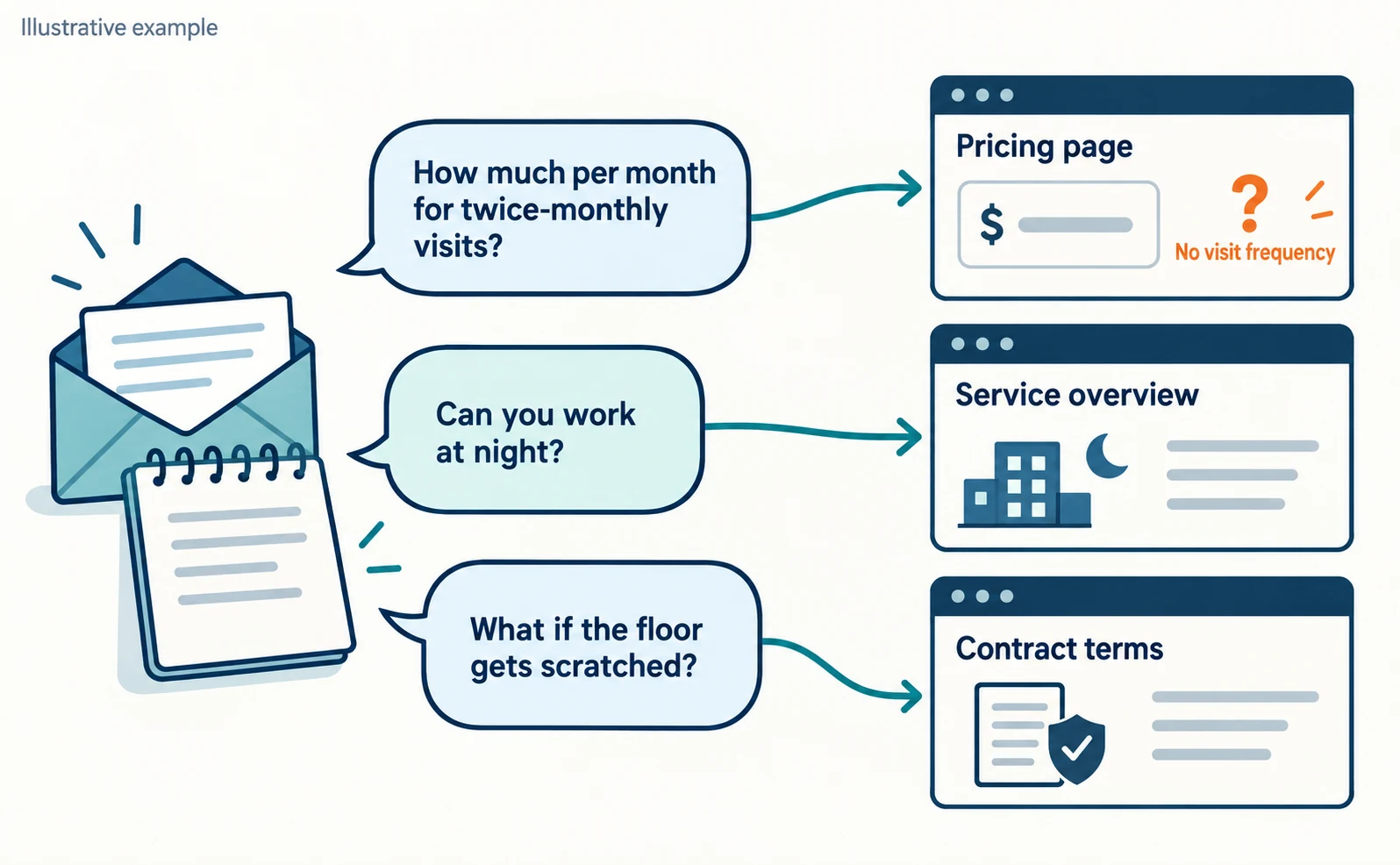
The word “cost” alone does not tell you whether someone wants the monthly price or is worried about extra charges. For a fictional commercial cleaning company, collect questions asked before booking from sales emails and meeting notes. Keep the meaning, not personal or customer names.
| Buyer question | What they need to decide | Page for the answer |
|---|---|---|
| How much per month for twice-monthly visits? | Whether it fits the budget | Pricing page |
| Can you work at night? | Whether operations can continue | Service overview |
| What if the floor gets scratched? | Whether the accident response is acceptable | Contract terms |
Before turning each row into an article, check whether an existing page already answers it. A pricing page with a price but no visit frequency does not answer the first question.
Label questions from real inquiries “confirmed in sales email” and ones your team imagined “assumed,” so assumptions are not treated as customer feedback.
Baseline Records: Separate AI-Referred Visits from Inquiries
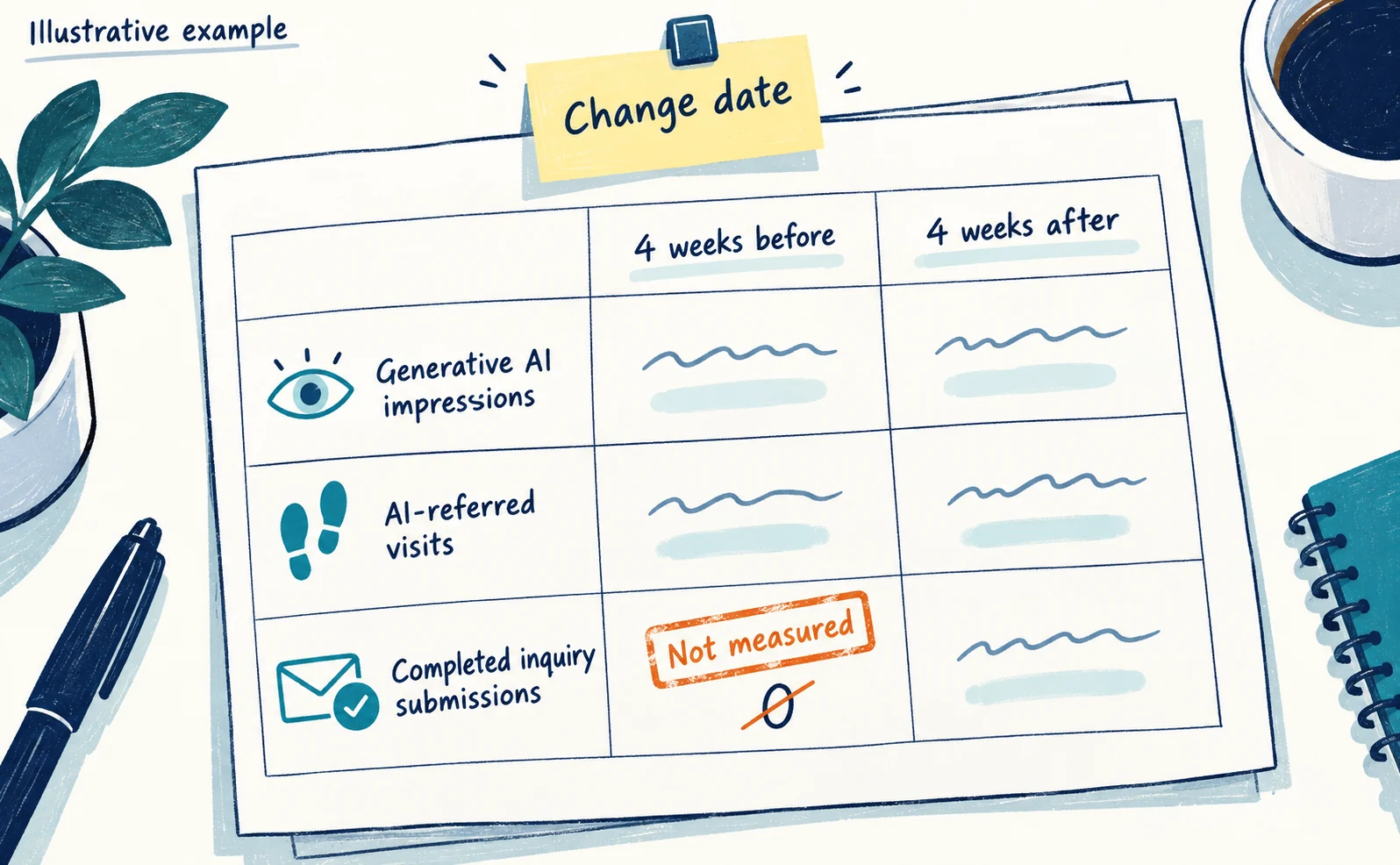
Before changing a page, record the change date, comparison periods, AI-referred visits, and completed inquiry submissions in separate columns. Also separate button clicks from completed submissions.
Impressions in Google Search’s AI features are available in Search Console’s generative AI report. As of August 31, 2026, it had rolled out to all websites worldwide and shows impressions in AI Overviews and AI Mode by page[2][3].
These impressions are not visits or inquiries, so give them their own column.
| What to record | Fictional example | What to check when comparing |
|---|---|---|
| Change date and location | Added visit frequency and extra costs to pricing page | Which change is being compared |
| Comparison periods | Four weeks before and after | Matching length and business days |
| Generative AI impressions | Figure for the pricing page | Dates are in Pacific Time |
| AI-referred visits | Current counting rules saved | Same rules before and after |
| Completed inquiry submissions | Not measured | Is there a way to count completions? |
Mark untracked items “not measured” rather than zero. When you export Search Console data, values shown as “~” or “-” become zeros[3].
Do Not Confuse Growth Rates with Rates by Traffic Source
“Did conversions increase?” and “Which traffic source converts better?” are different questions. The first compares one source before and after a change; the second compares sources in the same period.
The case’s 83.33% answers the first question, and 25x answers the second[1]. Reading 25x as “the work improved results 25 times” is incorrect.
If you use a conversion rate, decide the formula first, such as completed inquiry submissions divided by relevant visits. This is a suggested definition for your use, not the company’s method. Always keep the rate and the underlying counts together.
Add Answers and Evidence to Pages That Hold Up Decisions
Once you have questions and a baseline, start with pages missing answers buyers need before booking. For the cleaning company, a pricing page that does not let readers calculate the total is a candidate.
All prices and conditions below are fictional. Replace them with your own approved price list and contract terms.
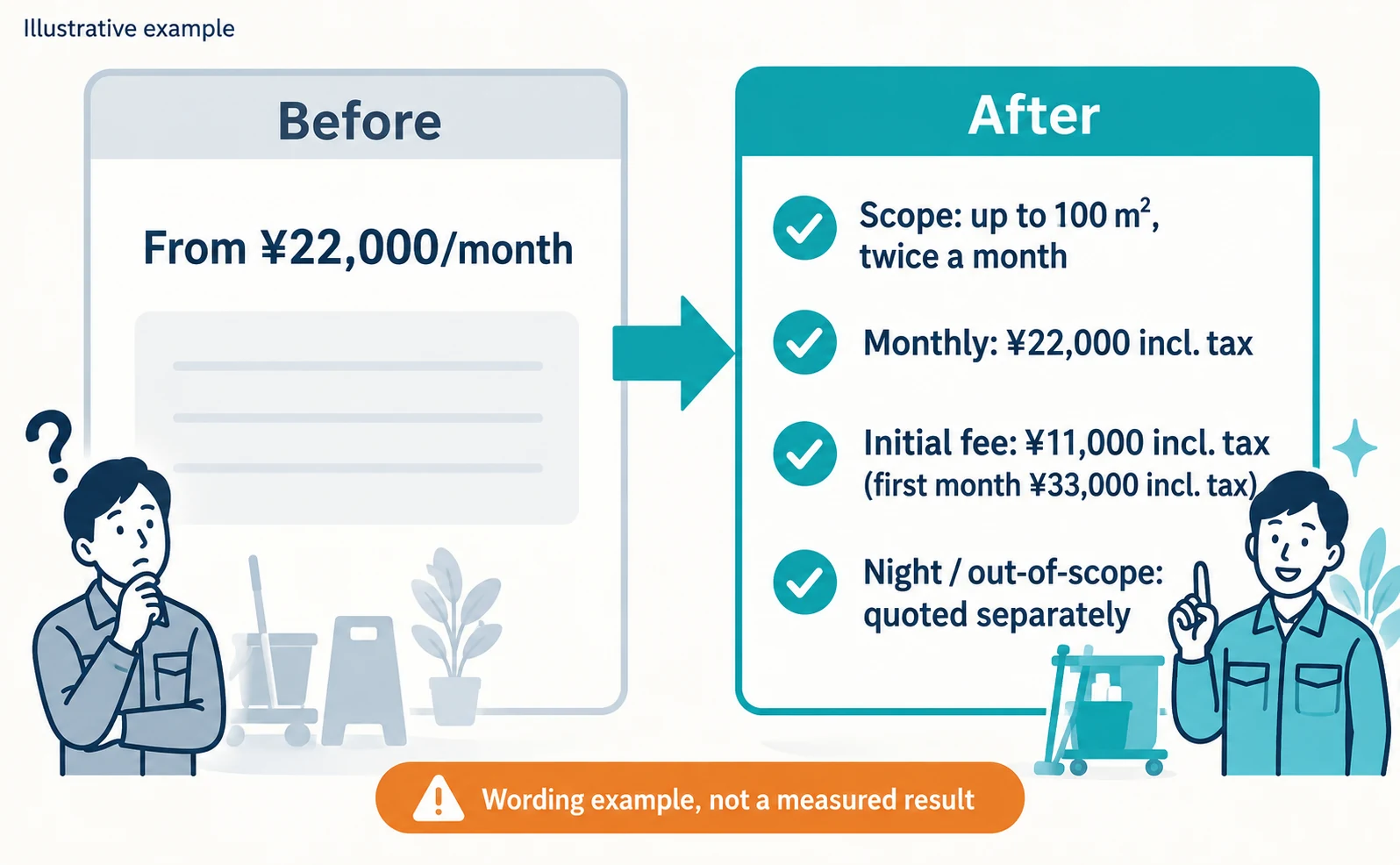
Before: “Office cleaning from ¥22,000 per month. Contact us for details.”
After: “Floor cleaning of up to 100 square meters twice a month costs ¥22,000 per month including tax. The initial fee is ¥11,000 including tax, so the first month totals ¥33,000 including tax under these conditions. Night work and work outside this scope are quoted separately, and we will give you the price before you confirm.”
The revised version shows frequency, scope, initial fee, and conditions for extra charges. It is a wording example, not a measured increase in inquiries.
Use your price list, contract terms, and work specifications as evidence. Do not publish guesses; confirm unclear items with the person who sets prices. Google also lists making important content available as text among the fundamentals that apply to AI features[4].
For more pricing questions to answer, see Five Questions Your Pricing Page Should Answer.
Answer Follow-Up Questions on the Same Page or a Separate One
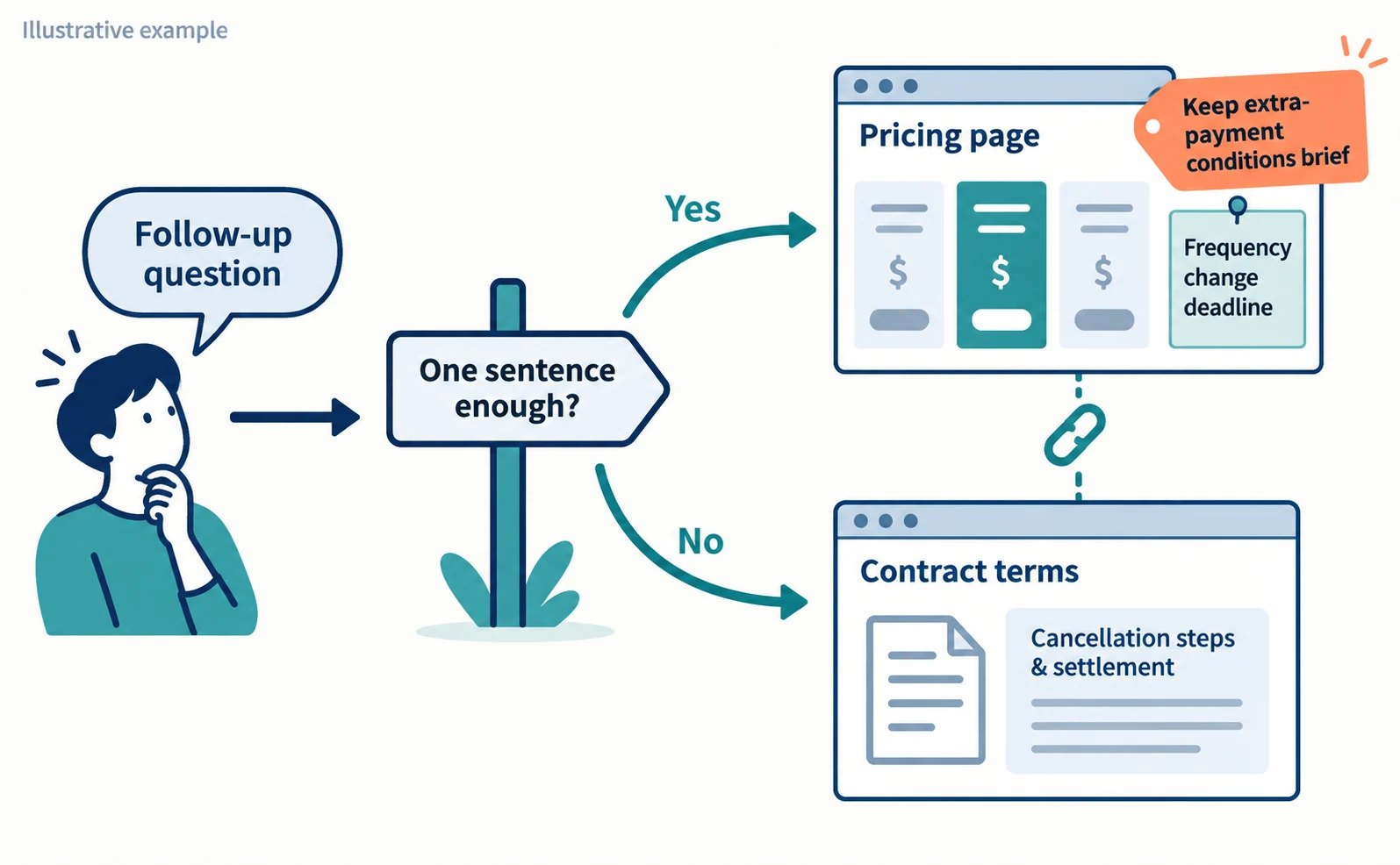
Put questions you can answer in one sentence on the same page; move topics that need procedural detail to a separate page and connect them with a descriptive link. Not every related question needs its own article.
Someone who now knows the monthly price may also wonder, “Can we change the frequency?” or “How much notice is needed to cancel?” These are illustrative assumptions.
If the deadline for changing frequency fits in one sentence, place it near the pricing table. If cancellation needs explanation of how to apply and settle charges, move it to the contract terms page. Even then, keep conditions affecting extra payments briefly on the pricing page.
Google says AI Overviews and AI Mode may use “query fan-out,” issuing multiple related searches to develop a response[4]. This does not mean every AI searches in the same order. See How Query Fan-Out Works for details.
Finally, put questions, answer pages, missing materials, and first actions on one sheet. Start with questions that affect the booking decision, lack an answer today, and can be supported with evidence. For collecting questions, see Start with Customer Inquiries.
FAQ
- Q. Does the 83.33% increase mean revenue grew?
- No. It is an increase in monthly conversions from AI referrals. What counted as a conversion and the underlying counts were not disclosed, so revenue growth cannot be confirmed.
- Q. Does 25x mean an improvement over the period before the work?
- No. It compares conversion rates between AI referrals and traditional search, not before and after the work.
- Q. Can a company with a limited track record expect the same results?
- This case cannot tell us. The company says it already had a reputation, expertise, and external mentions before starting.
Sources
- [1] Generative Engine Optimization (GEO) Case Study: 3X'ing Leads (Go Fish Digital) — accessed 2026-09-23
- [2] Introducing Search Generative AI performance reports in Search Console (Google Search Central Blog) — accessed 2026-09-23
- [3] Generative AI performance report (Search) (Search Console Help) — accessed 2026-09-23
- [4] AI features and your website (Google Search Central) — accessed 2026-09-23
About the author
Shogo MizushimaCEO of kairos Inc. / AgentSignal Developer
Develops AgentSignal, a tool for measuring AI crawler visits and AI-referred traffic, and diagnosing AIO readiness. Writes about measurement and practical improvements for AI search using observed data.
Related articles
AIO and AI search
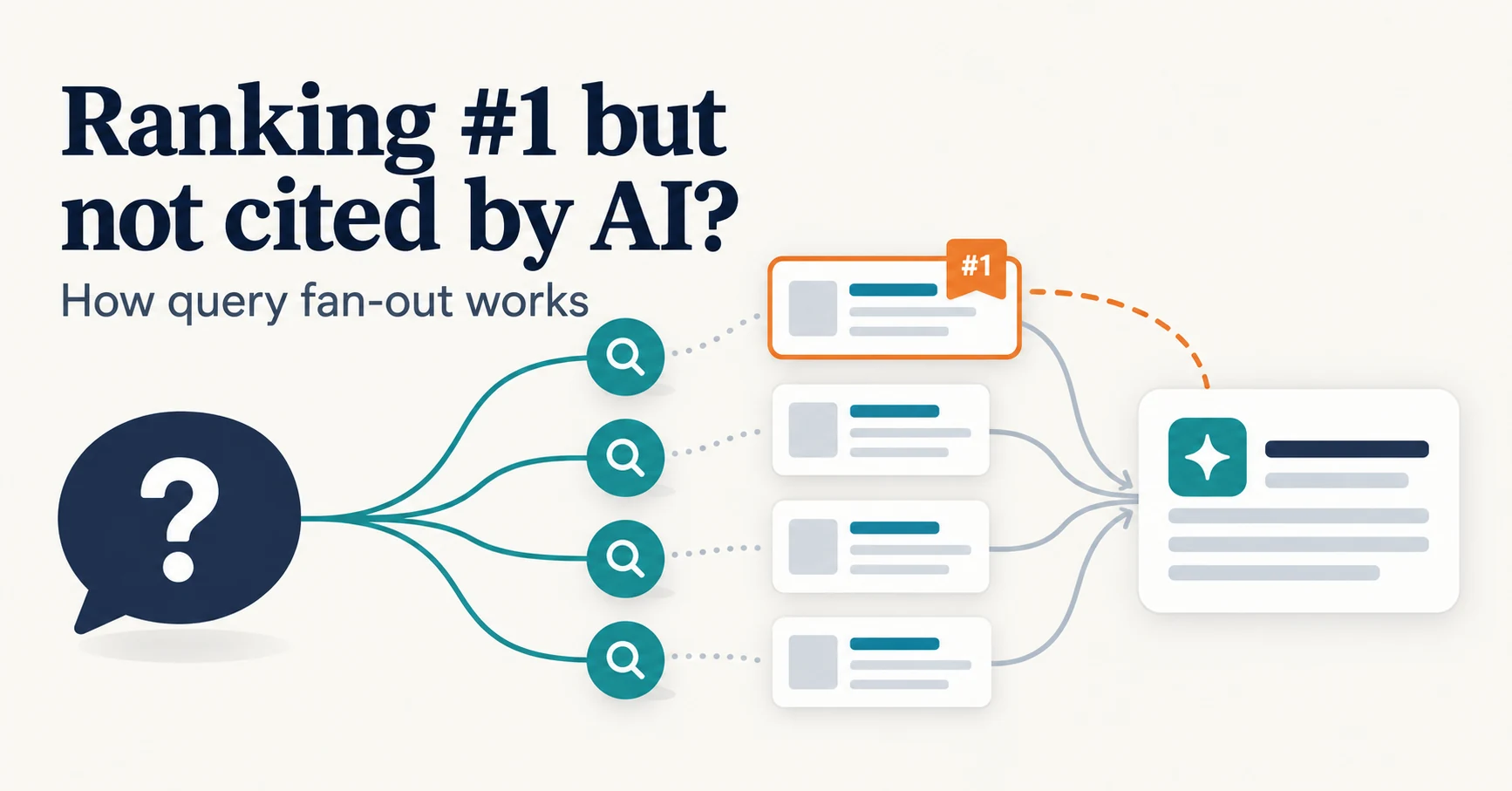
Ranking First but Not Cited by AI? How Query Fan-Out Works
Query fan-out is a technique in which AI may run several related searches to answer one question. Learn why a first-place page may not be cited, which related questions your pages should answer, and what you can observe in Search Console and Bing.
Published
Measurement and site improvement
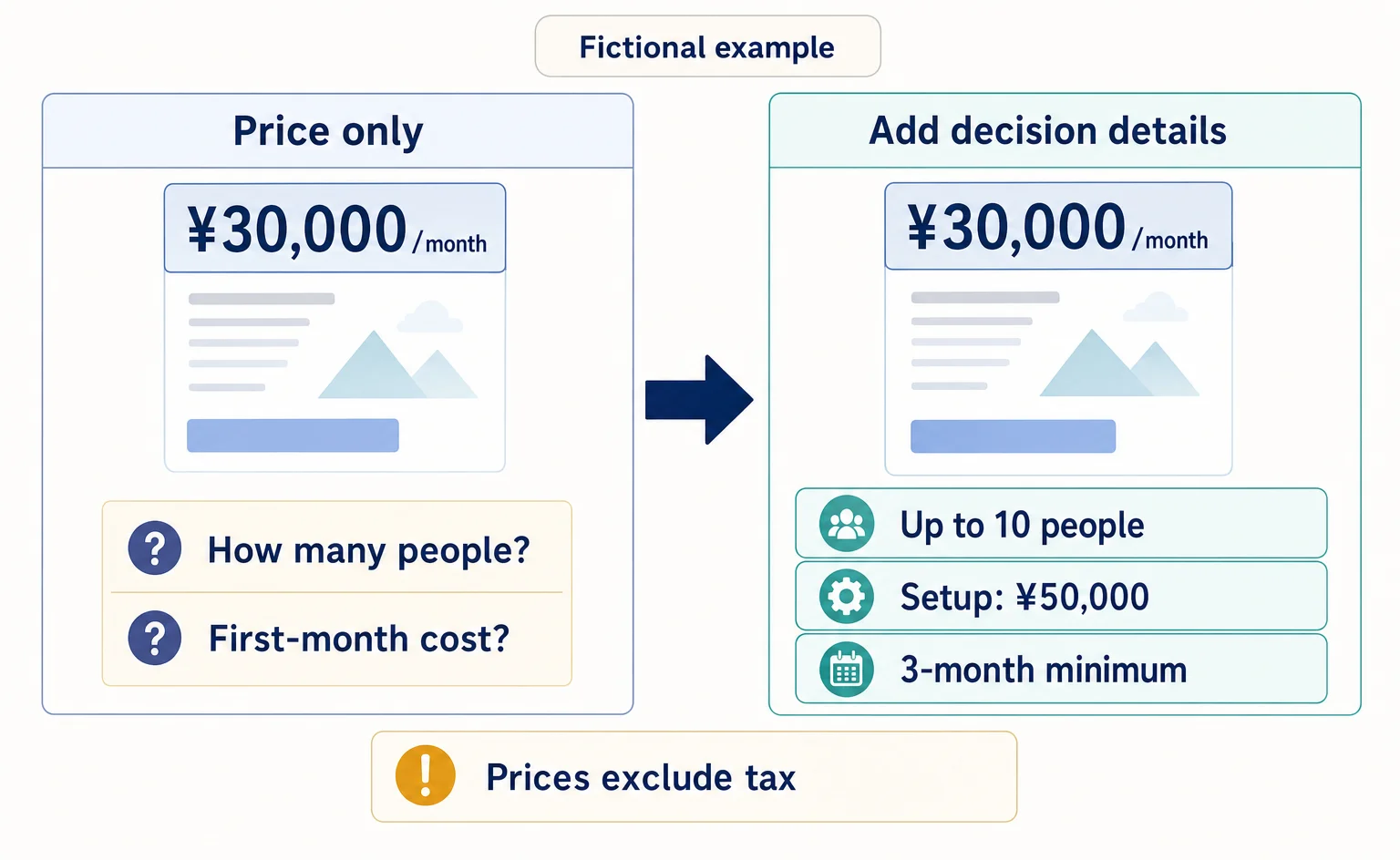
Before Adding More AI-Focused Articles: Five Questions Your Pricing Page Should Answer
Getting visits but few inquiries for your business service? Use this worksheet and a fictional before-and-after example to review what pricing includes, extra charges, cost calculations, contract terms, and what happens after someone applies.
Published
AIO and AI search
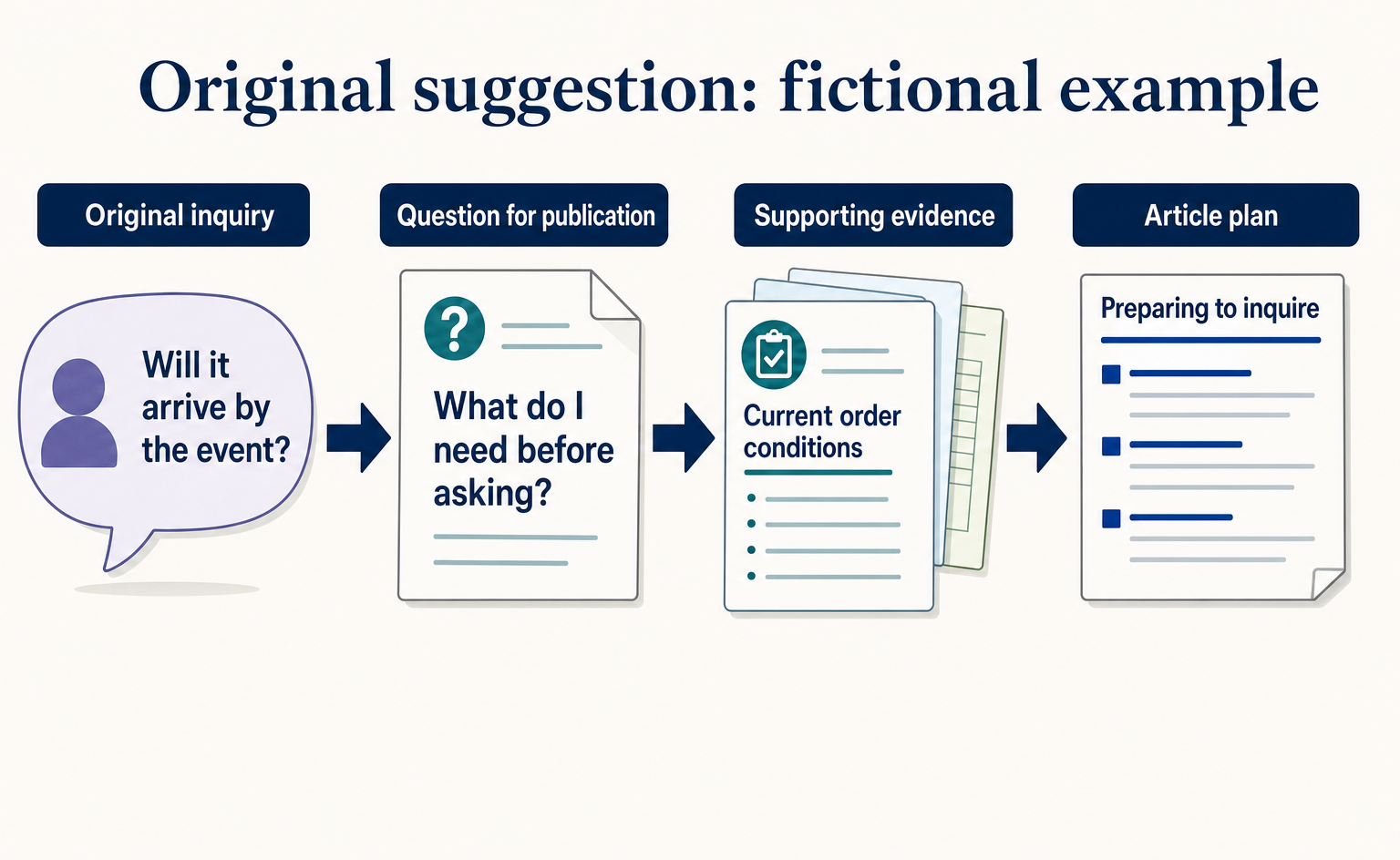
Where to Find Article Ideas Only Your Business Can Write: Start with Customer Inquiries
You do not need original research data to create useful articles. Learn how to turn customer questions, answers, and decision criteria into article plans, with worksheets and fictional before-and-after examples covering anonymization, question grouping, and evidence checks.
Published