Why Gemini Cites You but ChatGPT Does Not: A 960-Answer Study
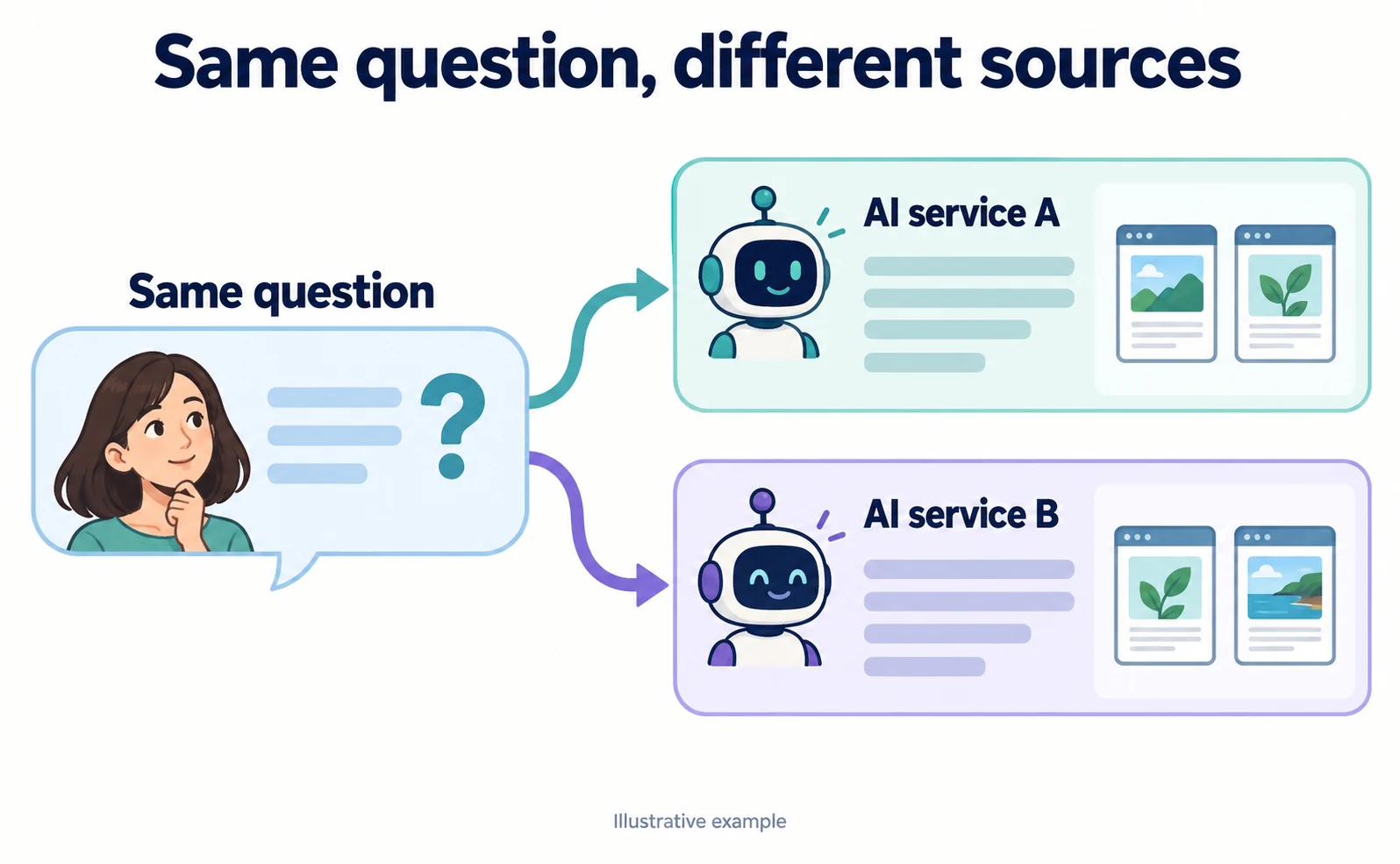
A page can appear in one AI service and be absent from another. Keep the results separate by engine before deciding what to change.
A page can appear in one AI service and be absent from another. Keep the results separate by engine before deciding what to change.
Your colleague finds the company in Gemini, while your ChatGPT answer recommends competitors. Neither observation automatically invalidates the other. The services may select different sources.
A Prefer study published on September 19, 2026 helps illustrate this issue. Its questions concern AI search, so the findings should not be treated as a benchmark for every industry.[1]
What differed across 960 answers?
On September 13, Prefer sent 80 questions to four engines three times each. Of 1,329 cited domains, 966 appeared in only one engine. A domain is the main part of a site's address—for example, agent-signal.ai.[1]
However, 23 of the 25 most-cited domains appeared in at least three engines. Some sources were shared widely; others appeared in just one service. The engines did not operate in completely separate source worlds.[1]
A citation points to a source. A brand mention is a name appearing in the answer. Record these separately: a company can be mentioned without a link to its website.
What this study does not establish
The researchers used APIs: interfaces through which software sends questions to AI. They did not collect 960 answers by operating the consumer ChatGPT interface. The repeated runs were close together, rather than daily observations.[1]
The study therefore does not tell you that your business underperforms in ChatGPT, or that three daily checks are sufficient. Its practical lesson is to preserve differences instead of hiding them inside one combined score.
The following is our proposed workflow, not a treatment proven by the study.
1. Choose a real buying question
Collect questions from sales calls and enquiries. Start with a question that searches for providers without naming your business. This helps you examine discovery by someone who does not already know you.
For a corporate training provider, an illustrative question is:
How should I choose beginner-friendly AI training for 20 employees, including support after the course?
Replace the conditions with those of your actual customers. Save the wording. If you change the question from lowest price to strongest ongoing support, treat it as a new question. Different recommendations would not be surprising.
2. Preserve the answer and its links
For an initial manual comparison, open ChatGPT and Gemini. Start a new conversation in each and submit the saved question. Keep follow-up conversations separate from these checks.
Record the following together. Include the model or feature where visible; do not invent settings that the interface does not expose.
| Record | What it helps establish |
|---|---|
| Time and exact question | Whether the conditions match |
| Full answer | Why a provider or product was selected |
| Company name and known aliases | Whether the brand was mentioned |
| Links to your website | Which pages readers could visit |
| Search and execution status | Whether an answer was obtained and search was observed |
This is an initial comparison. Tracking change requires repeated collection under consistent conditions and a history of results. Ongoing measurement tools reduce that manual work.
AgentSignal's AI citation view lets you examine results by AI service for registered questions. Read the captured answers and sources as well as the percentage. They provide clues about the information you may need to improve.
3. Read the answers where your page is missing
Open the cited pages and examine how they answer the question. The purpose is to identify missing information, not reproduce a competitor's article.
In the training example, useful conditions might include who provides post-course support, how long it lasts and whether there is an additional fee. If your company already offers that support but has not explained it, add verified details.
If your company does not provide the support that mattered to the recommendation, wording alone will not make it eligible. Consider the offer or a different customer need. Absence is not automatically a writing problem.
4. Compare each engine and question after the change
Record the URL, changes and publication date. Continue the same questions and examine results by engine.
As an illustrative calculation, links in three of ten successfully collected answers produce a 30% URL citation rate for those checks. This is not 30% of the market seeing your business. Keep failed executions separate from valid answers without a citation.
Mentions may rise while links do not. Links may rise without additional enquiries. Separate brand mentions, citations, visits and enquiries to identify the next improvement.
For Google's AI search features, readable important content and useful internal links remain part of the basic requirements. Eligibility does not guarantee inclusion.[2]
Begin with one question related to work you want to win. Record which engine recommended which page and why. That makes the comparison useful for improving information, rather than simply watching a score.
FAQ
- Q. Is checking one engine enough?
- Choose services relevant to your customers and preserve engine-level results rather than relying only on an aggregate.
- Q. Does absence imply poor writing?
- No. Relevance, service conditions and whether the page can be retrieved also need examination.
- Q. Was this a daily tracking study?
- No. Repeated runs took place close together and do not establish day-to-day variation.
Sources
- [1] How AI engines search and cite: 960 answers measured (Prefer) — accessed 2026-09-22
- [2] AI features and your website (Google Search Central) — accessed 2026-09-22
About the author
Shogo MizushimaCEO of kairos Inc. / AgentSignal Developer
Develops AgentSignal, a tool for measuring AI crawler visits and AI-referred traffic, and diagnosing AIO readiness. Writes about measurement and practical improvements for AI search using observed data.
Related articles
Case studies and research
37.5% More Search Visits: A Manufacturer’s SEO and AI Case
A specialist manufacturer reported 37.5% more organic search sessions after combined SEO and AI-search work. The useful lesson is how its content helped buyers choose, not a promise that AI optimization alone delivers that growth.
Published
Case studies and research
Claude and ElevenLabs: connect MCP for images, voice and video
Set up ElevenLabs MCP in Claude, prepare images, footage, narration and music, then finish in Studio. Includes connection commands and output checks.
Published
Case studies and research
Claude and HeyGen: set up MCP to create avatar explainers
Connect Claude and HeyGen through MCP, authenticate, prepare a script and create an avatar explainer. Includes voice, caption and MP4 checks.
Published