What Is AI Citation Rate? Denominators, Mention Rate, and Why the Numbers Vary
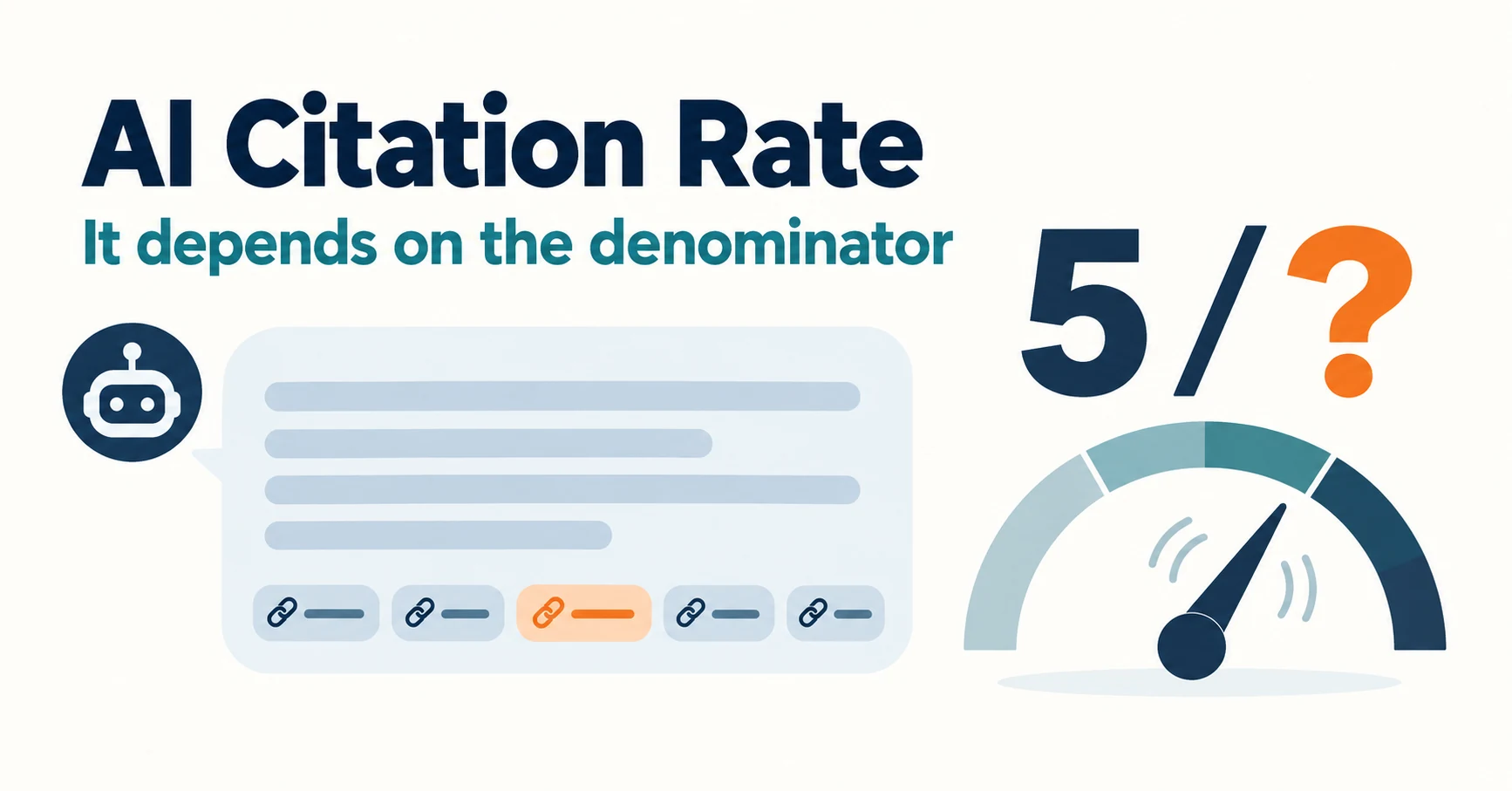
AI citation rate is the share of checked AI answers that cite your URL as a source. Learn how to set the denominator, handle failed runs, and how it differs from mention rate and Bing Citation Share, using one worked example.
AI citation rate is the share of AI answers to your chosen questions that list one of your page URLs as a source. A percentage alone means little. Always read it together with how many answers it was based on.
There is no industry-wide definition of a “citation” or a “mention”; counting rules differ by tool and provider. These rates are also separate from the AI feature impressions shown in Google Search Console.
Imagine your monthly report says “AI citation rate: 25%.” Your manager asks, “It was 30% last month. Why did it drop?”
To answer, you need to know the denominator and how the number was counted. The figure alone cannot tell you whether your pages got worse or only the counting changed.
This article uses one hypothetical example throughout. It is for explanation only and is not real customer or measurement data.
AI citation rate is the share of checked answers that cite your URL
AI citation rate is “answers whose source links include your URL ÷ answers checked.” A source link, or citation, is a link the AI shows as evidence for its answer.
Your company name appearing in the answer text does not count as a citation. The test is whether a reader can follow that link to your page.
Here is the example. A marketer at a fictional accounting service, “Sample Accounting,” chooses four questions customers might ask.
They send each question to one AI service five times, collecting 20 runs in total.
- Runs where the answer was retrieved: 16
- Runs that failed to retrieve an answer: 4
- Runs where a source link pointed to their URL: 5
- Runs where the company name appeared in the text: 8
So what is the AI citation rate? The answer depends on the denominator. The next section shows why.
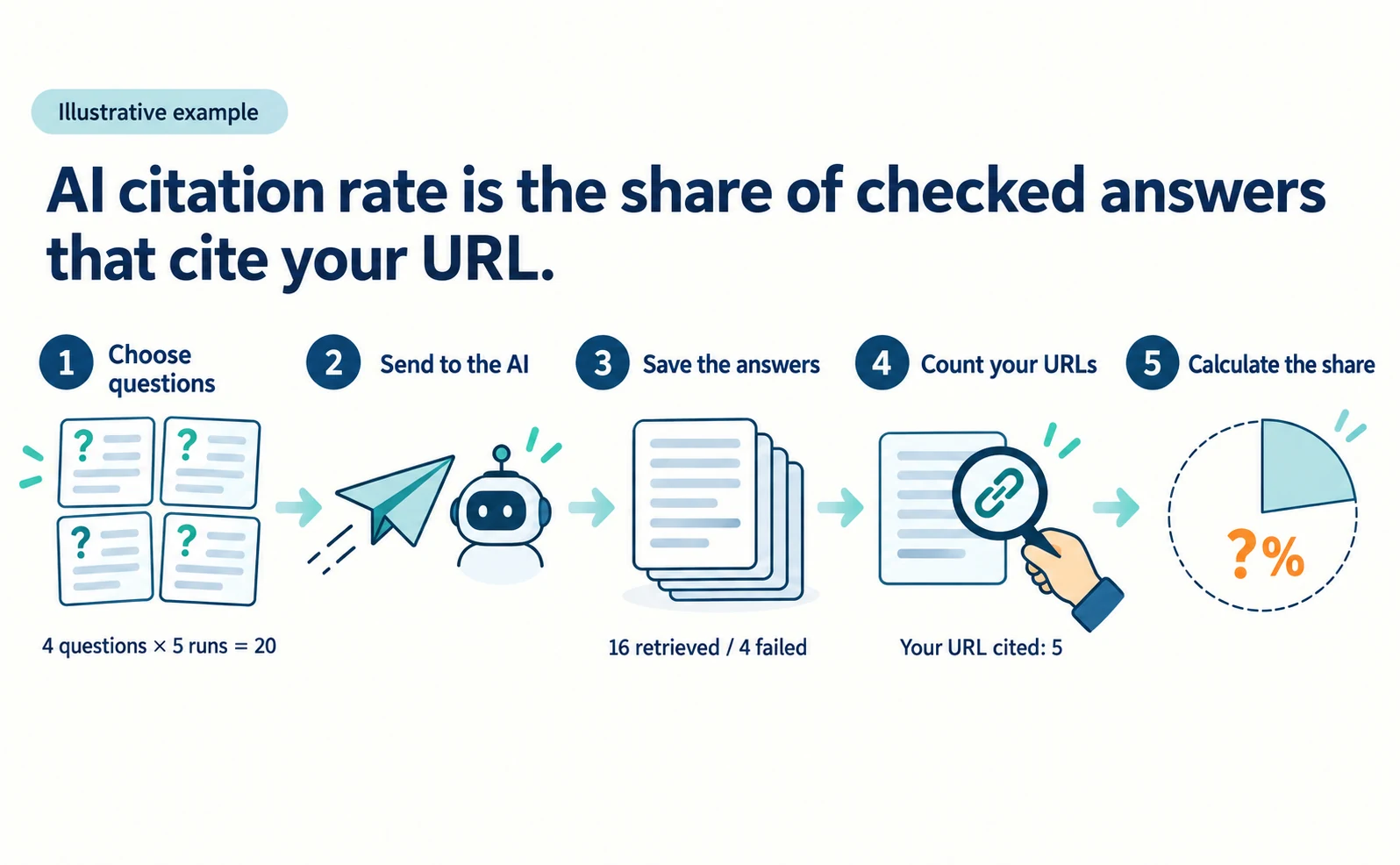
As the diagram shows, the rate is produced in order: choose questions, send them, save the answers, count your URLs, and calculate the share. A change at any step changes the final percentage.
The denominator: questions, runs, AI services, period, and failed runs
The denominator is the number of runs you actually carried out during the reporting period. Record the questions, runs per question, AI services, and run dates as the conditions behind that number, and count runs that failed to retrieve an answer separately rather than treating them as “not cited.”
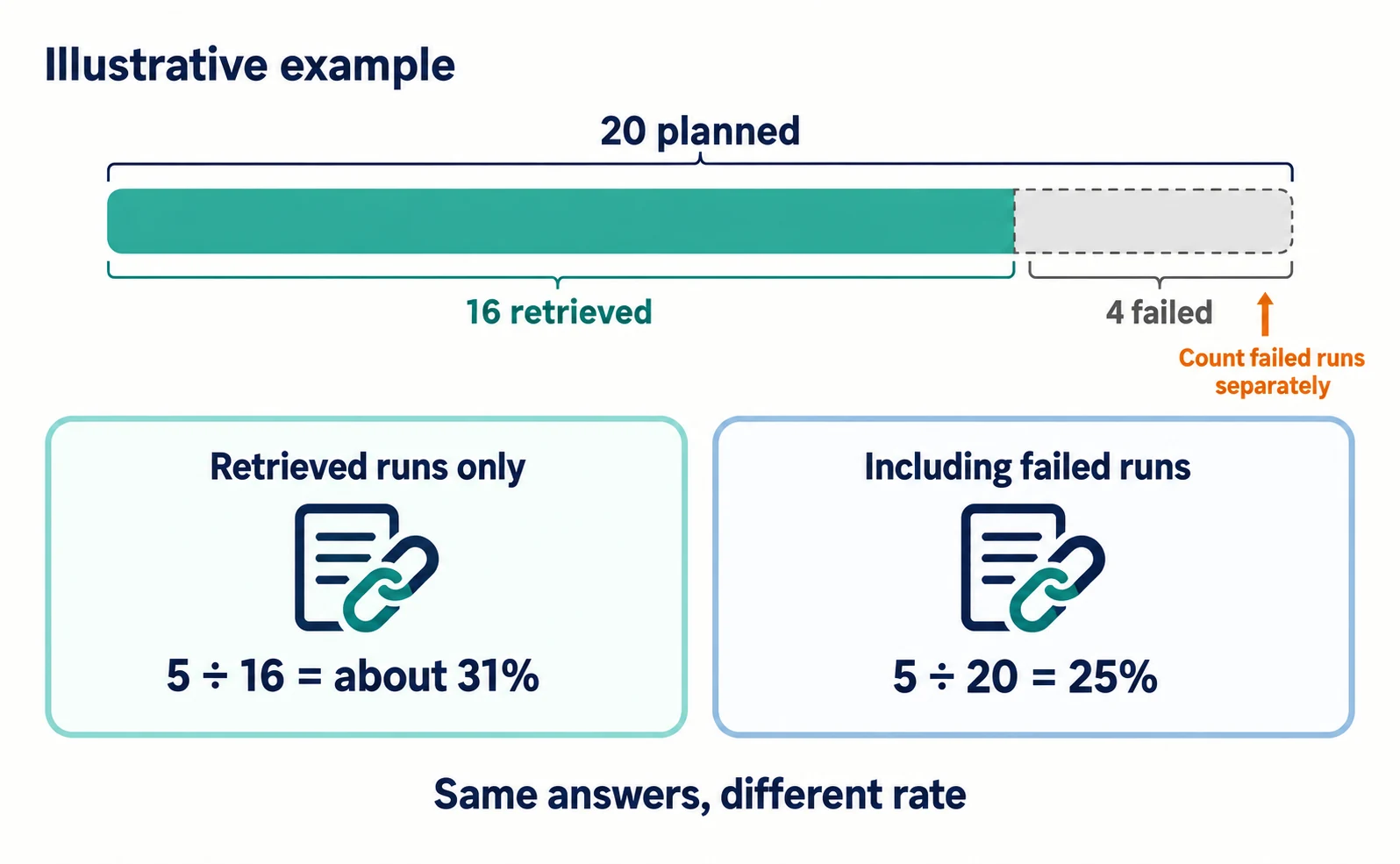
In the example, four questions were sent to one AI five times each, on one day in the month. That is 20 planned runs. Running the same set on two days in the month would make 40 planned runs. Do not multiply by the period; count the runs actually carried out.
Also separate planned runs from runs that returned an answer (valid answers). In the example, there were 20 planned runs and 16 valid answers.
Without these conditions, comparing this month with last month tells you little. The table shows what goes wrong when each one is missing.
| Condition | Value in the example | What goes wrong if it is not stated |
|---|---|---|
| Number of questions | 4 | A big shift after adding questions has no clear cause |
| Runs per question | 5 each | You cannot tell how much one run moves the rate |
| AI services | 1 | Results from another AI can slip in unnoticed |
| Period | 1 month | Different check dates get compared as if equal |
| Failed runs | 4 | An outage looks like a problem with your pages |
A failed run is one where an error or timeout prevented an answer from being recorded. The AI may not have declined to answer; the answer simply was not captured.
If you count those runs as “not cited,” the rate falls even though nothing on your pages changed.
How the same example changes when the denominator changes
In the example, 5 of the 20 runs cited your URL. Including or excluding failed runs gives different results.
| Denominator | Calculation | AI citation rate |
|---|---|---|
| Retrieved runs only | 5 ÷ 16 | about 31% |
| Including failed runs | 5 ÷ 20 | 25% |
The same answers produce a gap of about six percentage points. The “drop from 30% to 25%” in the opening scenario could come from more failures alone.
So report the number of retrieved runs and failed runs alongside the rate. Writing “5 of 16 (4 failed runs counted separately)” lets readers repeat the calculation.
How mention rate, URL citation rate, and Bing Citation Share differ
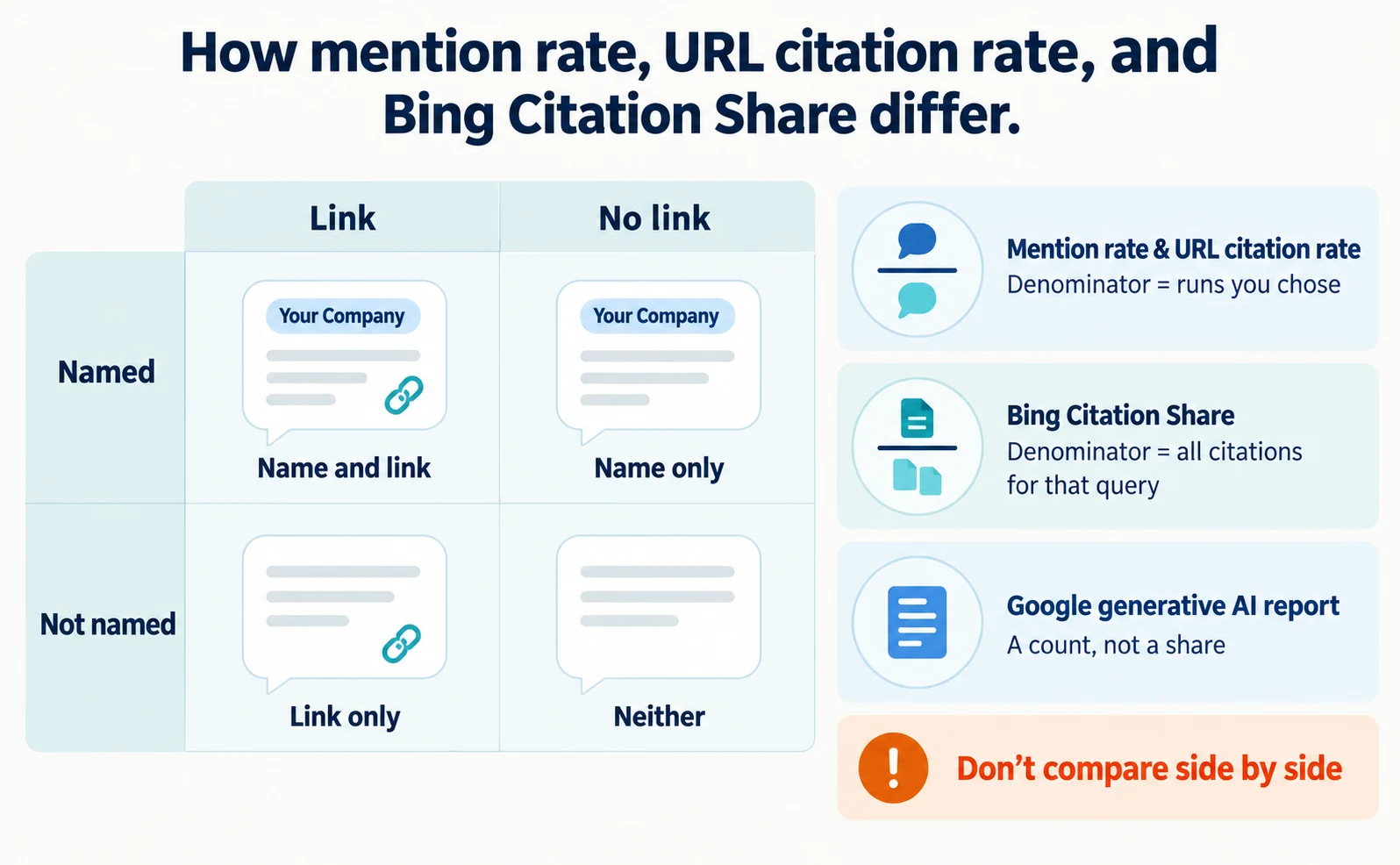
Mention rate is the share of answers that name your company, URL citation rate is the share that link to you, and Bing Citation Share is your site’s share of citations for a specific query. The names are similar, but each counts something different.
In the example, your name appeared in 8 of 16 answers, so the mention rate is 50%. The URL citation rate is 5 of 16, about 31%.
An answer that names you without linking to you may rely on another page, such as a comparison site. However, the gap between the two rates is not necessarily the number of “name only” answers, because some answers link to you without naming you.
So count each answer in one of four groups: “name and link,” “name only,” “link only,” and “neither.” The example gives only the totals of 8 mentions and 5 citations and does not set this breakdown.
On June 16, 2026, Microsoft announced a preview of Citation Share and other features in Bing Webmaster Tools [1].
Citation Share is the percentage of citations attributed to your site out of all citations shown across all sites for a specific “grounding query” [1]. A grounding query is a search the AI uses to find evidence for its answer.
Microsoft describes it as an observational metric. It is not a ranking or competitive scoreboard, it does not reveal competitor domains, and it does not represent traffic share [1].
The denominators differ too. The AI citation rate in this article divides by the number of answers you checked. Citation Share divides by all citations shown across all sites for that query. Even at the same 25%, they mean different things, so do not compare them side by side.
Google Search Console also has a generative AI report. It counts how many times links to your pages appeared in AI features [2]. It is a count, not a share.
| Metric | What it counts | Denominator | What it cannot tell you alone |
|---|---|---|---|
| Mention rate | Answers naming your company | Runs you chose | Whether there was a link |
| URL citation rate | Answers citing your URL | Runs you chose | Whether the description was accurate |
| Bing Citation Share | Your share of citations for one query | All citations for that query | Rankings or visits |
| Google generative AI impressions | Times your links appeared in AI features | Not a share | Clicks or people |
In reports, keep these on separate lines rather than merging them into one “AI score.”
Why AI citation rates vary
The same question does not always produce the same answer or sources. The fewer runs you have, the more a single run moves the rate.
Microsoft says citation patterns can shift with user behavior, evolving models, freshness signals, and partner refresh cycles [1].
Google also says AI Overviews and AI Mode may use different models and techniques, so the responses and links they show will vary [3].
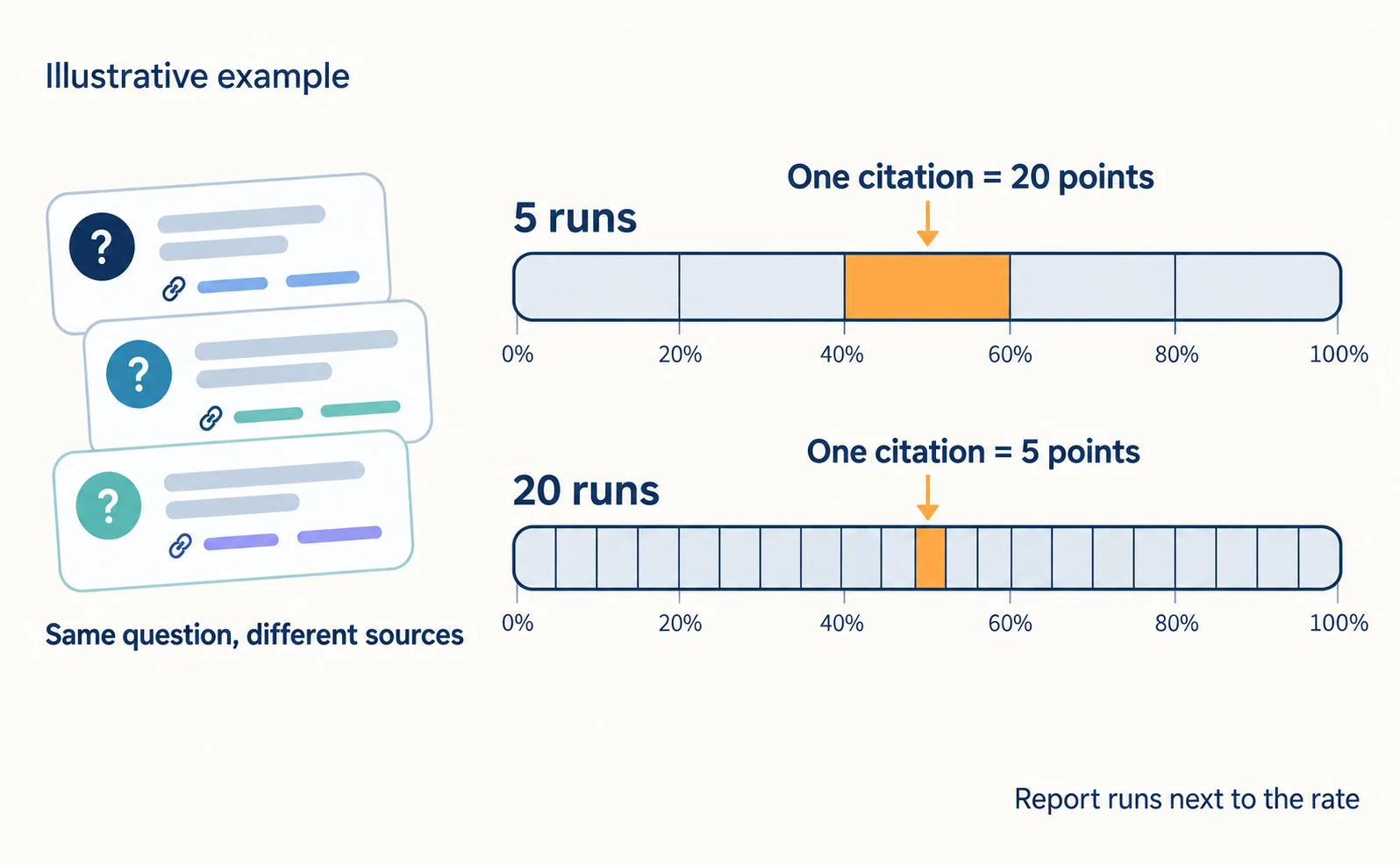
The example shows how the number of runs matters.
| Runs | Change from one extra citation |
|---|---|
| 5 | 20 percentage points |
| 20 | 5 percentage points |
With only five runs, one chance result moves the rate by 20 points. When comparing questions, always note how many runs each was based on.
Also record the dates when you changed collection methods or when the AI service or model changed. If those coincide with page edits, it becomes hard to tell which caused the change.
What to check when you receive an AI citation rate report
Check whether the report states the denominator, failed runs, collection method, and dates when conditions changed. If any are missing, ask the author.
| What to check | How to ask if it is missing |
|---|---|
| Full question text and count | “Could you share the list of questions?” |
| AI services and runs | “Which AI did you use, and how many times was each question sent?” |
| Retrieved and failed runs | “Are failed runs included in the denominator?” |
| What was counted | “Are name mentions and links counted separately?” |
| Dates conditions changed | “Did the questions or collection method change?” |
For the “30% to 25%” question, first check whether failed runs and question count match last month. Only if conditions are the same should you read the competitor pages cited instead and compare them with yours.
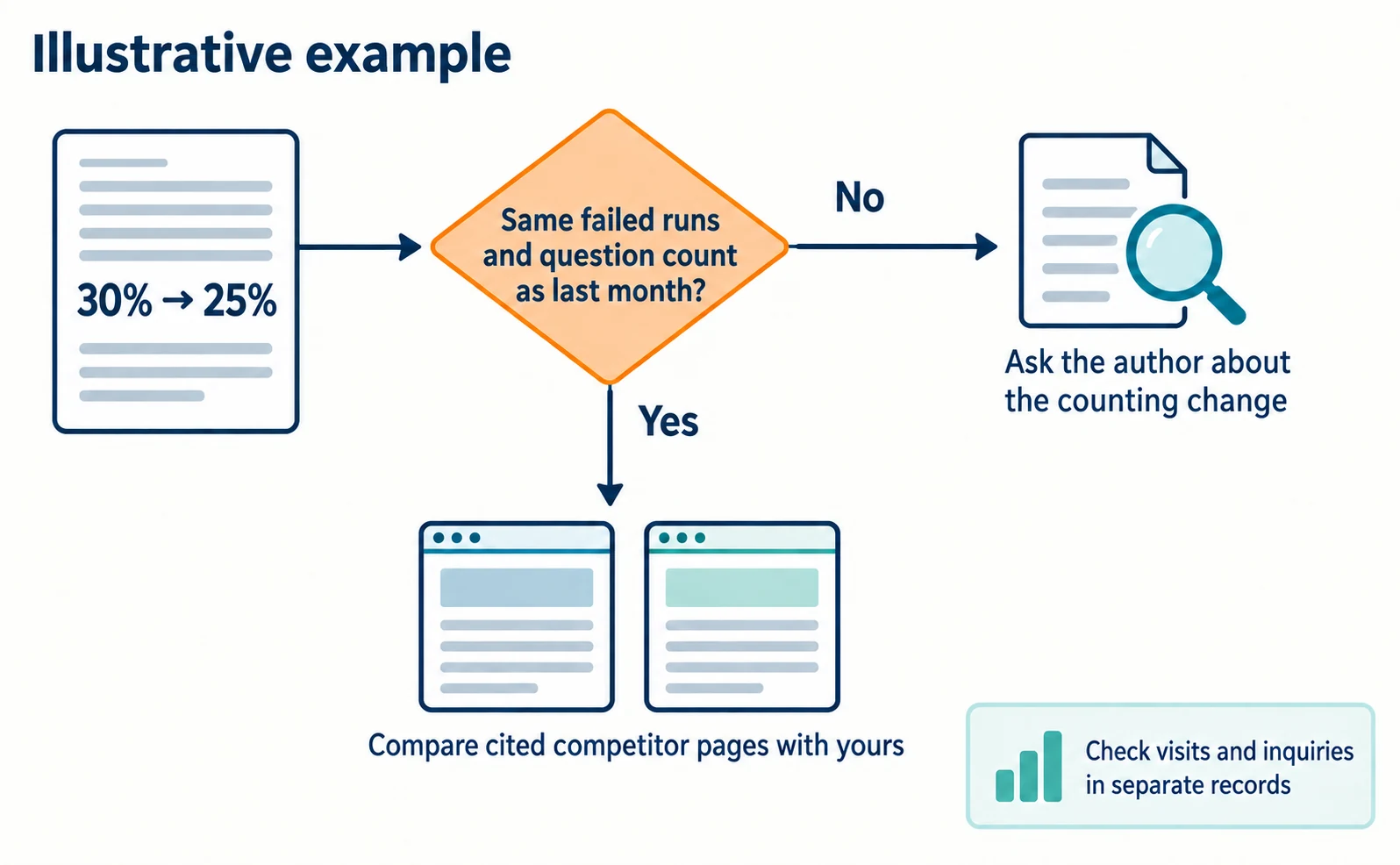
A higher citation rate does not guarantee more visits or inquiries. Check visits and inquiries in separate records, such as your analytics.
The relationship between citation rate, mention rate, and visits is also covered in What Is LLMO?. How AI runs related searches is explained in the article on query fan-out.
Steps for setting questions and run counts and recording answers in AgentSignal are in How to Use AI Optimization. Whatever tool you use, confirm how it handles the denominator and failed runs before comparing numbers.
FAQ
- Q. If our AI citation rate is high, will site visits increase too?
- Not necessarily. The citation rate shows how often answers linked to you, not whether anyone clicked. Check visits and inquiries in separate records such as your analytics.
- Q. How many runs are enough?
- There is no fixed standard. The fewer runs, the more one result moves the rate, so always report the number of runs with the rate and compare using the same count.
- Q. Is Bing Citation Share like a search ranking?
- No. Microsoft describes it as an observational metric showing your site’s share of citations for a specific query, not a ranking or traffic share.
Sources
- [1] New AI Visibility Insights in Bing Webmaster Tools: Intents, Topics, Citation Share, Compare (Microsoft Bing Blogs) — accessed 2026-09-23
- [2] Introducing Search Generative AI performance reports in Search Console (Google Search Central Blog) — accessed 2026-09-23
- [3] AI features and your website (Google Search Central) — accessed 2026-09-23
About the author
Shogo MizushimaCEO of kairos Inc. / AgentSignal Developer
Develops AgentSignal, a tool for measuring AI crawler visits and AI-referred traffic, and diagnosing AIO readiness. Writes about measurement and practical improvements for AI search using observed data.
Related articles
AIO and AI search
What Is LLMO? How It Differs from SEO and Why Some Say It Is Pointless
LLMO is the work of helping answers from ChatGPT and other AI find and accurately describe your company. Learn how it differs from SEO, why some call it pointless, how E-E-A-T relates, how to measure results and what to do in the first month.
Published
AIO and AI search
Ranking First but Not Cited by AI? How Query Fan-Out Works
Query fan-out is a technique in which AI may run several related searches to answer one question. Learn why a first-place page may not be cited, which related questions your pages should answer, and what you can observe in Search Console and Bing.
Published
AIO and AI search
Airbyte reported a $100,000 ChatGPT-originated deal: the content changes behind its AIO work
Airbyte reported one $100,000 contract originating from ChatGPT. The team analyzed over 500 prompts and revised content into direct answers, lists, and steps.
Published