AIO for Professional Services: Showing AI Your Track Record and Scope

When someone asks AI, “Which tax accountant in our city is good with inheritance?”, will your firm be mentioned? Learn how to state practice areas, service area, fee structure and track record clearly on your site, and what to check in your professional body’s advertising rules.
AIO for professional firms starts with stating your practice areas, service area, fee structure, and track record clearly in your website text. The starting point is not a special setting but whether prospective clients can read the information they need to decide.
Suppose the head of a tax accounting firm asks AI, “Which tax accountant in our city is good with inheritance?” The answer lists other nearby firms, not theirs. This scenario is hypothetical.
Google says there are no additional technical requirements to appear in AI Overviews or AI Mode, and that ordinary SEO basics still apply [1]. This article covers what to review on your firm’s site and what to check before describing your track record. It assumes firms in Japan, such as tax accountants and lawyers.
When AI Does Not Mention Your Professional Firm
If your firm does not appear when someone asks, “Which tax accountant in our city is good with inheritance?”, first suspect that your site does not state your practice areas, service area, and fees in its text. Without that information, neither AI nor search has much to go on.
Many firm websites say they handle “a wide range of matters, including inheritance, business succession, and corporate tax.” But that does not tell readers which areas you serve or what you handle within inheritance.
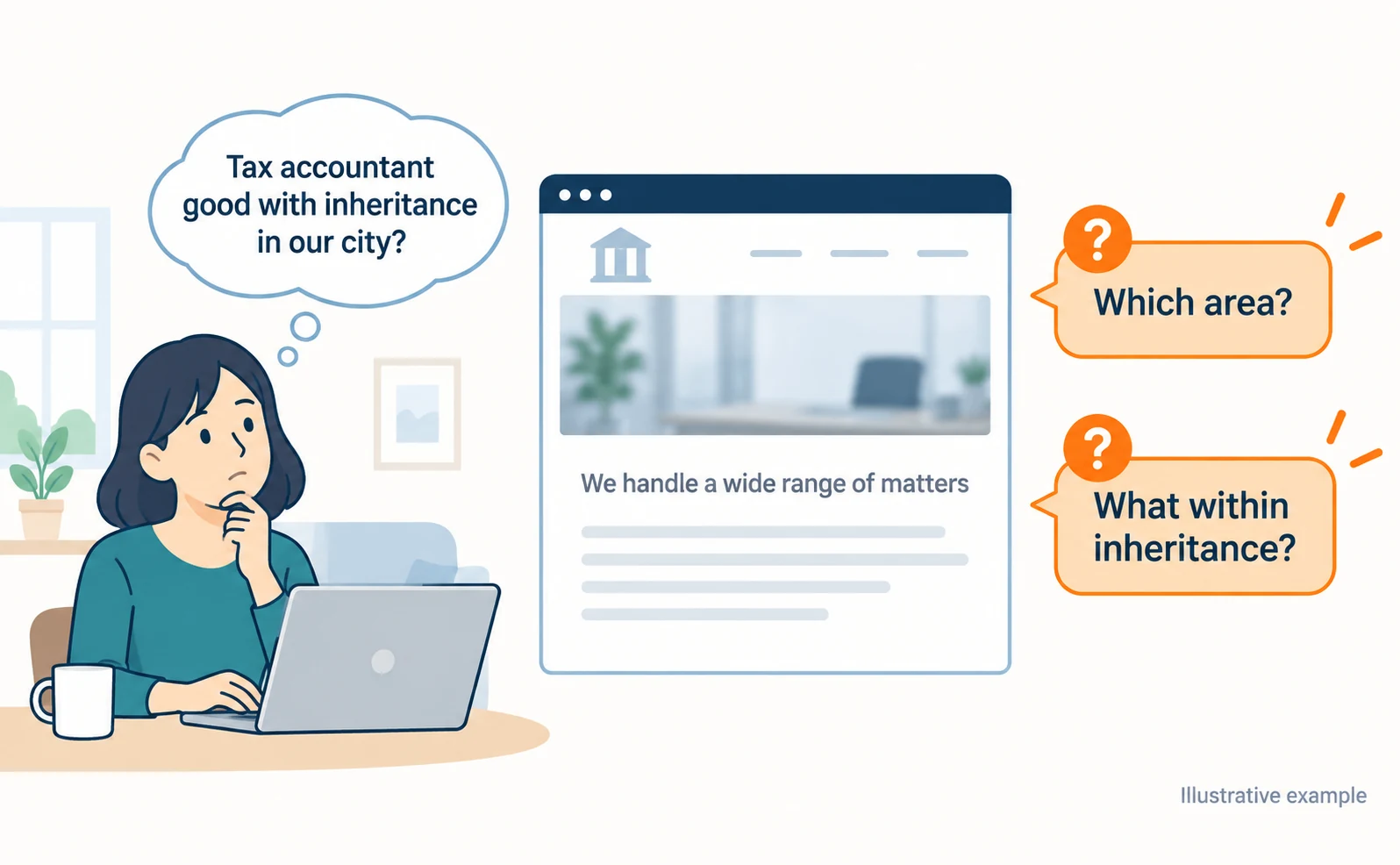
Google says a page must be indexed and eligible to be shown with a snippet to appear in AI features [1]. It also lists making important content available as text among the SEO basics [1].
There may be more than one reason your firm is not mentioned. But reviewing your page text is something your firm can start right away.
| What to check | Where to look |
|---|---|
| Are practice areas specific? | Service pages |
| Service area and online consultations | Home page, firm profile |
| Fee structure | Fees page |
| Staff and track record | Firm introduction, case examples |
State Practice Areas and Service Area in Your Text
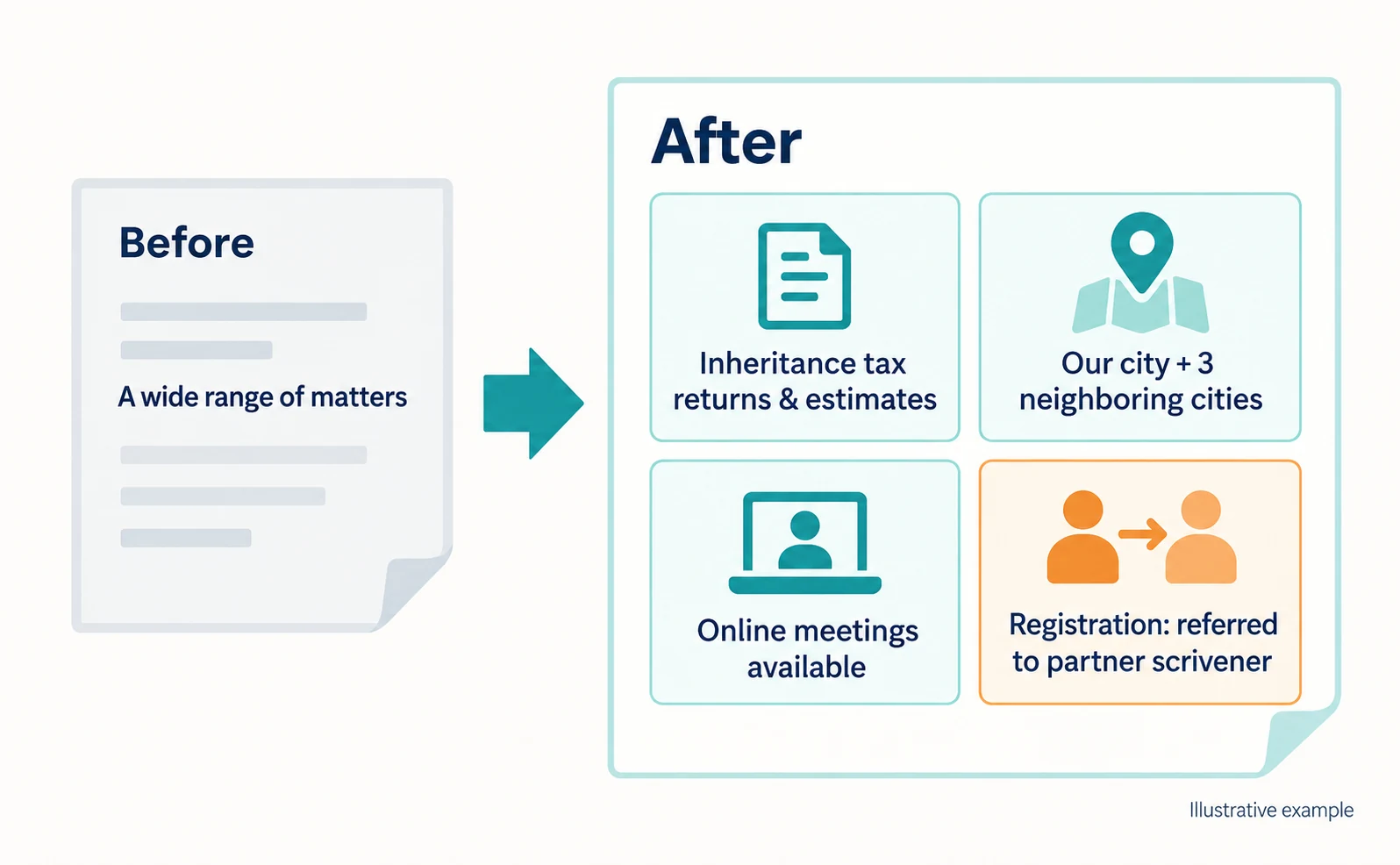
“A wide range of matters” does not tell readers what they can consult you about or who you serve. Put the areas you handle, areas you do not, your service area, and whether you offer online consultations on one readable page.
Here is a rewrite for a fictional tax accounting firm.
- Before: We handle a wide range of matters, including inheritance and business succession. Please feel free to contact us.
- After: We prepare inheritance tax returns and estimate inheritance tax in advance. We serve clients in our city and three neighboring cities. Online meetings are available. For inheritance property registration, we refer clients to a partner judicial scrivener.
With the rewrite, prospective clients can judge whether their matter fits. Stating what you do not handle also reduces inquiries you cannot take.
If you cover several areas, split them into separate pages or use separate headings on one page. Avoid creating many pages with the same content and only the place name changed. Google warns that mass-producing pages for search phrasings, mainly to manipulate rankings, violates its spam policies [5].
Show Your Fee Structure and Consultation Process
Even if you quote fees individually, you can explain what changes the fee, how the first consultation works, and the steps to engagement. With these three points, prospective clients can decide before contacting you.
| Item | Example wording (illustrative) |
|---|---|
| What changes the fee | The value of the estate, the number of heirs, and the number of land parcels |
| First consultation | Free for 60 minutes. You can consult even without all documents |
| Steps to engagement | Consultation → quote → contract after agreement |
| Guide price | If you can publish one, show a price guide with its conditions |
The prices and times in the table are fictional examples. Replace them with your actual terms.
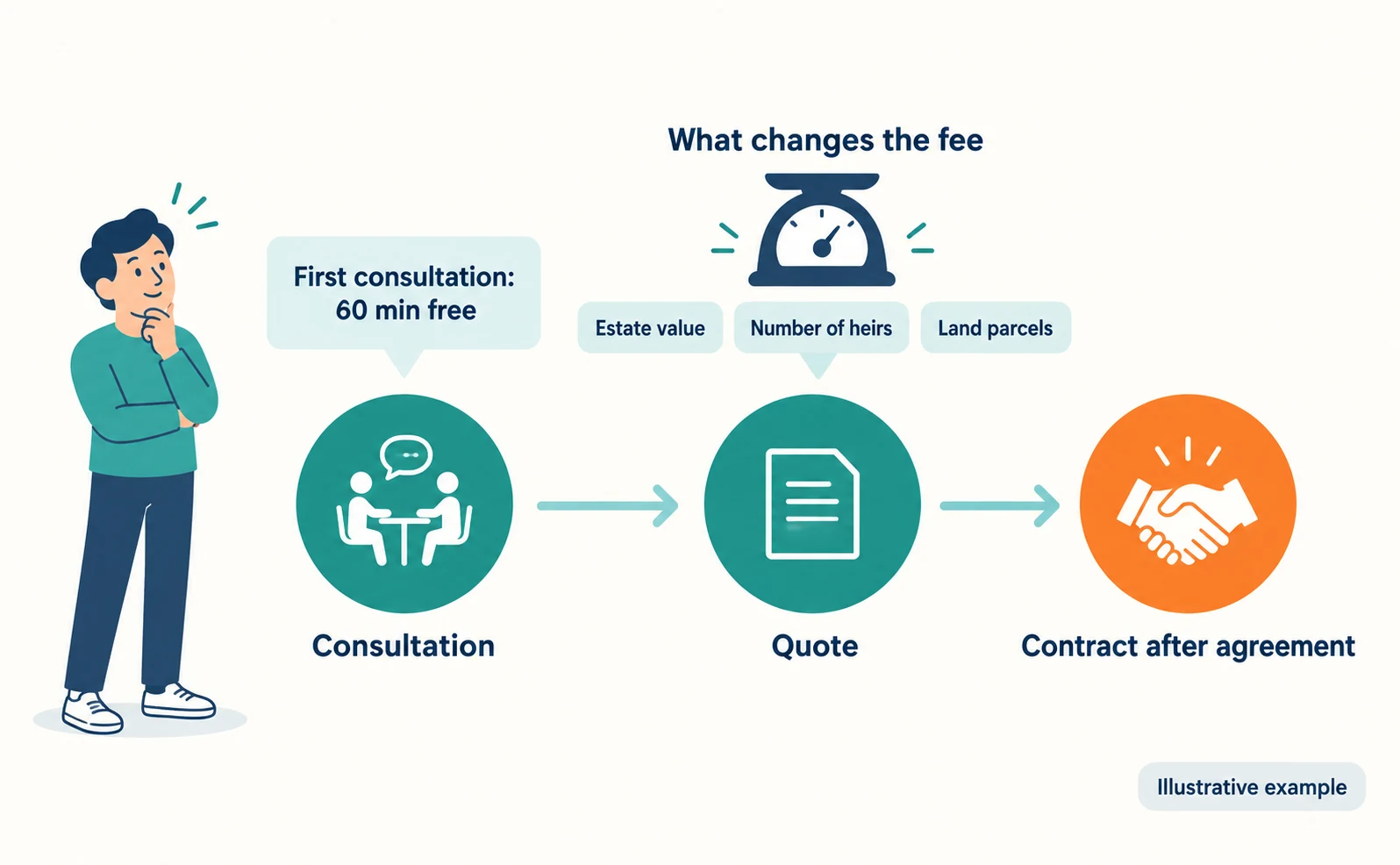
Explaining openly why you cannot state a fixed price makes it easier for people to get in touch. For more on fee pages, see Five Questions Your Pricing Page Should Answer.
Writing About Your Track Record and Advertising Rules
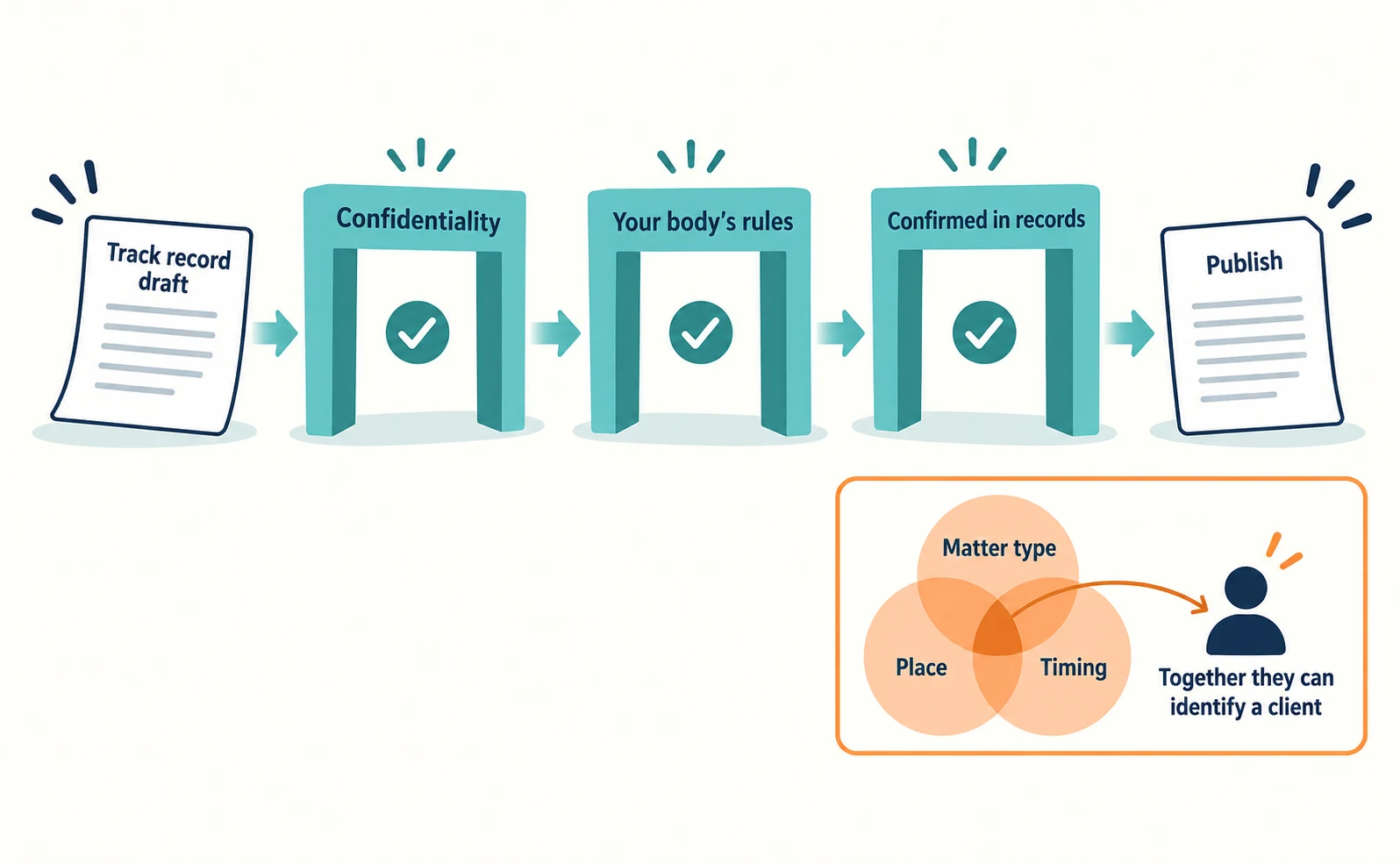
Before publishing your track record or case examples, check your confidentiality obligations and your professional body’s advertising rules. Then write only facts you can confirm from your records, such as numbers and practice areas.
In Japan, each profession has its own body—for lawyers, the Japan Federation of Bar Associations [3]; for tax accountants, the Japan Federation of Certified Public Tax Accountants’ Associations [4]. Check the original text of the rules set by your body or local association to see what you may advertise. This article does not explain the content of those rules.
Assume you will not publish information that could identify a client without their consent. Even a combination of matter type, place, and timing can lead to identification.
For finding article topics in real consultation records, see Where to Find Article Ideas Only Your Business Can Write.
Replace “Highly Experienced” with Specific Facts
Words like “highly experienced” or “proven track record” give neither prospective clients nor AI anything to judge. Replace them with facts you can confirm, such as practice areas, years, qualifications, and staff.
| Vague wording | Replacement example (illustrative) |
|---|---|
| Highly experienced | Has handled inheritance tax returns since 2015 |
| Proven track record | Handled ○ inheritance tax returns in 2025 |
| Handled by experts | In charge: ○○, certified tax accountant |
| Attentive service | After the meeting, we explain the estimate in writing |
If you state a number, confirm how it was counted and for what period using your records. Do not use the examples as they are; check against your professional body’s rules before publishing.
Align Firm Details on Your Site and External Listings
Keep your firm name, address, phone number, and practice areas consistent between your website and external listings such as map services and professional directories. Mismatches make it hard for prospective clients to tell which information is correct.
Google lists keeping your Google Business Profile information up to date among the SEO basics for AI features [1].
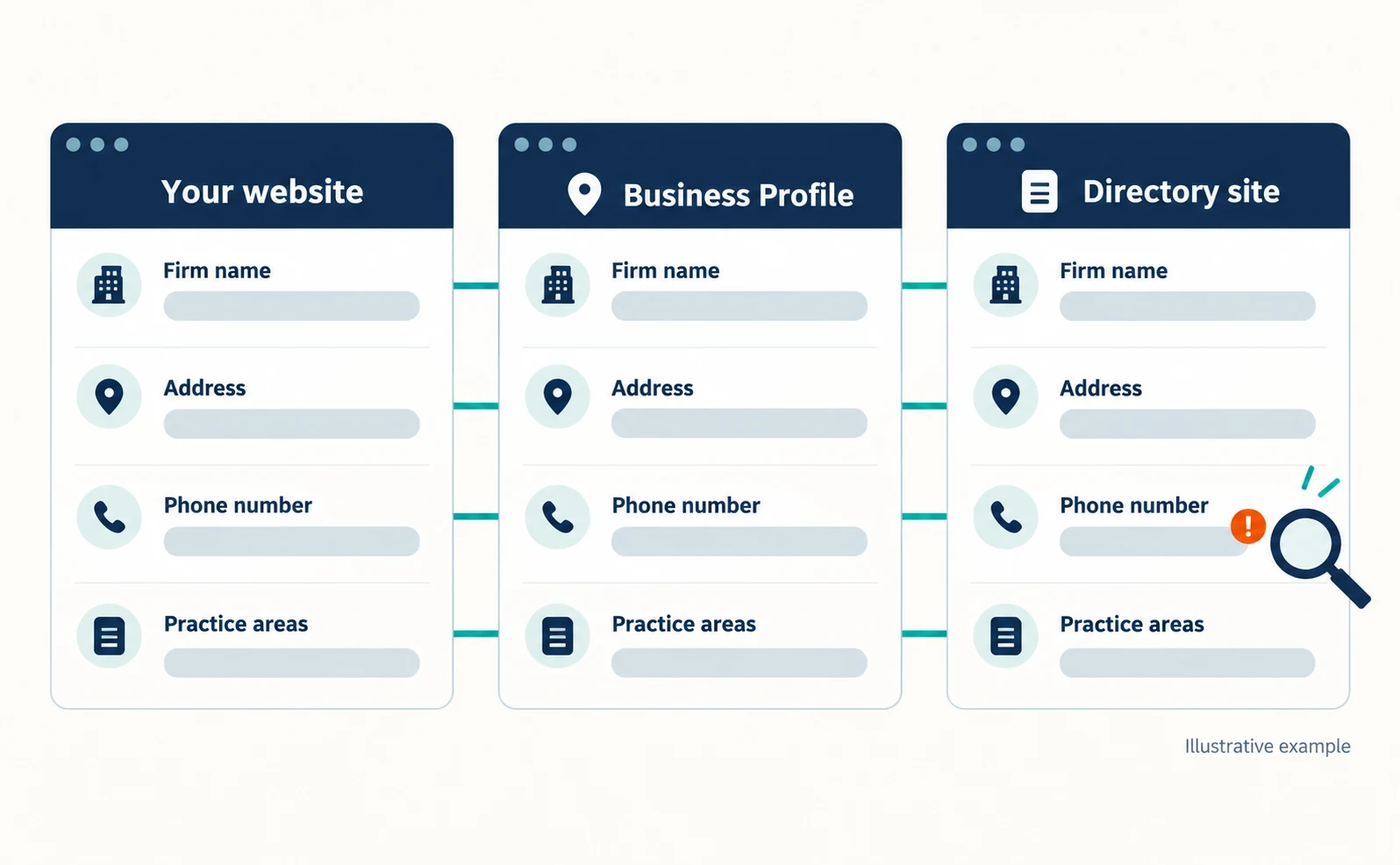
Copy what each listing shows into this checklist and compare.
| Item | Your website | Business Profile | Directory site |
|---|---|---|---|
| Firm name | |||
| Address | |||
| Phone number | |||
| Practice areas | |||
| Hours and online availability |
Structured data is markup that describes a page’s information for search engines [2]. If you use it, keep it consistent with what is visible on the page [2]. However, Google says no special structured data is needed to appear in AI features [1].
For steps to align company details and official links, see How to Align Company Details and Official Links.
Your first step is to open the page for your main practice area and check whether its text covers your scope, service area, and fee conditions.
FAQ
- Q. How can I describe my track record without naming clients?
- Use facts that do not identify clients, such as practice areas, years of experience, counts confirmed from your records, and staff qualifications. Check that matter type, place, and timing together do not identify anyone, and review your professional body’s rules before publishing.
- Q. Will AI skip my firm if fees are not public?
- Google's guidance for its AI features does not list publishing fees as a condition for appearing. However, explaining what changes the fee and how the first consultation works helps prospective clients decide.
- Q. Is structured data required?
- No. Google says no special structured data is needed to appear in AI features. If you use it, keep it consistent with what is visible on the page.
Sources
- [1] AI features and your website (Google Search Central) — accessed 2026-09-23
- [2] Introduction to structured data markup in Google Search (Google Search Central) — accessed 2026-09-23
- [3] Japan Federation of Bar Associations (Japan Federation of Bar Associations) — accessed 2026-09-23
- [4] Japan Federation of Certified Public Tax Accountants’ Associations (Japan Federation of Certified Public Tax Accountants’ Associations) — accessed 2026-09-23
- [5] Optimizing your website for generative AI features on Google Search (Google Search Central) — accessed 2026-09-23
About the author
Shogo MizushimaCEO of kairos Inc. / AgentSignal Developer
Develops AgentSignal, a tool for measuring AI crawler visits and AI-referred traffic, and diagnosing AIO readiness. Writes about measurement and practical improvements for AI search using observed data.
Related articles

AIO and AI search
What Is Organization Structured Data? Aligning Company Details and Official Links
Mistaken for a same-name company, or your site name and authors don’t show correctly? Align your company overview and official links, then describe them with Organization, WebSite and author structured data, and check the results after publishing.
Published
AIO and AI search
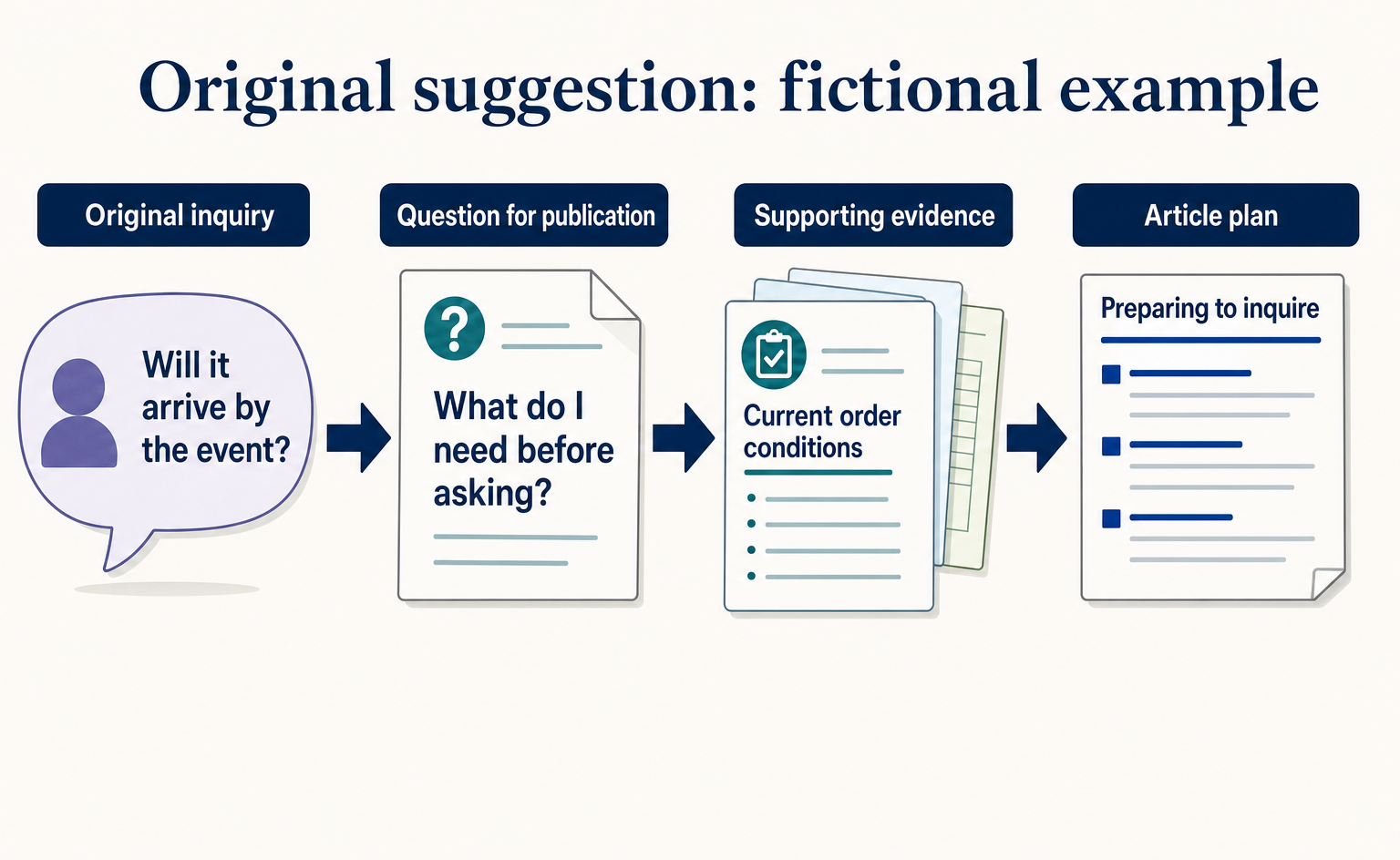
Where to Find Article Ideas Only Your Business Can Write: Start with Customer Inquiries
You do not need original research data to create useful articles. Learn how to turn customer questions, answers, and decision criteria into article plans, with worksheets and fictional before-and-after examples covering anonymization, question grouping, and evidence checks.
Published
Measurement and site improvement
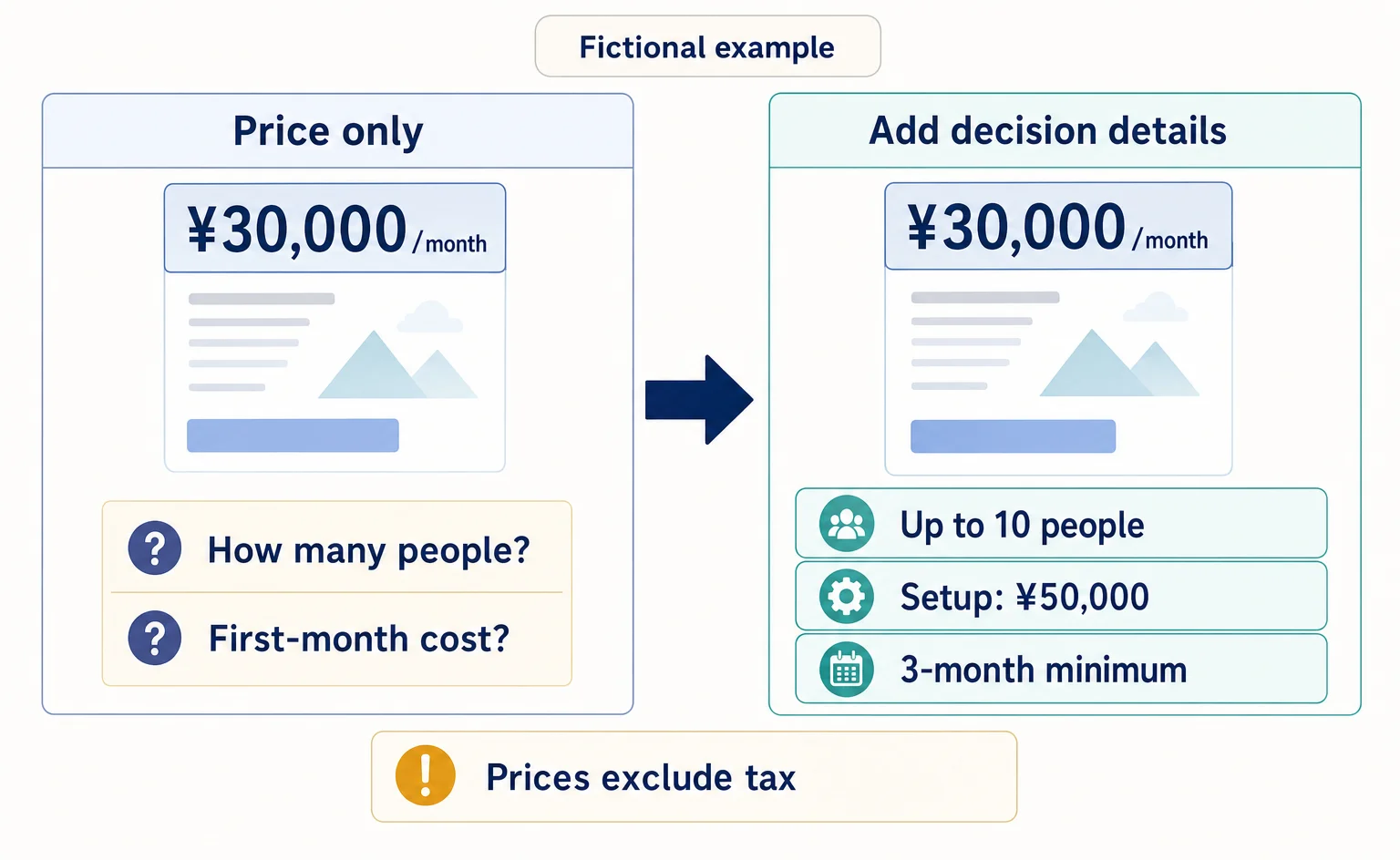
Before Adding More AI-Focused Articles: Five Questions Your Pricing Page Should Answer
Getting visits but few inquiries for your business service? Use this worksheet and a fictional before-and-after example to review what pricing includes, extra charges, cost calculations, contract terms, and what happens after someone applies.
Published