Turn AI Search Research into Content Updates: Lessons from Plaid’s Small Team
Plaid’s two-person search marketing team uses Profound for AI search research and content improvement proposals. Explore the case and AgentSignal’s proposed weekly work plan for turning findings into update candidates, editorial checks, and regular reports.
Plaid, which connects financial apps and other services with data from financial institutions, is featured in a case study in which a two-person team responsible for attracting visitors through search handled work from AI search research to content improvement proposals. AI search means using AI to summarize information in response to questions, with references where needed. The team uses Profound, a service that tracks how companies appear in AI answers and automates related work. The provider’s case study describes its use for page reviews, proposed rewrites, potential frequently asked questions, and regular reports. It also reports increases in AI-referred visits and conversion counts—the number of actions counted as outcomes, such as completed applications.[1]
For small teams, the useful lesson is to connect research to specific pages and assigned tasks rather than stopping at a report. This article uses worked examples to explain how to turn research findings into decisions about what to change, who should check it, and when to review it again.
The work plan and division of responsibilities below are AgentSignal’s own editorial proposals. They are not the tables Plaid used or its internal approval process. This is not a Profound setup guide. It explains a workflow you can consider using with your usual spreadsheet or shared documents.
Reference checked: September 15, 2026. This article is based on the published case study text. Its publication date could not be confirmed from that text, so it is not being treated as breaking news.[1]
Consider research complete when you can write down an update candidate
Here, AI search means using AI to summarize information in response to a question and provide references where needed. Website managers need to check more than whether their company’s name appears. They also need to know whether people considering a purchase or service receive the conditions they need to make a decision.
For example, imagine two people responsible for content about a corporate training service. All services, questions, answers, and terms below are fictional examples for illustration. In practice, replace them with your own products or services and the answers you actually checked.
The example question is: “Can I reschedule a training course I have booked?” Simply recording that the company did not appear in an AI answer does not tell you how to improve the article. Reading your own information page and checking whether it clearly explains the deadline and which courses qualify makes it possible to identify a specific update.
The person doing the research should do more than save the answer. Record three things together: what the reader wants to know, what explanation the page is missing, and what evidence needs checking before an edit. Here, evidence means materials used to verify the correct conditions, such as terms of service or information approved by the person responsible for the product.
| What to record | Fictional example entry |
|---|---|
| Reader’s question | Can I reschedule a training course I have booked? |
| Research record | The illustrative answer dated September 15 did not mention rescheduling conditions |
| Target page | The company website’s “Training Registration Guide” |
| Missing explanation on the page | The rescheduling deadline and excluded courses are unclear |
| Evidence to check | Current course terms and confirmation from the training operations staff |
| Update candidate | Add a rescheduling heading and explain the deadline and eligible courses |
This table does not imply that the AI answer caused the missing explanation. It uses research into AI answers as a prompt to check your own pages for gaps. In the answer-record location, add a link to the record you actually checked. For the target page, enter the address of the relevant page on your website.
Give the two people distinct roles: drafting and deciding whether to publish
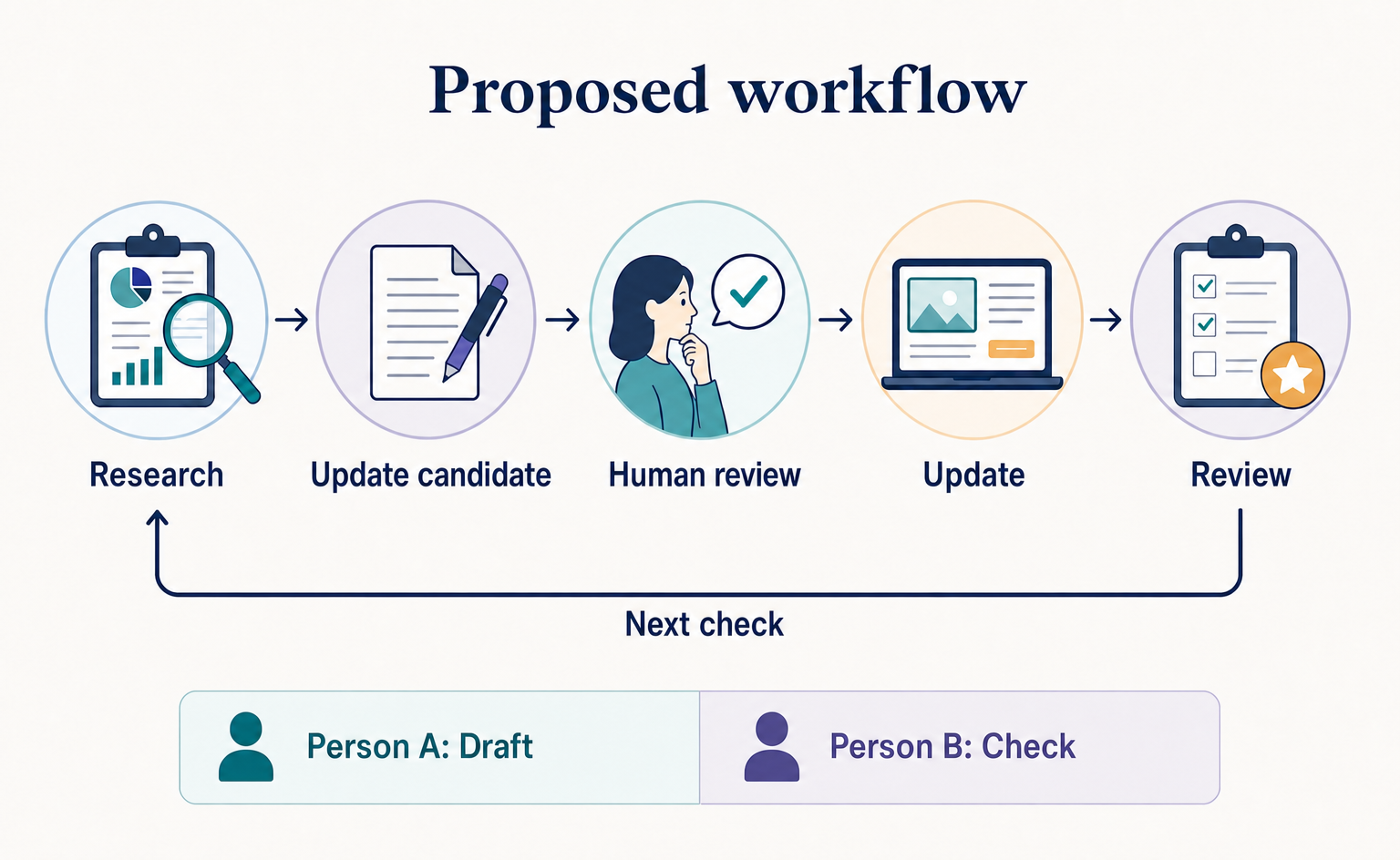
In this proposed workflow, Person A compiles the research and proposed edits, while Person B checks the content and decides whether it can be published. This is not a proposal to make these permanent job roles. The aim is to make clear who drafts and who checks each item, even if they swap roles the following week.
Person A’s job is to present the findings in a form that lets Person B make a decision. Rather than handing over only the full AI answer, specify which text should change and what evidence supports the change. Narrow down the points to check so Person B does not have to repeat the research from scratch.
Alongside readability, Person B checks conditions such as deadlines and eligibility. If neither person can confirm a contractual condition, they ask whoever sets that condition within the company, such as the training operations staff. They should not try to handle everything between themselves when confirmation is needed from someone outside the pair.
Even on days when the same person drafts and checks the text, keep separate columns for those tasks. This prevents “the text is finished” from being confused with “the supporting evidence has been checked.” If the reviewer is unavailable, mark the item as awaiting review rather than setting a publication date first.
Keep this week’s candidates small enough to verify
If there are many candidates, prioritize issues that need correcting first, such as inaccurate service terms. Then choose edits that readers need for their decisions and whose supporting evidence can be checked this week. For example, instead of assigning a rewrite of the entire registration guide, give Person A only the rescheduling explanation.
Do not delete items whose evidence is still unverified. Put them on hold and record whom to ask and what to ask. Limit the number of candidates passed to Person B to what they can review that week. Setting aside a day to clear pending reviews before producing more drafts makes it easier to spot bottlenecks in the work plan.
Plan page improvements and frequently asked questions together
Frequently asked questions, or FAQs, pair questions readers want answered with short responses. In this workflow, adding more FAQ entries is not the goal in itself. First, consider where the answer belongs in the registration guide.
In the fictional example, the rescheduling explanation goes near the registration steps because readers need it to understand what happens after they register. Then decide whether to include the same conditions in a question-and-answer section as well.
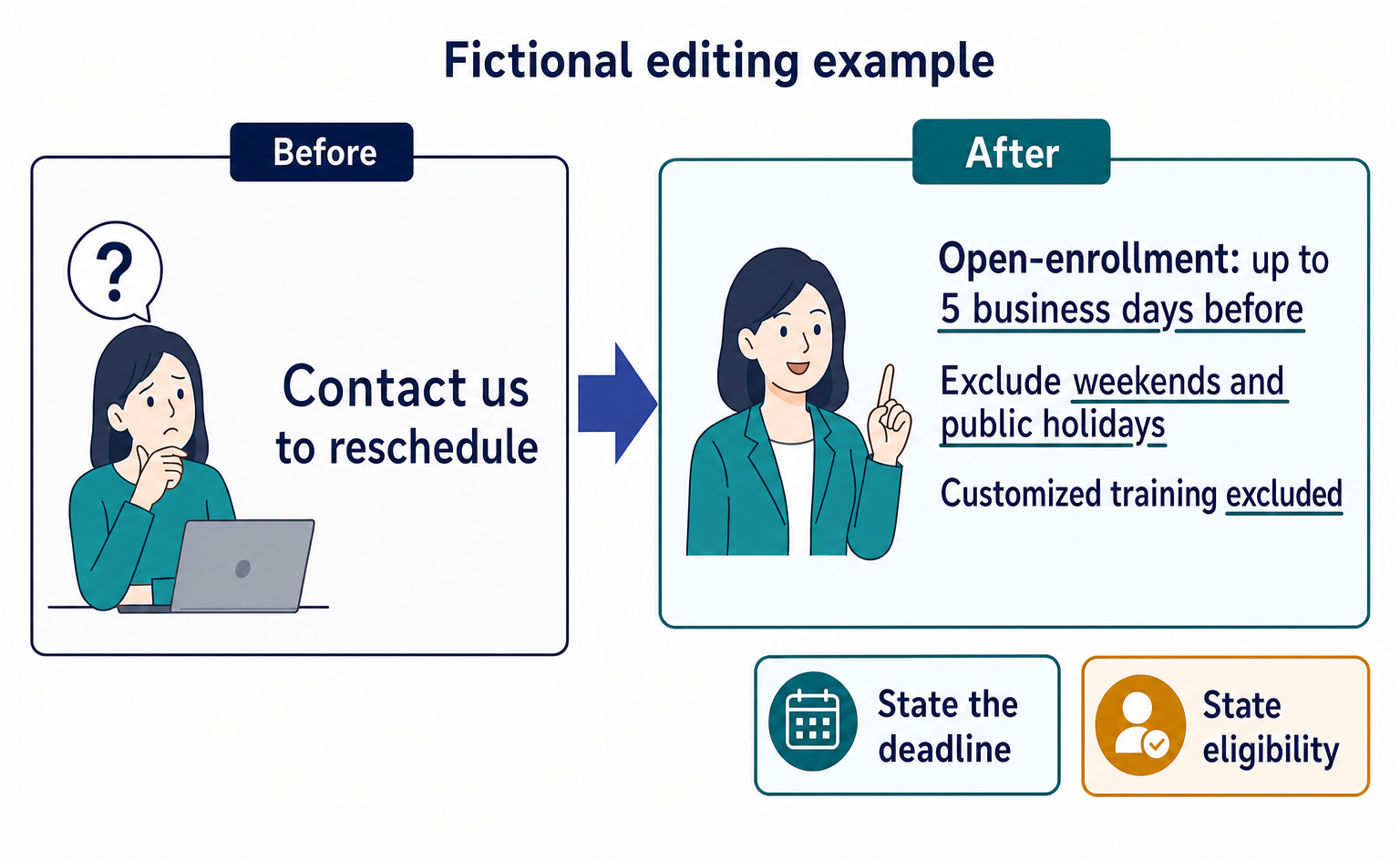
The following table shows illustrative before-and-after wording. “Five business days” is a fictional condition defined here as excluding Saturdays, Sundays, and public holidays. It is not a real service’s policy. When writing your own text, replace it with approved deadlines and exceptions.
| Location | Fictional wording before the edit | Fictional wording after the edit |
|---|---|---|
| Registration guide | Please contact us about rescheduling. | We accept requests to reschedule open-enrollment courses up to five business days before the course date. Saturdays, Sundays, and public holidays do not count. Customized training for individual companies is excluded. |
| Frequently asked questions | Can I reschedule? Please contact us. | Can I reschedule an open-enrollment course? We accept requests up to five business days before the course date. Please use the contact details provided in your registration information. |
The proposed edits let readers determine whether their own booking qualifies. It is important to state not just the deadline but also the different treatment of open-enrollment courses and customized training. However, these rewrites have not been shown to increase mentions in AI answers or registrations.
If you update both the registration guide and the FAQ section, check that the deadlines and eligibility conditions match. If outdated conditions remain in one location, the answer will depend on where someone reads it. Before creating a new article, also consider whether adding information to an existing page would answer the reader’s question.
In human review, check the conditions before polishing the wording
Even when using automatically generated proposals, Person B should first ask, “Are these conditions approved for publication?” Readable text cannot be published if its deadlines or exceptions are wrong. Setting a review order helps avoid polishing an unconfirmed proposal only to redo the work later.
In the fictional example, first check the rescheduling deadline and eligible courses against the course terms. Next, verify that the registration information actually includes the stated contact details. Finally, review whether a first-time reader can understand how the days are counted.
We suggest placing the following review fields alongside the proposed edit. “Checked” means the supporting evidence has been verified; “Awaiting confirmation” means a response is needed from the person being consulted. Do not interpret a blank field as approval.
| What to check | Fictional example entry | Status |
|---|---|---|
| Do the deadline and eligible courses match the terms? | Person B checked against the current terms | Checked |
| Does the stated contact point exist? | Awaiting a response from training operations staff | Awaiting confirmation |
| Do conditions match across pages? | Registration guide and FAQ section compared | Checked |
| Can this be published? | Review again once the contact point is confirmed | On hold |
In this example, publication remains on hold even though the text is finished. The next task is not another rewrite: Person A needs to verify the listed contact details. Rather than writing only “awaiting confirmation” in the work plan, record what is pending and who will check it.
Use the weekly work plan to decide next week’s tasks too
In the weekly meeting, focus on how far each item has progressed rather than reading out a list of problems found. Below is a fictional example of moving the same rescheduling item forward over one week. The weekdays are part of the proposed workflow; there is no requirement to publish on this schedule every week.
| Day | Owner | Record to add or task to complete | Condition for moving forward |
|---|---|---|---|
| Monday | A | Save the question and answer record, and describe the gap in the registration guide | Target page and missing information identified |
| Tuesday | A | Draft edits to the rescheduling explanation and FAQ section | Proposal passed to B with supporting materials |
| Wednesday | B | Check the terms, contact point, and consistency across pages | No unverified points remain |
| Thursday | A | Apply the approved wording and reread the published page | Wording and contact destination match the approval |
| Friday | A and B | Record the updates, items on hold, and next review date | Next week’s assigned tasks decided |
If the contact point has not been confirmed by Wednesday, do not make the update on Thursday. On Friday, record the reason for the hold and who will follow up on the response. The table should show not only whether publication happened on schedule but also what blocked progress.
The report can also use a short, consistent format. For this fictional example: “Added the rescheduling deadline and eligible courses to the registration guide. Updated the FAQ section to match. Next time, check answers and references for the same set of questions. Impact on visits not yet assessed.” It is important not to combine confirmed changes and still-unknown results in a single sentence.
Report completed updates separately from changes in AI answers
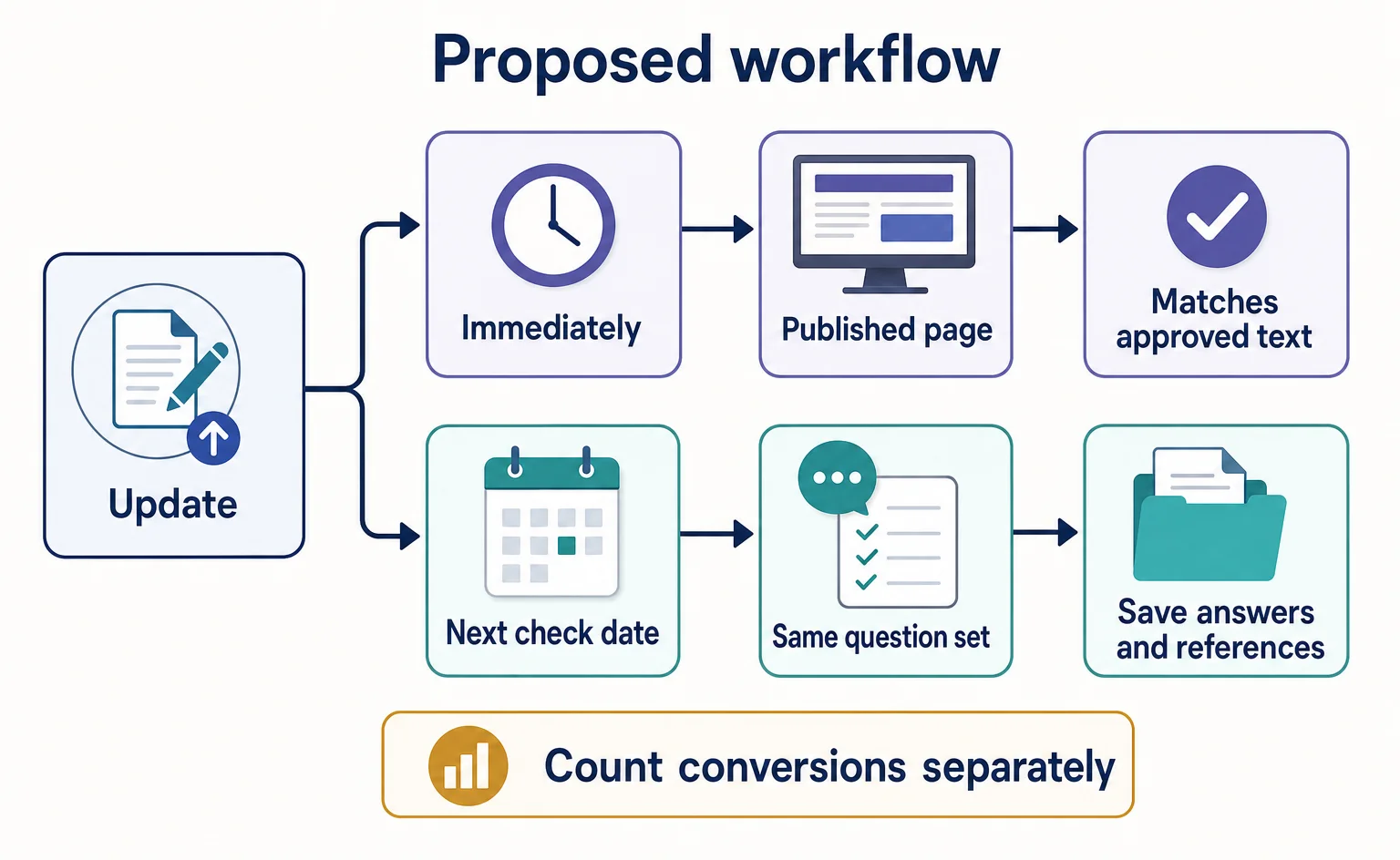
Immediately after an update, check whether the approved wording appears on your own page. Treat any change in AI answers as a separate check. In this workflow, do not treat a single answer as the final result. Set dates to check the same set of questions repeatedly.
In the fictional example, the ongoing questions are “Can I reschedule a training course?”, “What is the deadline for rescheduling?”, and “Does this also apply to customized training?” Record the question wording, the AI service used, the date checked, and where the answer and references are saved. If you change a question or the service, record that change too.
For report readers, distinguish between the company being mentioned in an answer, someone visiting through a link, and someone completing a registration or another action. A conversion count is the number of actions you have chosen to count, such as completed registrations. When making comparisons for your own business, keep the definition of one conversion fixed and do not mix counts with rates or revenue.
Plaid’s results are a self-reported case study published by the service provider. The official page does not establish the definition of a conversion, the comparison period, or the starting count. The work-time comparisons also include staff estimates; this was not an independent experiment.[1]
If you also want to examine visits and conversion counts, you need consistent measurement conditions separate from the research and editing work plan.
For a small team starting out, focus first on one existing page and connect the research record to a proposed edit, review, publication, and follow-up check. The useful output is not a large pile of drafts. It is a page updated after its supporting evidence was checked, plus clear assignments for the next review. If many items are awaiting confirmation, do not add more proposals. Start the next week by addressing the reasons work has stalled.

Official guides for your own checks
For your own checks, Google explains eligibility for its AI search features[2] and how to review Search impressions and clicks in Search Console[3]. The company’s results in this article come from source[1]; Google’s guides do not verify those results.
FAQ
- Q. Is the weekly work plan in this article the one Plaid uses?
- No. It is AgentSignal’s own editorial proposal. The official announcement confirms Plaid’s use of the service for research, page improvement proposals, potential questions, report creation, and related work.[1]
- Q. Does Plaid’s increase in conversion counts mean revenue increased?
- An increase in revenue cannot be confirmed. The official page does not make clear what was counted as one conversion, so the reported count should not be interpreted as revenue or a conversion rate.[1]
- Q. Can I use Plaid’s work-time comparison to plan my own schedule?
- Not as a guarantee of how long the work will take. The case study’s comparison includes staff estimates and is not the result of an independent experiment. For your own planning, separate research, drafting, and time spent awaiting review.[1]
Sources
- [1] How Plaid grew Answer Engine referral traffic 300% with Profound (Profound) — accessed 2026-09-15
- [2] AI Features and Your Website | Google Search Central | Documentation | Google for Developers (Google) — accessed 2026-09-15
- [3] How To Use Search Console | Google Search Central | Documentation | Google for Developers (Google) — accessed 2026-09-15
About the author
Shogo MizushimaCEO of kairos Inc. / AgentSignal Developer
Develops AgentSignal, a tool for measuring AI crawler visits and AI-referred traffic, and diagnosing AIO readiness. Writes about measurement and practical improvements for AI search using observed data.
Related articles
AIO and AI search
What Is LLMO? How It Differs from SEO and Why Some Say It Is Pointless
LLMO is the work of helping answers from ChatGPT and other AI find and accurately describe your company. Learn how it differs from SEO, why some call it pointless, how E-E-A-T relates, how to measure results and what to do in the first month.
Published
AIO and AI search
Where to Find Article Ideas Only Your Business Can Write: Start with Customer Inquiries
You do not need original research data to create useful articles. Learn how to turn customer questions, answers, and decision criteria into article plans, with worksheets and fictional before-and-after examples covering anonymization, question grouping, and evidence checks.
Published

Case studies and research
Claude and ElevenLabs: connect MCP for images, voice and video
Set up ElevenLabs MCP in Claude, prepare images, footage, narration and music, then finish in Studio. Includes connection commands and output checks.
Published