AI Help for Shopping Stalled at Payment: Cashfree’s Proposed Use Case
Cashfree’s GFF 2026 page describes voice AI contacting shoppers after payment failures. This article separates that use case from confirmed availability and results, and explains the information, example guidance, and conditions ecommerce managers should review.
Payment service provider Cashfree describes a use case on its GFF 2026 information page in which voice AI calls shoppers after a payment failure to help them complete payment. However, the official source does not provide results, such as how many payments were completed after receiving support.[1]
This use case concerns shopping that stalls at payment after the customer has chosen a product. For ecommerce managers looking to reduce checkout abandonment, this article explains where AI assistance might be useful and what stores should check first. It is an explanation to support evaluation, not an implementation guide for stores in Japan to start using the service immediately.
Source review date: September 15, 2026. The evidence is the official page. The actual management interface, calls, and payment processing have not been checked.
Resolve Uncertainty After a Payment Attempt, Rather Than Recommend Products
The question for payment support is not “What should I buy?” but “What should I do next after trying to buy it?” Voice AI is artificial intelligence that conducts spoken conversations. It is easier to understand this use case if you think of it as a contact point where shoppers can explain their situation and receive guidance.
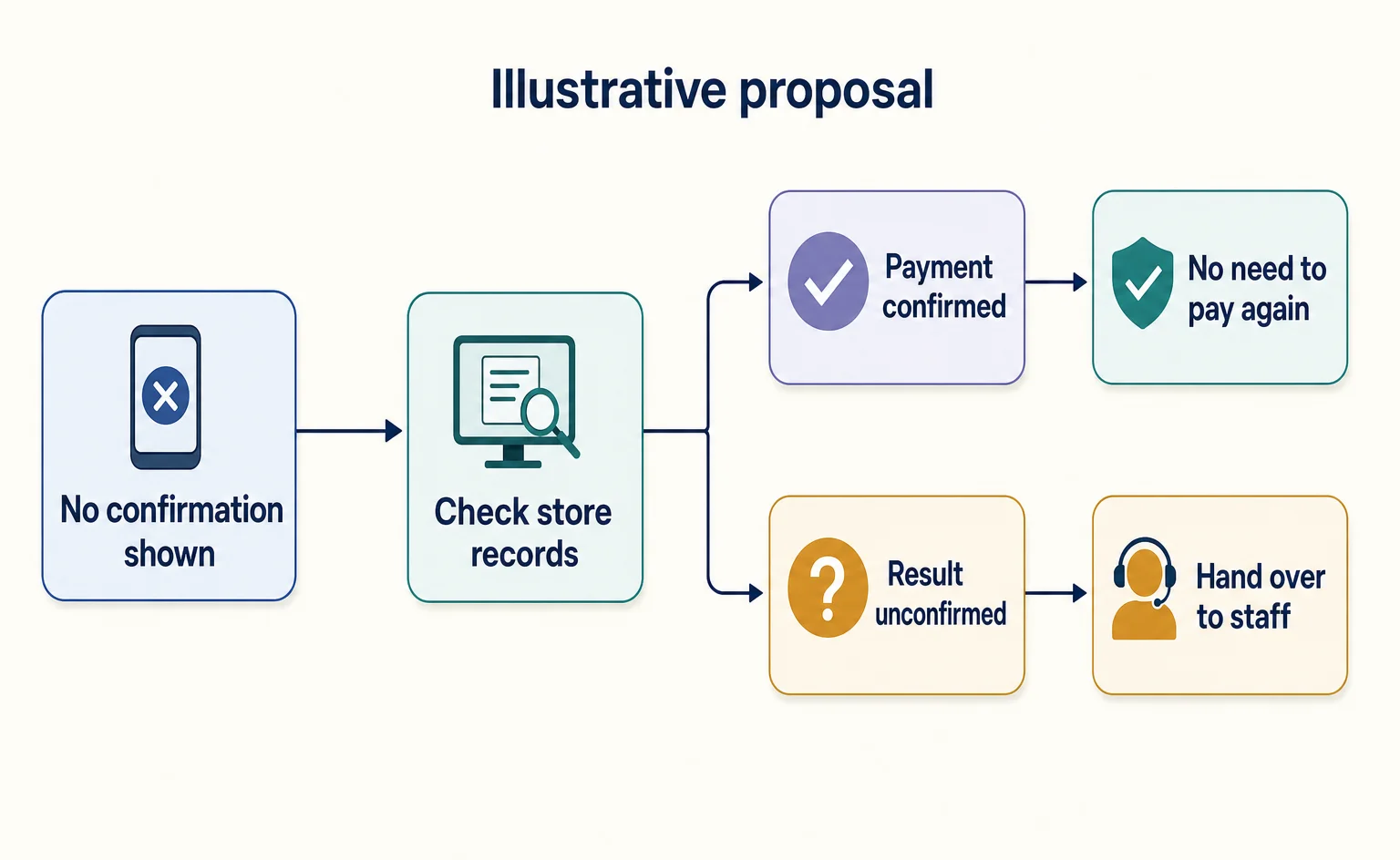
For example, suppose someone tries to buy an electric kettle from an online home goods store but cannot find a confirmation message after making a payment. The shopper does not know whether to pay again or wait a while. Even if they contact the store, they may be unsure what information to provide.
Useful support in this situation does not mean immediately encouraging another purchase. It means checking the payment status available to the store and explaining what the shopper can do next. If shoppers can get the guidance they need without waiting for a staff member, it could reduce their waiting time and the work staff must do to gather the details from scratch.
The electric kettle scenario, worksheet, sample guidance, and figures below are all editorial proposals created for this article. They are not operations carried out by Cashfree or verified product specifications.
What Cashfree’s Page Describes
The official page calls its set of AI-based payment-related capabilities the “Cashfree Agentic Stack.” Within that set, “AGENTS THAT RECOVER” refers to a role focused on recovering failed payments: voice AI calls immediately after a payment failure to help the shopper complete payment. This is the company’s description of a capability; this article has not tested how it works or how effective it is.[1]
When reading the announcement, it is important to distinguish between AI making contact and AI being able to check payment status correctly. Even if it can explain things clearly over the phone, without access to order information it cannot determine whether its guidance fits that particular purchase. Stores considering adoption should look beyond how natural the voice sounds and examine the information on which the guidance would be based.
In the electric kettle example, the same report—“I can’t see a confirmation message”—requires different answers depending on whether the store can confirm that payment is complete or still does not know the result. In the first case, guidance confirming completion may be appropriate. In the second, the store should first establish a policy not to recommend another payment while the result remains unconfirmed.
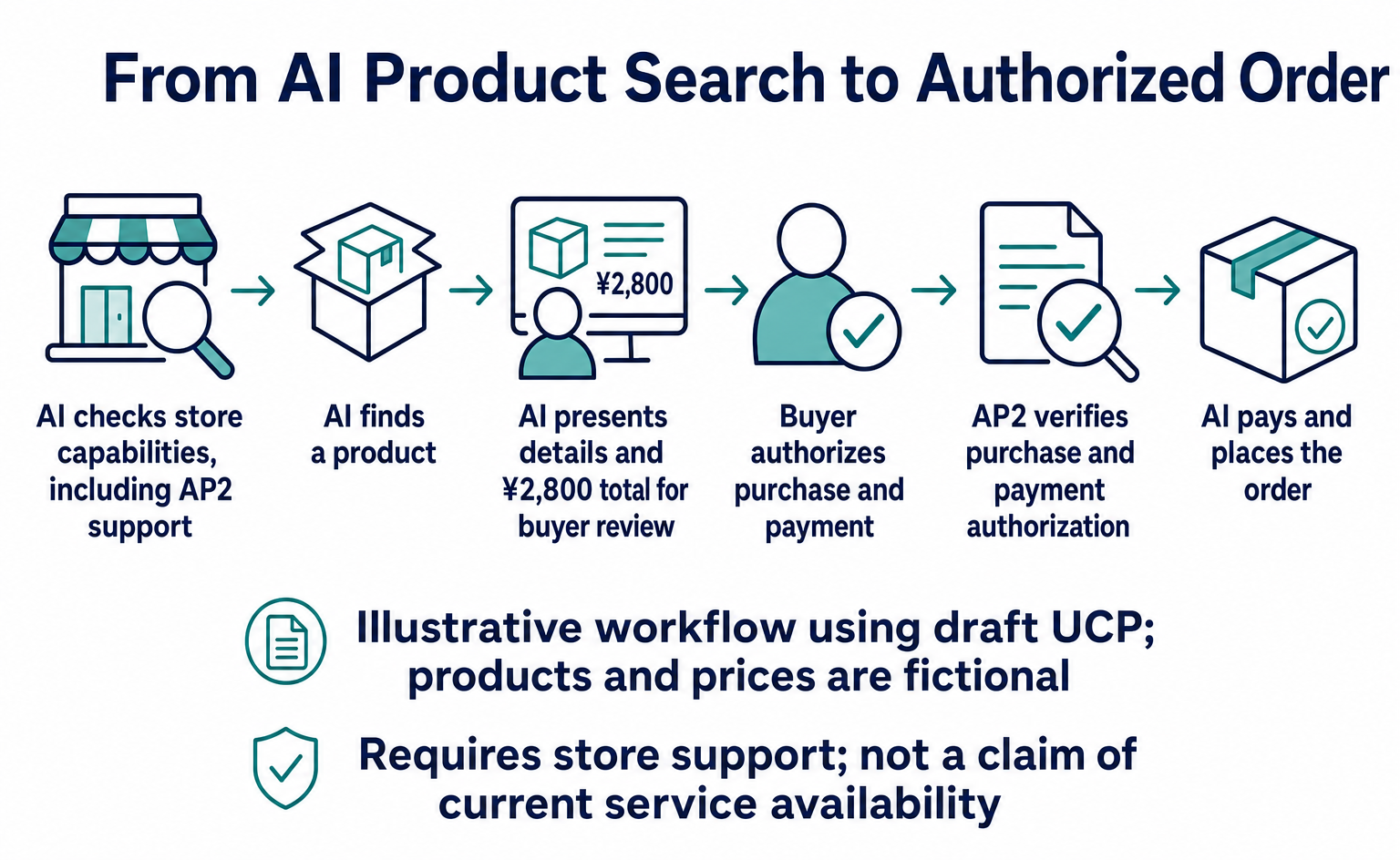
The AI role discussed here is guidance that helps move a stalled purchase forward. This raises different questions from deciding the extent to which a shopper authorizes AI to make purchases. The following article covers systems for recording purchase authorization.
Stores Need Information That Can Support the Guidance
The first decisions are which information AI may access and what it may tell the shopper. Rather than starting with conversational wording, prepare a mapping of “this status means this guidance.” This lets you assess the process without allowing natural-sounding conversation to hide gaps in information.
The following table is a fictional completed worksheet based on the electric kettle purchase. It is intended as an example of a meeting document filled out by the store’s ecommerce manager and the person responsible for payment operations. “Records to consult” means the information used as the basis for guidance, while “conditions for guidance” means the circumstances in which a particular explanation may be given.
| What to check | Fictional entry | Conditions for guidance and response if information is missing |
|---|---|---|
| Which purchase is involved? | A reference number identifying the electric kettle order | Do not disclose a specific payment status if the purchase cannot be identified |
| What happened to the payment? | The payment record says “Result unconfirmed” | Do not state that it succeeded or failed; hand over to a staff member |
| Was an order created? | The purchase appears in the store’s order records | Check whether it matches the payment record |
| How current is the information? | Enter the time the status was last checked | If the information is old, check again before giving guidance |
| Is contact permitted? | Record whether permission to contact the shopper for this support has been confirmed | If permission cannot be confirmed, do not include the shopper in automated calls |
| When should a person take over? | When payment and order records conflict | Pass on the conflicting fields and the information already confirmed |
A reference number is a number the store uses to distinguish individual orders. During evaluation, do not search for a fictional number as though it were a real order; instead, check the types of numbers your company uses. The status names in the table are also illustrative and may not appear in Cashfree’s interface or your own.
“Payment” and “order” are separate rows to make the policy of checking both explicit. In this example, the store also checks its order records before asking the shopper to take another action. If it is not possible to decide which record should take priority, leave that judgment to a staff member rather than asking AI to infer a conclusion.
The design should also avoid collecting information that is unnecessary for the support. For example, the proposed policy would reject asking shoppers to read out their full card number or PIN and other secret authentication details to begin a conversation, and would instead require a separate review of identity verification methods. This is an operational proposal in this article, not a statement that the provider’s formal integration requirements or security have been verified.
Do Not Start the Guidance with “Pay Again”
The proposed improvements to the guidance put the shopper’s immediate question first. In the electric kettle example, that question is “Has my payment gone through?” Before recommending another payment method, distinguish between what is known and what is still unknown.
The following before-and-after examples are illustrative, not actual call transcripts. “After” refers to a proposed guidance design, not demonstrated improvement in payment completion rates.
| Situation | Before: example wording | After: proposed wording |
|---|---|---|
| Payment result is unconfirmed | Your payment failed. Please try again. | We cannot currently confirm the payment result. A staff member will check the status before you try again. |
| The store has confirmed payment completion | Please continue with your purchase. | We have confirmed that payment for this order is complete. You do not need to pay again. |
| The shopper declines support | You can continue using another payment method. | Understood. We’ll stop offering payment assistance now. |
The proposed changes avoid calling an unconfirmed result a failure, do not request another payment if it is already complete, and stop the guidance when the shopper declines. These are policies for avoiding unnecessary actions by shoppers, not for increasing the number of connected calls.
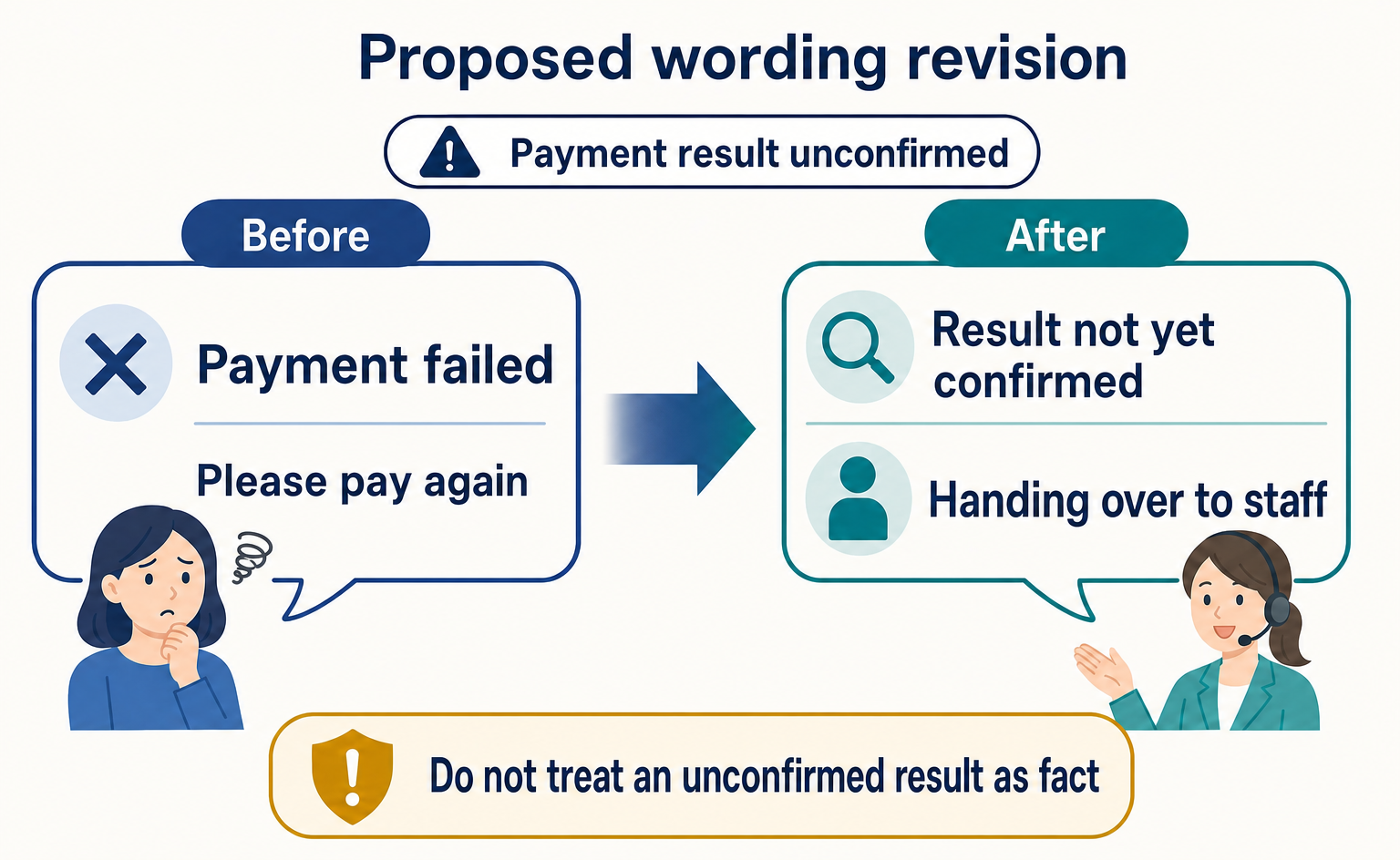
When handing over to a person, simply saying “Please speak to a staff member for details” leaves the shopper having to repeat the same explanation. In this example, one design option is to pass along the order involved, the payment status checked, and the unresolved questions. If there is also a record of what AI told the shopper, the staff member can more easily decide how to continue the conversation.
If the shopper says during the call that they no longer want to make the purchase, stop guiding them toward completing payment. However, the proposed policy treats ending guidance and processing an order cancellation as separate actions. Decide in advance which actions will actually be performed so that shoppers do not mistakenly think their order has been canceled merely because AI stopped the guidance.
Assess Usefulness Separately at Each Stage, from Contact to Completion
It is also worth planning in advance how to evaluate the support after adoption. This article proposes recording separately whether the call connected, whether the shopper wanted guidance, and whether payment completion was confirmed. Combining these into a single “success” measure would make it unclear at which stage the support helped.
For example, consider a call that connects when the shopper has already paid using another method. The measurement design should not count that contact as “payment completed with AI support.” Keeping separate records of the payment status before contact and after support provides a basis for judgment.
Initial checks should examine whether the guidance works as intended and whether the handover conditions are followed. During continued use, compare results using consistent evaluation periods and criteria for eligible purchases, including the number of shoppers who declined support and any discrepancies in records. This approach avoids concluding from a single call check that the system can reduce abandonment.
Even if payment completions increase, record any changes made to the payment screen or payment methods during the same period. To judge whether the change came from AI guidance alone, the comparison needs to account for other changes. Deciding before a trial “What would we need to confirm before considering continued use?” helps prevent the decision from being driven solely by large counts.
Check Launch Status Separately from Eligibility for Stores in Japan
The official page lists the event dates as September 9–11, 2026. Meanwhile, some capability descriptions still carry a “COMING SOON” notice. The official page does not establish the general availability date for individual capabilities, supported regions, Japanese-language support, pricing, or where to apply to use them.[1]
For that reason, this article does not present the information as breaking news as of September 15 or as a service that stores in Japan can use immediately. For a future availability check, the reference is Cashfree’s official GFF 2026 page (event and capability overview). This link has not been verified as a place to apply for the service.[1]
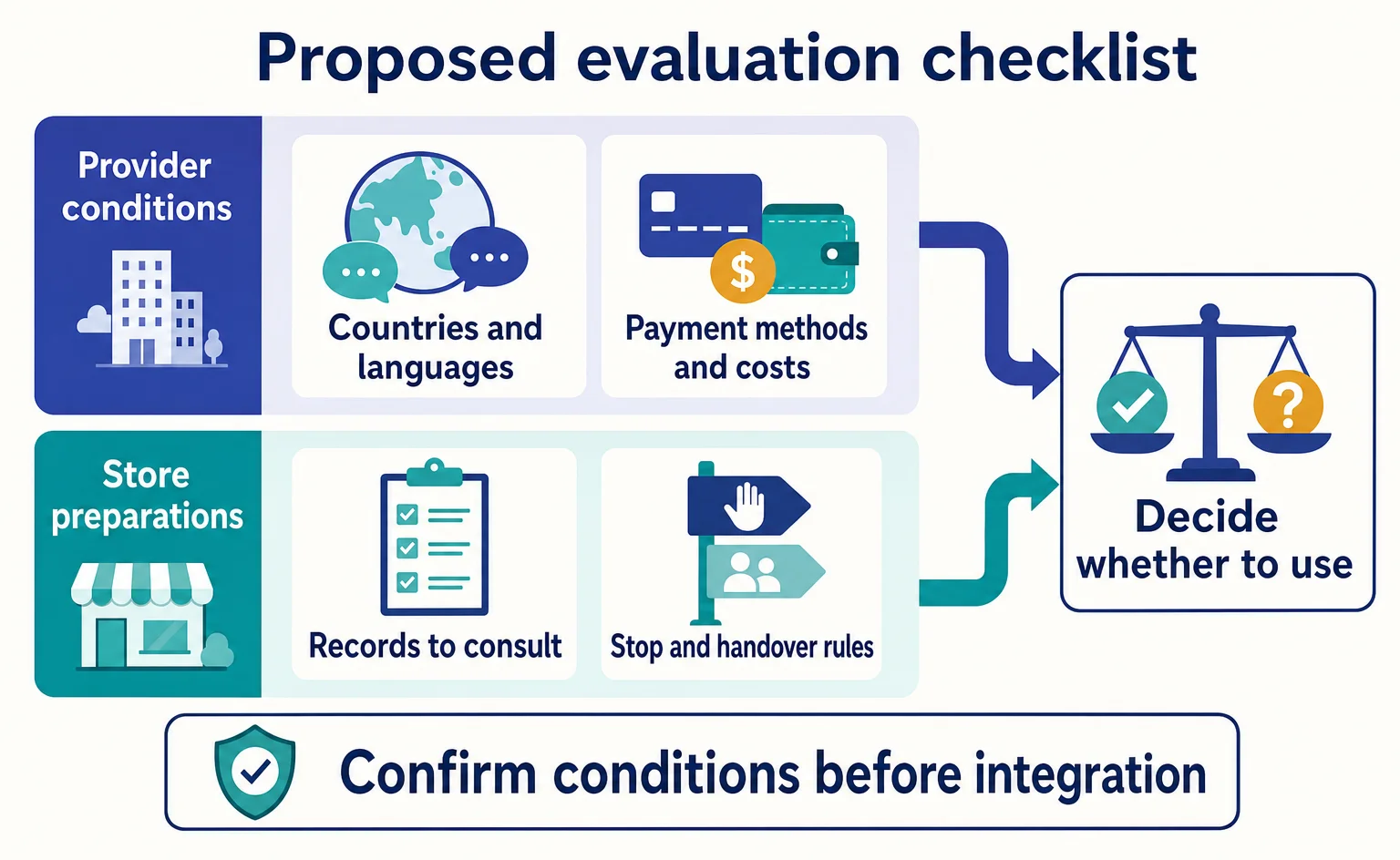
What ecommerce managers can do now is choose one situation in their own business where shoppers need payment guidance. As in the electric kettle example, document the display that confuses the shopper, the records the store can check, and the questions only a staff member can resolve. At this stage, the task is to organize the types of information and the guidance policy without sending customers’ personal information outside the company.
When deciding whether to use the service, separate conditions to confirm with the provider from decisions to make within the store. Provider questions include supported countries, payment methods, languages, systems available for integration, how consent to contact is handled, and costs. Internal decisions include which purchases to cover, which statuses should stop the guidance, and who should receive handovers.
Until the formal terms of availability are known, it may not be possible to proceed with automated calls or payment integration settings. However, you can assess whether your company can confirm payment status and whether its guidance to shoppers is overly definitive, independently of whether you adopt the product. To make use of Cashfree’s description in your own business, treat it as a starting point for deciding what evidence should support guidance for a stalled purchase, rather than focusing on AI making contact in itself.
Official guides for your own checks
For conventional payment integrations, Cashfree provides notifications for successful payments, failed payments, and user drop-offs.[2] These are webhooks: automatic messages sent to another system when something happens. Its documentation also explains verifying their signatures to authenticate the messages.[3] This is a concrete way to distinguish an AI saying a payment succeeded from the store checking the payment result. Public payment APIs do not establish general availability of the AI feature discussed here or eligibility for merchants in Japan.
FAQ
- Q. What AI use case does Cashfree describe?
- It describes voice AI calling shoppers immediately after a payment failure to help them complete payment. This article has not tested the actual operation.[1]
- Q. Can online stores in Japan apply right now?
- The supplied page text does not establish eligibility for stores in Japan, supported regions, or where to apply for individual capabilities. It also provides no basis for concluding that they are unavailable.[1]
- Q. Are there results showing fewer payment failures or less abandonment?
- The official announcement does not report the number of payments completed after support or rates of improvement. This article does not treat the capability description as evidence of verified effectiveness.[1]
- Q. Are the tables and sample guidance Cashfree’s official specifications?
- No. They are illustrative editorial proposals created for this article. The article distinguishes the use case described in the official material from the information and guidance examples stores can consider.[1]
Sources
- [1] Global Fintech Fest - GFF 2026 | Cashfree Payments (Cashfree Payments) — accessed 2026-09-15
- [2] Payment Status Events | Cashfree (Cashfree Payments) — accessed 2026-09-15
- [3] Payment Webhook Setup | Cashfree (Cashfree Payments) — accessed 2026-09-15
About the author
Shogo MizushimaCEO of kairos Inc. / AgentSignal Developer
Develops AgentSignal, a tool for measuring AI crawler visits and AI-referred traffic, and diagnosing AIO readiness. Writes about measurement and practical improvements for AI search using observed data.
Related articles
AI shopping and booking
From Product Comparison to In-Chat Checkout: What Does Salesforce’s Carter Do?
Explore Salesforce’s shopping AI, Carter, through a fictional commuter-bag example. Separate product discovery, questions, checkout, and store-side processing, and see what ecommerce managers in Japan need to confirm before adoption.
Published
Measurement and site improvement
How to Fix Contact Forms That Leave Customers Thinking They Have Submitted
Learn how to tell customers what to enter, how to fix errors, and whether their inquiry was received. Original before-and-after examples and review tables help you check each step from clicking Submit to confirmed receipt.
Published
AI shopping and booking
51% of US consumers use AI shopping tools. How much has product selection changed?
That does not mean AI placed 51% of orders. It is the share of US consumers who reported using at least one AI-powered shopping tool during the past month.
Published