AIO Case Studies: What Changed and What Happened
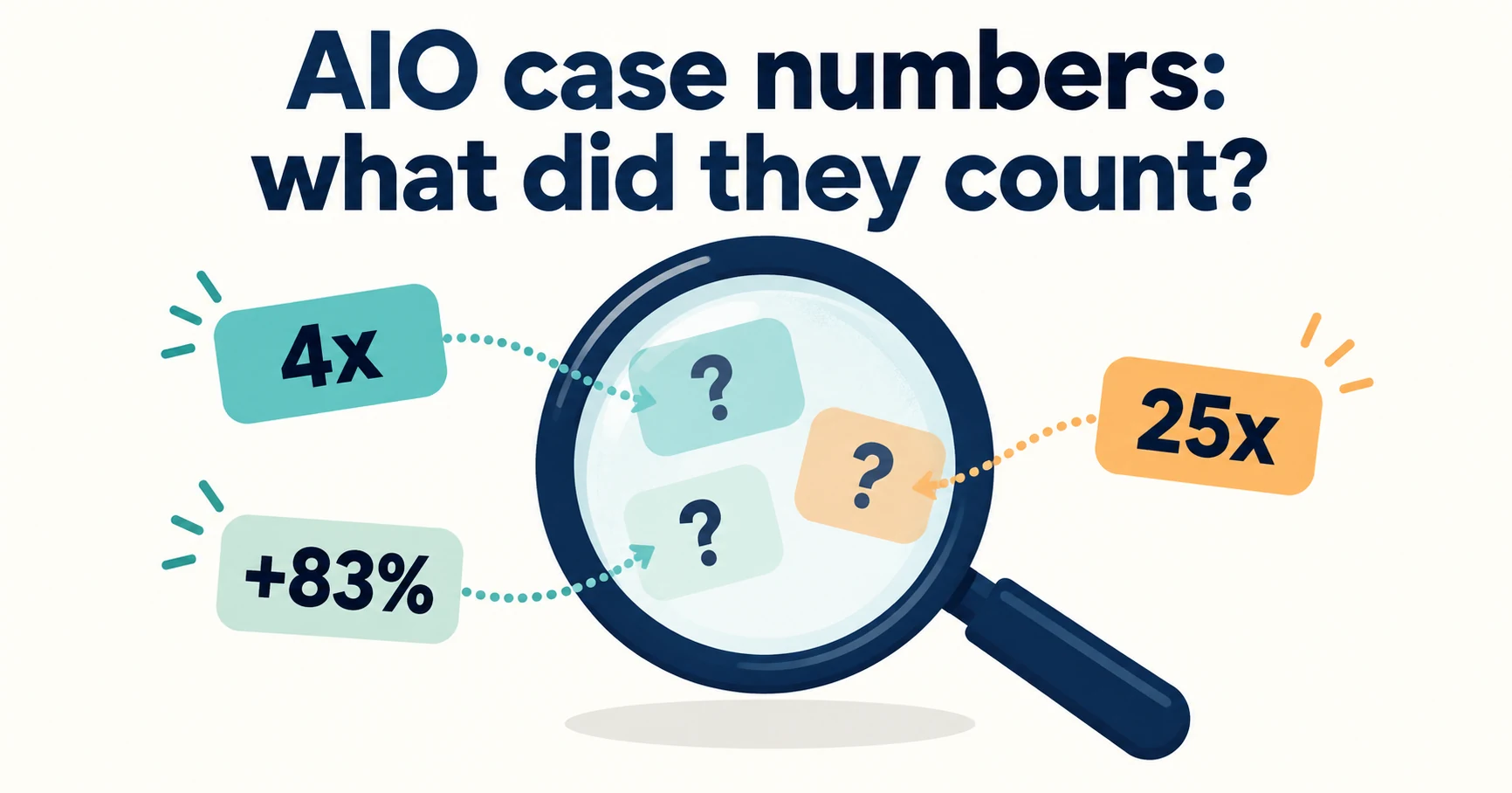
Compare AIO case studies by what was changed, what was counted and who reported it. This list keeps revenue, inquiries and customer counts apart so you can choose which actions to try yourself.
AIO means preparing your site’s information and structure so AI search and AI answers can recommend your business. When you ask for budget internally, it is tempting to line up success stories from other companies.
But “4x,” “83% up” and “25x” measure different things. Putting them in one table as-is can mislead your manager.
This article first sets three axes for comparing cases, then lines up two cases whose primary sources we read in full on those axes. The list is short, but it is built to keep metrics from getting mixed up. Sources were checked on September 23, 2026.
Three Axes for Comparing AIO Cases: Action, Success Metric and Reporter
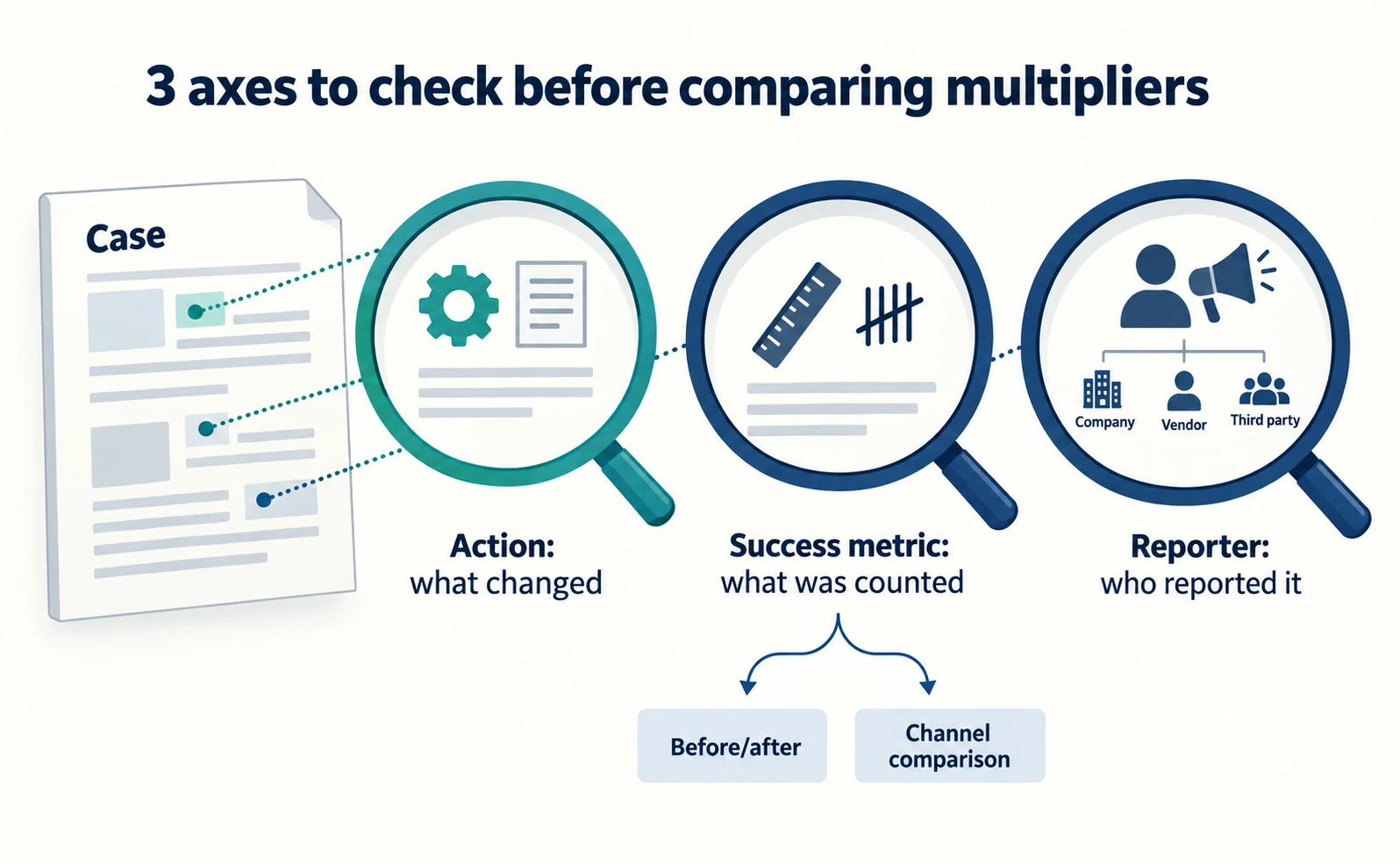
Multipliers cannot be compared unless you align what was changed, what was counted and who reported it.
| Axis | What to confirm | Misreading if you skip it |
|---|---|---|
| Action | Which pages or settings changed, and how | Generalizing to “more articles means growth” |
| Success metric | What counts as one, and what it is compared with | Reading 4x customers as 4x revenue |
| Reporter | The company itself, a vendor, or a third party | Treating a promotional report as neutral verification |
For the metric, also check the type of comparison. A before-and-after comparison means something different from a comparison against another channel in the same period.
AIO Case Studies by Action
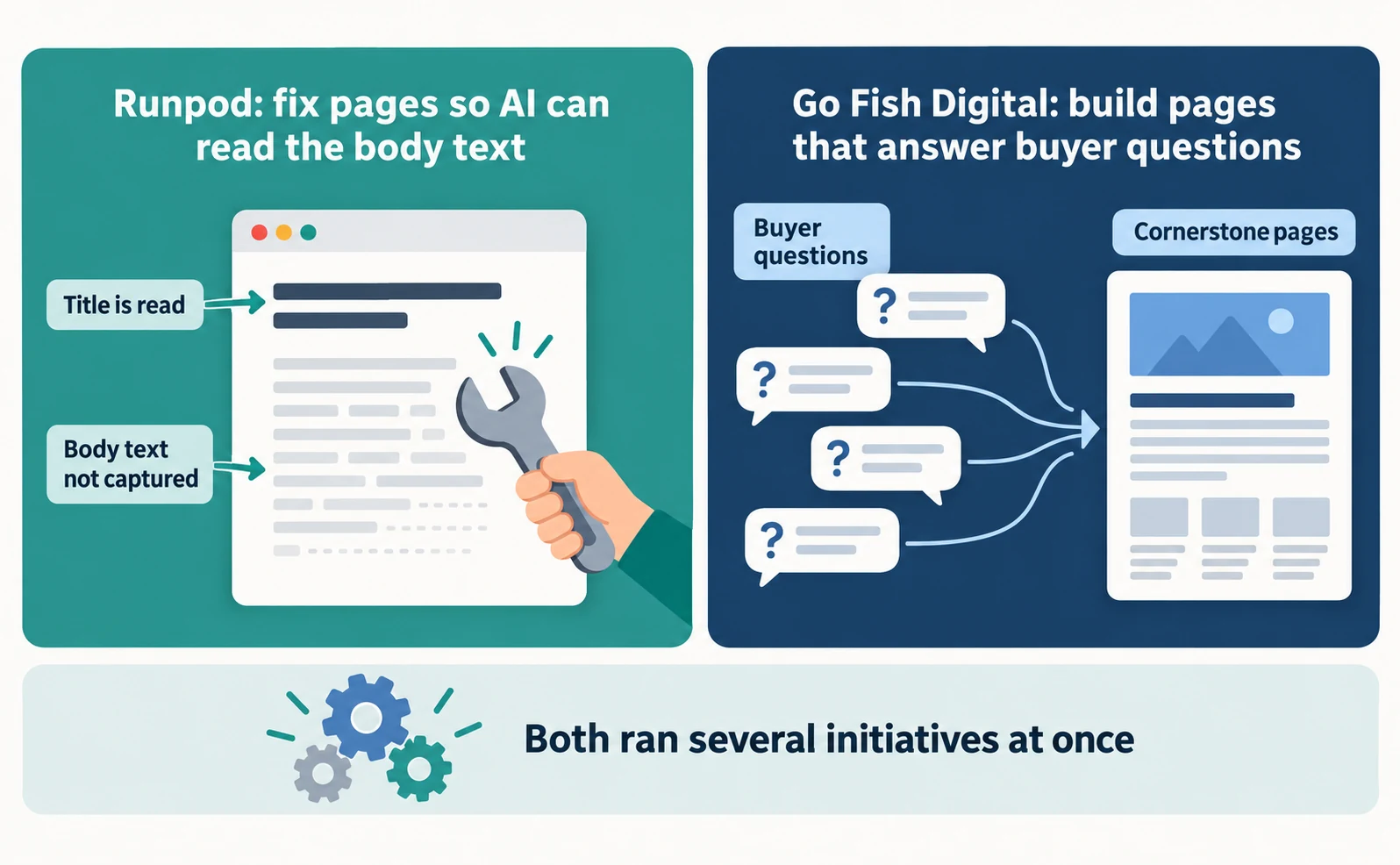
We present two cases under two actions: making body text readable, and building pages that answer buyer questions.
| Action | Case | Reporter |
|---|---|---|
| Fix pages so AI can read the body text | Runpod | Scrunch, the tool vendor |
| Build pages that answer buyer questions | Go Fish Digital | Go Fish Digital itself |
Both ran several initiatives at once. Be careful not to read the results as the effect of a single action.
A Case of Making Body Text Readable to AI
Runpod found articles whose titles were captured but whose body text was not fully captured, and fixed the pages.
Runpod rents computing capacity for AI development over the internet [1]. In early 2025, new paying customers from AI search had reportedly plateaued at around 300–400 a month [1].
From April 2025, it expanded the questions it tracked from 50 to 300 [1]. A site audit found that some articles’ body text was not being captured, and the team updated metadata, restructured pages and corrected formatting [1].
The report says monthly new paying customers grew 4x after adopting Scrunch, presented as a change within 90 days [1]. The exact measurement window is not stated. The reporter, however, is the tool vendor. Because the question expansion happened at the same time, the effect of the page fixes alone is unknown.
A Case of Building Pages That Answer Buyer Questions
Go Fish Digital mapped the questions buyers ask when choosing an agency and built fact-dense cornerstone pages.
The company is a US marketing agency, and it published this case about itself on September 24, 2025 [2]. Over roughly three months, it mapped buyer questions, recorded baseline numbers, built 5–8 cornerstone pages and created pages answering related questions [2].
It reports a 43% increase in monthly visitors from AI referrals and an 83.33% increase in monthly conversions [2]. What counted as one conversion is not published, so it cannot be confirmed as revenue.
The company also notes it already had reputation, authority and external mentions before starting [2]. We cover the details in our Go Fish Digital case article.
Metrics Side by Side: Don’t Mix Revenue, Inquiries and Customer Counts
Putting the original metric, comparison type, period and reporter in one table makes the differences visible.
| Case | Original metric | Meaning | Comparison | Period | Reporter |
|---|---|---|---|---|---|
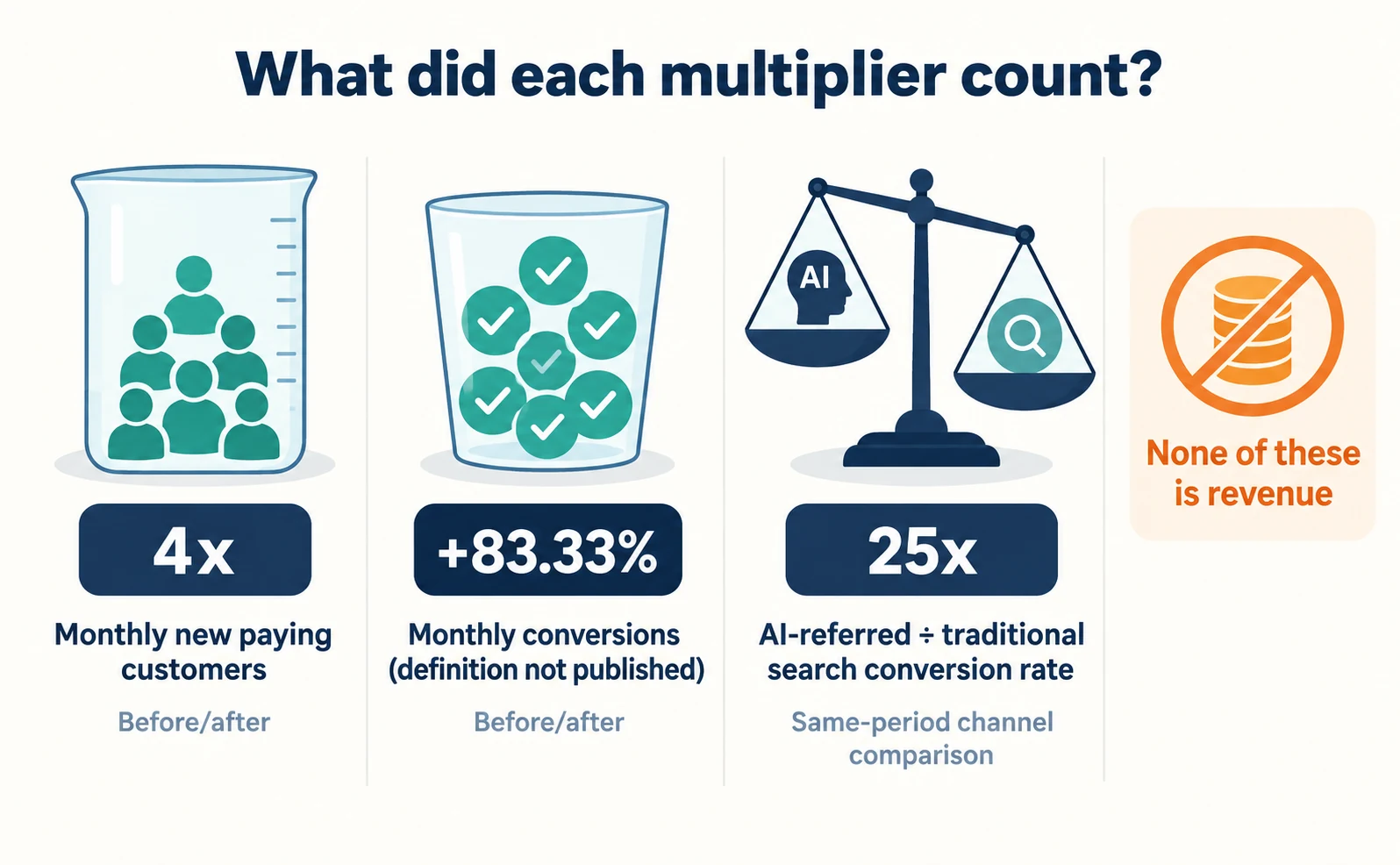
| Runpod | New paying customers per month: 4x | Monthly new paying customers grew 4x | Before/after | Within 90 days after adoption (details not stated) | Vendor |
| Runpod | Conversion rate 8% (2,100 from ~28,000 visitors) | Share of visits resulting in conversions (definition not published) | Rate | Not stated | Vendor |
| Go Fish Digital | Monthly visitors from AI referrals: +43% | Monthly AI-referred visits up 43% | Before/after | ~3 months | Self |
| Go Fish Digital | Monthly conversions: +83.33% | Monthly conversions up 83.33% (definition not published) | Before/after | ~3 months | Self |
| Go Fish Digital | Conversion rate: 25X | AI-referred conversion rate 25x that of traditional search | Channel comparison | ~3 months | Self |
The table shows:
- None of these is an increase in revenue.
- 25x does not mean 25 times better than before. It compares AI referrals with traditional search in the same period.
- 4x and +83.33% count different things, so they cannot tell you which action worked better.
Google also says meeting the requirements does not guarantee appearance in its AI features [3]. Case figures are not a forecast of your own results.
How to Use Cases When Explaining Internally
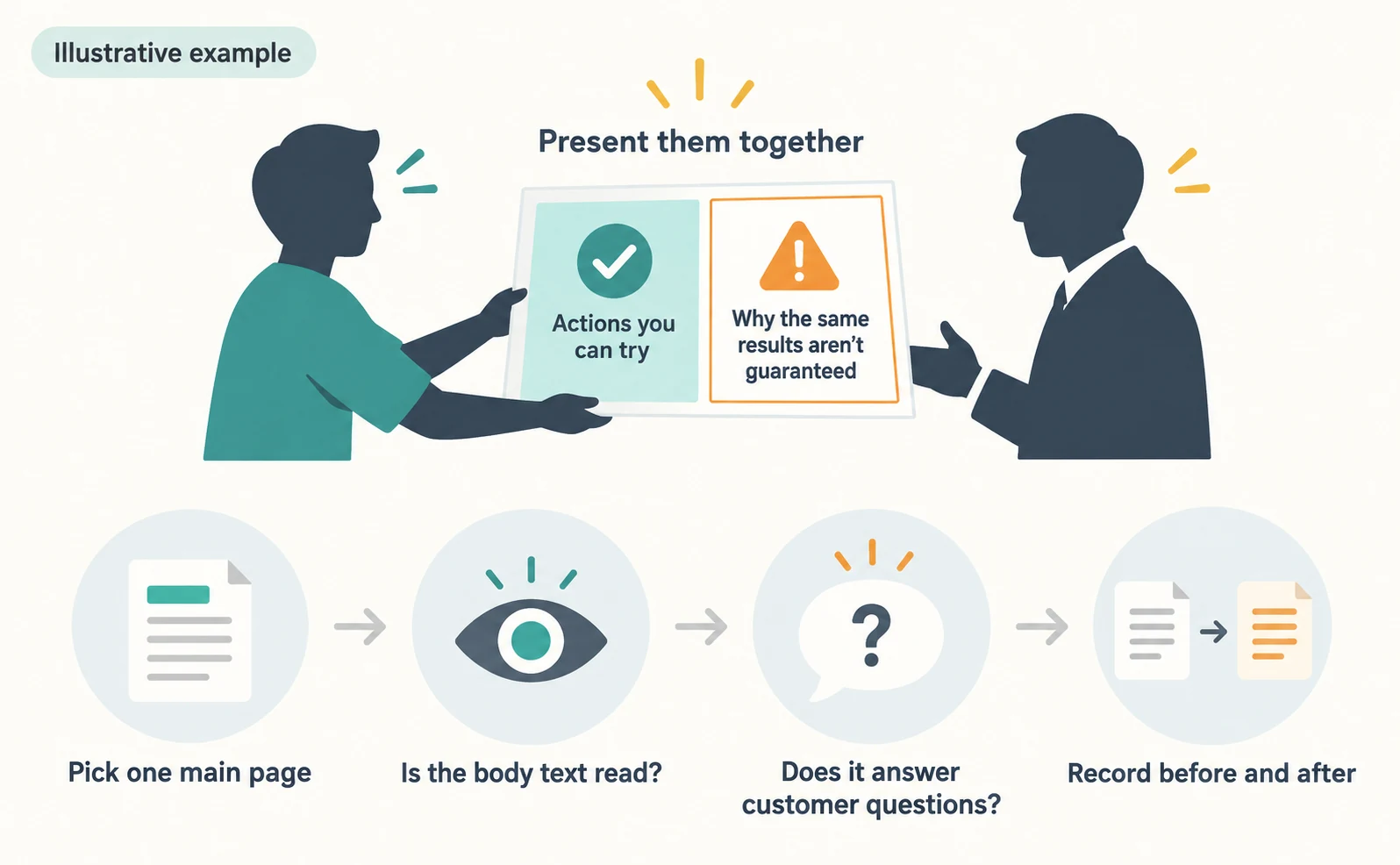
Present the actions you can try together with the reasons the same results are not guaranteed.
An example explanation:
Two overseas companies reported growth in customers or conversions after work for AI search—one fixed how body text is read, the other built pages answering buyer questions. Both are reports by the company or its vendor, and neither is a revenue increase. We would like to first check whether our main pages’ body text is being read and whether they answer customer questions, then compare records before and after changes.
Phrasings to avoid:
| Avoid | Why | Say instead |
|---|---|---|
| AIO quadrupled revenue | It was a customer count | Reported 4x monthly new paying customers |
| The action raised conversion rate 25x | It was a channel comparison | Reported AI-referred conversion rate 25x that of traditional search |
| Results come in three months | Conditions differ | The company reported roughly three months of work |
If you try something first, pick one main page and check whether its body text is being read and whether it answers customer questions. For reviewing existing pages before adding articles, see Before Adding Articles for AI Traffic, Review Your Existing Pages; for where AI visitors land, see the Ahrefs case.
FAQ
- Q. Are there cases from Japanese companies?
- This article covers only two overseas cases whose primary sources we read in full. We will consider adding Japanese cases once we can confirm their metrics, periods and reporters on the same basis.
- Q. Can I use a case’s multiplier as our target?
- We do not recommend it. Each case counts different things, compares differently and started from different conditions such as existing reputation. Record your own numbers before changes and set targets from their movement.
- Q. Are there failure cases?
- The sources we checked include no cases where the actions failed. Looking only at success stories skews expectations, so record months with no results in your own tracking too.
Sources
- [1] How Runpod leveraged the Scrunch AI platform to achieve 4x growth, turning ChatGPT into a top performing acquisition channel (Scrunch) — accessed 2026-09-23
- [2] Generative Engine Optimization (GEO) Case Study: 3X'ing Leads (Go Fish Digital) — accessed 2026-09-23
- [3] AI features and your website (Google Search Central) — accessed 2026-09-23
About the author
Shogo MizushimaCEO of kairos Inc. / AgentSignal Developer
Develops AgentSignal, a tool for measuring AI crawler visits and AI-referred traffic, and diagnosing AIO readiness. Writes about measurement and practical improvements for AI search using observed data.
Related articles

Case studies and research
Go Fish Digital’s GEO Case: Four Decisions Before Adding Articles
What do Go Fish Digital’s reported 83.33% increase and 25x figure actually measure? This article explains the numbers, then shows how to organize buyer questions, record a baseline, and add answers to pages, using a fictional pricing page.
Published

Case studies and research
B2B AI Search: Review Existing Pages Before Adding New Articles
Before adding articles for AI search, B2B companies can find gaps in existing pages and choose to keep, correct, combine, or create. This guide uses a case study and worked examples, and shows how Search Console’s generative AI report can help narrow down pages.
Published

Case studies and research
Where Do AI Visitors Land? Choosing Pages to Improve from the Ahrefs Case
Ahrefs reported that AI-referred visits land on pages beyond its blog. Learn how to find the landing pages for your own AI traffic and choose which pages to improve first.
Published