Trip.com and Mastercard: from AI advice to travel booking
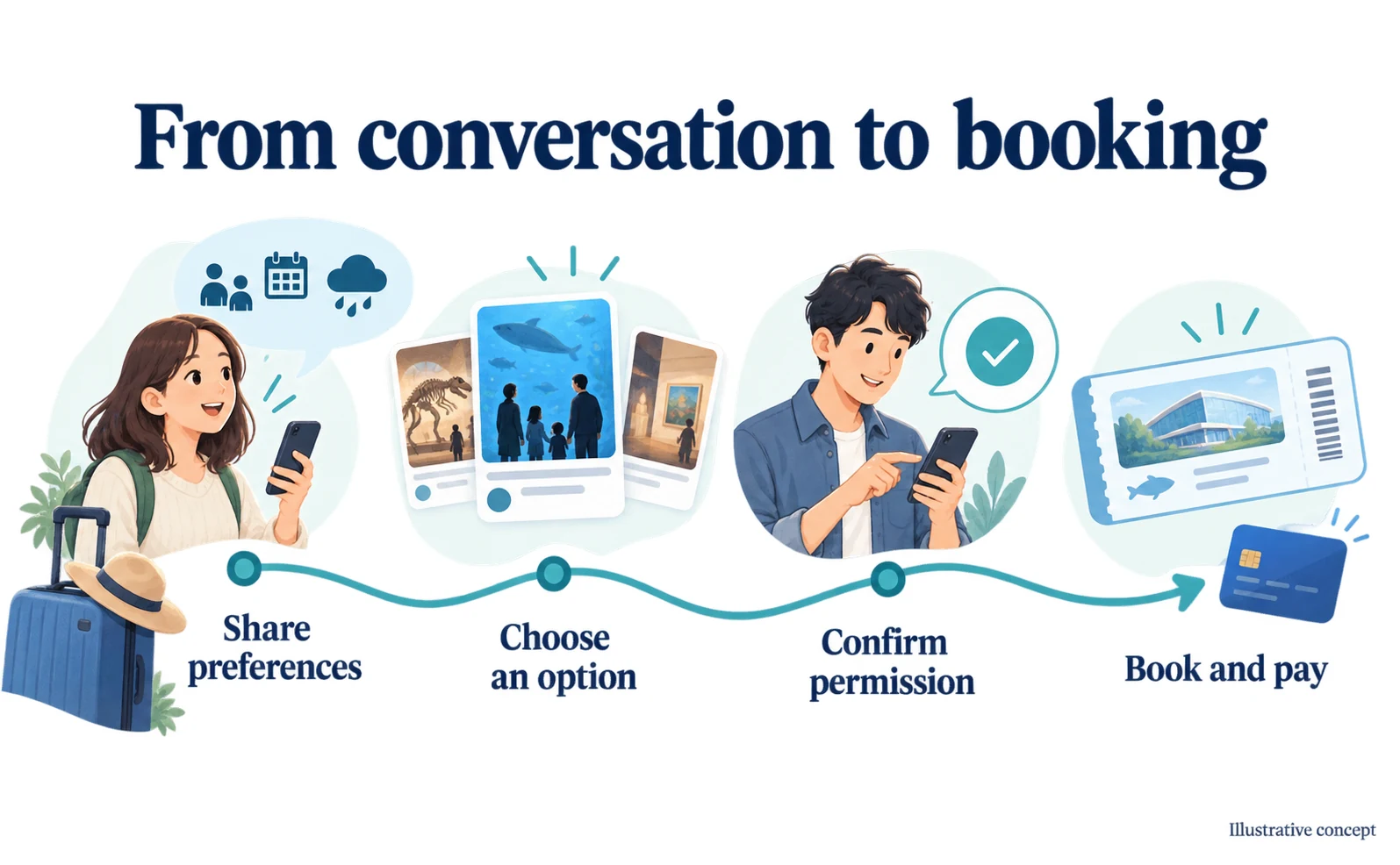
Follow an illustrative travel booking from preferences to availability, authorization and confirmation, with the planned 2027 launch kept separate from current access.
Trip.com and Mastercard have showcased a way to move from an AI conversation to discovering, booking and paying for travel services. The initiative aims to support purchases authorized by the traveler, with commercial launch expected in early 2027.[1]
For a travel business, being recommended by AI is only the beginning. Customers may still have to select dates and party sizes again, check prices and move to another payment screen. This announcement concerns how AI could help bridge that work.
Based on Mastercard’s September 16, 2026 announcement, this article explains the companies’ roles and the information needed to complete a booking. It was checked on September 18. It is an explanation of the use case and rollout stage, not a public implementation guide that Japanese merchants can follow to activate the integration today.
What becomes easier? Continuing from advice to booking
A traveler can receive an AI recommendation yet still have to find the booking page and re-enter their requirements. Finding an option does not complete the journey.
Trip.com’s travel assistant, TripGenie, handles the conversation in this initiative. The announcement describes discovery, booking and purchasing, with selected services such as attractions and ancillary offerings. It does not announce immediate coverage of every travel product.[1]
Consider this fictional scenario. It illustrates the mechanism, rather than reproducing a real TripGenie screen or the partners’ demonstration:
A family wants an indoor activity during a trip. Two adults and one child will attend, and they need to finish by 3 p.m.
“Here is an indoor activity” is not enough to book. The traveler also needs availability, age requirements, duration and the price for all three people. If AI can work with these details, it could reduce repeated explanations and data entry. That is an expected benefit, not a measured time saving or revenue result from this announcement.
What each participant provides
Trip.com is not supplying every component of payment itself. Mastercard provides merchant AI-commerce capabilities, while Network International contributes merchant acquiring capabilities: infrastructure that helps a seller accept payments.[1]
| Participant | Role | Meaning for the traveler |
|---|---|---|
| Trip.com / TripGenie | Travel information and the conversation | Describe needs and choose options |
| Mastercard Agent Suite for Merchants | Capabilities for merchant AI shopping and purchasing experiences | Connect assistance with the purchase journey |
| Network International | Merchant payment acceptance infrastructure | Support payment for the chosen service |
Agent Suite for Merchants is Mastercard’s merchant-facing AI-shopping offering. It describes support for merchant-owned shopping assistants and connections with supported external agents, including product discovery and cart-related work.[2][3]
Displaying a Mastercard acceptance logo is not the same as enabling this experience. Products, prices and purchasing systems must be connected with AI. Existing card acceptance and availability of the new travel integration are separate questions.
Follow the booking from the first request to confirmation
Return to the fictional family activity. The following dates, amounts and checkpoints are explanatory examples, not a Trip.com API specification. An API is a defined interface through which systems exchange information or request operations. The announcement does not establish a publicly usable booking endpoint and complete request format.
1. Turn preferences into searchable conditions
The traveler specifies an indoor activity, two adults, one child and a 3 p.m. finish. If the date or destination is missing, the assistant must resolve that first.
The seller needs accurate descriptions, location, duration and age limits. “Great for families” does not establish whether a young child can participate. Merchants still supply the underlying facts, even when AI handles more of the conversation.
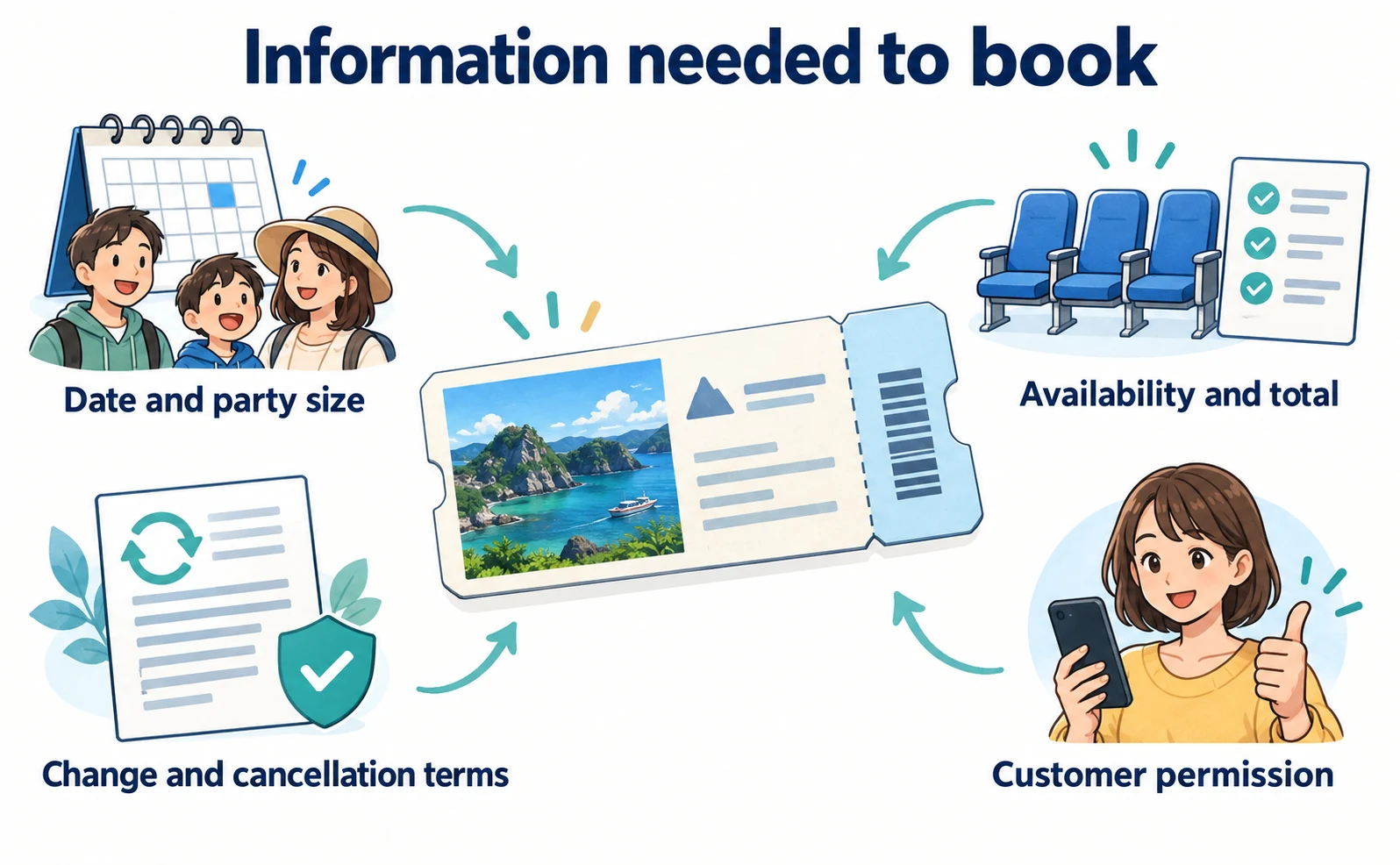
2. Check availability and the total
The system needs to establish whether three people can attend the selected session. A page saying “daily departures” does not guarantee a place on the chosen date.
For an illustrative price of ¥6,000 per adult and ¥3,000 per child, the three-person amount is ¥15,000. Any additional fees or selected options must be reflected before purchase. An old amount found on a page should not silently become the confirmed booking price.
3. Obtain permission for the actual purchase
The proposed booking must match the request. The traveler needs the date, party size, total and change or cancellation conditions to decide.
If an option would finish at 4 p.m., it no longer meets the original request. That requires another choice rather than automatic payment. Mastercard describes the initiative in terms of consumer-authorized transactions.[1][2]
4. Confirm both payment and the reservation
The traveler needs to understand whether payment succeeded and a place was actually secured. A booking reference, date and meeting-point information also matter for using the service.
If communication fails, repeating a payment before checking the result can create duplicate bookings. Failure handling is therefore a meaningful adoption question. The announcement does not provide detailed retry or inventory-reservation specifications.
Your own shopping assistant and an external AI have different entry points
An assistant on your own site primarily helps visitors already there compare and book. Reaching people through an external AI requires a supported route for that AI to access product information and purchasing services.
Mastercard describes a merchant-owned Shopping Agent and Agent Connect for supported external AI ecosystems. This is not a promise of automatic listing in every AI service.[3]
For a smaller activity provider, the priority might look like this:
| Current problem | What is needed first |
|---|---|
| Visitors repeatedly ask about age limits or duration | Clear product information and answers |
| Availability always requires a phone call | A system for dated availability and reservations |
| AI mentions the activity but the booking route is unclear | Correct product and purchasing links |
| The business wants conversation-to-purchase booking | Connected information, availability, permission, payment and confirmation |
Buying the final integration does not fix inaccurate availability data. Conversely, a business with a functioning reservation system may be able to expose the same information through additional AI entry points. This is an adoption framework, not a claim that the announced collaboration already connects to every booking platform.
Can a Japanese merchant apply now?
The Trip.com collaboration describes phased rollout and commercial launch expected in early 2027. The announcement does not establish immediate public access for Japanese activity providers or a price list.[1]
Mastercard’s broader merchant AI offering is explained on the Agent Suite for Merchants page. A product information page is not confirmation that this particular Trip.com integration can be activated for your business.[3]
A useful decision today is how much work you want AI to handle: answering questions, finding availability or completing purchases. That scope determines which product information and reservation connections are needed.
If the immediate gap is traveler information, the Lake.com case discussion offers a separate starting point. For the division between merchant ordering and payment infrastructure, see Worldline’s UCP payment support.
AI discovery and completed bookings are connected parts of a journey. This announcement is useful evidence of work extending into the latter stages of travel commerce, with its actual rollout conditions still important to track.
FAQ
- Q. Can Japanese merchants use it immediately?
- The collaboration targets commercial launch in early 2027. Public Japanese eligibility and pricing were not established.
- Q. Does accepting Mastercard mean it is enabled?
- No. Card acceptance is different from connecting AI with products and booking workflows.
- Q. Does the AI purchase without permission?
- The announcement describes consumer-authorized purchases. The article illustrates checking booking details and the total.
Sources
- [1] Mastercard and Trip.com pave the way for agentic commerce in the travel sector (Mastercard) — accessed 2026-09-18
- [2] Mastercard gives merchants a simpler way to build, connect and scale AI-powered shopping experiences (Mastercard) — accessed 2026-09-18
- [3] AI powered commerce solutions (Mastercard) — accessed 2026-09-18
About the author
Shogo MizushimaCEO of kairos Inc. / AgentSignal Developer
Develops AgentSignal, a tool for measuring AI crawler visits and AI-referred traffic, and diagnosing AIO readiness. Writes about measurement and practical improvements for AI search using observed data.
Related articles

Case studies and research
Lake.com’s AI Search Case: Choosing Articles That Answer Travelers
Lake.com, a lakefront rental platform, created articles based on AI search question patterns. This article explains what its reported 5x figure measures and shows how accommodation providers can choose articles by splitting traveler questions into destination, activities, and lodging.
Published
AI shopping and booking
Worldline UCP payments: what an online store must prepare
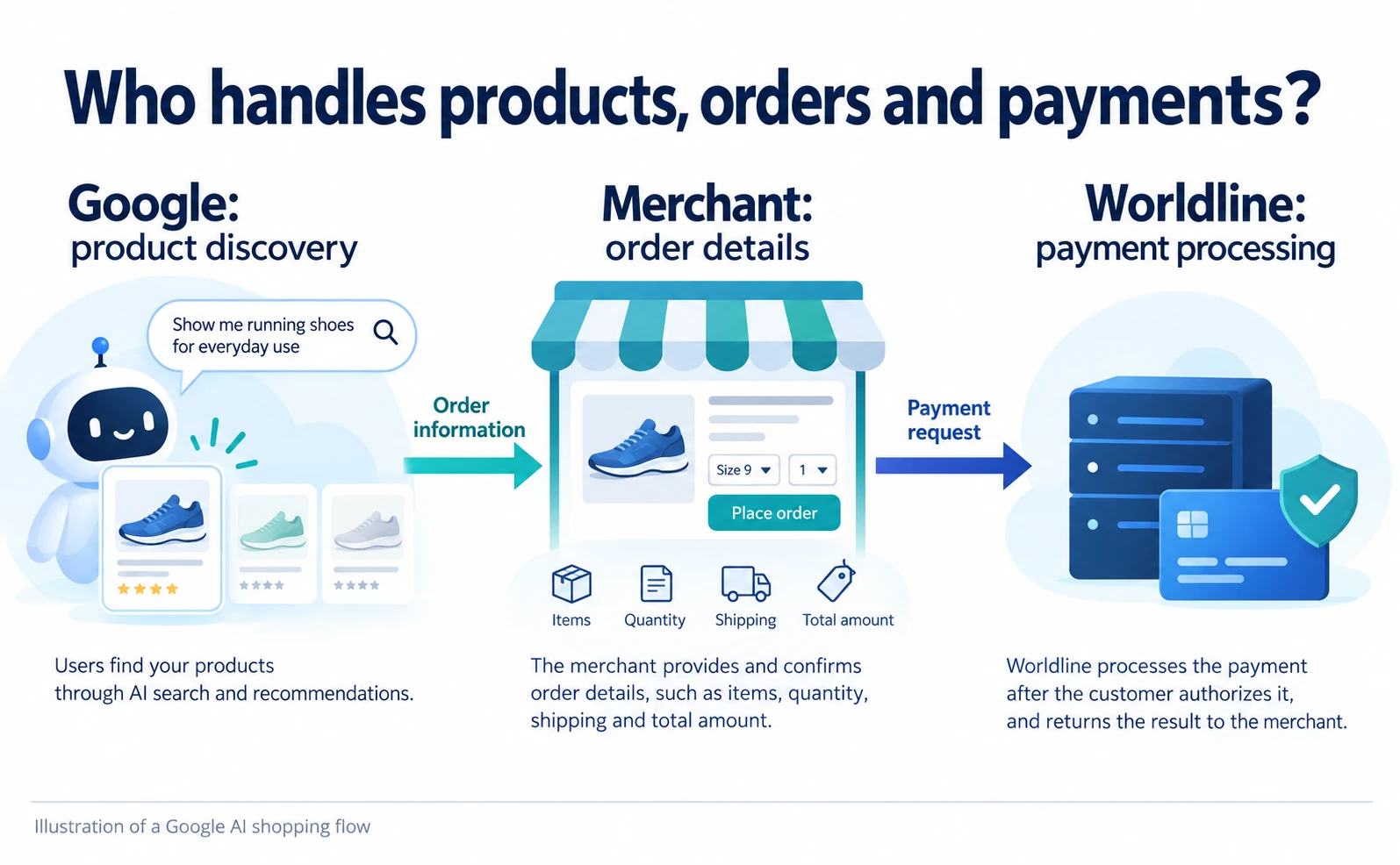
Follow Worldline’s UCP payment flow from product discovery to checkout, buyer approval and payment processing. Understand what the merchant still implements, the documented beta status and the eligibility questions to ask before integration.
Published
AI shopping and booking
AI Help for Shopping Stalled at Payment: Cashfree’s Proposed Use Case
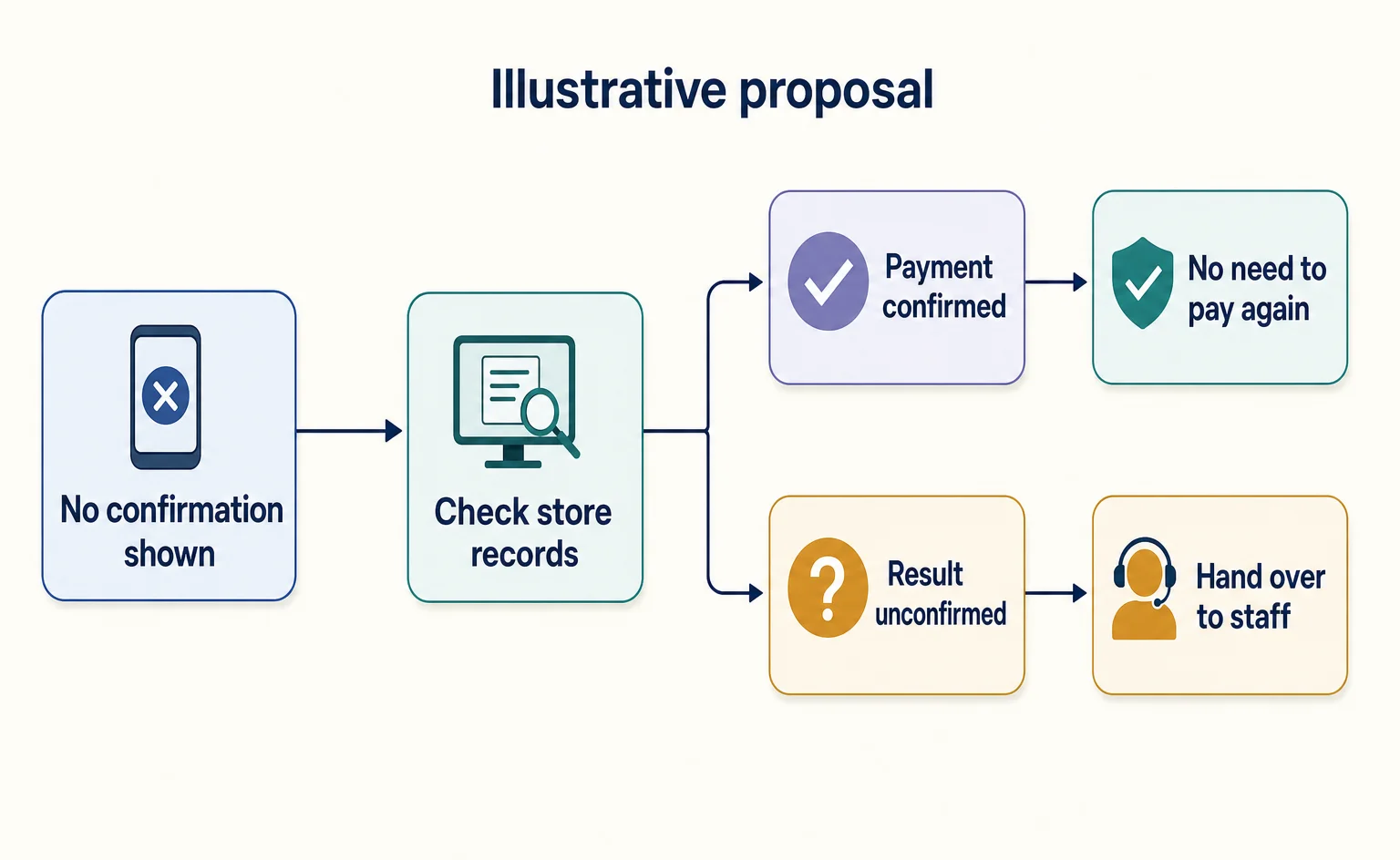
Cashfree’s GFF 2026 page describes voice AI contacting shoppers after payment failures. This article separates that use case from confirmed availability and results, and explains the information, example guidance, and conditions ecommerce managers should review.
Published