From Budget to Purchase: Mastercard’s Canadian AI Trial
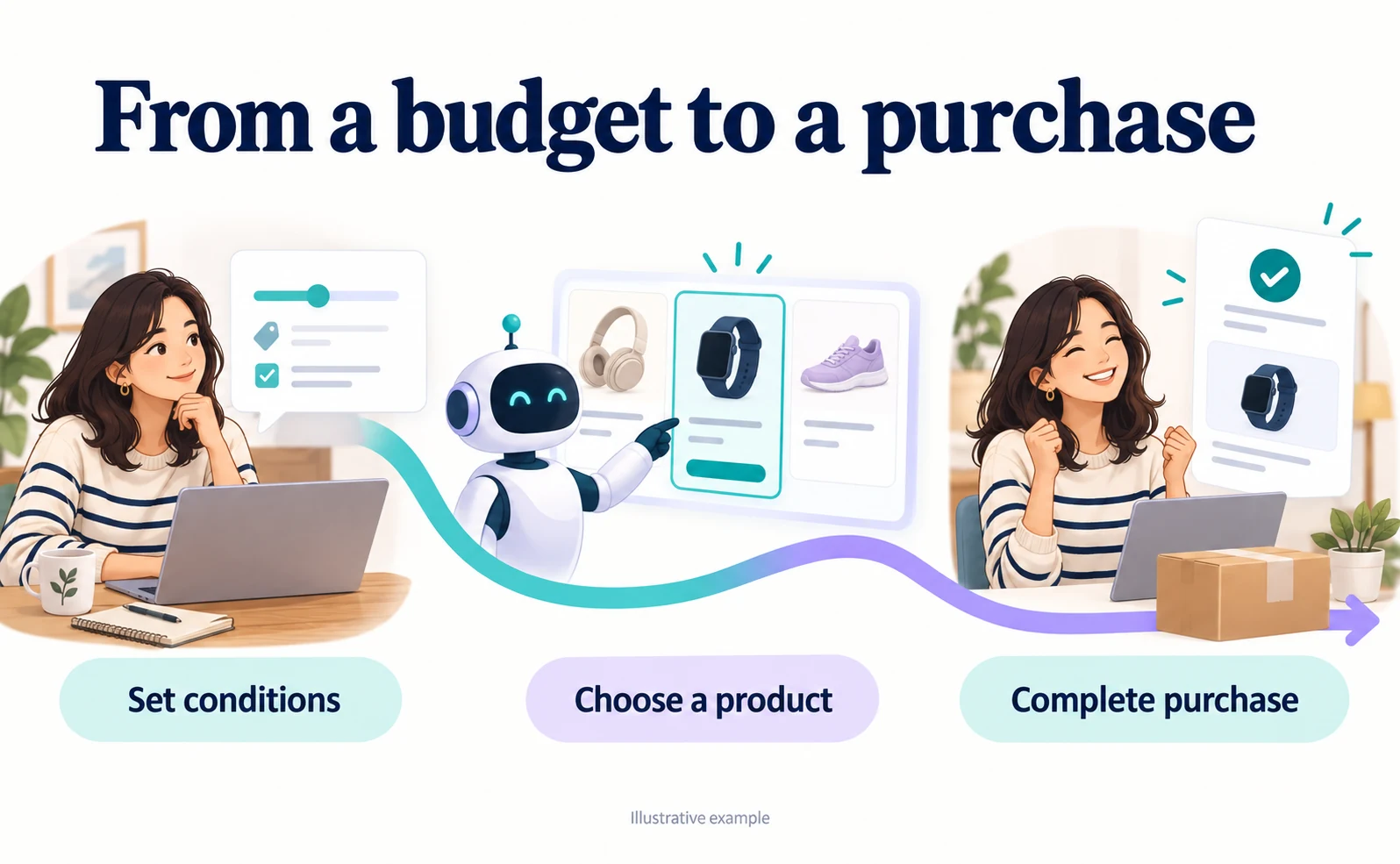
An AI assistant has completed a purchase within a shopper’s stated budget in a transaction announced in Canada. The task went beyond recommending a product.
An AI assistant has completed a purchase within a shopper’s stated budget in a transaction announced in Canada. The task went beyond recommending a product.
For an online retailer, the practical question is what happens after a recommendation. Does the customer place the order, or does the AI continue? The latter requires current stock, a final total and a reliable order result, as well as discoverable product information.
Mastercard, Flybits and Rogers Bank announced the transaction on September 21, 2026. This article explains its scope and proposes a preparation exercise for merchants, based on information checked on September 22. It is not a guide to an open merchant enrolment programme.[1]
What did the AI actually do?
According to the announcement, a Flybits-powered assistant followed a Rogers Red credit cardholder’s instructions, selected an eligible product within a specified budget, and completed the purchase using Mastercard Agent Pay. The transaction used validated consumer instructions and predefined spending limits.[1]
Agent Pay is Mastercard’s framework supporting payments when AI acts for a shopper. We have not inspected the purchased product or the actual checkout screen. The announcement does not establish a measured time saving or an increase in merchant revenue.[1]
The potential customer benefit is straightforward: less work between finding something suitable and buying it. Whether a particular store can offer that experience depends on its supported connections and operating conditions.
Three stages to examine in your own store
The following is our preparation exercise. It does not reproduce Mastercard’s enrolment instructions or the transaction interface.
1. Can a suitable product be selected?
A product price alone may not show whether a purchase fits a budget once delivery is included. Different sizes or colours may also have different prices.
Open one product’s public page, the page customers see rather than its administration screen. Check whether the name, price, availability, variants and delivery restrictions are clear.
Showing shipping costs at checkout is not automatically a problem. But an AI purchasing integration needs a defined point at which the relevant system calculates those costs. Do not add an invented flat shipping fee to the description just to make the information look complete.
2. Can the total and terms be checked before purchase?
A suitable product is not necessarily an order that can still be fulfilled. Stock may run out or delivery charges may change with the address.
Add the product to your own basket and inspect the steps before order confirmation. Note where quantity, item price, shipping, tax and delivery expectations become final. Use a test environment for transaction tests; otherwise stop before submitting an actual order.
The design question is when the AI should receive this information. Decide how a connected service should stop a purchase outside the permitted conditions or ask the person to confirm. A budget limit should not become optional simply because software handles the purchase.
3. Can the result be verified afterwards?
Reaching a payment page does not prove that an order exists. The store needs an order number associated with the correct items and quantities.
Inspect the confirmation process, including what happens when payment fails or an item sells out. For a future AI connection, add tests for tracing the same order across systems and preventing duplicate orders.
This inventory is useful before adopting a new integration. It identifies which information already exists and what still needs to be connected.
Does accepting Mastercard mean the store is ready?
The announcement does not establish whether any particular store is eligible. It describes a transaction connecting an AI service, a card issuer and payment infrastructure. It is not evidence that every store accepting Mastercard can immediately receive the same AI-led purchases.[1]
Check official information from the payment provider or commerce service under consideration:
| Check | Decision it supports |
|---|---|
| Eligible countries, merchants and products | Whether the business can participate |
| Product submission and update method | Whether prices and stock can stay current |
| Order and payment connection | Whether the existing store can integrate |
| Consumer permission and spending limits | When to stop or ask for confirmation |
| Failure, cancellation and return handling | How staff can trace and resolve a problem |
Leave unanswered questions marked as unconfirmed. Keep planned features separate from functions available under an actual contract.
Product discovery still comes first
A checkout connection is useful only when an AI can find a suitable product. Conversely, appearing in an AI recommendation does not mean the order process is connected.
First establish which sales channel will receive which product information. Then investigate its ordering requirements. The ACP merchant preparation guide explains this relationship for ChatGPT-related commerce.
For the role of permission records, read AP2 and purchase authorization. Those shared rules and Mastercard Agent Pay should not be treated as interchangeable service names.
A concrete next step is to document one product’s selection information, final checkout information and order result. That makes a future integration discussion specific enough to evaluate.
FAQ
- Q. Can any merchant enrol now?
- The announcement does not establish general merchant eligibility, including eligibility in Japan. Check the provider’s country, merchant and connection requirements.
- Q. Does this prove a revenue increase?
- No. It reports a completed transaction, not a measured increase in merchant revenue or conversion.
- Q. What can a retailer do first?
- Document one product’s selection information, final checkout total and order confirmation process.
Sources
- [1] Mastercard, Flybits and Rogers establish benchmark for secure, consumer-controlled agentic commerce in Canada (Mastercard) — accessed 2026-09-22
About the author
Shogo MizushimaCEO of kairos Inc. / AgentSignal Developer
Develops AgentSignal, a tool for measuring AI crawler visits and AI-referred traffic, and diagnosing AIO readiness. Writes about measurement and practical improvements for AI search using observed data.
Related articles
AI shopping and booking
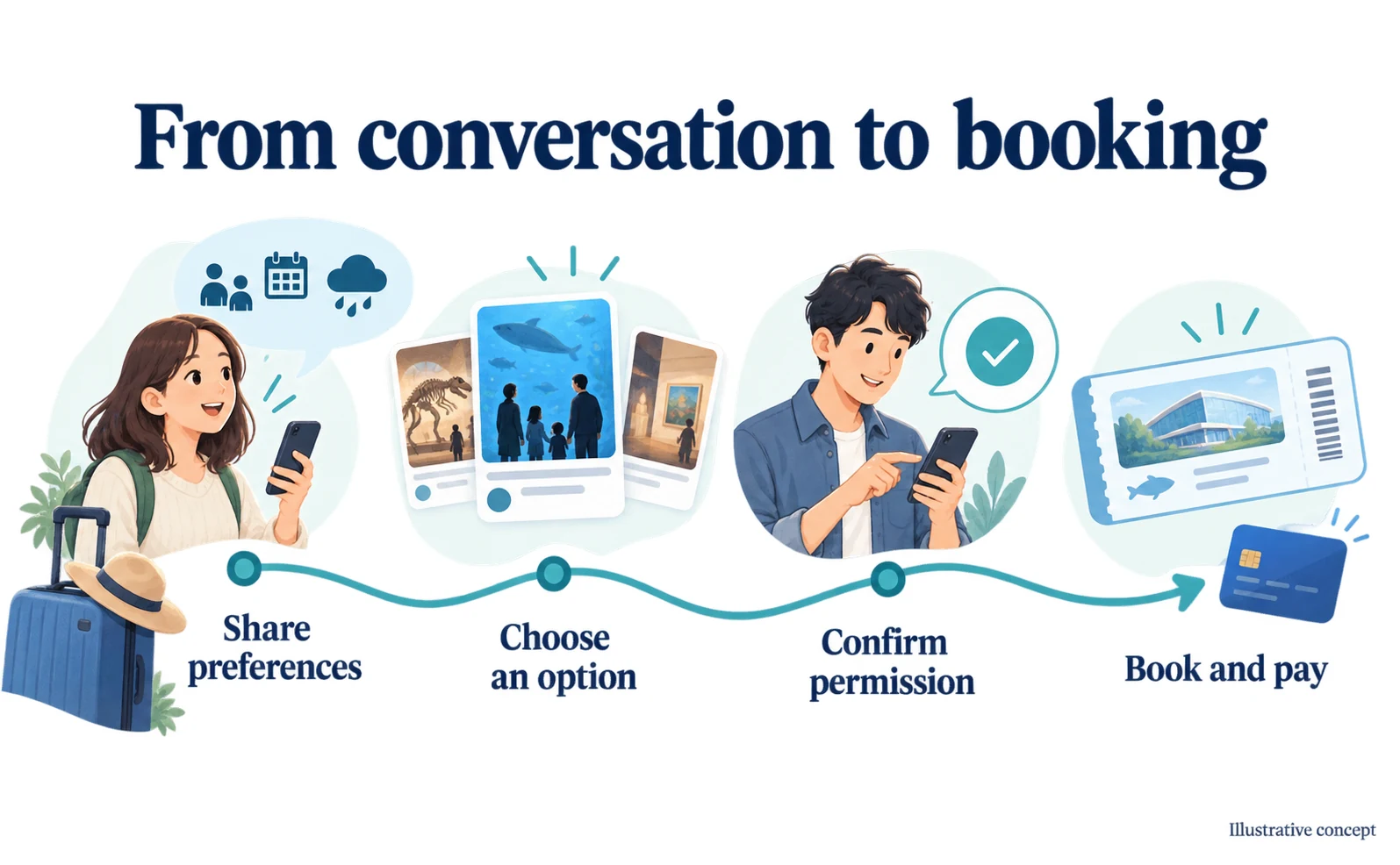
Trip.com and Mastercard: from AI advice to travel booking
Follow an illustrative travel booking from preferences to availability, authorization and confirmation, with the planned 2027 launch kept separate from current access.
Published
AI shopping and booking
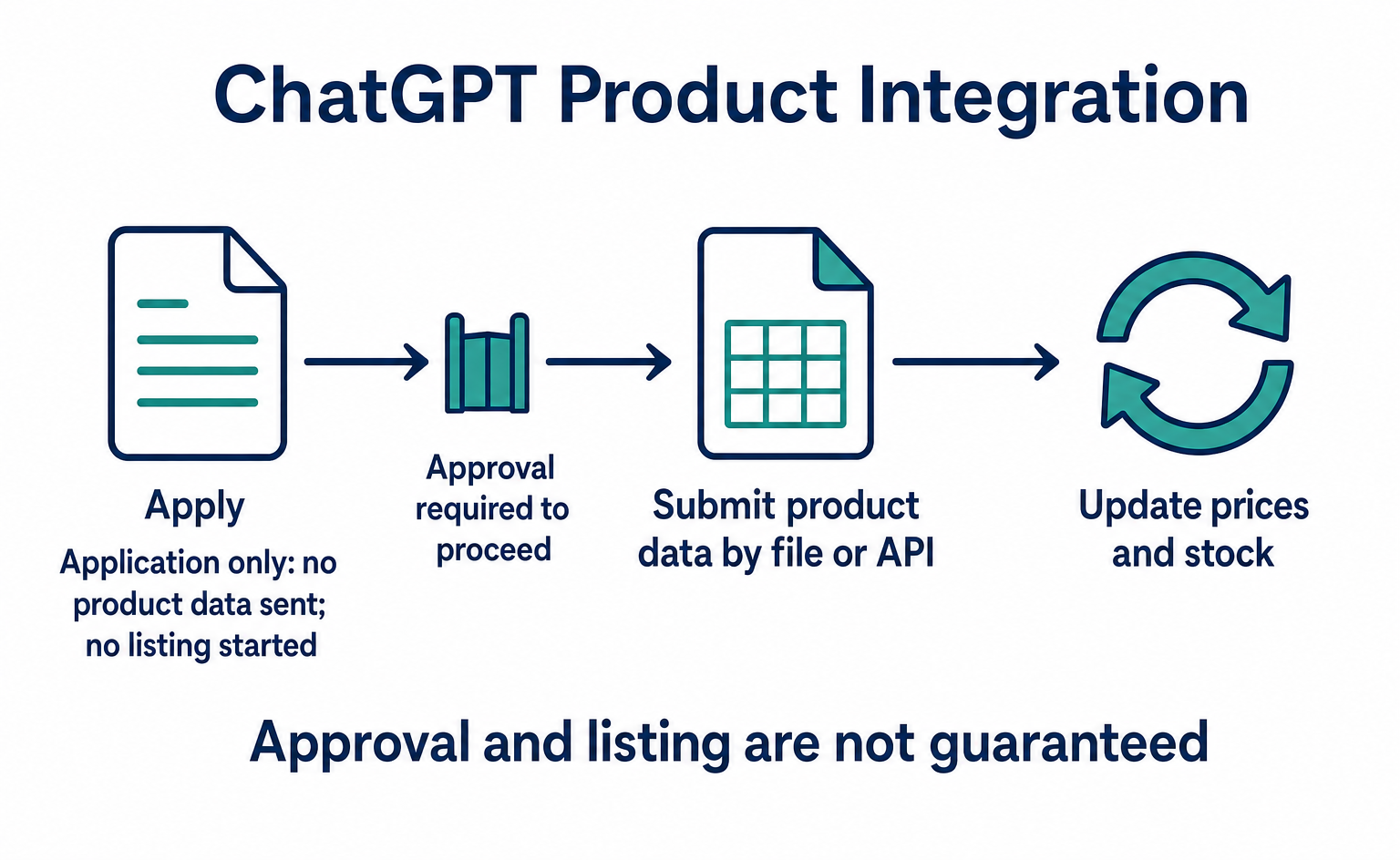
How to List Products on ChatGPT: From ACP Product Integration to Orders
A step-by-step guide to applying for product integration, sending and updating product data, and directing shoppers to checkout. Learn when order APIs are needed, how to test version 2026-04-17, and which features were available or still proposed as of September 10, 2026.
Published
AI shopping and booking
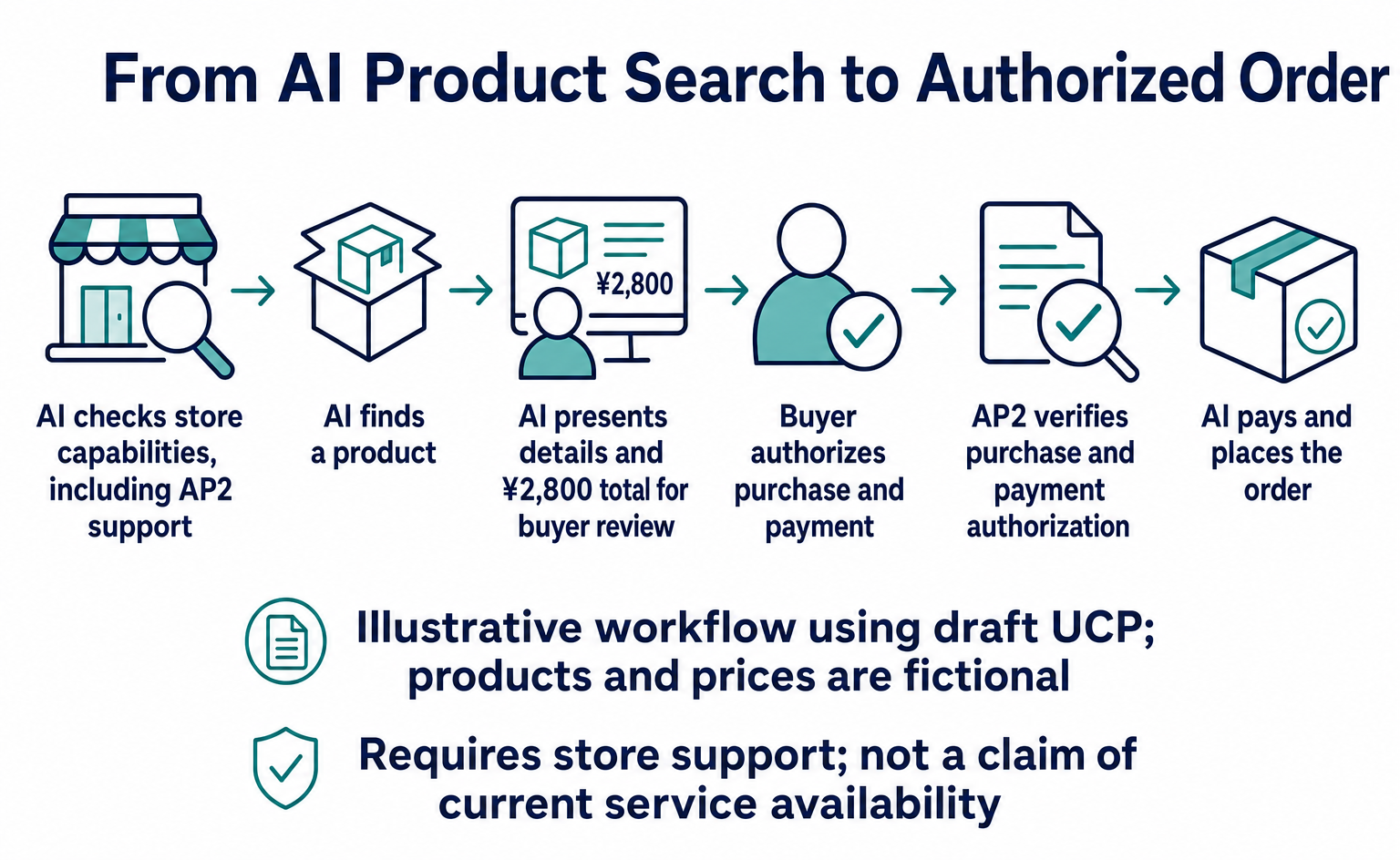
What Is AP2? Following the Data from AI Product Search to Order
AP2 provides shared rules for checking whether an AI order matches the buyer’s authorization. Follow the same product ID and amounts through search, shipping costs, approval, payment and ordering, with benefits for online stores and the specification’s status as of September 10, 2026.
Published