Why Do Third-Party Media and Comparison Sites Matter for LLMO?

AI answers cite industry media and comparison sites, not just your own website. Learn how to find the third-party sites cited for your customers' questions, request corrections, and avoid risky placement tactics.
When you ask AI about your business, the sources listed under the answer may be industry publications or comparison sites rather than your own website. Because AI answers also cite pages outside your site, how those pages describe you is part of LLMO.
LLMO means making sure AI services such as ChatGPT describe your business and services accurately. For the basics and how to check your own site, see What Is LLMO? How to Check Whether Your Company Appears in AI Answers.
This article is for communications staff who manage how the company appears outside its own website. It shows how to find the third-party sites cited for your questions, request a correction when information is outdated, and decide what to avoid when seeking new coverage.
AI answers also cite pages outside your own website
The pages AI shows as sources for its answers include industry publications, comparison sites, and review sites as well as your own website. If customers make decisions from those answers, the way third-party pages describe you affects those decisions.
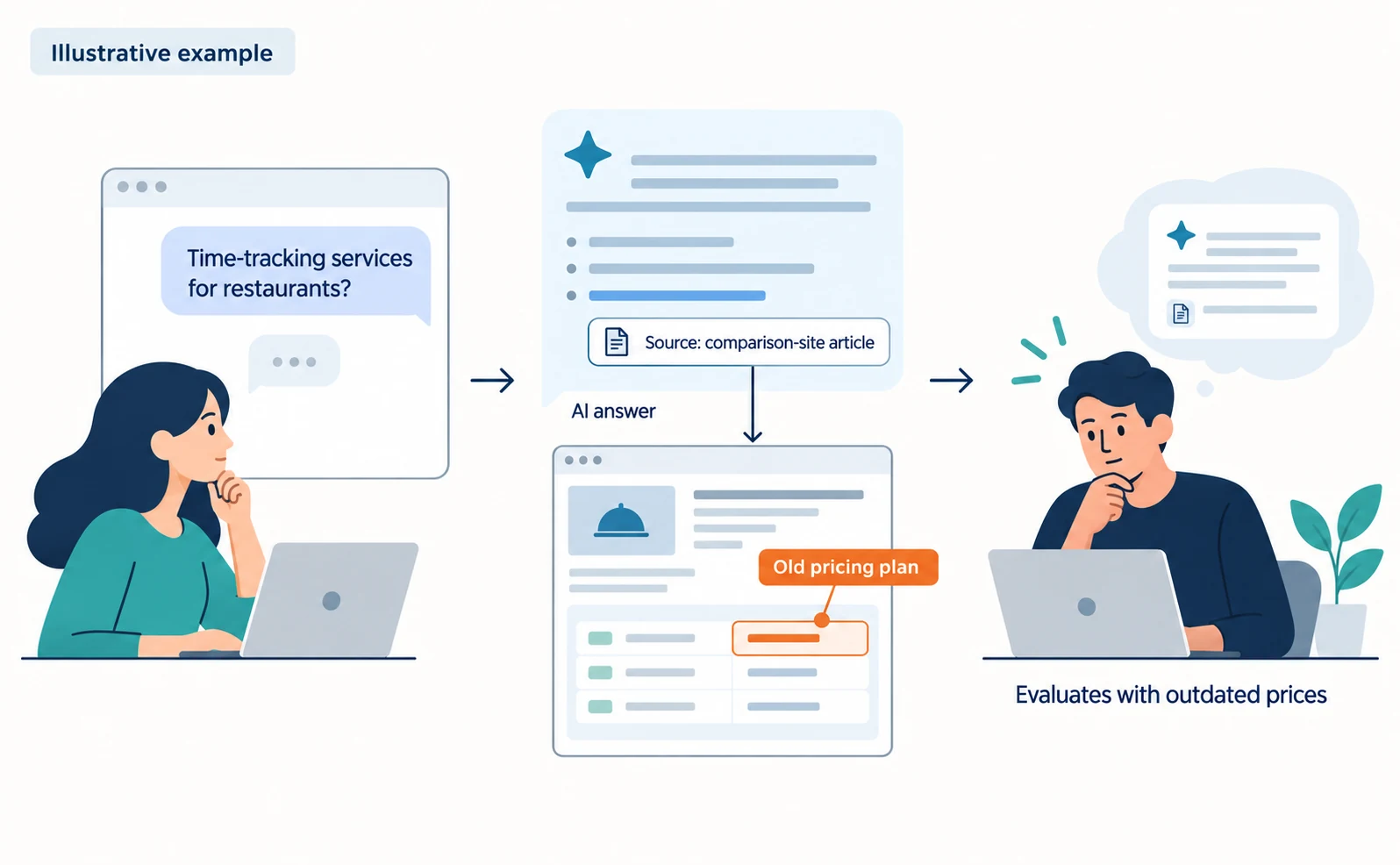
Consider an illustrative, fictional scenario. A communications manager at a company offering time-tracking software asks ChatGPT, “Which time-tracking services work well for restaurants?”
The answer mentions the company, but the cited source is a comparison-site article. That article still lists the company's old pricing plan. Someone reading the answer may evaluate the service based on outdated prices.
Research has also looked at how often third-party pages are cited. In May 2026, Citera studied English-language B2B SaaS (business cloud software) search terms in the US. Across ChatGPT, Claude, Perplexity and Google AI Overviews, it found that 61% of cited articles came from earned media such as review sites, industry publications and LinkedIn, while companies' own sites accounted for 29%.[1]
However, Citera itself sells services to B2B SaaS companies, and the researchers explain that each AI service was asked each question once and that the comparison does not control for factors such as site strength.[1] It covers US English-language queries. The same shares should not be assumed for Japanese queries or other industries.
Even so, it shows that third-party pages are commonly used as sources. The same study found companies' own sites made up nearly 30% of citations.[1] Checking third-party sites does not replace maintaining your own site; the two tasks run in parallel.
Find the third-party sites cited for your own questions
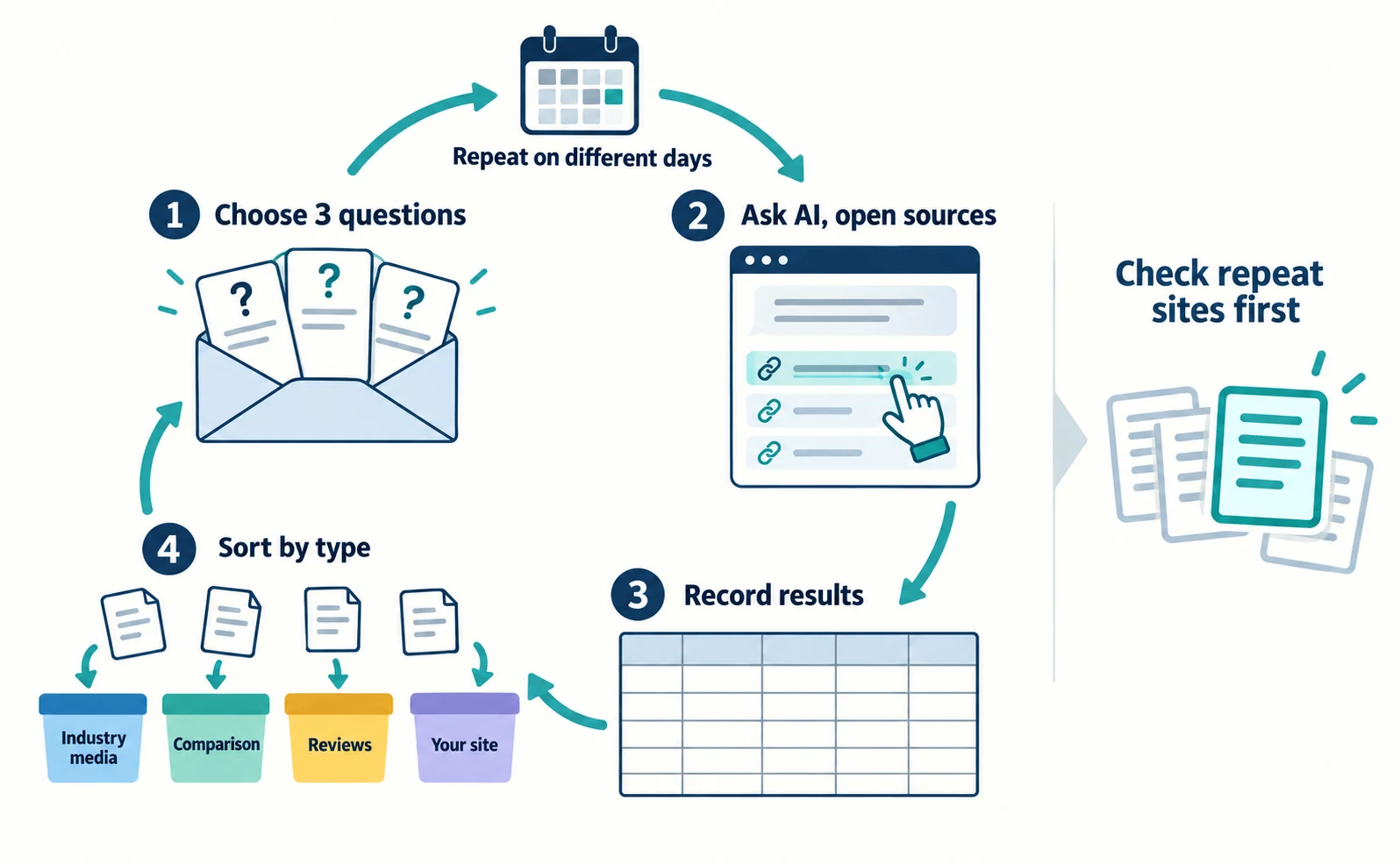
Choose three questions customers are likely to ask AI, record the source links attached to the answers, and sort the sites by type. Start with the sites that appear repeatedly.
Follow these steps.
- Choose questions. Pick three questions customers have actually asked, using inquiry emails or sales notes. Including questions that compare options, such as “best X” or “X comparison,” makes it easier to see answers that cite third-party sites.
- Ask AI. Open the AI service you want to check (for example, ChatGPT) and enter each question as written. If the answer includes source links, open all of them.
- Record the results. Note the question, AI service, date and time, cited URL, site type, and how your company is described.
- Sort the sites. Group them as industry publications, comparison sites, review sites, your own site, or other.
Here is a sample record. Company and site names are fictional.
| Question | AI service, time | Cited page | Type | How you are described |
|---|---|---|---|---|
| Time-tracking services for restaurants? | ChatGPT, Sep 23, 10:00 | Comparison site A (example) | Comparison site | Named, old pricing plan |
| Time-tracking services that also build shift schedules? | ChatGPT, Sep 23, 10:00 | Industry publication B (example) | Industry publication | Not mentioned |
| Time-tracking services that also build shift schedules? | ChatGPT, Sep 23, 10:00 | Your feature page | Your own site | Accurate |
AI answers change depending on the day and the wording. Do not decide from one result. Repeat the same questions on different days and check the sites that appear repeatedly first.
Bing Webmaster Tools, Microsoft's dashboard for site owners, includes an AI Performance report showing how often your pages are cited in AI answers in Microsoft Copilot, Bing and select partner AI experiences. On June 16, 2026, Microsoft began rolling out new features in preview, including Citation Share.[2] Citation Share is your site's percentage of all citations shown for a specific grounding query, the search query the AI uses to find supporting sources.[2] It is calculated differently from a citation rate that counts how many answers cite you.
However, Citation Share does not reveal competitor domains (site addresses).[2] To learn which third-party sites are cited, you still need to ask the questions yourself and record the results as in the table above.
Once you have your records, use this table to decide what to do next.
| What you found | Next step |
|---|---|
| A frequently cited third-party site describes you accurately | Keep it as is and check it periodically |
| A frequently cited third-party site has outdated or wrong details | Ask the publisher for a correction (next section) |
| A frequently cited third-party site does not mention you | Consider whether to offer information (final section) |
| Your own site is cited | Check that the cited page is up to date |
What to do when a third-party listing is outdated or wrong
Contact the publisher through its contact channel and ask for a correction, citing your official page as evidence. The publisher decides whether to change the article, so state briefly and accurately what is wrong, what is correct, and why.
Before you ask, make sure your own website is current. If your pricing page is outdated, you cannot point to it as evidence. For aligning your company name, address, and other basic details, see How to Align Company Details and Official Links.
Next, look on the publisher's site for a contact page or an editorial contact address. It is often at the end of the article or the bottom of the site. If you cannot find one, use the operating company's contact details.
Include these five items in your request:
- The article URL and title
- The incorrect passage, quoted briefly
- The correct information
- The URL of your official page that supports it
- Your name and contact details
Here is a sample request. The company, contact name, and prices are fictional.
I am Yamada, communications manager at Sample Inc. Your article “Time-Tracking Services for Restaurants Compared” lists our monthly price as ¥300 per user. Since April 2026, the price has been ¥250 per user. Our pricing page (URL) confirms this. Whether to update the article is, of course, your decision.
Do not ask for a better rating or ranking, and do not offer payment in exchange for changes. Request factual corrections only.
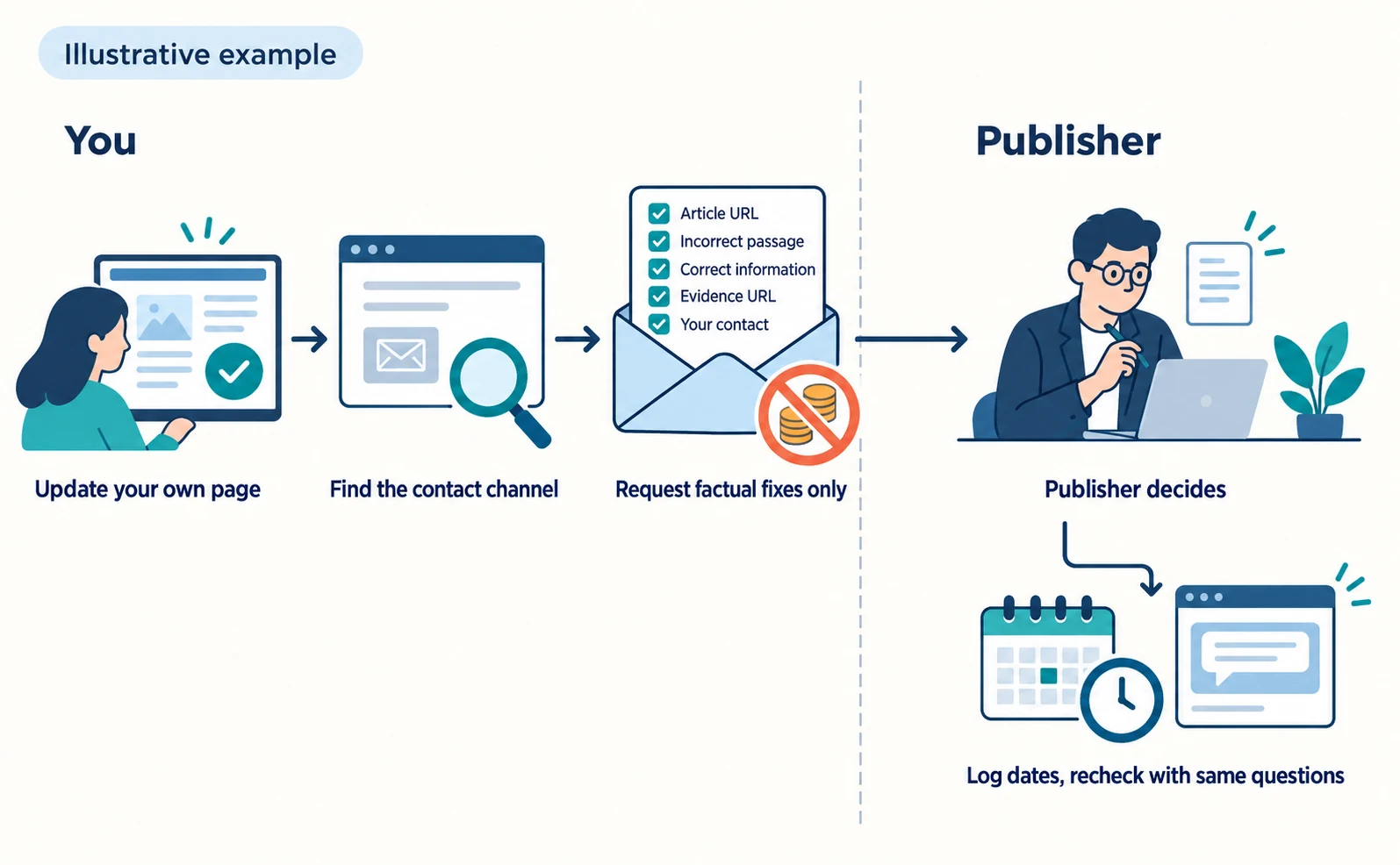
Even after a correction, AI answers may not change right away. Record the request date and the date of the fix, then check again later using the same questions from the previous section.
| Request date | Publisher | Request | Response | Fix confirmed | AI rechecked |
|---|---|---|---|---|---|
| Sep 24 | Comparison site A (example) | Pricing correction | Will update | Not yet | Not yet |
What to avoid when seeking new coverage
Avoid paid placements with links that pass ranking credit, and avoid mass-producing low-value promotional pages. Google may treat these practices as spam, and no placement method guarantees more AI citations.
Google's search spam policies cover attempts to manipulate generative AI responses in Google Search, not only attempts to manipulate rankings.[3] Sites that violate the policies may rank lower or not appear in results at all.[3]
For example, paying for articles with links intended to boost search rankings is listed as link spam.[3] Advertising or sponsorship links themselves do not violate the policy when they carry a rel="sponsored" or rel="nofollow" attribute.[3]
This attribute is a short label added to a link. It tells search engines that the link is an ad and should not be used for ranking. Before a paid placement, confirm with the publisher that the content is labeled as advertising and that links carry this attribute.
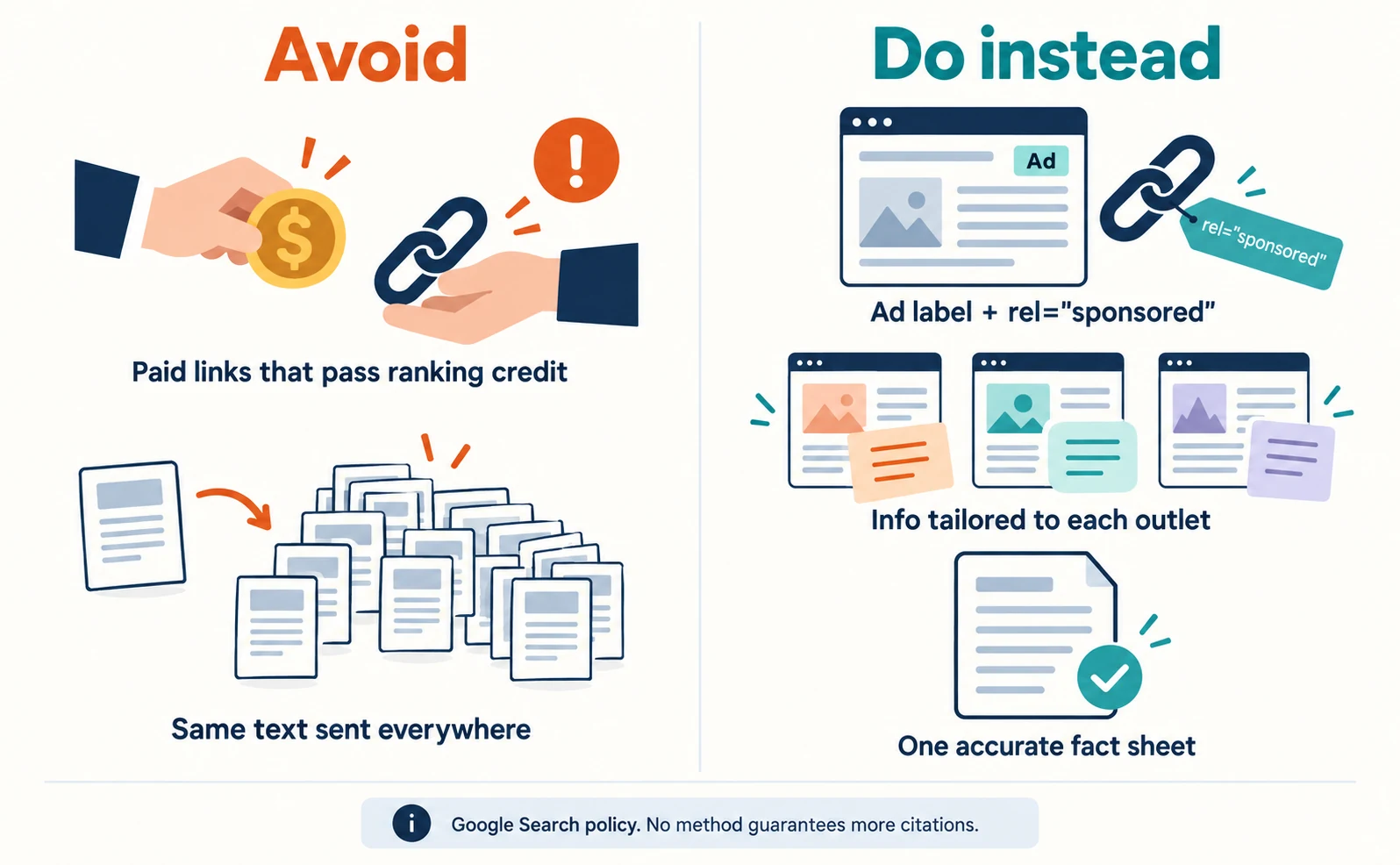
Using generative AI or other tools to create many pages that add little value for readers is also listed as spam.[3] Do not distribute the same promotional text across many sites.
Note that this is Google Search's policy. It does not tell us how ChatGPT or other AI services treat these practices.
| Practice to avoid | Why | What to do instead |
|---|---|---|
| Paid articles with links that pass ranking credit | May count as link spam | Confirm links carry rel="sponsored" and the content is labeled as advertising |
| Distributing the same text to many sites | Mass-producing low-value pages is a listed spam example | Provide information tailored to each outlet's readers |
| Asking outlets to publish unsupported claims | Wrong information may be used in AI answers | Share only figures whose period and scope you can explain |
Instead, prepare materials so you can give accurate information when an outlet asks for an interview or a mention. Put your official service name, target customers, what the service does and does not do, pricing, and official page URLs on one page.
When comparing agency proposals for third-party coverage, note that terms such as LLMO and GEO may cover different work. For the differences, see LLMO, GEO, AEO and AIO: Understanding AI Optimization Terms.
As a first step, list the third-party sites AI cites for your three main questions. You will then know which sites to check and whom to contact.
FAQ
- Q. Will a paid listing on a comparison site get us cited by AI?
- There is no guarantee. If you pay for a placement, confirm with the publisher that it is labeled as advertising and that links carry rel="sponsored" or a similar attribute. Google lists buying links that pass ranking credit as an example of link spam.
- Q. Do press releases help with LLMO?
- It has not been shown that they increase AI citations. Google lists links that pass ranking credit in articles or press releases distributed on other sites as an example of link spam. Use press releases to share accurate information, and check results later with the same questions.
Sources
- [1] An Analysis of 350,000 B2B SaaS Articles: What Predicts Google Ranking and AI Citation (Citera) — accessed 2026-09-23
- [2] New AI Visibility Insights in Bing Webmaster Tools: Intents, Topics, Citation Share, Compare (Microsoft Bing) — accessed 2026-09-23
- [3] Spam policies for Google web search (Google Search Central) — accessed 2026-09-23
About the author
Shogo MizushimaCEO of kairos Inc. / AgentSignal Developer
Develops AgentSignal, a tool for measuring AI crawler visits and AI-referred traffic, and diagnosing AIO readiness. Writes about measurement and practical improvements for AI search using observed data.
Related articles
AIO and AI search
What Is LLMO? How It Differs from SEO and Why Some Say It Is Pointless
LLMO is the work of helping answers from ChatGPT and other AI find and accurately describe your company. Learn how it differs from SEO, why some call it pointless, how E-E-A-T relates, how to measure results and what to do in the first month.
Published

AIO and AI search
What Is Organization Structured Data? Aligning Company Details and Official Links
Mistaken for a same-name company, or your site name and authors don’t show correctly? Align your company overview and official links, then describe them with Organization, WebSite and author structured data, and check the results after publishing.
Published
AIO and AI search
LLMO, GEO, AEO and AIO: Understanding AI Optimization Terms
LLMO, GEO, AEO and AIO are names for work that helps AI answers find your company. Learn what GEO and AEO mean, how GEO differs from local map optimization, where the terms overlap, and how to compare proposals that use different names.
Published