How to Build LLMO Comparison Pages: 1840 & Co's Reported 0% to 11% AI Visibility

Examine 1840 & Co's reported AI visibility result, then build a comparison page with consistent criteria, documented evidence, and repeatable observation.
Before placing the business first in an LLMO comparison article, define what the reader needs to compare. Price, service scope, and the work remaining after purchase can all matter. Consistent criteria make it possible to explain when the business fits and when another option does.
A public case concerning staffing company 1840 & Co reports AI visibility moving from 0% to 11%. Its provider, Profound, describes comparison content, FAQs, and ongoing observation.[1]
LLMO, or large language model optimization, concerns helping information be discovered and represented appropriately in services built around large language models. This guide explains the reported metric and a practical process for producing one evidence-based comparison page.
The production workflow and worksheets below are our proposals. They do not reproduce 1840 & Co's internal process or predict equivalent results.
What 1840 & Co's reported 0% → 11% actually measures
The figure is AI visibility reported by Profound, not revenue or inquiry growth. Identify the observed outcome before applying the headline to another business.
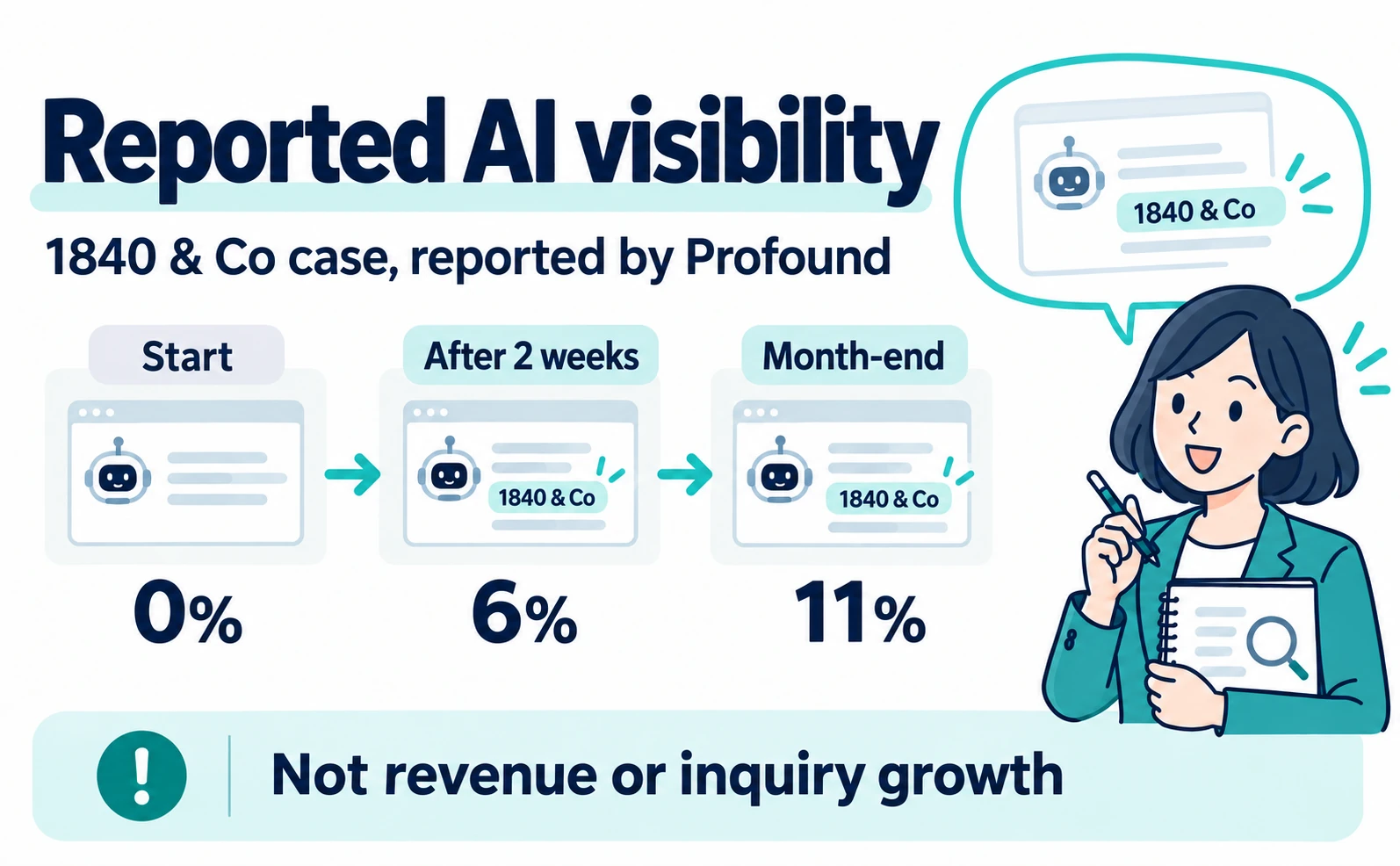
Figures are reported in the Profound case. The illustration is not an actual dashboard.
Profound describes a progression from 0% at the start to 6% after two weeks and 11% by month-end. It concerns brand presence in AI answers; the case does not isolate the comparison article as the sole cause.[1]
The source mentions observing many questions but does not publish all prompts and aggregation conditions needed to reproduce the result. Sales, registrations, and inquiries cannot be derived from that percentage.
Consequently, “publish a comparison and reach 11%” is not a supported target. The questions, AI services, and number of observations affect what is measured.
A prompt naming a business differs from an unbranded request for training services for a small company. Replacing an unbranded question set with branded questions could raise mentions without showing broader discovery.
Name appearance, a link to the official site, and an actual recommendation are also different. Record each separately to understand what needs improvement.
| Change to inspect | Record | What it does not establish |
|---|---|---|
| Name appears | Brand mention in the answer | Whether it was recommended |
| Page is cited | Actual linked URL | Whether anyone clicked |
| Business is a candidate | Conditions under which it is suggested | Whether someone bought or applied |
| Site receives a visit | Referrer and visit record | Total audience of the AI answer |
| Inquiry is completed | Completed inquiry count | Whether the comparison page alone caused it |
For an editor, accuracy of presentation is an early concern. Is the business described as suitable for unsupported company sizes? Is work outside its offering attributed to it? More exposure with incorrect conditions does not help a buyer.
Replace broad report labels such as “AI optimization results” with the state actually counted: for example, how many responses to a fixed question set mentioned the business.
Retain original responses too. A total alone cannot distinguish a positive recommendation from an example of an unsuitable provider. Prompts, answers, links, and timestamps allow later review.
The transferable task is organizing comparison material and repeatedly checking how it is represented. Pair publishing with observation so the work leads to specific corrections rather than ending with the article's release.
The reported work: comparisons, positioning, short FAQs, and observation
The case describes including the business in comparison content, explaining its position, adding short FAQs, and observing results over time. It is not an experiment measuring the independent effect of each element.
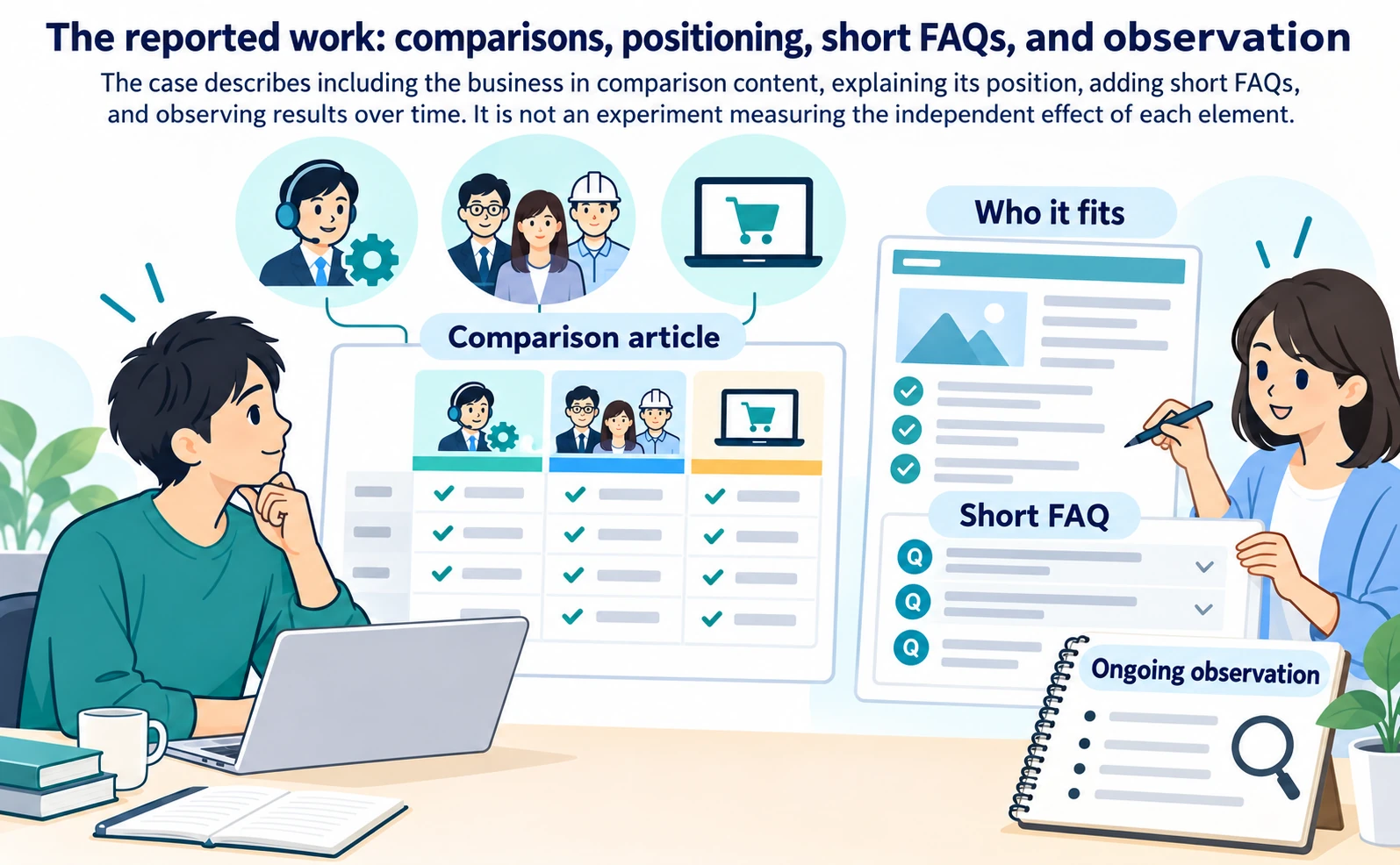
Illustrative diagram; interfaces and work records are conceptual.
Profound describes a ten-company article at the time, with 1840 & Co listed first, and FAQ additions.[1] It does not establish a general rule that self-ranking first produces AI recommendations.
A company publishing a comparison usually has a commercial interest. Make that authorship clear and let readers verify the conditions instead of presenting the article as an independent ranking.
A training provider might explain that it is comparing options, including its own, to help an implementation owner evaluate approaches. Distinguish knowledge of the company's own service from information checked in competitors' public materials.
There is no need to avoid describing strengths. But “best” does not explain fit. Specify verifiable differences: individual consultation, materials-only access, or particular operational support.
A business wanting employees to repeat the same material independently has different needs from one seeking a curriculum designed around its own work. Explaining those circumstances helps readers evaluate suitability before contacting a provider.
Introduce selection criteria before candidate descriptions, then use the same fields for each candidate. Readers should not have to hunt through inconsistent paragraphs to compare equivalent information.
Short FAQs can address remaining questions, such as what the fee includes or what must be prepared. They need not duplicate every statement already in the table.
For updating questions and answers in an existing article, see the Alchemy case on FAQs and concise answers. This guide focuses on constructing the comparison itself.
The current article groups options by type, not a simple ranking
The currently published 1840 & Co article organizes eight options by type. Keep that current version separate from the ten-company version described in the case.[2]
The current comparison distinguishes broader managed support, specialist talent networks, and freelance platforms. It discusses circumstances favoring a candidate and circumstances favoring alternatives.[2]
When checked on September 29, 2026, the page displayed publication on November 14, 2024 and an update on July 28, 2026. Its current structure cannot be treated as proven evidence of the changes that produced the historical result.
Read the categories as well as the list. Then inspect the conditions describing fit. Options serving the same broad hiring goal can leave different responsibilities with the buyer.
Applied to a training comparison, separate self-paced materials, scheduled classes, and company-specific programs. Preparation and use cases differ across those approaches.
Price alone can obscure that difference. Access to materials and a trainer designing a company-specific program include different work. Explaining types first makes clear why a cheapest-first list may be inadequate.
Categories alone do not ensure a fair comparison. Detailed praise for the publisher and one-line descriptions of competitors leave uneven evidence. Use consistent fields within comparable categories and state where cross-category comparisons are limited.
The current page is still 1840 & Co's own publication. Treat it as an example of editorial structure, not an independent third-party ranking.
How to build an LLMO comparison page
Define who is choosing what, then organize option types, comparison criteria, and evidence. Those decisions make the order and depth of candidate descriptions easier to determine.
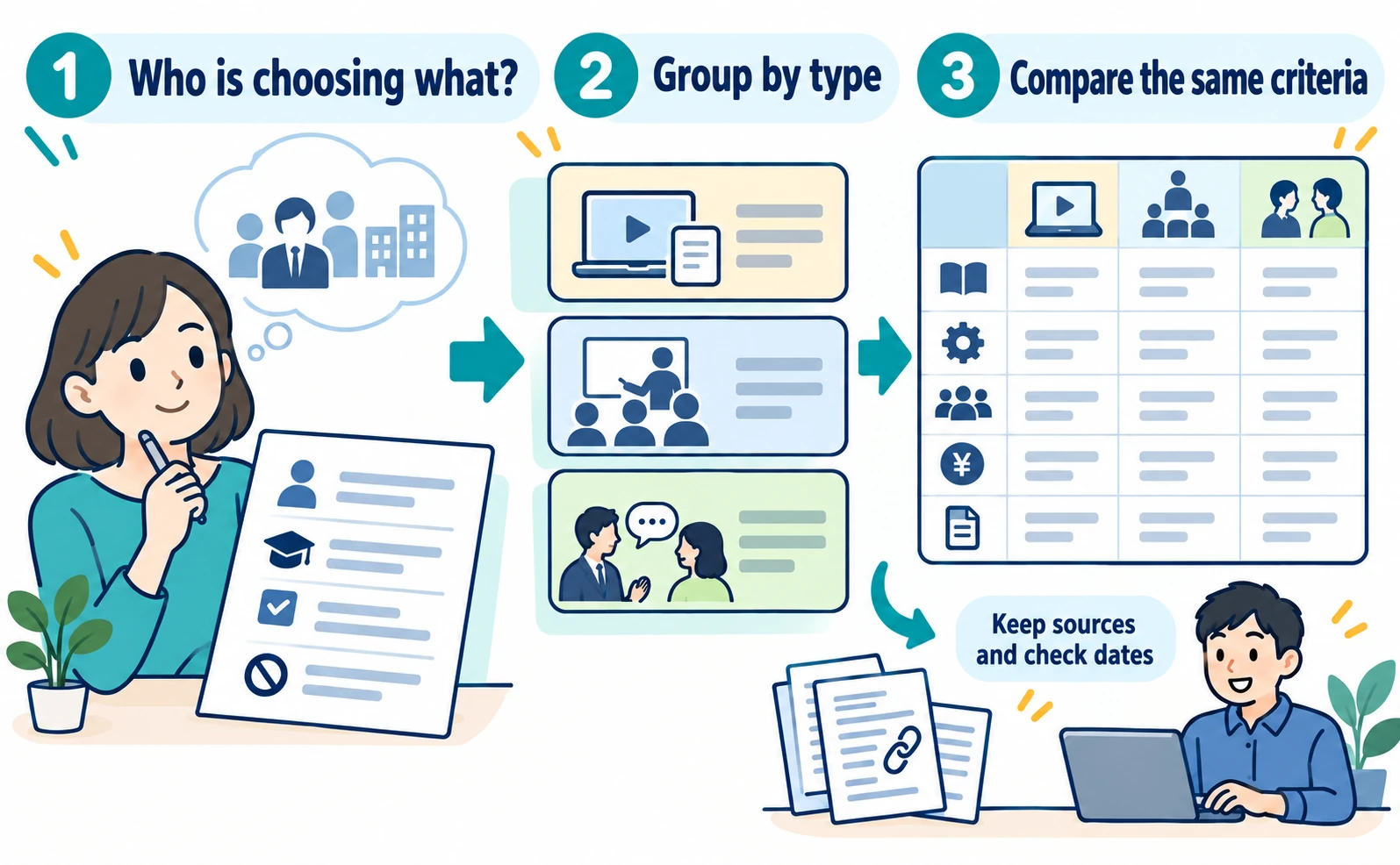
Illustrative diagram; interfaces and work records are conceptual.
The running example is a fictional training company writing about new-employee training for small businesses. No real providers or prices are invented. The tables are designed to be filled using actual research.
Prepare current internal service documentation, candidate providers' official pages, a research spreadsheet, and a drafting document. Identify someone who can verify the company's own conditions before publication.
Keep the first page focused. “All corporate training” combines management development, specialist skills, and other distinct needs. Here, the reader is responsible for arranging introductory training for new employees in a small business.
Define the buyer's decision and group options by type
Write four things: reader, decision, mandatory conditions, and exclusions. Use that scope both to select candidates and to introduce the article.
The following settings are illustrative, not market-wide definitions.
| Scope field | Example |
|---|---|
| Reader | An operations or HR employee arranging new-hire training |
| Decision | Use external instruction or run training internally with materials |
| Mandatory condition | Start with a small group and understand internal preparation |
| Comparison criteria | Learning format, customization, internal workload, cost scope |
| Excluded topics | Specific qualifications, management training, legally mandated training |
Define the intended size range in the production brief. If a public article uses a numerical range, explain the scope. Do not infer small-group eligibility without checking a provider's conditions.
Next, organize service types rather than assigning company rankings immediately.
| Type | What to verify | Work that may remain internally |
|---|---|---|
| Self-paced materials or video | Content, access period, progress visibility | Enrollment guidance, progress checks, questions |
| Scheduled classes | Dates, audience, syllabus, participation method | Attendee selection, scheduling, follow-up |
| Company-specific program | Customization scope, trainer consultation, preparation period | Sharing objectives, gathering examples, assigning a contact |
This is a planning framework. Actual responsibilities vary by provider; do not infer individual features from the category.
When collecting candidates, check official descriptions relevant to the scope. Do not simply transfer search-result snippets. Verify audience, delivery method, and contact information on the provider's site.
Record a reason for including each option: published small-group conditions or documented company-specific planning, for example. Search position alone does not establish relevance.
There is no need to impose a ten-company quota. If fewer suitable options exist, explain the verified range rather than adding unrelated services to enlarge the list.
Check whether the chosen categories unfairly favor the publisher. A company selling customized instruction can still explain when materials alone may fit a business that already has a trainer.
A concise introduction might state that the article compares learning formats and organizer preparation for small-group new-hire training, excluding qualifications and management development.
The output at this stage is a candidate list and inclusion reasons. Verify their fit before drafting long profiles.
For a research handoff, state inclusion and exclusion rules together. “Find popular services” may produce only well-known names. Asking for candidates whose relevant eligibility can be officially verified aligns the task with the reader's decision.
A provider may span multiple categories. If it sells both materials and custom programs, specify which plan or method is being compared. Categorize the offering the reader would buy rather than forcing the whole company into one box.
Similarly, distinguish similarly named services for individuals and businesses. Record the formal service name and the audience of the researched page to avoid mixing conditions.
Apply the same criteria to every provider and explain when alternatives fit
Use the same relevant criteria for the publisher and competitors. Choose fields from the reader's decision rather than adding only those that favor the business.
For training, begin with content, participation format, customization, organizer preparation, and included costs. Investigate each candidate in that order.
The research table should include evidence and verification status, not just answers. An empty field is an unresolved question, not an invitation to guess.
| Field | Information to enter | Evidence to retain |
|---|---|---|
| Content | Intended work and learners | Official course description |
| Delivery | Verified video, online, or in-person formats | Participation instructions |
| Customization | Available changes and conditions | Service description or verified response |
| Internal preparation | Materials, contact role, technical requirements | Onboarding or delivery guide |
| Cost | Published amount, unit, included work | Pricing page and verification date |
| Unknowns | Conditions unavailable publicly | Questions for follow-up |
One spreadsheet structure uses candidate in column A, criterion in B, verified detail in C, source URL in D, check date in E, and status in F. The published comparison need not expose the entire working research table.
Keep the article's table focused on decision-useful information while retaining detailed evidence in the production record. Publishing every research note can make the conclusion harder to find.
Research can proceed provider by provider or criterion by criterion. Establish each provider's audience and format first, then compare pricing, preparation, and support across the set. This helps reveal inconsistent fields.
Link to the page containing the actual condition, not just the homepage. Add a location note such as “additional costs below the pricing table” when useful, reducing review effort.
Keep the date of verification distinct from the source page's update date. Reading a page today does not mean the provider updated it today. Label dates accordingly in public wording too.
Recognize the information advantage when writing about the publisher's own service. A competitor's less detailed public documentation is not itself proof of inferior service. Separate verified information from what needs an inquiry.
Check billing units before comparing amounts. Per-person, per-session, annual access, and individual quotes are different. Avoid a cheapest-first ranking when conditions cannot be aligned.
If materials access excludes trainer consultation, place that condition beside the cost. If another offer includes consultation, verify the scope and duration. “Support included” alone is insufficient.
For unpublished prices, state that a quote is needed rather than assuming expensive or inexpensive. Explain what headcount or scheduling information is needed to request one, where verified.
Likewise, distinguish “not found in official information” from “unsupported.” The latter requires evidence. For a provider response, retain when it was obtained and the conditions it addressed.
Draft candidate descriptions from verified facts. This is a fictional template for a materials-based option:
This approach uses a defined curriculum that employees study independently, with progress reviewed internally. It may fit teams needing flexible study times. Businesses requiring a trainer-led program built around company examples should also compare customizable services. Confirm the access period and question-support scope before contracting.
The sequence covers format, suitable conditions, circumstances favoring another option, and unresolved checks. Replace every detail with the actual offering before publication.
Use the same sequence for the publisher. A customized program can explain what is adjustable and what preparation meetings involve, while acknowledging that materials-only access may better fit someone wanting immediate independent study.
Explaining when an alternative fits clarifies the business's scope. It is not a requirement to disparage the publisher. Clear responsibilities can also make initial inquiries more productive.
Review adjectives after drafting. Replace unsupported superlatives with specific facts: supported subjects, the content of consultation, or documented delivery conditions.
Choose an understandable order, such as category followed by name. If the publisher appears first, explain the ordering so placement is not mistaken for a proven overall rank.
Scoring requires criteria, weights, and evidence. For a first page, explaining equal conditions in a table may be more useful than assigning numbers that cannot be justified.
A reusable production brief is:
Create a comparison for [reader] choosing [service]. Cover [scope] and exclude [out-of-scope topics]. Group candidates by [types]. Explain each candidate using audience, delivery format, internal preparation, cost conditions, and suitable circumstances in that order. Apply the same fields to our company and competitors. Use the verified evidence table. Do not fill unresolved fields by guessing. Describe conditions favoring alternatives as well as our own service. Do not present listing order as an overall ranking.
This can guide a human writer or a writing assistant. If AI is used, check especially for features or prices absent from the evidence table. Fluency does not prevent specifications from being assigned to the wrong candidate.
Review one candidate's factual claims against the evidence, then inspect the same criterion across the others. This is more concrete than judging only the article's overall impression.
If the publisher receives a detailed preparation period while a competitor is called merely “easy to adopt,” the comparison is uneven. Mark unknown preparation requirements as unknown and explain what to ask rather than substituting an evaluative phrase.
Situation-based conclusions should also trace back to verified conditions. Suggest comparing self-paced options for flexible schedules or confirming customization for company-specific examples. A generic recommendation repeated for every candidate adds little direction.
After the table, explain circumstances that change the decision: whether all employees can attend together, whether internal staff can monitor progress, or whether company examples are essential.
Reserve FAQs for remaining doubts. Small-group eligibility may vary by candidate; preparation questions can explain what to organize before an inquiry. Make publisher-specific answers clearly about the publisher.
Once drafted, separate factual review from rendering review. Check prices, audience, delivery, and links against the evidence table. Then inspect desktop and mobile display, including correspondence between candidate names and source links.
If a table becomes too wide, reduce columns and move detailed explanations into nearby candidate sections. Keep decisive exclusions visible in the comparison itself.
Ask another reader to explain which options fit a stated situation. If they cannot, improve the categories and criteria before adding more candidates.
Completion means readers can narrow options and identify what remains to verify. Trying to send every reader to one provider makes it harder to describe fit honestly.
After publication, leave the editor and open the actual URL. Check table-of-contents navigation, source links, and the current inquiry destination.
On mobile, ensure the relationship between candidate names and conditions stays understandable while scrolling. Fewer columns or nearby concise descriptions may help when the candidate name disappears off-screen.
Keep category definitions and decisive conditions in body text even when adding illustrations. Readers should understand the comparison if an image fails to load.
Repeat the same question set after publication
Save prompt wording and conditions, then record how the business is presented. Track explanation accuracy and cited pages as well as name appearances.
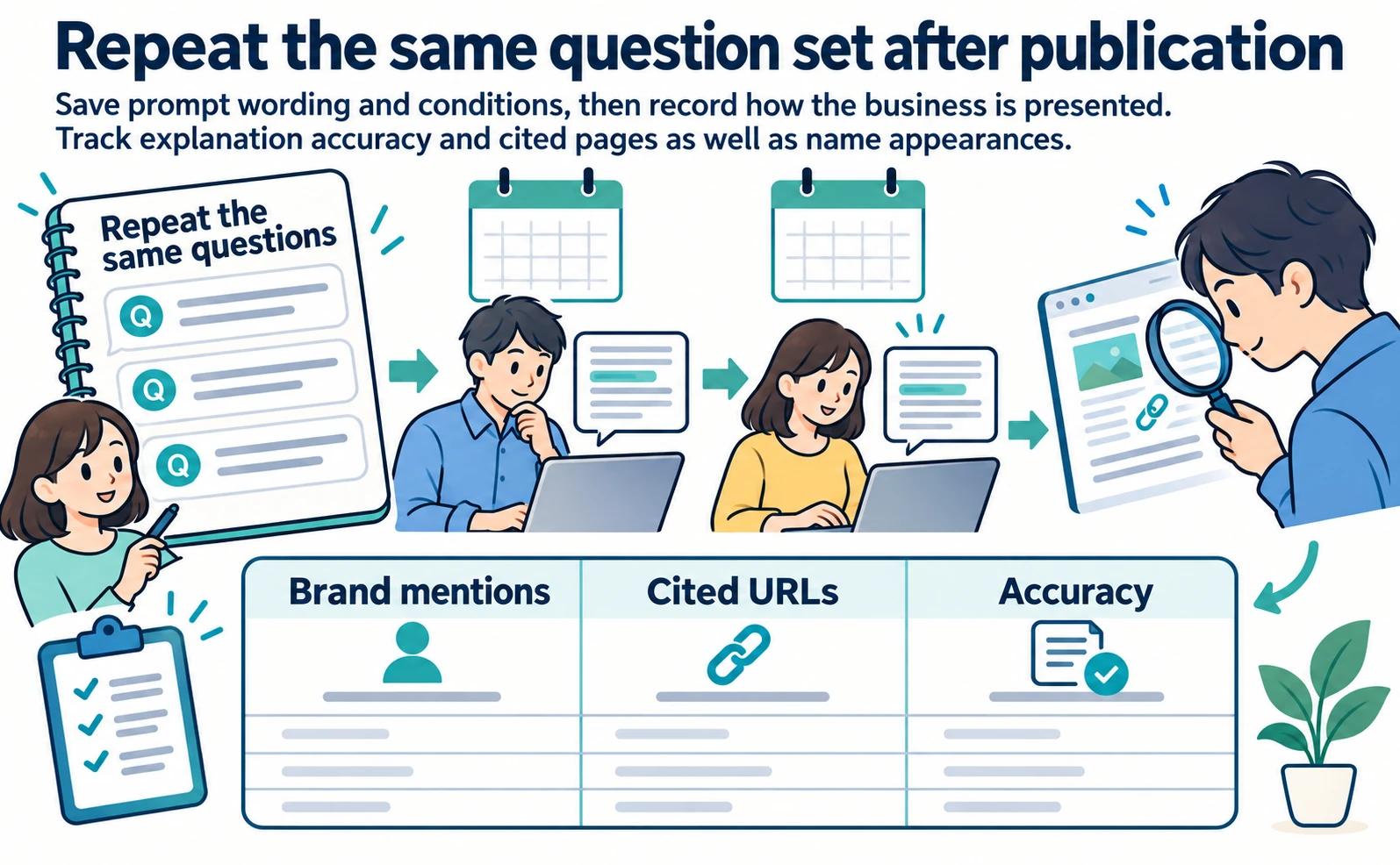
Illustrative diagram; interfaces and work records are conceptual.
Build initial prompts from the buyer scenario. These are our fictional observation examples, not queries collected from real customers.
A small company is considering training for new employees. Which delivery formats should it compare if reducing organizer preparation is important? Include official support for any named candidates.
When should a company choose self-paced new-hire training rather than scheduled classes?
What should a company verify before contracting for new-hire training tailored to its own work?
Keep branded and unbranded questions in separate groups. One examines discovery among options; the other examines how accurately the known business is described.
Save the initial questions before publication or at the first observation. Add new questions with dates and keep them separate from the original group. Do not rewrite a prompt until a favorable answer appears and retain only that result.
A spreadsheet is sufficient to begin. The essential requirement is tracing each answer to the question and conditions that produced it.
| Field | Record |
|---|---|
| Question ID and wording | Exact reusable prompt |
| Time | Date and time |
| Service and conditions | AI service, displayed model, search use where visible |
| Brand treatment | Absent, mentioned, or recommended as a candidate |
| Accuracy | Audience, conditions, and service scope |
| Citation | Actual accessible URL |
| Article version | Publication date and latest change |
| Other changes | Pricing updates, announcements, other initiatives |
Define how name variants count. Japanese and English names or abbreviations may refer to one company; unrelated companies sharing a name should not be included.
For a simple fictional calculation, two mentions across ten responses can be reported as two out of ten, or 20%. This arithmetic does not reproduce Profound's AI visibility methodology.
If each of ten questions is tested three times, distinguish ten questions from thirty answers. “Questions with at least one mention” and “responses containing a mention” use different denominators. Do not compare rates across a methodology change without explaining it.
Keep counts beside rates. With ten answers, a one-answer difference changes the rate by ten percentage points. Movement alone does not establish a stable trend.
When mentioned, open the citation. It may point to the new comparison, another company page, or a third-party article. Name presence alone does not prove the comparison page was used.
For an inaccurate description, check whether the source page is ambiguous. If a materials-only offering is described as trainer-led, verify whether scope is clearly stated nearby. Editing the source may improve clarity but cannot directly guarantee the AI's next answer.
If absent, check prompt-to-page fit before repeating the company name more often. A question about custom instruction may not be answered by a materials-only comparison. Revisit the selection conditions in the body.
For deeper citation research, see how to inspect sources AI cites for competitors. Separate citation investigation from drafting so each leads to a clear task.
Track site visits and inquiries too, but do not infer sole causation when their timing overlaps with increased AI mentions. Record advertising, sales work, and pricing changes in the same period.
Comparison pages also require maintenance. When a candidate's price or scope changes, verify the affected facts and record the update. Do not imply that the entire article has been reverified merely by changing its displayed date.
Assign an owner and review triggers: a known price change, a broken link, or recurring new sales questions. Set a regular interval the team can sustain as well.
Not every update requires replacing the shortlist. First revise the affected condition and assess whether it changes eligibility. Ending small-group support might invalidate a candidate; a new contact URL may only require a link update.
Describe changes specifically: “Updated candidate A's access period” or “Added candidate B's customization conditions.” Such records are more useful for later comparison than “improved the article.”
Use three categories for observation-led revisions. Update outdated facts; clarify ambiguous fit conditions; and route genuinely different questions to another explanation rather than stretching the page's scope.
For example, a question about training internal instructors will not be answered merely by adding more external providers. Preserve the comparison's purpose and create or link to the additional explanation readers need.
When inquiries inform an update, remove identifying details and extract questions that generalize. Repeated questions may reveal a missing criterion; a single unusual contract condition should not automatically become a universal FAQ.
This connects monitoring to reader problems rather than only chasing a percentage. Even during flat numerical periods, record improvements in evidence freshness, clarity, and preparation guidance.
When observation ownership changes, hand over the prompt set and counting definitions. If one person counts recommendations and another counts every name appearance, the metric can change without any content change.
Include one real example of a correct and an incorrect presentation where available. Use saved observations; do not place fictional explanatory responses in the results dataset.
For foundations, see what LLMO means. For a different way of organizing comparisons, see Ramp's company-size-specific comparison pages.
Begin with one buyer scenario, group options by type, and collect evidence under consistent criteria. Retain the published article and the questions used to observe it together, so the next review starts from concrete records.
FAQ
- Q. Does listing our business first guarantee AI recommendations?
- No such general rule is established. The case includes several activities and does not isolate ranking position as a cause.
- Q. How should an undocumented competitor feature be described?
- Mark it as unverified rather than unsupported. Identify the conditions to check or the relevant contact route where necessary.
- Q. What should be compared after publication?
- Using fixed prompts and recorded conditions, track mentions, actual cited URLs, and explanation accuracy. Measure visits and inquiries separately.
Sources
- [1] 1840 & Co AEO case study (Profound) — accessed 2026-09-29
- [2] Remote staffing agencies (1840 & Co) — accessed 2026-09-29
About the author
Shogo MizushimaCEO of kairos Inc. / AgentSignal Developer
Develops AgentSignal, a tool for measuring AI crawler visits and AI-referred traffic, and diagnosing AIO readiness. Writes about measurement and practical improvements for AI search using observed data.
Related articles
AIO and AI search
Why Does AI Recommend Your Competitors? How to Check Cited Pages
When AI answers keep recommending competitors, start with the cited links. Learn how to sort cited pages by type and use a decision table to choose between updating your own page, contacting another site, or accepting that wording alone will not fix it.
Published
AIO and AI search
What Is LLMO? How It Differs from SEO and Why Some Say It Is Pointless
LLMO is the work of helping answers from ChatGPT and other AI find and accurately describe your company. Learn how it differs from SEO, why some call it pointless, how E-E-A-T relates, how to measure results and what to do in the first month.
Published
AIO and AI search
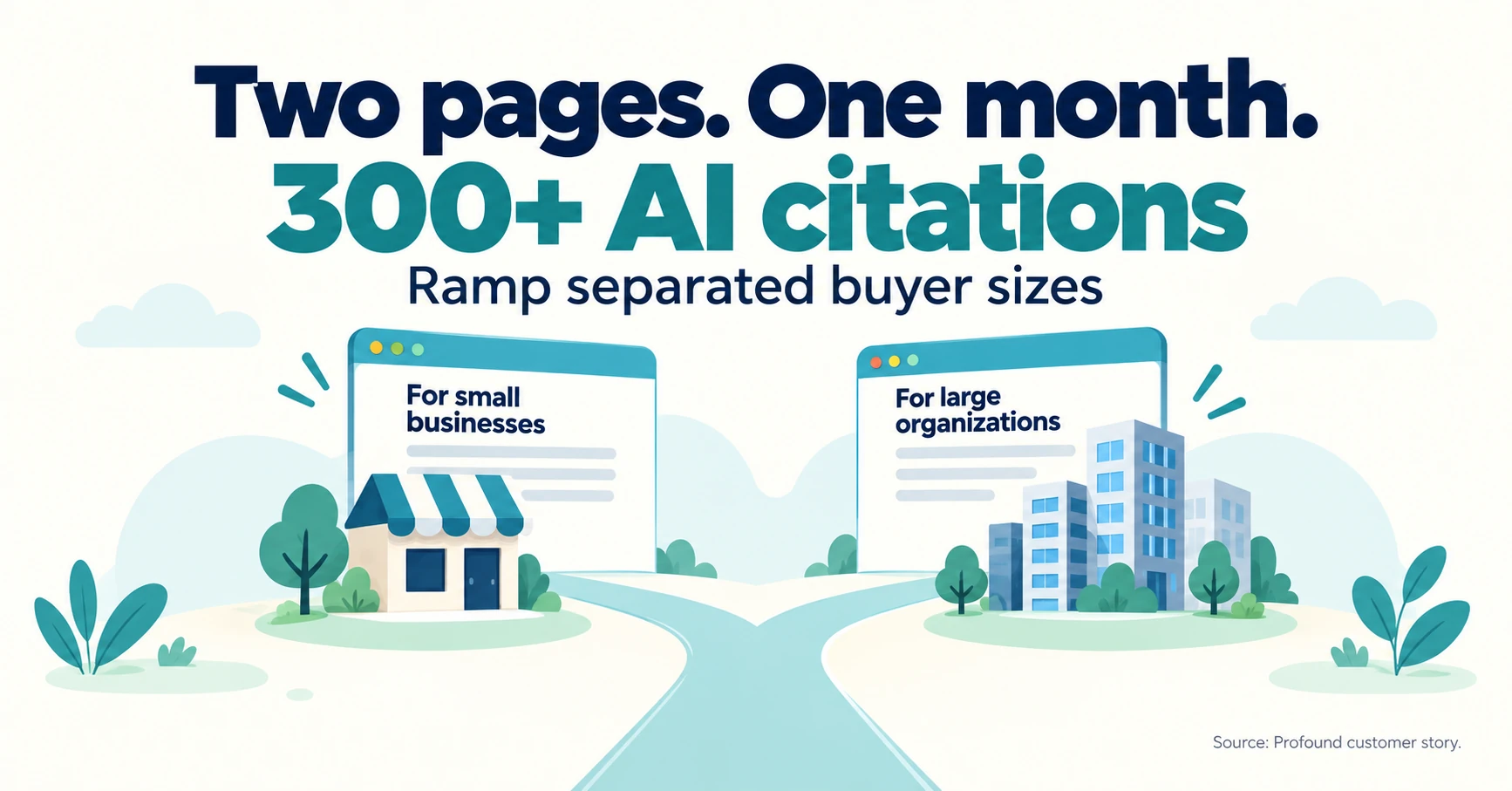
Over 300 AI citations in a month: Ramp’s two company-size comparison pages
Ramp reported more than 300 AI citations across two comparison pages in one month. Separate pages addressed accounts-payable requirements for small and large businesses.
Published