AI Search Optimization: Alchemy's 7× Signup Rate and What It Added to Older Articles
Read Alchemy's reported AI signup-rate comparison, then follow a practical workflow for adding verified questions, short answers, and conditions to existing articles.
Before adding more articles to an AI search optimization program, look at the pages already published. Can a reader find answers to the questions customers regularly ask?
Alchemy offers one example of AI referrals leading to registrations. Its provider, Profound, reports that visitors arriving through AI converted to signups at seven times the rate of other sources.[1]
The work behind that headline is worth examining: adding FAQs to older articles and making questions and short answers easier to find. This guide explains what the reported result means and how an editor can test a similar content improvement on one existing page.
Here, AI search optimization means improving information, checking how AI services present it, and helping people discover it through AI answers. The practical workflow below is our proposed application, not a reconstruction of Alchemy's internal process.
Alchemy's 7× AI signup rate: what was being compared?
The figure compares signup rates across acquisition channels. It does not mean revenue or signup volume rose sevenfold after an intervention.
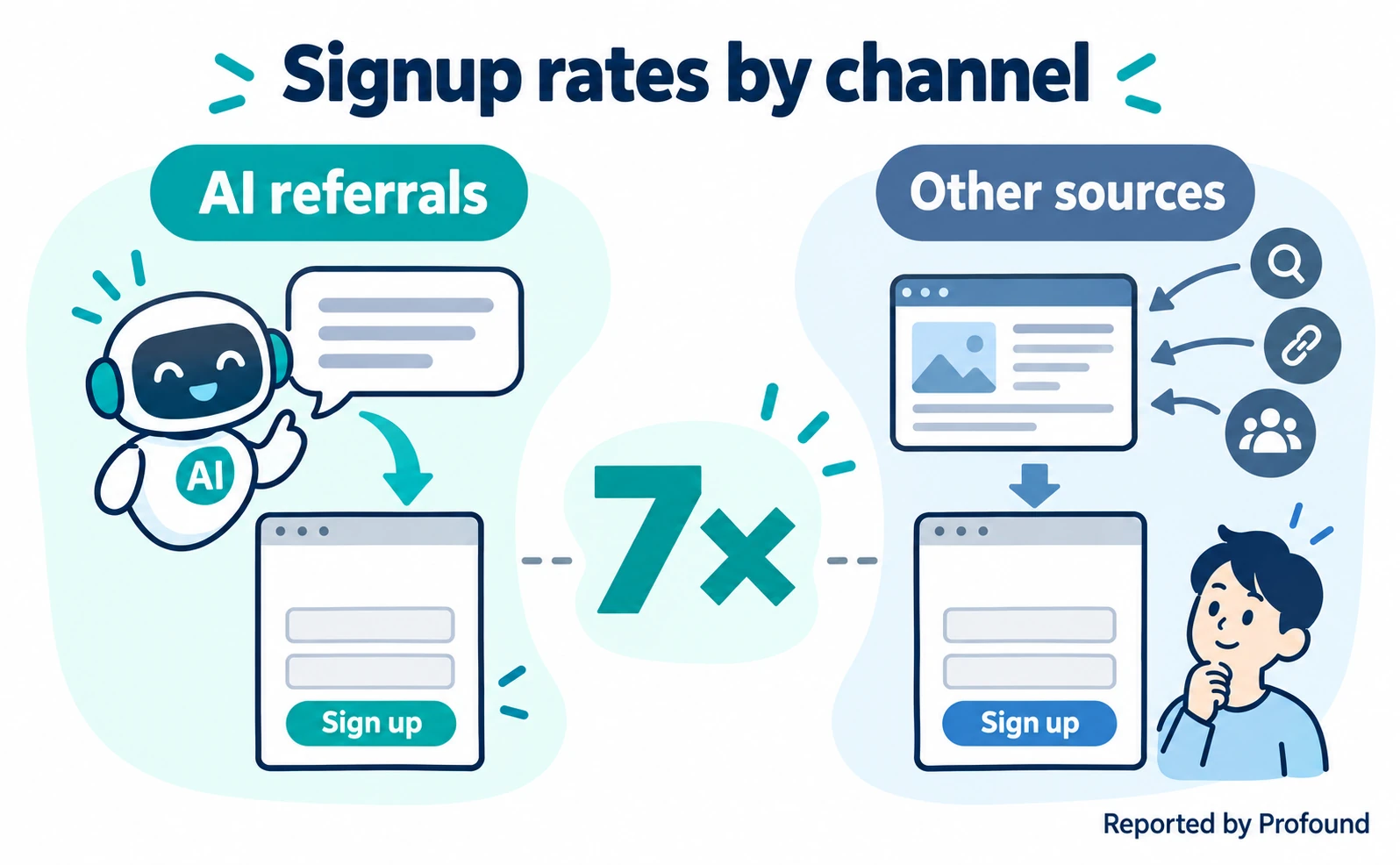
Figures are reported in the Profound case. The illustration is not an actual dashboard.
Alchemy provides infrastructure for developers building blockchain applications. Profound also reports a threefold increase over one year in the share of self-reported signups attributed to AI.[1]
These measures have different denominators. One asks how often visitors signed up; the other asks what share of people signing up named AI as their source.
The public case does not provide the absolute signup rates, sample sizes, measurement window for the rate comparison, or the precise signup event. It is a provider report, not an independently verified experiment isolating individual changes.
Before using a similar metric internally, define the action being counted. Account creation, a free trial, an inquiry, and a paid contract describe different outcomes.
An email registration to download a document should be labeled as such. Calling it a sale would imply an outcome the measurement did not establish.
A high rate alone is also insufficient for a budget decision. A channel with few visitors may produce relatively few signups even when its conversion rate is high. Counts and rates together describe both scale and conversion propensity.
| Question | Useful record | What it does not establish |
|---|---|---|
| Did visitors sign up? | Visits and signups by channel | Whether they later became paying customers |
| How did signups discover the business? | A signup-source survey | Every path they clicked |
| Did AI mention the business? | Answers and cited URLs for saved questions | How many people saw those answers |
| Did the edit help? | Before-and-after records and other changes | Whether the edit alone caused the result |
Start by replacing the vague word “results” in a report with one observable action. That makes it easier to choose metrics relevant to the editorial work.
The content changes: FAQs, question headings, and short answers
The reported approach included adding questions and answers to existing articles and making explanations easier to extract. An FAQ is a set of frequently asked questions paired with answers.
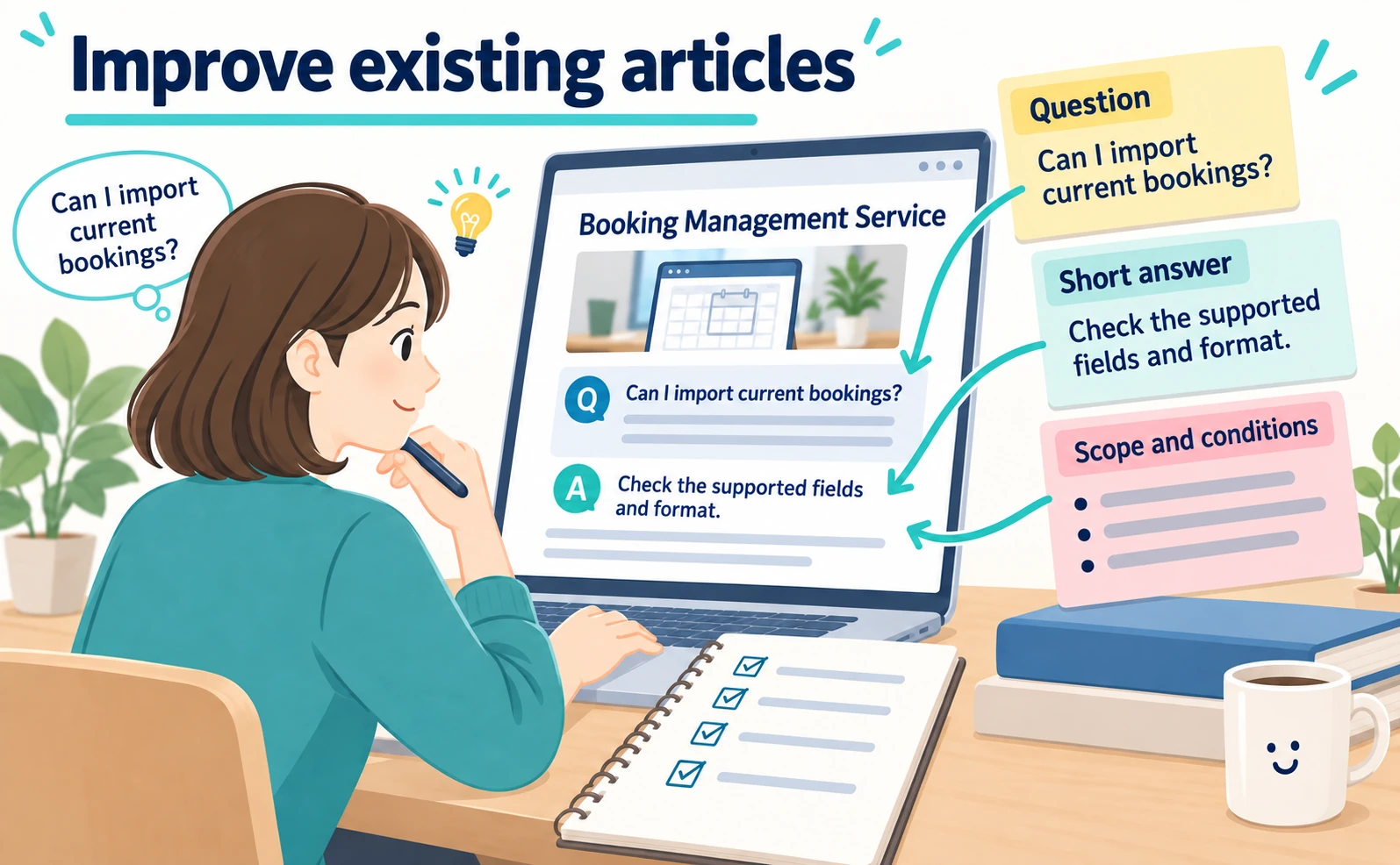
Illustrative diagram; interfaces and work records are conceptual.
Profound describes FAQ additions, question-based subheadings, and concise explanations. The team also examined external sources appearing in citations, but the public case does not establish a page-by-page editing sequence or specific changes made to external pages.[1]
For an internal project, begin with the question a reader still has after finishing the article. This produces a clearer task than simply requesting an FAQ component.
Consider a hypothetical booking-management service whose introduction says only that it is easy to implement. A buyer may still need to know whether existing reservations can be imported, whether reception staff can make changes, and what information must be prepared.
A long article may leave all three unanswered. Describing supported data and the work required from the buyer gives that reader something concrete to evaluate.
Separate the questions before deciding where to add answers.
| Reader's question | Possible location | Information to add |
|---|---|---|
| What can it do? | Introduction or feature explanation | The task and an example |
| Will it work for us? | Eligibility or requirements | Supported environments and exclusions |
| How do we start? | Setup instructions | Required information and the first action |
| What will it cost? | Cost section or pricing page | Billing units and additional-cost conditions |
| What if something goes wrong? | Instructions or FAQ | What to check and where to get help |
This is our suggested planning table, not Alchemy's classification system.
Answers do not all belong at the end. Put an answer near the point where the reader needs it. Reserve a closing FAQ for brief questions that remain after the main explanation.
Avoid copying the same answer into the prose, a table, and an FAQ. Let paragraphs explain reasons and steps, tables compare conditions, and FAQs resolve remaining doubts.
Choosing older articles by grouping questions around products
Alchemy grouped questions by product to help prioritize new and updated content. The public source supports product-level grouping but does not publish its detailed taxonomy.[1]
Applied to a small project, this could mean collecting questions about one service only. Combining booking-management, recruiting, and expense-reporting questions would make the article's audience too broad.
Even questions about one product come from different stages of consideration. Someone asking what a service does needs an overview. Someone asking whether existing reservations can be transferred needs supported fields and preparation steps.
Give each reader the appropriate explanation rather than trying to cover both with a generic sentence.
Traffic is not the only criterion for choosing a page. Consider articles that salespeople repeatedly supplement, support staff regularly send, or readers finish before asking the same unresolved question.
Repeated inquiries do not automatically prove poor writing. Pricing complexity, internal approval, or genuinely individual conditions may explain them. Select a question that published information can reasonably answer.
A useful initial objective is: “After this edit, the page will answer this specific question.” That keeps the work manageable without requiring a complete rewrite.
Looking at a current Alchemy FAQ
An existing Alchemy article provides a visible example of using a short FAQ to revisit a choice discussed in the main text. It is a current-page observation, not a historical before-and-after comparison.
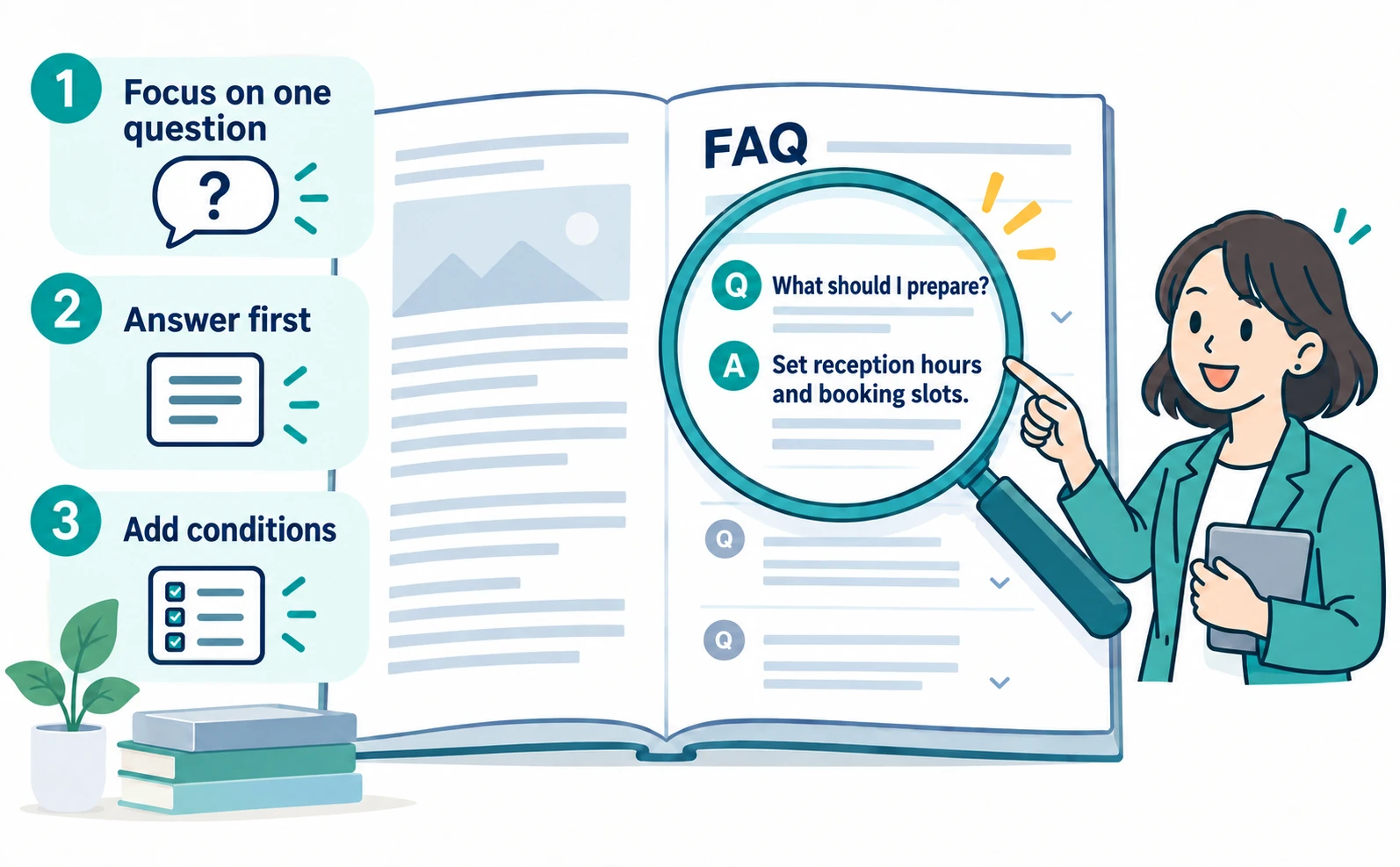
Illustrative diagram; interfaces and work records are conceptual.
The public article concerns building a stablecoin. It displayed a February 3, 2026 update date when reviewed. Its closing FAQ includes a question about choosing an existing outside solution or building internally.[2]
The relevant editorial idea is expressing a decision in the reader's own question format. This guide is not borrowing the article's financial or technical advice.
To inspect the structure, open the page and search within it for “Frequently asked questions.” Find the build-versus-buy question and read the answer immediately below it. Understanding the whole technical article is unnecessary for seeing the question-and-answer relationship.
Use the same technique on an internal article: read each question first, then ask whether the first two sentences provide useful direction.
For example, answering “Is implementation easy?” with “It is easy to implement” merely repeats the claim. Naming what the reader must prepare makes the response actionable.
The following are fictional writing examples, not product specifications.
Question: Is implementation easy?
Answer: It is easy to implement, and anyone can start immediately.
Question: What should be prepared before using booking-management software?
Answer: Decide reception hours and booking slots, and prepare the current reservation list. Check the chosen service's supported file format and fields before attempting an import.
The second answer identifies preparation without promising a completion time or universal ease of use.
Review three things together when revising an FAQ.
Give the question one decision to address. A question combining price, setup, and support invites a sprawling response. Separate cost from migration eligibility.
Make the opening sentence answer the question. A product introduction delays the information for someone asking whether an action is possible. If the answer is conditional, keep the condition nearby.
Follow the short answer with necessary detail. Do not remove exceptions just to fit one sentence. State the answer, scope, conditions, and link to detailed instructions in that order where appropriate.
Keep the answer distinct from sales messaging. A question about required files needs formats and fields before it needs a statement about helpful support.
Explain unfamiliar terms briefly. “CSV supported” may not tell a beginner what to prepare. Keeping the formal name while explaining that CSV stores table data connects the term to a practical action.
Completion does not mean producing five FAQs. It means a first-time reader can identify the next preparation step and the conditions that matter. Concision should preserve the explanation needed to act.
A practical edit on one existing article
Choose one recurring question and add the missing answer to an existing page. The steps below are our suggested workflow, not Alchemy's documented operating procedure.
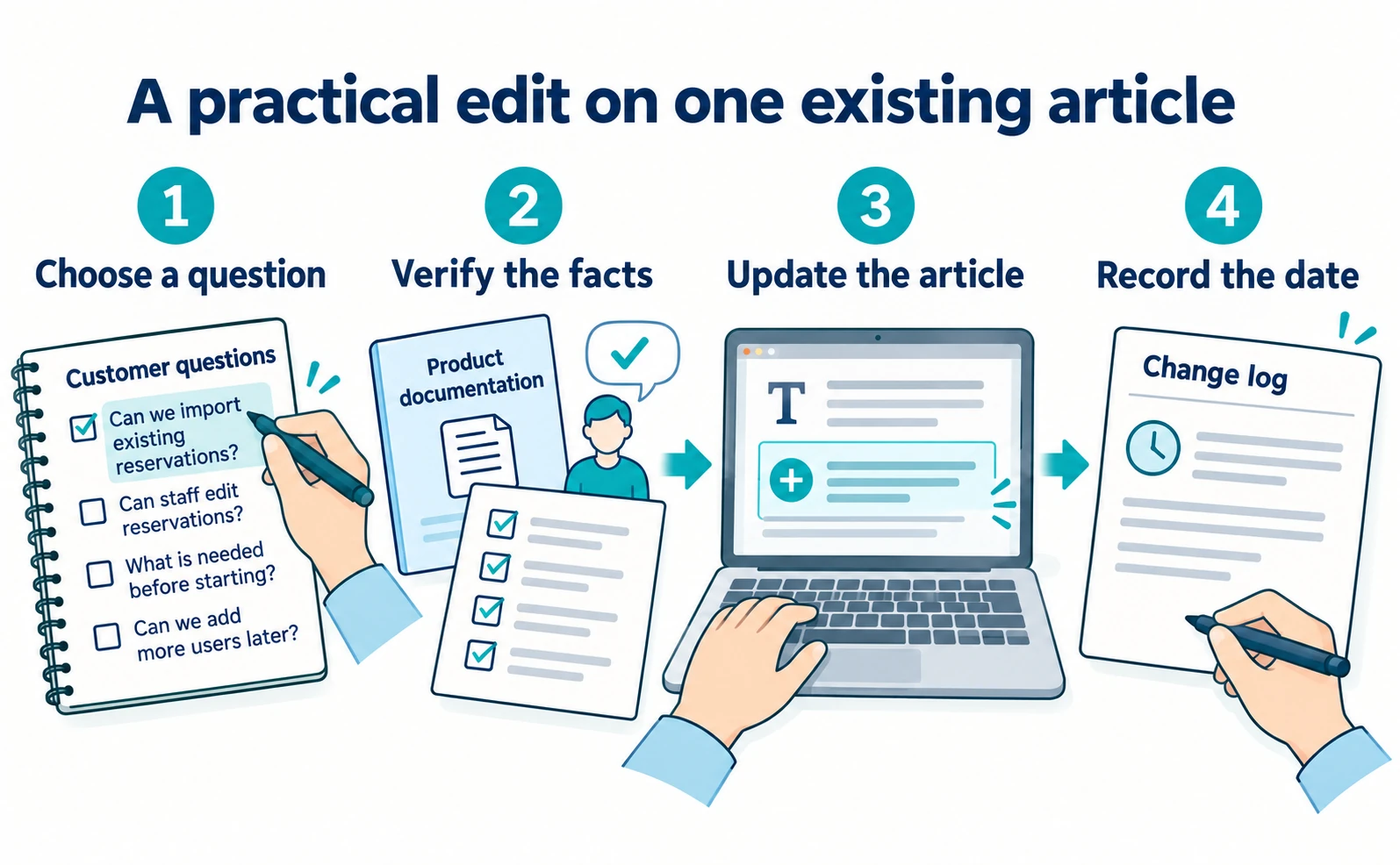
Illustrative diagram; interfaces and work records are conceptual.
The running example is a fictional booking-software company updating an article about choosing a booking-management service. Assume the editor has permission to edit and a product contact who can verify current conditions.
Prepare the published article, inquiry or sales notes, current product documentation, and a document for the proposed edit. Customer names and contact information are unnecessary; extract only the substance of the questions.
Starting across every article would expand both research and review. Complete the full cycle on one page first: choose a question, verify the answer, edit, publish, and observe.
Select a page from recurring customer questions
Choose the page that should answer the question, even if it is not the highest-traffic article.
- Open the inquiry records or sales notes already used by the team.
- List roughly three to five recurring questions about the same service.
- Select one published page closely related to those questions.
- Read the public page and note where each answer appears.
- Mark missing answers or missing conditions as editing candidates.
Three to five is a manageable starting range, not a quota. If only two questions exist, do not invent customer inquiries. Label editorially anticipated questions separately from questions customers actually asked.
The booking example might produce this fictional table.
| Recurring question | Existing answer | Missing information | First verification source |
|---|---|---|---|
| Can existing reservations be imported? | “Migration supported” in setup section | Fields, format, exclusions | Current migration instructions and product owner |
| Can reception staff change reservations? | None | Permission controls | Permissions documentation |
| What is needed before starting? | Only a signup link | Required information and sequence | Onboarding instructions |
| Can the number of users be increased later? | An old pricing link | Current limits and change process | Current pricing page |
The missing-information column becomes the writing brief. It is more useful than “make this more detailed.”
A matching keyword is not an answer. After finding “migration” or “permissions,” read the surrounding text to see whether the reader can determine what is possible and under which conditions.
If the answer already exists, investigate discoverability instead of duplicating it. A clearer heading or a link to the right instructions may be enough.
For information available only in internal materials, verify both current accuracy and what can be published. An exception granted to one customer is not necessarily a standard feature.
Send a proposed public statement with the verification request, rather than asking a vague question.
We want to add migration conditions to the booking-software selection article. Please confirm the supported fields, accepted file formats, excluded information, and eligibility behind the statement “reservation information can be transferred.” Please share any current material suitable for publication and distinguish standard support from individual arrangements.
If the answer is “it depends,” ask what it depends on: the previous service, format, record count, or reservation status. Publish the conditions that can be disclosed.
Where detailed eligibility cannot be published, explain what to prepare for an inquiry. Naming the current service and available export fields is more useful than simply saying “contact us.”
Before writing, retain three things: the target URL, the first question to answer, and evidence supporting that answer.
Add a question heading followed by a direct answer
Put the answer immediately under the question, then add scope, conditions, and examples. A question-shaped heading alone does not repair missing information.
The following fictional rewrite assumes a product owner has confirmed the conditions. Replace every field and restriction with the real product's specifications before using it.
Before
Our booking-management service is easy to introduce. Flexible data migration makes everyday management more efficient.
After
Heading: Can current reservation information be transferred?
Answer: Reservation dates, times, and customer names can be imported from a CSV file in the specified format. Historical change logs and attachments are excluded.
Detail: CSV is a format for storing table data. Export the reservation list from the current service and compare its columns with the import template. Keep the original data and verify a small test import before migrating the full set.
The revision names what can and cannot move and what to check first. It adds decision-useful facts rather than more evaluative language.
Not every question requires the same formula. A yes-or-no question can receive a conditional answer. A selection question may need alternatives based on priorities.
For “Which booking service is best?”, feature count alone may be insufficient. Daily users may prioritize ease of operation, while a business with many existing reservations may prioritize migration. State the relevant selection criteria first.
If drafting feels difficult, write four separate lines:
- A direct answer.
- The scope or conditions under which it applies.
- The first action or check for the reader.
- A source or link for detailed instructions.
Then combine overlaps into natural paragraphs. The list is a drafting aid, not a format every published answer must use.
Do not bury decisive conditions in parentheses far from the answer. If a feature requires a particular plan or an extra fee, put that condition where the reader evaluates whether to use it.
Save the original text before editing. Use the editor's revision or draft feature where available; otherwise retain the previous wording and change date in a separate document.
Insert the answer near the relevant explanation. Migration belongs near setup, and extra charges belong near pricing. Do not automatically append every answer to the end.
Button names vary across publishing systems. Use the system's draft and preview workflow and inspect the rendered page before publishing.
Check whether headings are visually distinct, answers sit below them, tables remain readable on a phone, and links lead to the correct explanation. The editing field and public page may look different.
Special FAQ structured data is not a prerequisite for beginning this work. Structured data supplies machine-readable information about a page. Google says its AI search features do not require a special schema. Any structured data used should match the visible content.[3]
That is guidance about Google Search, not a universal specification for every AI service. Start with answers readers can actually read on the page.
Keep important conditions in text even when adding a diagram. “Attachments cannot be transferred” should not appear only as tiny text inside an image.
After publication, reopen the actual URL outside the editor. Check desktop and mobile rendering, visibility to readers who are not logged in, and links that might lead to outdated instructions or an unintended login screen.
| Observed problem | Next action |
|---|---|
| The added text is missing | Check the saved version, publication state, and delivery |
| Conditions are far from the answer | Move decisive restrictions closer |
| Pricing and article text disagree | Verify current conditions and align both |
| Important information exists only in an image | Add the explanation as body text |
| The next step has no clear link | Add a descriptive link to the appropriate instructions |
| Content and rendering are correct | Save the URL and date, then begin observation |
When handing the edit to another person, include verified conditions with the finished wording. Otherwise, polishing may inadvertently remove qualifications approved by the product owner.
In the example, the essential meaning is supported reservation fields, excluded attachments, and the required format. Those conditions must survive a change in phrasing.
A reusable editing request is:
Update [public URL] so a buyer can determine whether existing reservations can be transferred. Add the verified question and answer under [relevant heading]. Preserve supported fields, exclusions, and eligibility, using short paragraphs. Do not invent pricing or features; return uncertain points for verification. Check links to current pricing and migration instructions before publication.
This works as a brief for a person or a writing assistant. An AI assistant does not need personal reservation data or complete customer messages; a publishable question and verified answer are sufficient.
Review the draft in the order a newcomer reads it. Are exclusions clear immediately after the affirmative answer? Does the preparation step explain where to go next? Reading the sequence reveals gaps that spelling checks miss.
When expanding to other articles, do not paste the same FAQ everywhere. Add a short explanation where needed and link to detailed instructions. Repeating complete specifications across many pages increases the maintenance burden.
Still, decisive restrictions belong on the selection page itself. State that some data is excluded there, and link elsewhere for detailed file preparation.
At this point, the edit is complete. Separate verification of the published page from later observation of AI mentions, visits, and signups; waiting for a mention is not part of finishing the publication step.
Compare AI-referred signup rates with other channels after the edit
Track AI mentions, site visits, and signups separately. Calculate channel conversion rates using the same population and definitions.
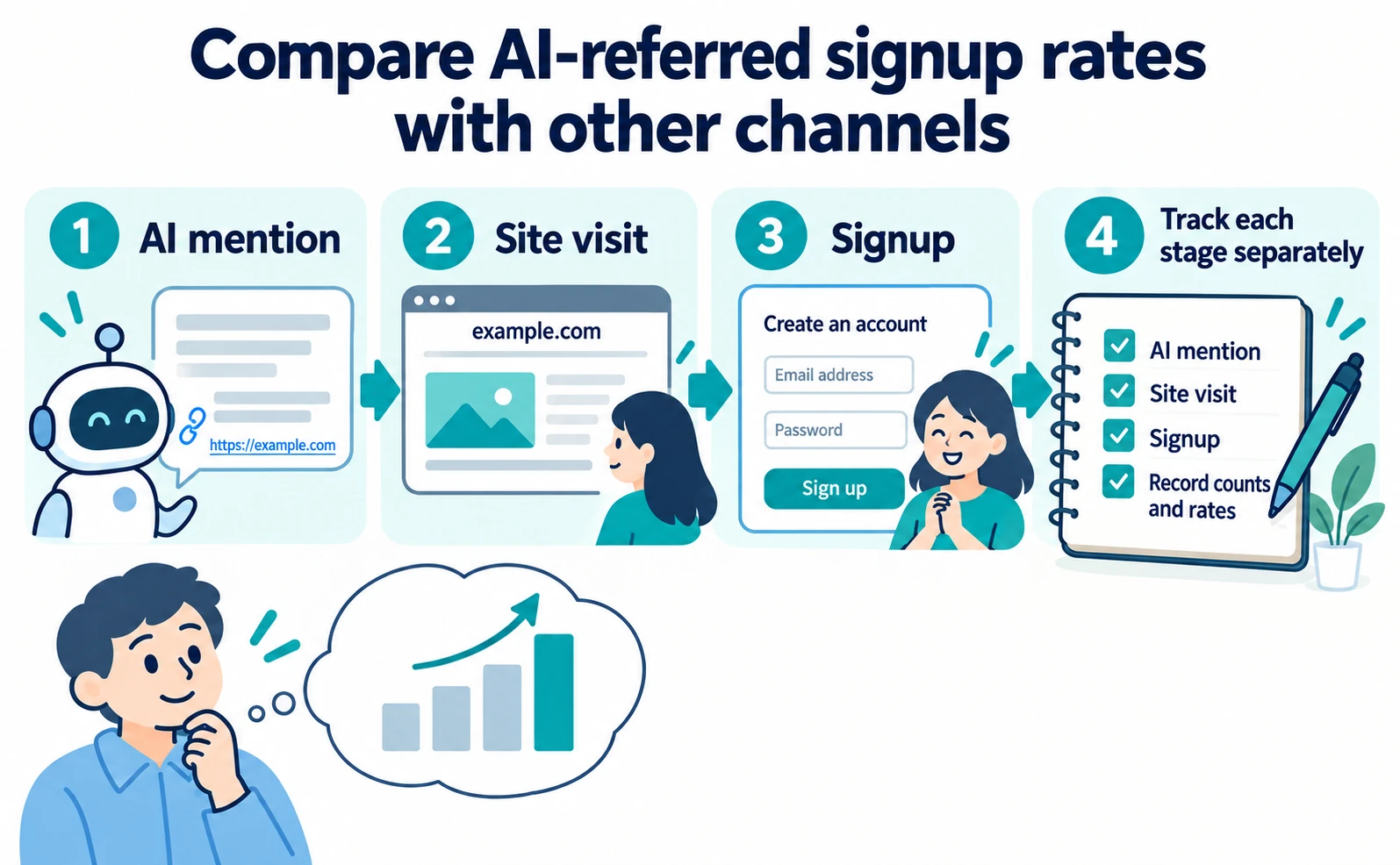
Illustrative diagram; interfaces and work records are conceptual.
A link in an AI answer does not prove anyone clicked it. A visit does not necessarily produce an immediate signup. Examine the sequence rather than treating one number as the whole outcome.
| Stage | Record | Question to consider |
|---|---|---|
| Article edited | URL, date, question, added wording | Is the missing answer now complete? |
| Mentioned by AI | Prompt, answer, cited URL, time | How is the explanation presented? |
| Site visited | Period, referrer, page, visits | Are mentions associated with identifiable visits? |
| Signup completed | Signups under the same definitions | Does the post-visit journey need improvement? |
Automated fetching by an AI service is also different from a person visiting the site. Mixing the two changes the conversion-rate denominator. Document what the table includes.
The basic calculation divides signups by visits in the same scope. But users versus sessions, attribution rules, and signup definitions can change the result. Agree on the existing analytics definition and keep it consistent.
These numbers are fictional arithmetic examples, not Alchemy's data or a forecast.
| Channel | Visits in the same period | Signups | Signups ÷ visits |
|---|---|---|---|
| Identifiable AI referrals | 200 | 10 | 5% |
| Other comparison traffic | 1,000 | 20 | 2% |
AI's rate is 2.5 times higher here, while signup counts are ten versus twenty. The channel generating more signups is different from the one converting a greater share of visits.
In a spreadsheet, place visits in column B and signups in C, then divide C by B in D and format as a percentage. When visits are zero, mark the rate as not applicable. Missing measurements should be marked unavailable, not zero.
Do not force unidentified visits into the AI category. Keep referrer-based visits and self-reported discovery survey results in separate columns; adding them could count the same person twice.
Define the time boundary too. Grouping by visit date and grouping by signup completion date handle month-end conversions differently. Either can be documented, but comparison channels must use consistent rules.
Use an actual completed action, such as a submitted form or created account. A signup-button click may include visitors stopped by validation errors. Confirm the meaning of existing events with the measurement owner.
This does not require immediately buying a new analytics service. First determine which comparisons existing records support. If counts are missing, make the measurement possible before comparing rates.
Small samples can produce striking percentages. One signup from ten visits is 10%; two is 20%. The arithmetic is correct, but one additional signup is not evidence of a stable trend.
Report underlying counts alongside rates. “Two signups from ten visits, compared with one from ten previously” communicates the scale better than a percentage alone.
If extending the observation period, record product or tracking changes within it. A longer window does not automatically make every comparison valid; a changed signup form should be noted.
Do not average weekly percentages without accounting for volume. A week with ten visits and one with a thousand should not receive equal weight. For compatible periods, sum signups and visits first, then divide.
Choose the next edit according to the stage that needs attention. If mentions increase but visits do not, inspect the questions and answers producing those mentions. If visits occur without signups, examine eligibility information and the route to the signup page.
Confusing pricing or a hard-to-find next step may affect readers from every source. Review the shared page experience as well as the AI referral segment.
Save the change date and URL, then repeat the same questions
Save questions and conditions and repeat the observation, rather than relying on one AI response. A result seen only on publication day does not establish a continuing change.
Begin with the question that motivated the edit. In the fictional booking example: “What should a business check when choosing booking software that can import existing reservations?” This is an editorial test question, not an observed customer query.
Ask it in the AI service being examined without including confidential information. Save the response and links, open the links, and record which page appeared. Save non-mentions too.
Changing the wording to obtain a favorable result makes it difficult to separate content changes from prompt changes. Keep the original wording; place new prompts in separate rows. Separate branded from unbranded questions as well.
| Field | Example record |
|---|---|
| Target page | The edited article's URL |
| Change | Added supported and excluded migration data |
| Date | Date public rendering was verified |
| Question | Exact input text |
| Service and conditions | Service, displayed model, search use |
| Observation time | Date and time |
| Answer | Mention, citation, accuracy |
| Visits and signups | Period and counts using consistent definitions |
Set multiple observation dates at an interval the team can maintain. This is an operating schedule, not a promise that results arrive after a certain number of days.
Check other work conducted in the same period: pricing changes, advertising, sales initiatives, or product announcements. A change log makes the limits of causal interpretation visible.
When AI mentions the page, inspect accuracy as well as presence. If it says attachments can be imported when they cannot, consider making the exclusion easier to find. Editing the source cannot guarantee control of the AI response, but the page's explanation can be improved.
A missing mention is not an automatic reason to add more words. Recheck whether the article answers the saved question using the reader's terms and includes relevant conditions and evidence. For a deeper citation investigation, see how to examine pages AI cites for competitors.
For a broader starting point, read what AI search optimization means and the AIO site checklist. The concrete first task in this case is smaller: add one verified answer missing from one older article.
The initial deliverable is a record containing the question, verified answer, public URL, and change date. Track mentions, visits, and signups from that starting point to decide what to improve next.
FAQ
- Q. Does AI search optimization require many new articles?
- An initial project can improve one existing page that leaves a recurring customer question unanswered. Verify the answer and conditions before adding them.
- Q. Will adding an FAQ produce a 7× signup rate?
- No such result is guaranteed. Alchemy's figure compares signup rates across channels; it does not isolate the effect of an FAQ addition.
- Q. What should be recorded after publication?
- Save the edited URL and date, fixed questions, AI responses and citations, and visits and signups measured under consistent definitions.
Sources
- [1] Alchemy AI search case study (Profound) — accessed 2026-09-29
- [2] How to build a stablecoin (Alchemy) — accessed 2026-09-29
- [3] AI features and your website (Google Search Central) — accessed 2026-09-29
About the author
Shogo MizushimaCEO of kairos Inc. / AgentSignal Developer
Develops AgentSignal, a tool for measuring AI crawler visits and AI-referred traffic, and diagnosing AIO readiness. Writes about measurement and practical improvements for AI search using observed data.
Related articles
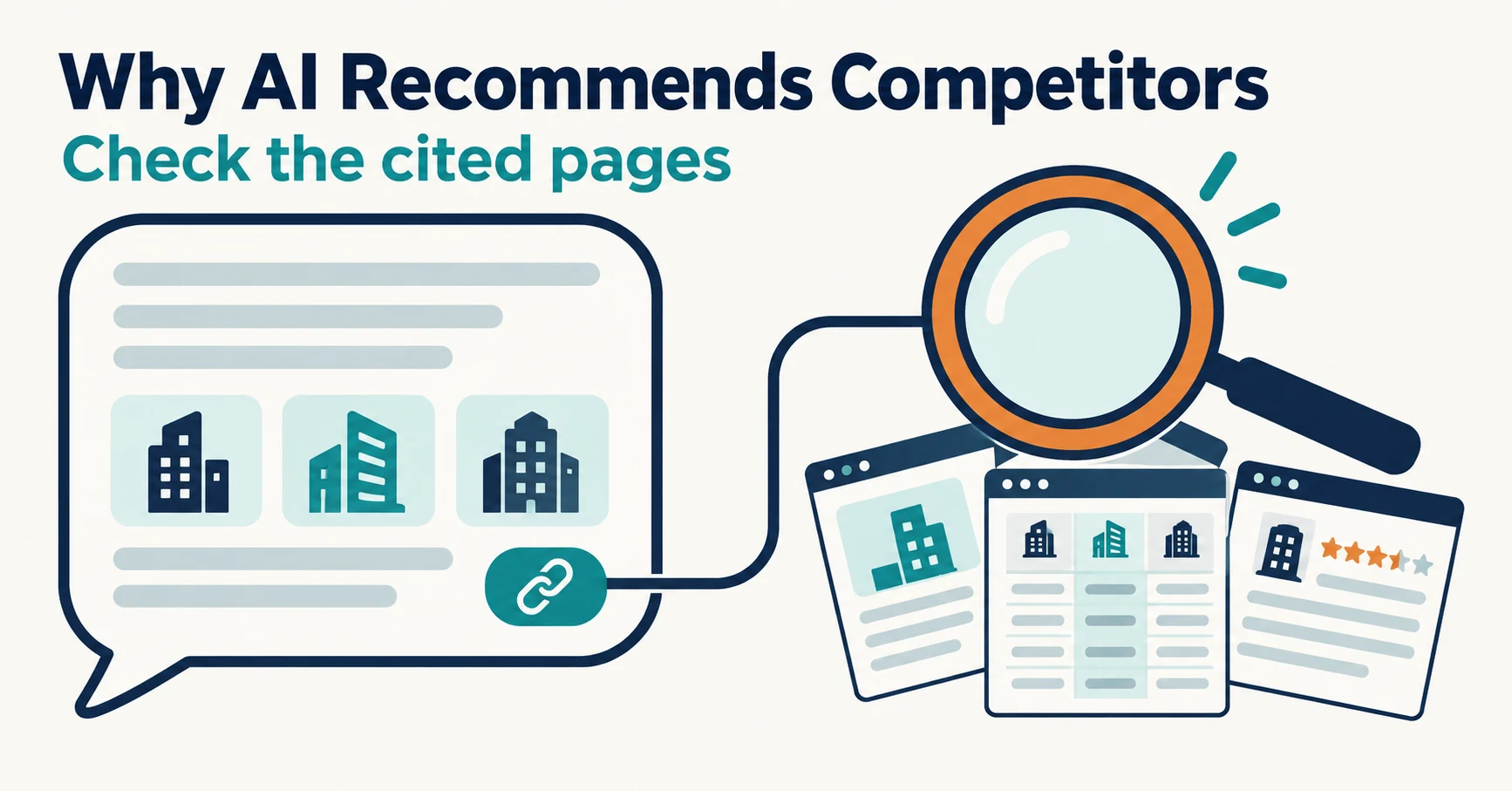
AIO and AI search
Why Does AI Recommend Your Competitors? How to Check Cited Pages
When AI answers keep recommending competitors, start with the cited links. Learn how to sort cited pages by type and use a decision table to choose between updating your own page, contacting another site, or accepting that wording alone will not fix it.
Published

AIO and AI search
What Is AIO? Its Two Meanings and Where to Start with AI Optimization
AIO has two meanings: work to get your company featured in AI answers, and Google Search’s AI Overviews. Learn how it relates to SEO, what to confirm in a proposal, what Search Console and Bing reports show, and your first tasks.
Published
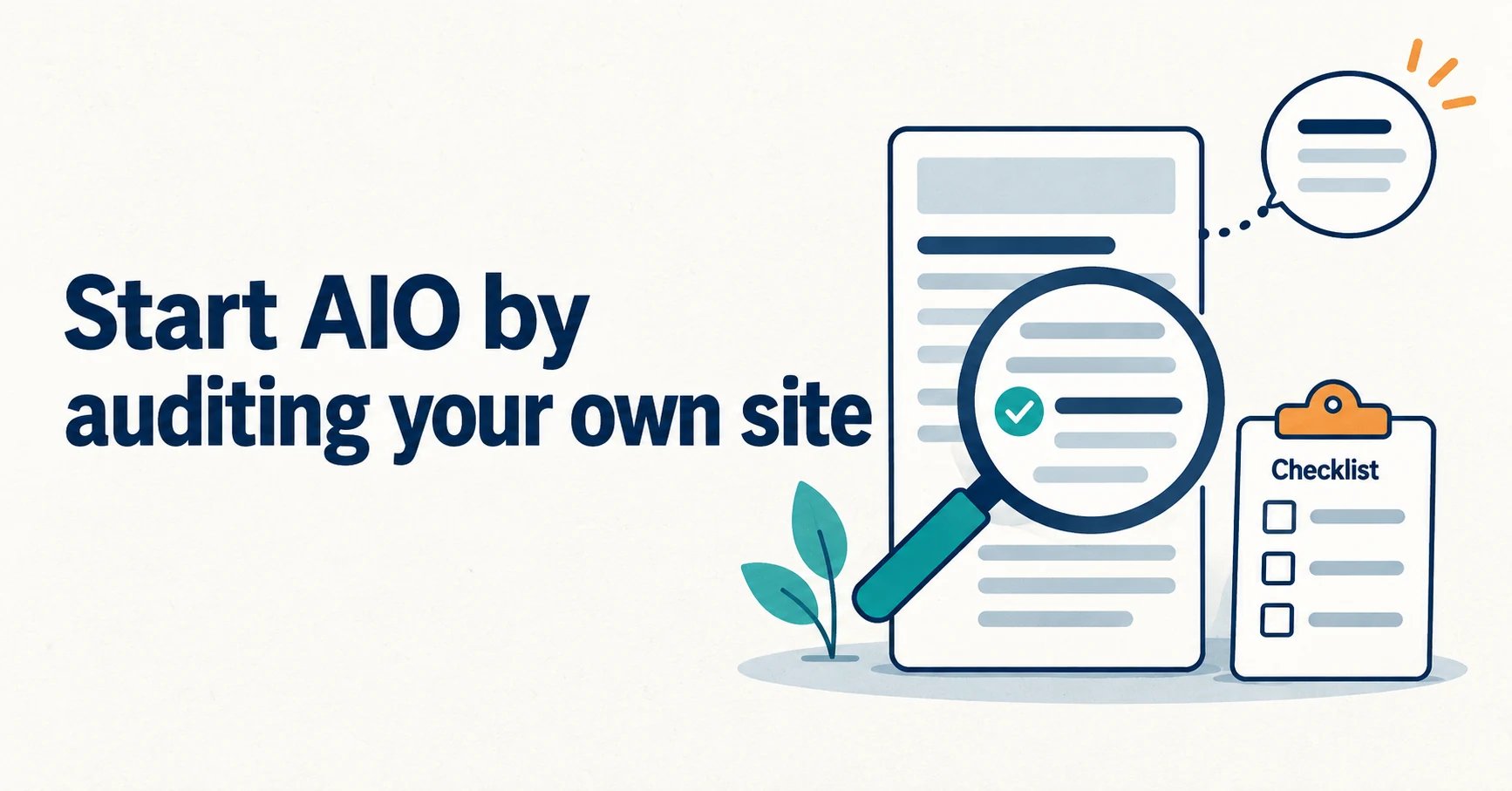
AIO and AI search
How to Do AIO: A Checklist for Auditing Your Company Website
AIO work follows a clear flow: record your current state, check site-wide technical settings, audit each page type, decide what to fix first, and remeasure under the same conditions. This checklist covers pricing pages, company profiles, and how to set priorities.
Published