AI Share of Voice Rose From 2.26% to 12.94%: A Tutoring Case
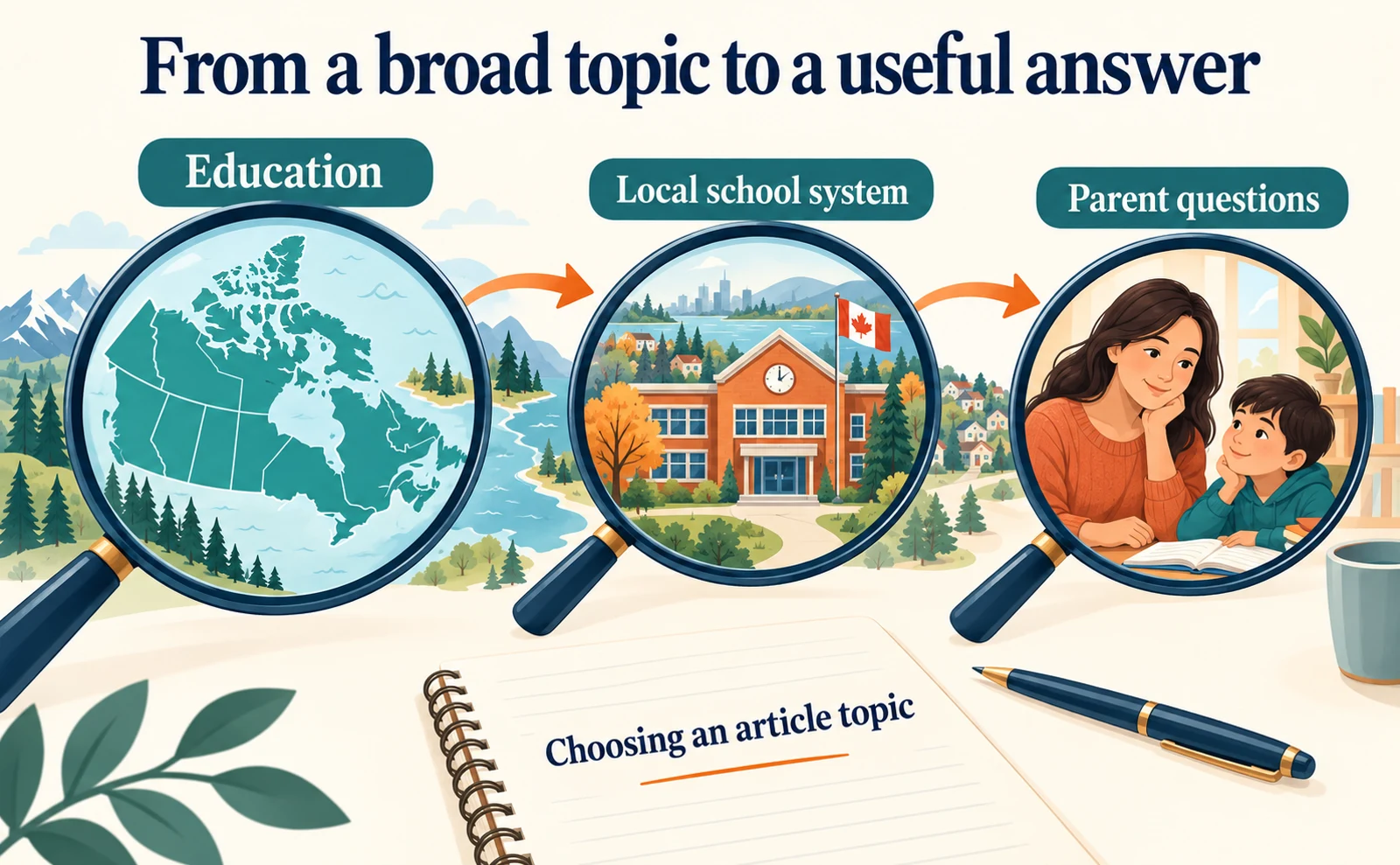
A Canadian tutoring case shows how local customer questions can shape useful content. Group inquiries, check existing coverage, gather evidence, and build one article while keeping visibility metrics separate from applications.
A specific customer question can be a better starting point than the broad topic a large competitor already dominates. A Canadian tutoring case offers a useful way to think about AI search optimization: helping AI answers understand and introduce a business.
For a local learning centre, that may mean answering questions about the school system its families actually use. This guide takes a content owner from real inquiries to one article topic with a clear purpose.
The content focused on local parents' questions
Genie Teacher connects Canadian families with certified teachers. Agency LoudFace reports building content around Ontario parents' report-card and exam questions and tracking 81 AI prompts. Reported AI share of voice rose from 2.26% on May 25 to 12.94% on August 24, 2026. This is a vendor-specific metric, not revenue or market-wide awareness. Tracking had a gap. It is an agency self-report, not proof of an isolated treatment effect.[1]
The useful exercise is to identify whom an article serves and which question it resolves. The workflow below is our recommendation, not the company's unpublished editorial process.
Open actual inquiries and extract useful questions
Start with recent inquiries or notes from customer conversations. Choose questions about services the business can actually provide. Remove names and addresses, retaining the decision the person needed to make and the missing information.
The table uses a fictional local learning centre. These are not Genie Teacher's customer records or working documents.
| Example question | Decision the reader faces | Evidence to gather |
|---|---|---|
| My child is falling behind in class | Whether the centre can help with the relevant work | Supported grades, teaching content, staff qualifications |
| Can lessons fit around extracurricular activities? | Whether a workable schedule exists | Timetable and rescheduling conditions |
| Can we decline after a trial lesson? | Whether trying the service creates an obligation | Trial fees and enrolment process |
Keep the question in recognizable language at first. “Can we just try a lesson?” is more useful for drafting than “enrolment decision barriers” because it names the answer the reader needs.
If inquiries are scarce, collect explanations staff repeatedly give. If those are unavailable too, label proposed questions as editorial hypotheses. Do not present imagined customer concerns as observed conversations.
Group questions by the answer they need
“Can we just try?” and “Can we decline after the trial?” may need the same explanation. Different wording does not require separate articles.
Rescheduling after joining is a different question. Trial conditions do not answer it; it may belong with the explanation of ongoing attendance.
Add a note beside each question: can the same answer resolve this and another question? For each group, inspect the existing site before drafting a new page.
| Existing coverage | Editorial action |
|---|---|
| A page already answers the question | Update outdated conditions or missing details |
| Answers are scattered across pages | Bring the explanation together and link to details |
| No answer exists, but evidence is available | Consider a new article |
| The business lacks evidence or the relevant service | Set the topic aside |
Do not create identical articles with different place names. Explain conditions that actually matter in that location. If the school system differs, the official evidence may differ too. Without meaningful local differences, one useful explanation may be enough.
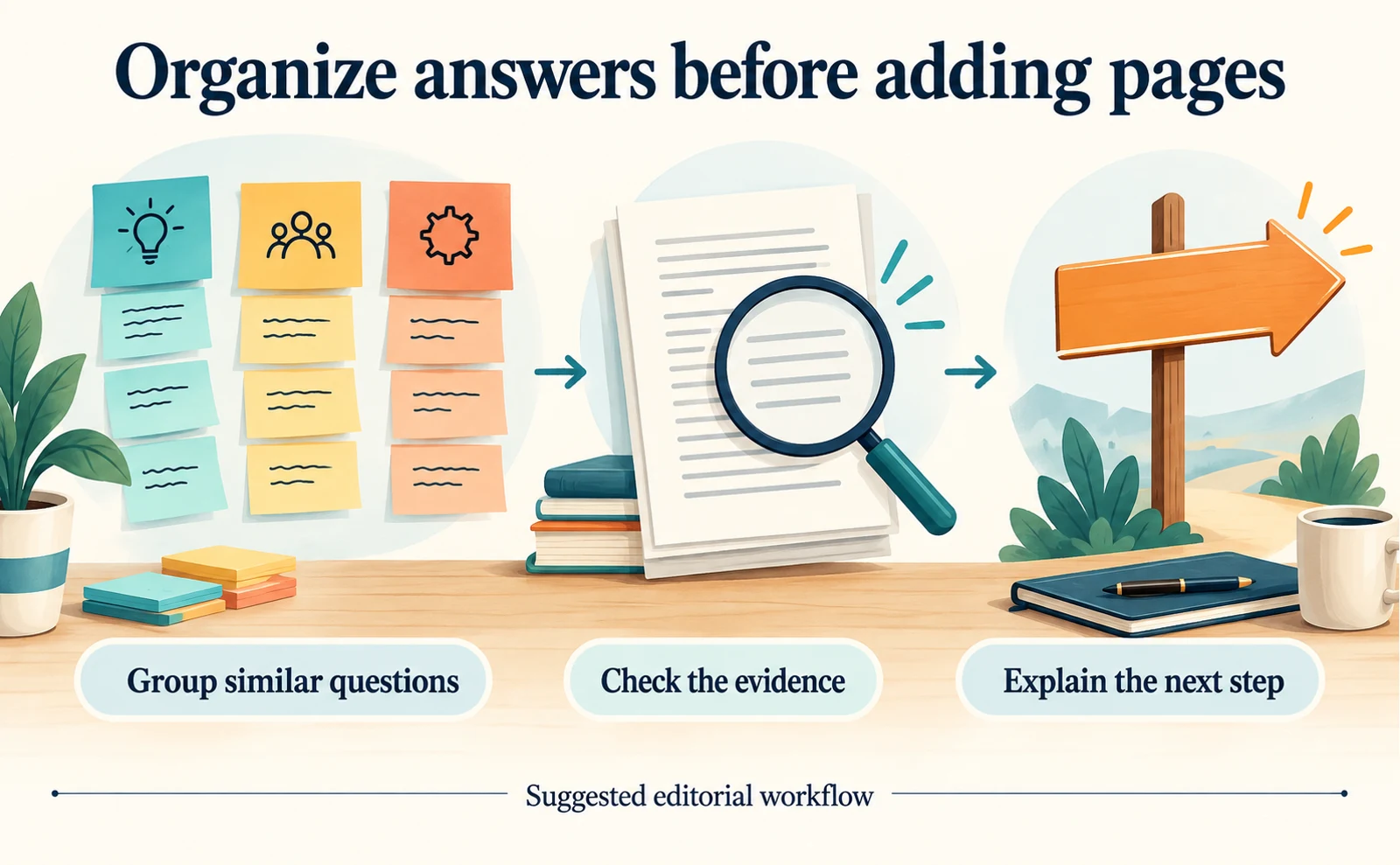
Choose search terms that match the question
Once the questions are organized, investigate the language people use to search. SEO means helping searchers find a relevant page. An article's title should identify what the reader can learn.
For example, “Can tutoring fit around school activities? Check schedules and rescheduling” says more than “Optimal learning solutions.” Use such a title only if the article actually explains those conditions.
A long-tail keyword describes a more specific subject or need. Adding more words does not guarantee a ranking. “Tutoring around school activities” simply identifies a situation more precisely than “tutoring.”
Large search demand is not a reason to choose a question the business cannot answer. Smaller demand can still matter when it reflects a real decision before enrolment. If a tool returns no volume, record the demand as unknown, not zero.
Google's guidance emphasizes helpful content and demonstrated knowledge or experience.[2] Use that principle to fill a missing answer, rather than treating an extra published page as the goal.
Build one article around an answer
Create a draft in the editor your business already uses. Screens vary, so the table describes what the body needs. If a row cannot be completed, gather its missing evidence first.
| Reading order | Example content for a learning centre |
|---|---|
| Direct answer | Conditions under which lessons can fit around activities |
| Things to check | Lesson days, journey home, homework, rescheduling |
| Concrete example | A clearly fictional weekly schedule |
| When it will not work | Actual timetable constraints |
| Next action | View the timetable or check trial conditions |
Label an invented student or schedule as an example. Use the business's real rules and timetable. Do not invent an improvement in grades or a customer success story.
Ask a colleague who did not write the draft to explain when a reader could enrol and what still needs checking. Their answers help locate missing information. A clear next task for the reader is also a useful test of the article's purpose.
Observe AI inclusion and enrolment separately
Before publishing, fix the questions you plan to test. A request for tutoring compatible with extracurricular activities needs the region and grade appropriate to actual customers. Keep questions that name the business separate from discovery questions that do not.
For continuing observations in AgentSignal, use the AI citation guide to register the site and questions. Login and analysis credits are required. Keep the question, AI service, and other conditions consistent, and inspect both the answer and cited pages.
The source case's share-of-voice measure need not use the same calculation as AgentSignal's citation rate. Its 12.94% is not a target score for a different business or tool.
Record Google impressions and clicks, identifiable AI referrals, and trial applications separately. More AI mentions may not produce more visits. If applications increase, also check for advertising or seasonal changes.
Google says established SEO practices remain relevant to its AI features, including useful internal links and accessible text.[3] Establish those conditions and then observe what changes.
The first article does not need to explain all of education. It needs to answer one problem a customer faces now. Open actual inquiries, check existing coverage, and add a supported answer. Repeating that process builds information people can use to make decisions, alongside the article count.
FAQ
- Q. Should I make one article per place name?
- Only consider separate coverage when real local conditions justify it. Do not replicate the same text with different names.
- Q. Does each question need its own article?
- Group questions answered by the same explanation and review existing coverage first.
- Q. Can I use the reported figure as my target?
- Different prompts, services, and calculations prevent a direct comparison. Track your own changes under consistent conditions.
Sources
- [1] How a tutoring startup’s search visibility went vertical (LoudFace) — accessed 2026-09-21
- [2] Creating helpful, reliable, people-first content (Google) — accessed 2026-09-21
- [3] AI features and your website (Google) — accessed 2026-09-21
About the author
Shogo MizushimaCEO of kairos Inc. / AgentSignal Developer
Develops AgentSignal, a tool for measuring AI crawler visits and AI-referred traffic, and diagnosing AIO readiness. Writes about measurement and practical improvements for AI search using observed data.
Related articles
AIO and AI search
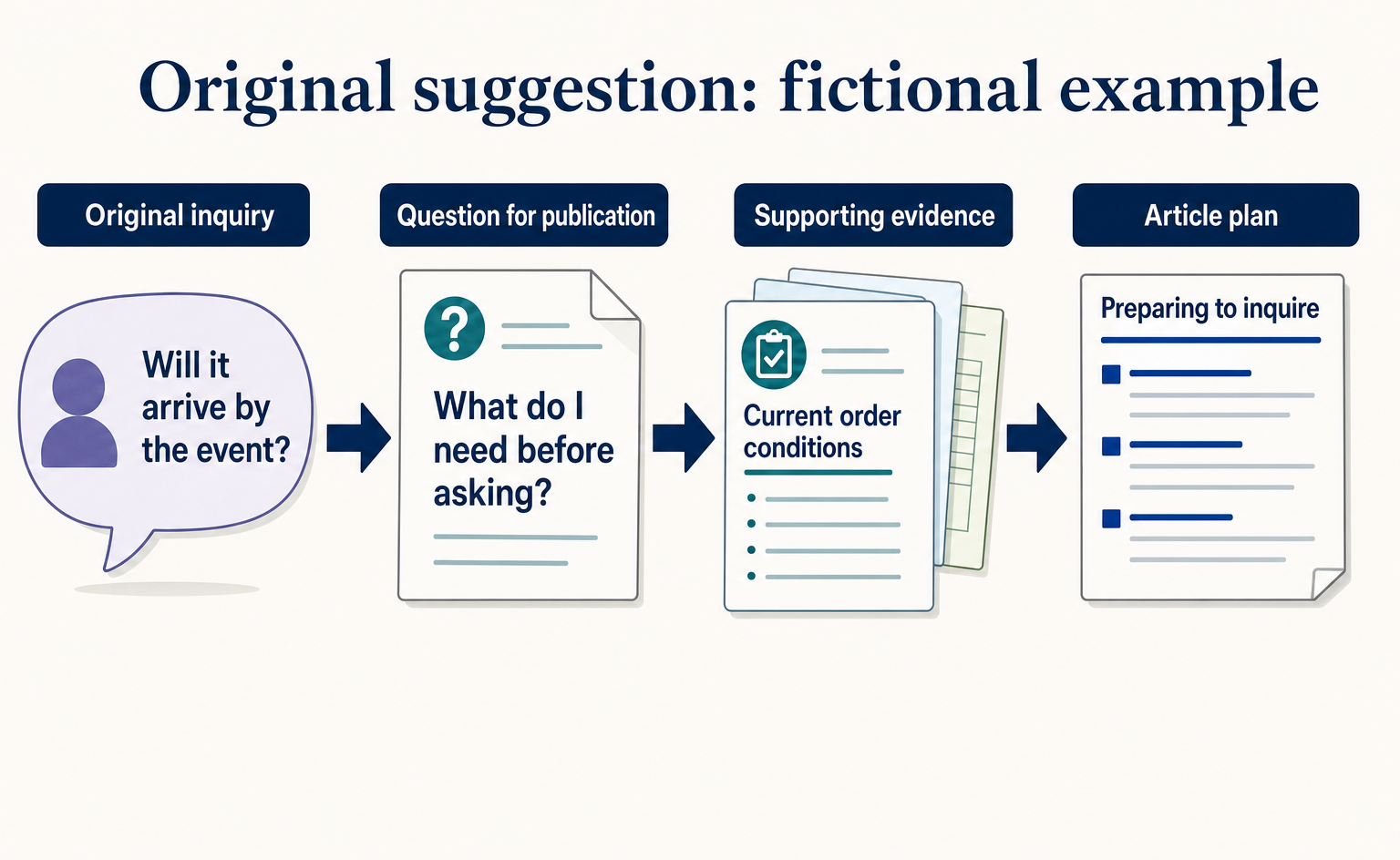
Where to Find Article Ideas Only Your Business Can Write: Start with Customer Inquiries
You do not need original research data to create useful articles. Learn how to turn customer questions, answers, and decision criteria into article plans, with worksheets and fictional before-and-after examples covering anonymization, question grouping, and evidence checks.
Published

AIO and AI search
What Is AIO? Its Two Meanings and Where to Start with AI Optimization
AIO has two meanings: work to get your company featured in AI answers, and Google Search’s AI Overviews. Learn how it relates to SEO, what to confirm in a proposal, what Search Console and Bing reports show, and your first tasks.
Published
AIO and AI search
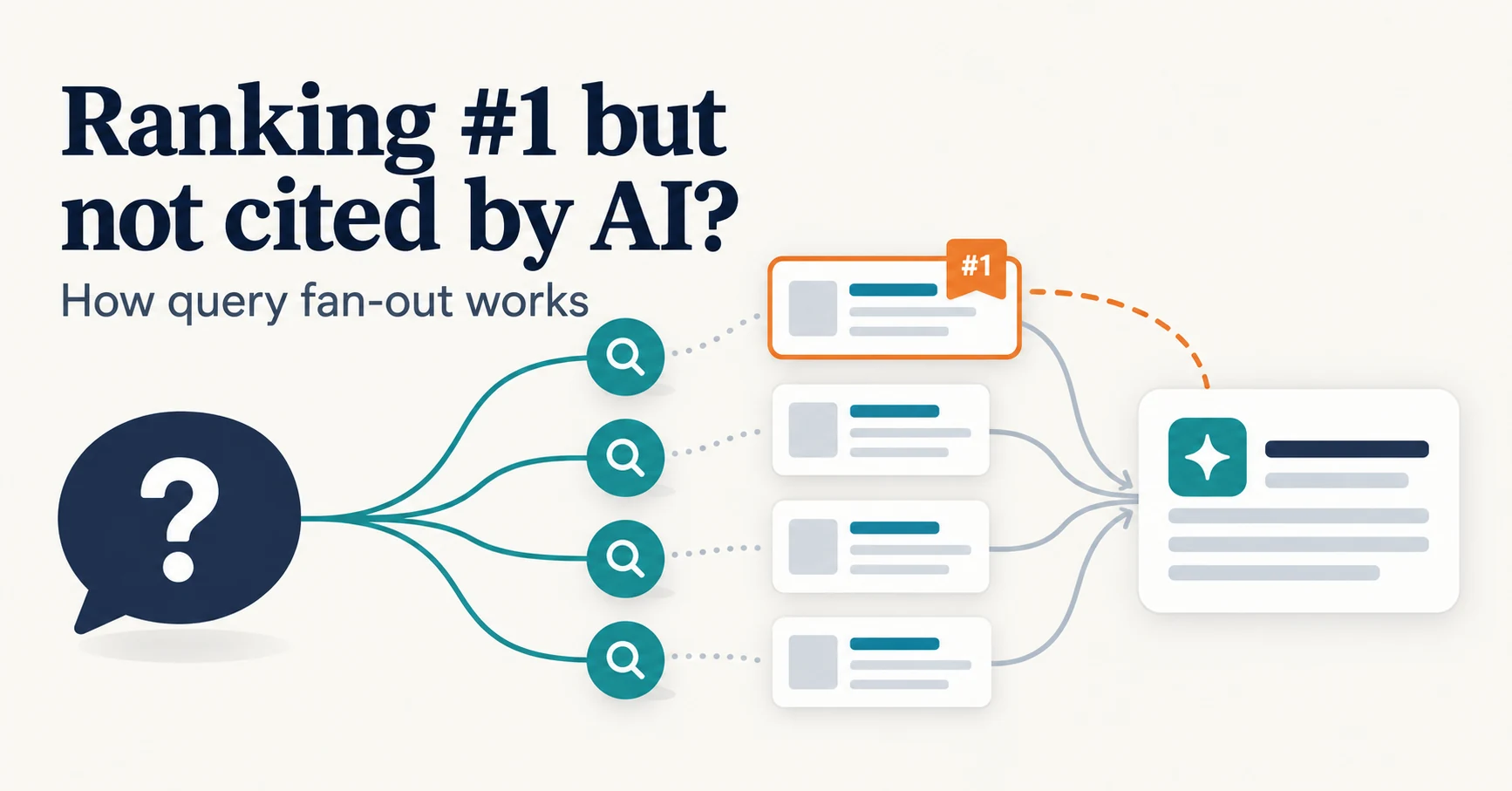
Ranking First but Not Cited by AI? How Query Fan-Out Works
Query fan-out is a technique in which AI may run several related searches to answer one question. Learn why a first-place page may not be cited, which related questions your pages should answer, and what you can observe in Search Console and Bing.
Published