Product descriptions and FAQs for AI commerce: what BigCommerce and Feedonomics announced
Explore the BigCommerce and Feedonomics enrichment announcement, from descriptions and FAQs to human review, language support and adoption questions.
“Can this product be used outdoors?” “Do I need additional parts?” If a product page cannot answer these questions, a shopper must look elsewhere. An AI assistant helping someone choose also needs usable product information.
Commerce announced BigCommerce Catalog Enrichment and Feedonomics Enrichment on September 29, 2026. The features use existing product data to generate and improve items such as names, descriptions and FAQs.[1]
This article explains the announcement in terms of the work a catalog team needs to do. Information was checked on September 30, 2026. Suggested review steps below are our practical recommendations, distinct from the vendor’s announcement.
New product-data features for AI commerce
The features address catalog information used in product discovery and comparison, including AI-assisted shopping. They bring enrichment closer to the systems where store and product data are managed.[1]
Generate product descriptions and FAQs together
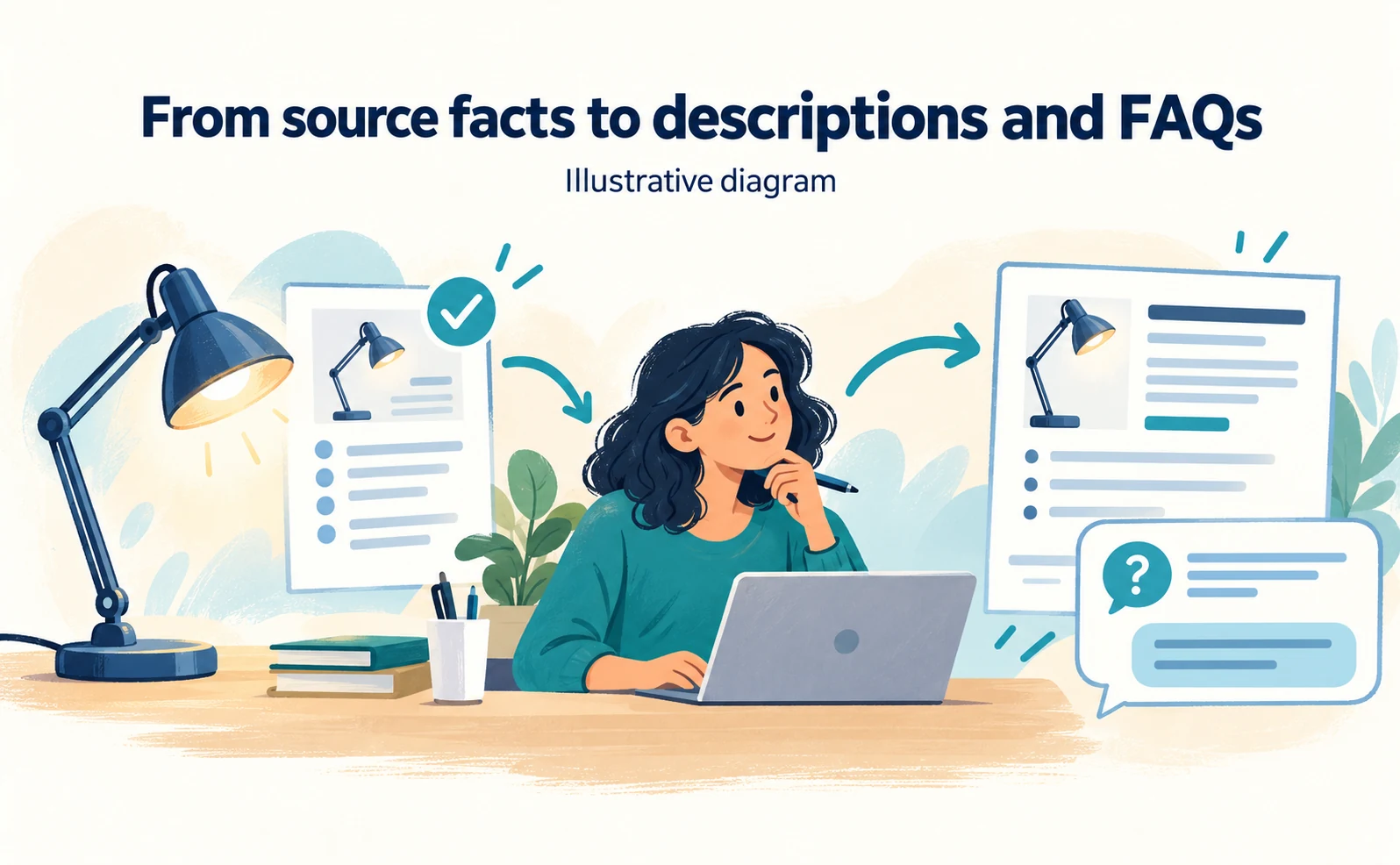
The announcement lists product names, descriptions, feature bullets, FAQs and SEO information among the generated content. The workflow uses existing product information, with review before application.[1]
The prerequisite is reliable product facts. Producing more prose cannot resolve an unknown dimension. For storage products, relevant inputs might include internal and external measurements, materials, load limits and assembly requirements.
The required fields differ by product. Treat preparation as gathering facts rather than drafting long copy: a purchasing team can verify specifications, logistics can verify shipping conditions and an editor can review clarity.
Gaps in product information become unanswered buying questions
The value of enrichment is not simply a higher word count. It is the ability to answer questions that affect a purchase.
The following examples concern an imaginary desk lamp; they are not specifications of a real product.
| Vague wording | Shopper’s question | Source information needed |
|---|---|---|
| Compact design | Will it fit on my desk? | Base width and depth |
| Adjustable brightness | How do I adjust it? | Controls and adjustment options |
| Long-lasting | Can the light source be replaced? | Replacement and maintenance guidance |
Reject generated numbers that do not exist in a reliable source. An unanswered field should become a question for the product owner, rather than an opportunity for the model to fill a gap.
How BigCommerce and Feedonomics differ
The distinction is primarily where the work happens. BigCommerce brings the workflow into store administration, while Feedonomics focuses on product information distributed across destinations.[1][2]

BigCommerce: edit products within store administration
BigCommerce Catalog Enrichment is described as a flow in which a user selects products, supplies brand information, generates content, reviews it and applies the result.[1]
A practical first trial could use a small group of products with accessible specifications. This is our operating suggestion, not a vendor-mandated product count.
Select products you expect to keep selling and assign a reviewer before generating content. Otherwise, bulk generation may simply create a larger review queue. We have not tested the new interface in a subscribed account; check current screen labels and plan eligibility in your admin and official documentation.
Feedonomics: prepare information for multiple sales destinations
Feedonomics describes handling fields including product names, categories, brands, descriptions and custom attributes across data sources and destinations.[2]
When a store and a marketplace disagree about a specification, shoppers may struggle to identify the product. Decide which system maintains each field before adding a generation step.
For example, inventory might come from stock management, prices from a business system and descriptions from the ecommerce platform. Generated copy should not inadvertently replace inventory or price records.
Draw a simple path from source data to editing system to destination. That makes it easier to identify where a correction must be made as more channels are added.
Review AI-generated product copy before publication
Review specifications, wording and sales conditions in that order. Fluent writing is not proof that a statement about a product is correct.
Compare quality scores with real product documentation
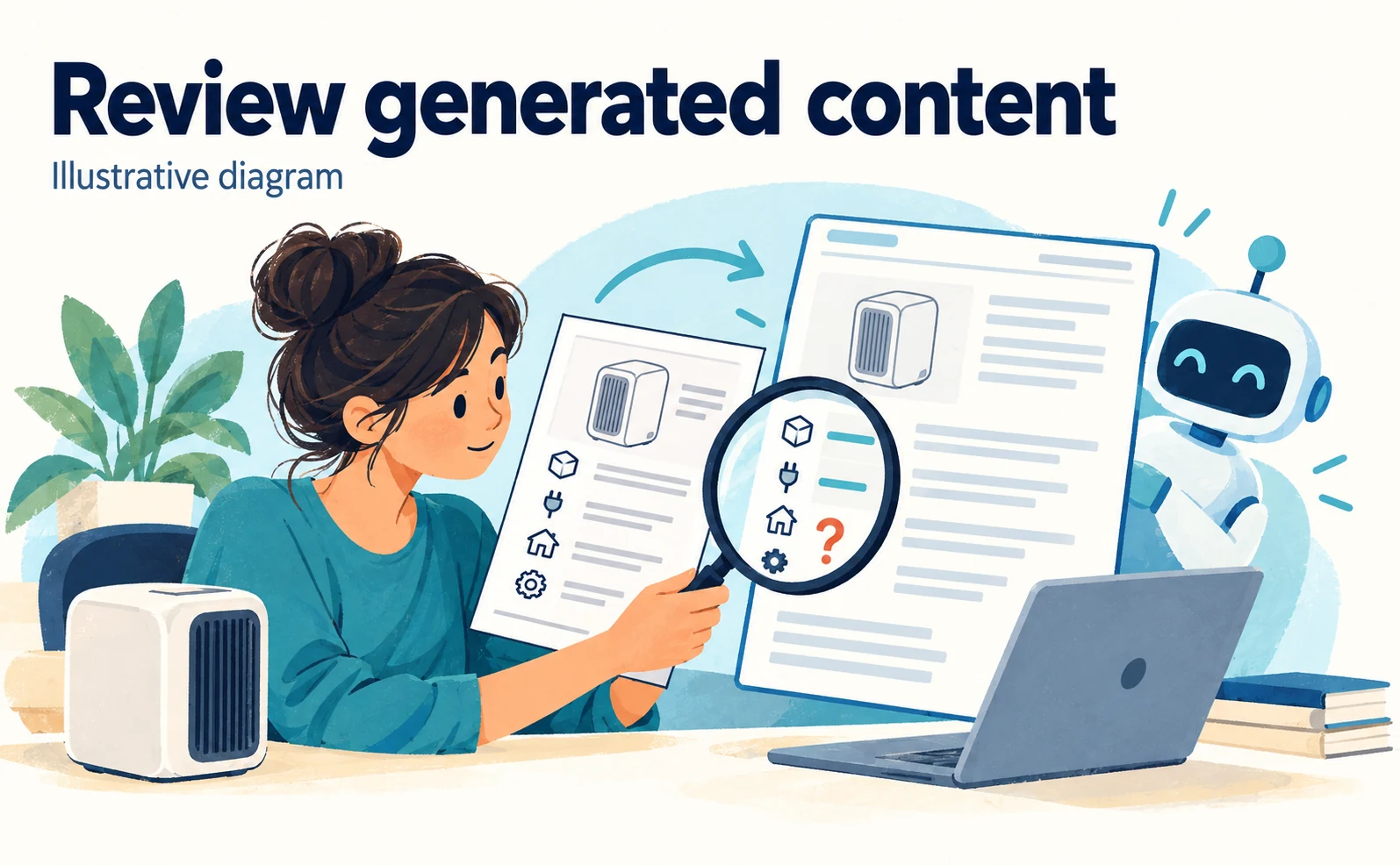
The announcement describes scoring for accuracy, consistency and adherence to the brand’s expression.[1] A score cannot replace manufacturer documentation or a check of the item itself.
Place each generated claim beside the relevant evidence:
| Generated field | Evidence to check | Review status |
|---|---|---|
| Dimensions | Correct model’s specification sheet | Matches, revise or unverified |
| Accessories | Included-items list | Matches, revise or unverified |
| Suitable environment | Product instructions | Matches, revise or unverified |
| Dispatch time | Current store operations | Matches, revise or unverified |
Check that the document covers the correct model and size. If a performance claim lacks support, do not merely soften the wording. Return to the evidence question and exclude the claim if it cannot be verified.
Check names, FAQs and sales conditions as one page
Read the name, description, FAQ and sales conditions together. More information can create more confusion if the parts contradict each other.
For example, an “indoor use” specification and an FAQ recommending garden use require a factual correction. A color in the title that differs from the selected variant needs investigation beyond the heading alone.
- Preserve the original copy.
- Have the product owner verify facts.
- Edit repetition and unclear wording.
- Confirm the product and fields being updated.
- Inspect the live page and relevant destinations.
Generation is an intermediate state. Completion means the correct information reaches the shopper and the previous copy remains available if restoration is needed.
Conditions to check before adopting AI commerce enrichment
Confirm language support, catalog size, costs and destinations. The useful trial scope depends on your contract and how your product data is managed.
Separate current English support from multilingual plans
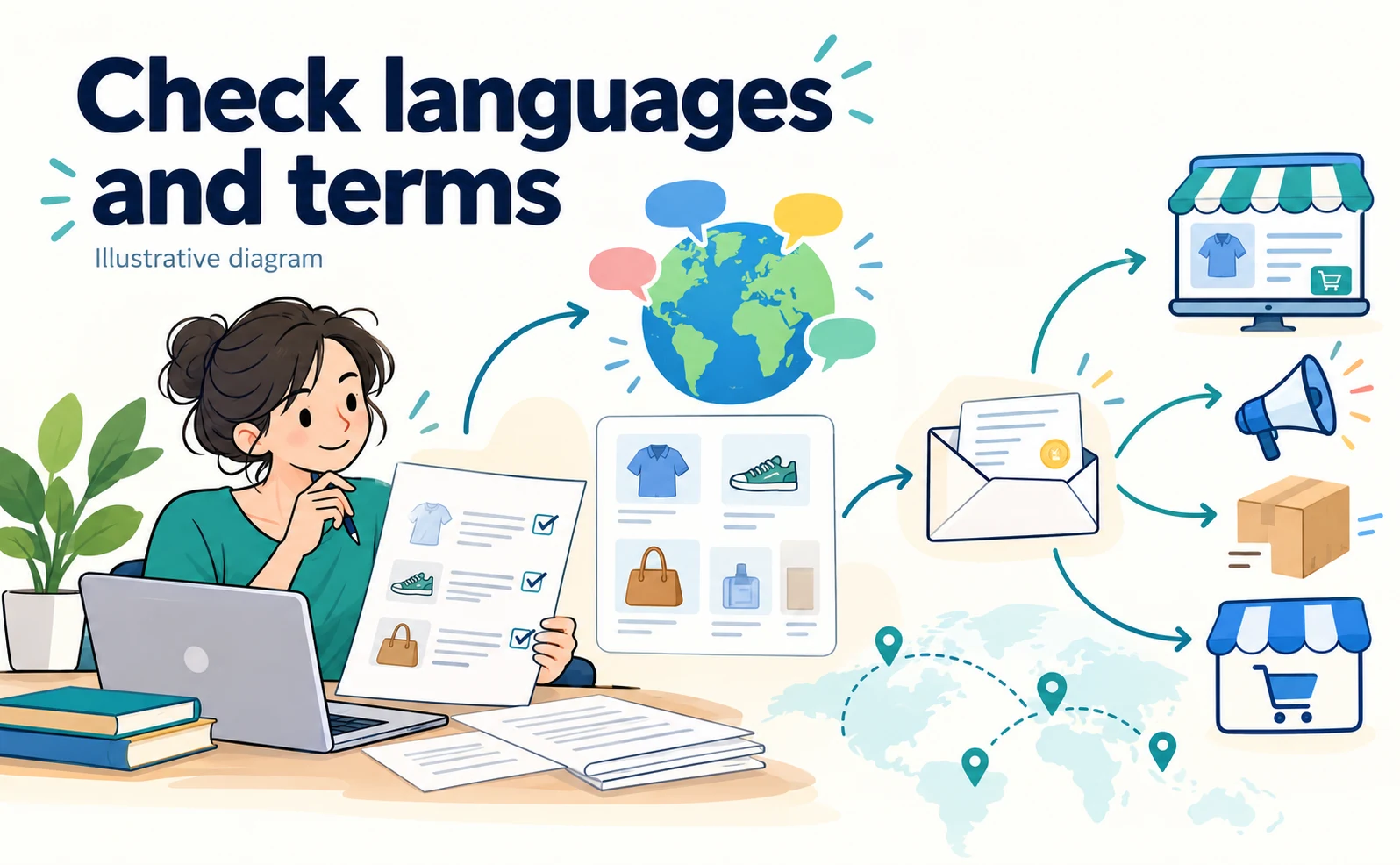
The September 29 announcement describes the new Feedonomics Enrichment product-copy feature as supporting English, with multilingual support planned. The general product page also discusses multiple languages.[1][2]
Do not combine those statements into an assumption that the newly announced feature already supports Japanese. Ask about the exact feature and contract. Likewise, do not apply Feedonomics conditions to BigCommerce without checking.
A Japanese store should specify both the language it wants to generate and the markets it serves. Improving an English export catalog and generating Japanese storefront copy are different requirements. Where translation is involved, recheck model identifiers, units and accessory names.
Ask the official demo team about volume, costs and update destinations
The official Feedonomics product page provides an entry point for a demo or enquiry. Explain your current setup rather than asking only for a generic feature list.
We are evaluating the newly announced Enrichment features.
Current ecommerce platform: [service]
Catalog size: [products and variants]
Required generation languages: [languages]
Destinations: [storefront, advertising services and marketplaces]

Please confirm eligible plans, additional costs, review-before-apply options,
restoring previous copy and the fields that can be updated.
We would like to begin with a limited product group.
Track review time and the types of corrections required, alongside the number of products generated. After publication, review customer questions as well. The first preparation task is to assemble reliable facts and assign reviewers who can verify them.
FAQ
- Q. Can AI fill in missing specifications reliably?
- Do not accept dimensions or capabilities absent from approved sources. Resolve missing information with the product owner or manufacturer documentation.
- Q. Should I evaluate BigCommerce or Feedonomics?
- Start with whether you need storefront editing or product-data distribution across destinations. Explain your existing platform and update process to the provider.
- Q. Does the newly announced Feedonomics feature support Japanese?
- The September 29 release specifies English with multilingual support planned. Verify the exact feature and contract instead of inferring availability from a broader product page.
- Q. What should a store prepare before a demo?
- Bring catalog and variant counts, reliable specifications, language needs, destinations and review ownership. Ask about costs, editable fields and restoration of previous copy.
Sources
- [1] Commerce Introduces Data Enrichment for BigCommerce and Feedonomics to Power Agentic Commerce (Commerce.com, Inc.) — accessed 2026-09-30
- [2] AI Data Enrichment (Feedonomics) — accessed 2026-09-30
About the author
Shogo MizushimaCEO of kairos Inc. / AgentSignal Developer
Develops AgentSignal, a tool for measuring AI crawler visits and AI-referred traffic, and diagnosing AIO readiness. Writes about measurement and practical improvements for AI search using observed data.
Related articles

AIO and AI search
AIO case study: Mito Red Light reports 200% growth in monthly AI revenue. Improve product information first
Understand Mito Red Light’s reported 200% monthly AI revenue growth, then improve product descriptions, specifications and FAQs with a Shopify review workflow.
Published
AI shopping and booking
Muse expands into a business AI agent: advertising analysis and Shopify connections explained
Understand Meta’s Muse for Small Business announcement, its advertising and Shopify connections, a sample analysis prompt and availability checks.
Published

AI shopping and booking
Who authorized the AI purchase? IDEMIA’s agentic commerce payment announcement explained
Understand IDEMIA’s agentic commerce payment announcement: authentication, spending limits, consent evidence and questions for your payment provider.
Published