AIO for SaaS and B2B Services: Getting Recommended in Comparison Questions
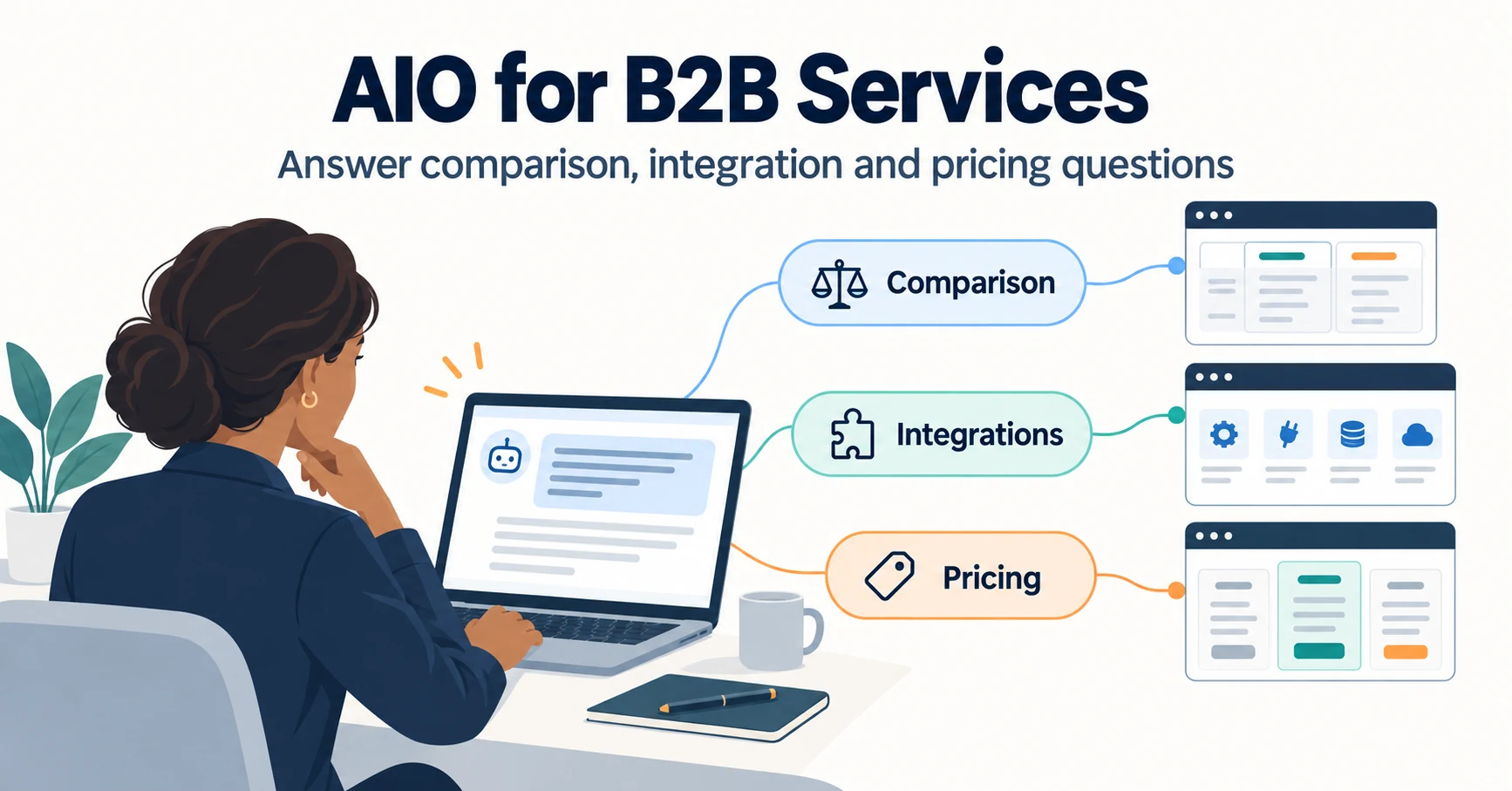
For SaaS and B2B services, what matters is whether AI recommends you when buyers ask about comparisons, alternatives, integrations and pricing. Learn how to assign a page to each question type and review comparison pages, integration lists and third-party listings.
AIO for SaaS and B2B services means deciding which page answers each type of question buyers ask AI—comparisons, integrations, and pricing or implementation—and then improving that page. AIO refers to work that helps AI answers describe your business accurately.
Suppose someone at a time-tracking software company asks ChatGPT, “What tool can replace Company A for time tracking?” The answer lists competitors and comparison sites, but not their company. This scenario is hypothetical.
Before adding more articles, check whether your site has pages that answer comparison, integration, and pricing questions. Google says there are no additional requirements beyond ordinary SEO to appear in AI Overviews or AI Mode [1]. The starting point is to answer the question in your page text, not to add special settings.
For an overview of the term, see What Is AIO? Its Two Meanings and Where to Start with AI Optimization.
Three Types of Questions B2B Buyers Ask AI
Questions B2B buyers ask AI can be grouped into three types: comparisons and alternatives, integrations, and pricing and implementation. Each type needs a different page to answer it.
This grouping is our editorial framework. It is not based on measured AI question volumes.
| Question type | Example question (illustrative) | Page that answers it |
|---|---|---|
| Comparison and alternatives | “What can replace Company A?” “How do A and B differ?” | Comparison page, customer stories |
| Integrations | “Does it connect with our accounting software?” | Integrations list, per-integration details |
| Pricing and implementation | “What does it cost for 50 users?” “How long does setup take?” | Pricing page, implementation guide |
Start by collecting questions that actually came up in sales calls and inquiries, then sort them into these three types.
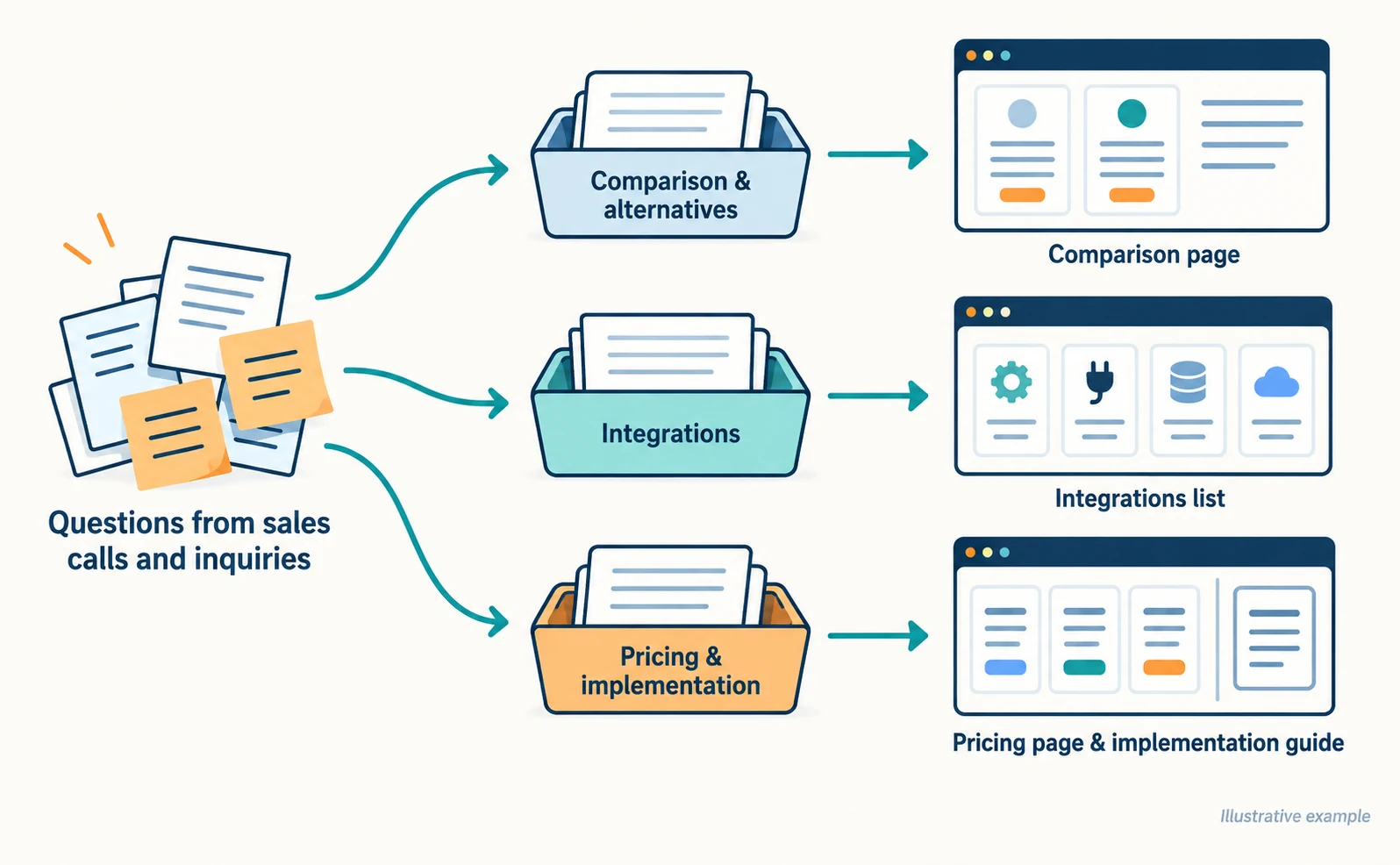
Google says AI may run several related searches to answer one question [1]. Even a comparison question may require answers about pricing or integrations. That is why you should review all three types together.
Pages That Answer Comparison and Alternative Questions
Answer comparison and alternative questions on your own comparison page by stating consistent criteria, the company sizes you suit, and situations you do not suit. Avoid placing your product first by default.
Readers want to know which option fits their situation. A table where your product wins every row is hard to trust as decision material.
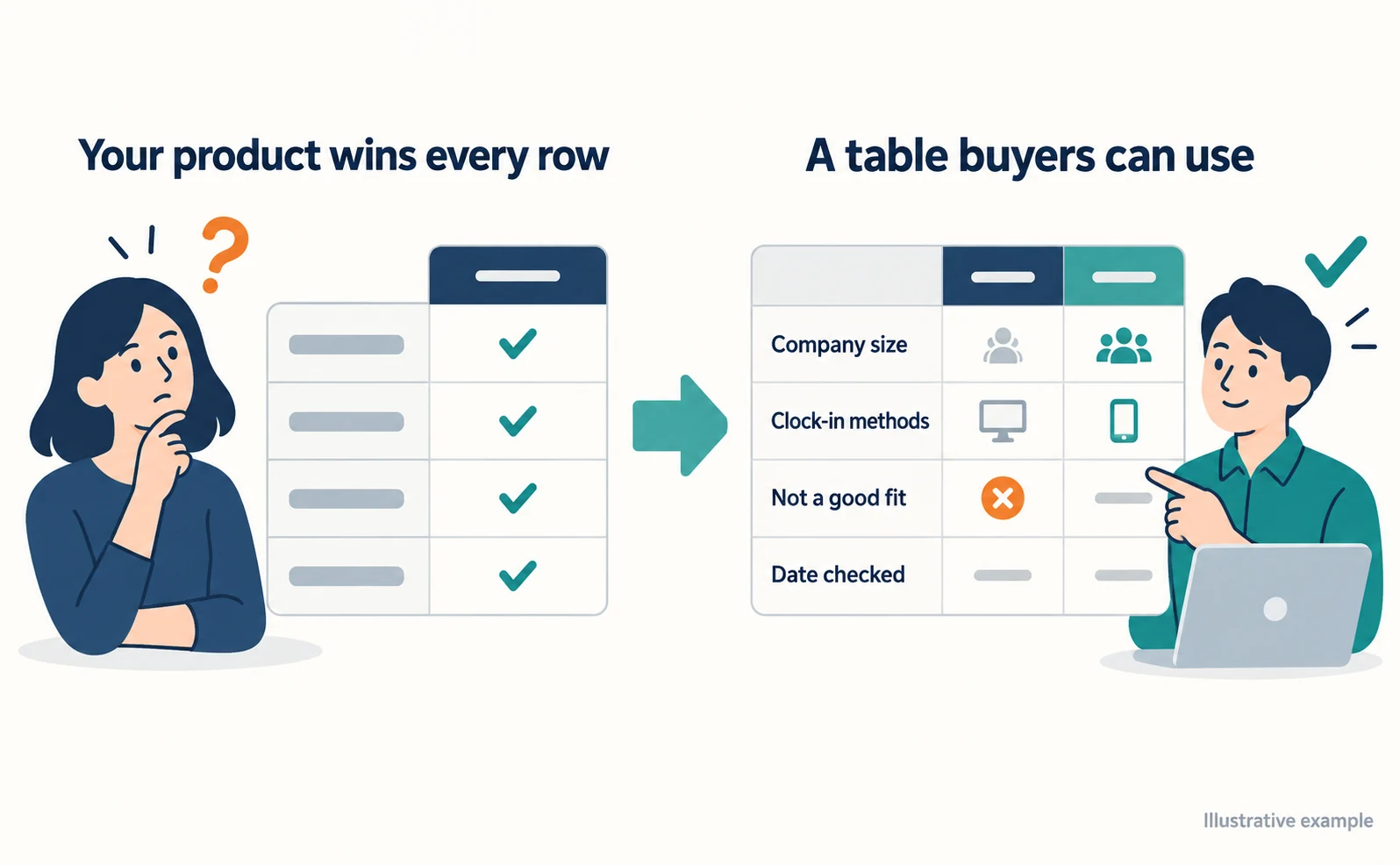
The example below uses a fictional time-tracking service called “TimeNote.” It is not a real product.
| Criterion | TimeNote (illustrative) | Writing tip |
|---|---|---|
| Company size | 10–300 employees | Use numbers |
| Clock-in methods | IC cards, smartphones | Also list methods you do not support |
| Not a good fit | Companies over 1,000 people with complex approvals | Be candid |
| Date checked | Date entered | Record when you checked competitor details |
If you mention competitors’ names or features, include only what you can confirm in their public information. Comparative claims can also raise legal issues, so check with your legal team before publishing.
Google says it values content with a unique perspective based on experience, rather than summaries of common knowledge [2]. Using the decision criteria your team actually hears during implementations gives your page something other pages lack.
Pages That Answer Integration and Implementation Questions
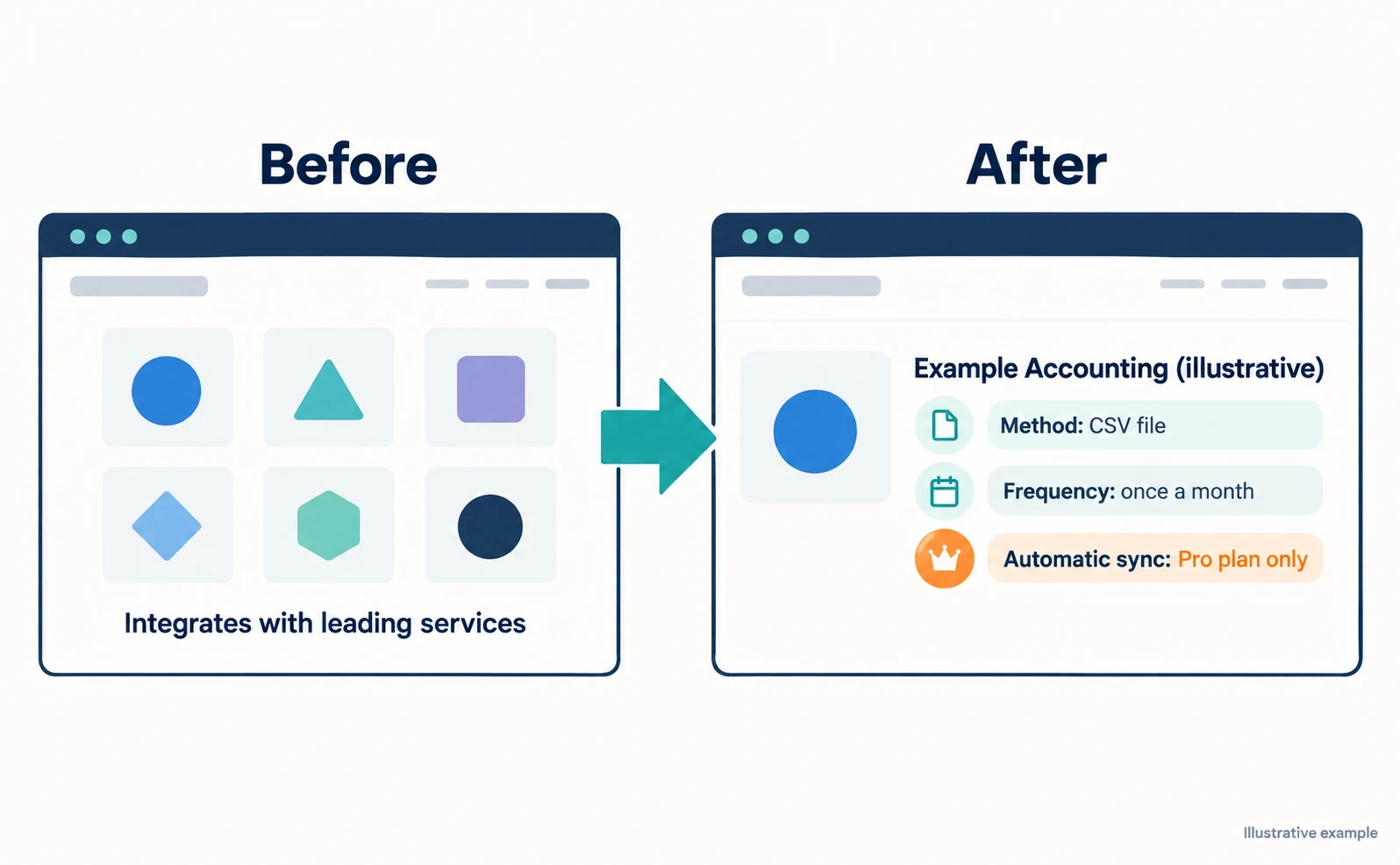
Answer “Does it integrate with…?” in your integrations list by adding text that explains the method and plan conditions. A list of logos alone does not explain what the integration does.
Google lists making important content available as text among the SEO basics for AI features [1]. With logo images alone, neither readers nor AI can easily judge what is supported.
Here is an illustrative rewrite.
- Before: A row of logo images with only “Integrates with leading services.”
- After: “Example Accounting (illustrative): Export time data as a CSV file once a month and import it. Automatic sync is available on the Pro plan only.”
The rewrite shows the method, frequency, and eligible plan.
The same applies to implementation questions. Instead of “Get started right away,” explain what the customer must prepare for initial setup, data migration, and informing employees. If you use structured data, keep it consistent with what appears on the page [1].
Reviewing Your Information on Comparison and Review Sites
AI also uses information outside your own site when composing answers. Check whether comparison and review sites show outdated pricing or features for your product, and if you find errors, ask for a correction with supporting evidence.
In a May 2026 analysis of B2B SaaS articles using US English search terms, Citera found that 61% of AI-cited articles came from external media such as review sites and industry publications, and 29% from companies’ own sites [6]. Foundation’s analysis of seven B2B verticals also found that brand-owned content made up only a small fraction of citations [5].
Both are observations under specific conditions. The same shares may not apply to Japanese-language questions or to your industry. Still, they suggest that fixing only your own site may not change AI answers.
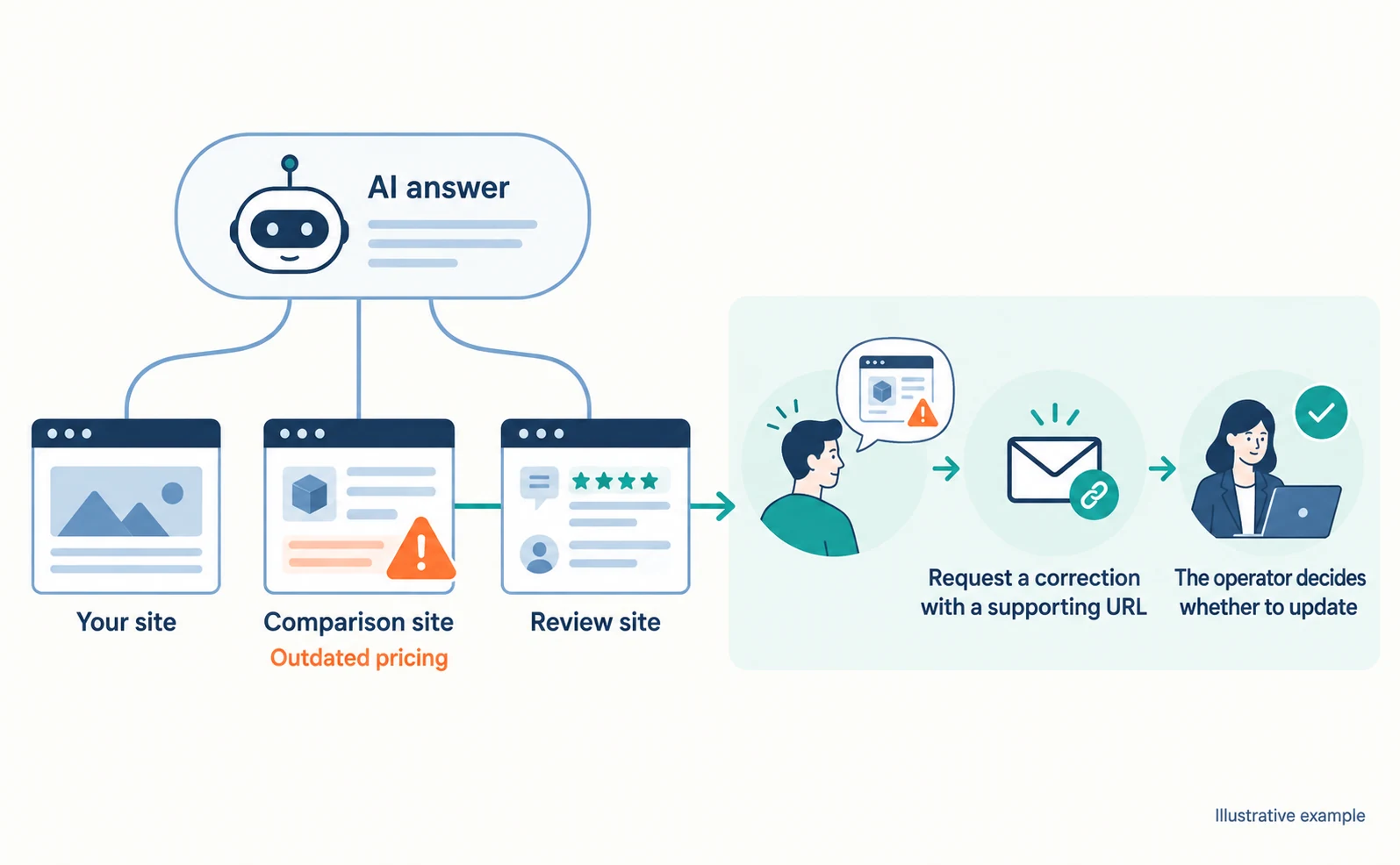
A correction request might read:
Your time-tracking comparison lists our monthly price at a previous rate. Our current pricing is published on our pricing page (URL). Could you review it and consider updating the listing?
You may not be able to edit a third-party listing yourself. Include a supporting URL and leave the decision to the site operator.
Build a Map of Questions and Pages to Improve
Decide which page to fix first with a map that lists, for each question, the responsible page and the missing explanation. Start with questions that come up often in sales and that you can answer with confirmed information right away.
| Question (illustrative) | Type | Responsible page | Missing explanation | Priority |
|---|---|---|---|---|
| What time-tracking tool can replace Company A? | Comparison | Comparison page | When it is not a good fit | High |
| Does it connect with Example Accounting? | Integration | Integrations list | Method and plan conditions | High |
| What does it cost per month for 50 users? | Pricing | Pricing page | Example calculation by headcount | Medium |
| How many days does setup take? | Implementation | Implementation guide | Customer-side preparation | Medium |
Set priority by whether you can confirm the answer internally and how often it comes up in sales. If the answer is not settled internally, check with the responsible team first.
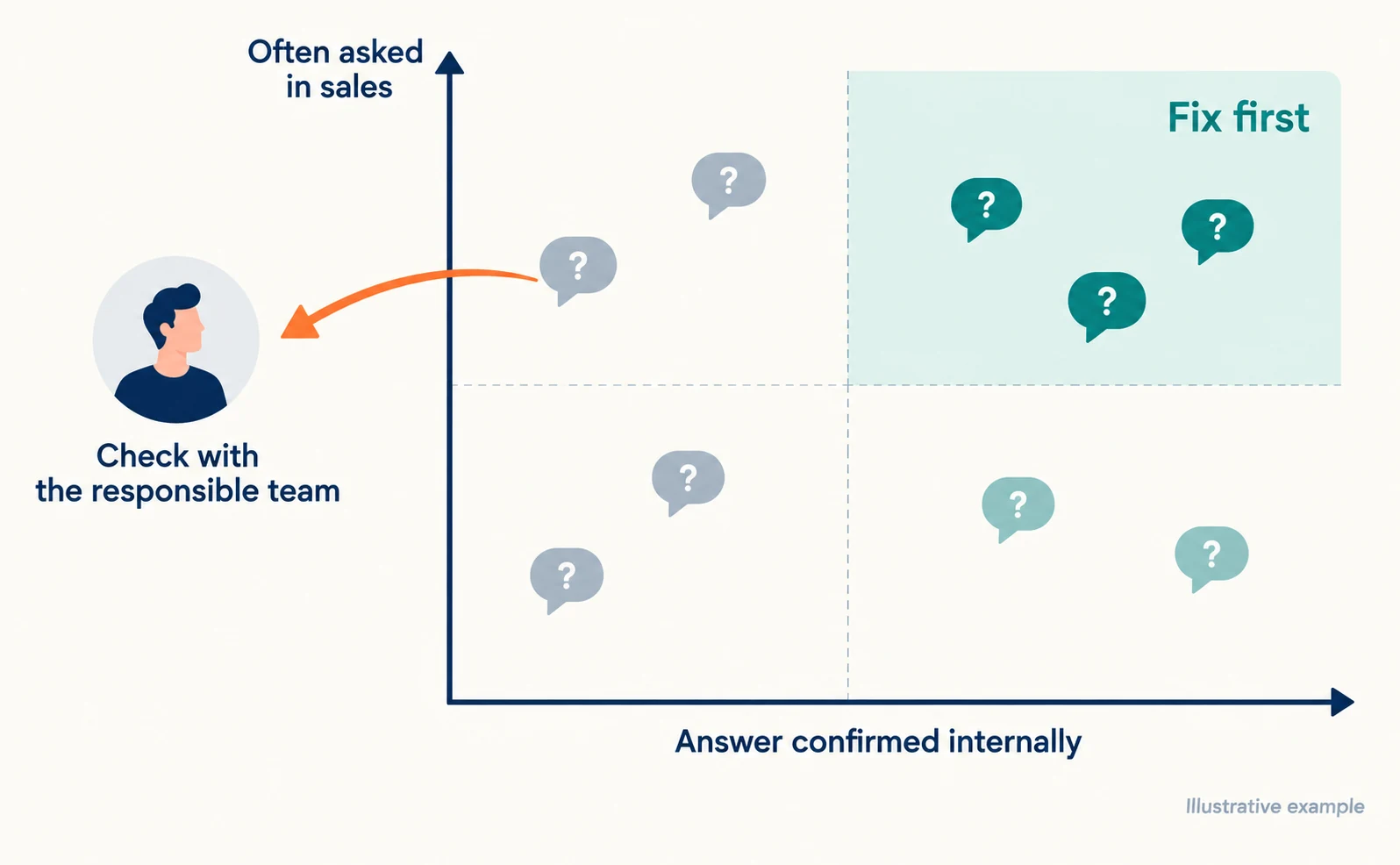
Questions without a responsible page are candidates for new pages. However, Google warns that creating many pages for every search phrasing, mainly to manipulate rankings, violates its spam policies [2]. First check whether an existing page can answer the question.
For how to review existing pages, see Before Adding Articles for AI Traffic, Review Your Existing Pages. For pricing pages, see Five Questions Your Pricing Page Should Answer.
Measuring AI-Driven Results for B2B
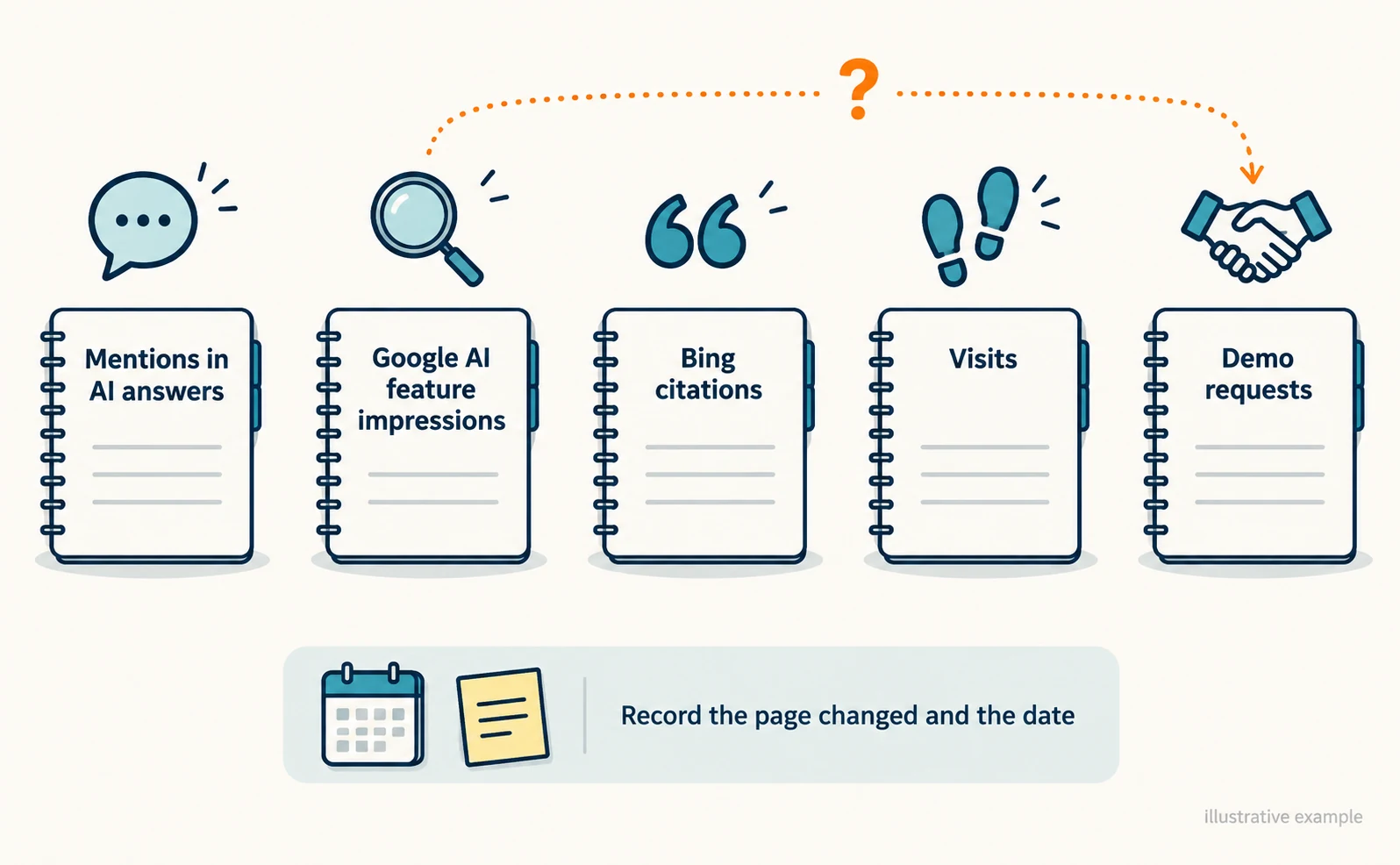
For B2B, keep separate records of mentions in AI answers, search impressions, site visits, and demo requests. Do not judge the impact on sales from a single number.
In June 2026, Google added reports for generative AI features to Search Console and later noted that they had rolled out to all websites worldwide on August 31, 2026 [4]. You can check impressions in AI Overviews and AI Mode by page, country, device, and date [4].
On June 16, 2026, Bing began a preview of Intents, Topics, Citation Share, and Compare in Bing Webmaster Tools [3]. Citation Share is the percentage of citations your site receives among all citations shown for a specific query. Bing says it is not a ranking or traffic share and does not reveal competitor domains [3]. It also differs from counting how many of your repeated answers mention you, which uses the number of answers as the denominator.
| Record | Where to check | What it shows |
|---|---|---|
| Mentions in AI answers | Ask the target AI the same question repeatedly | Whether your name or link appeared at that time |
| Google AI feature impressions | Search Console generative AI report | Impressions by page |
| Bing citations | Bing Webmaster Tools | Citation share and trends by query |
| Visits | Website analytics | Visitors from AI services |
| Demo requests | Form and CRM records | Sales opportunities generated |
More impressions do not necessarily mean more demo requests. Record which page you changed and when, and compare periods of the same length. Do not conclude that your revision caused a change based on before-and-after figures alone.
Start by choosing three key comparison questions and filling in the map.
FAQ
- Q. Can I name competitors on a comparison page?
- If you do, include only what you can confirm in their public information and record the date you checked. Comparative claims can raise legal issues, so check with your legal team before publishing.
- Q. What should I write if pricing is not public?
- You can still explain what affects the price, what information a quote requires and whether setup fees apply. Our article on five questions your pricing page should answer covers this in detail.
- Q. Is Bing’s Citation Share a search ranking?
- No. Bing describes it as your share of citations among all citations shown for a specific query, not a ranking or traffic share. It does not show competitor domains.
Sources
- [1] AI features and your website (Google Search Central) — accessed 2026-09-23
- [2] Optimizing your website for generative AI features on Google Search (Google Search Central) — accessed 2026-09-23
- [3] New AI Visibility Insights in Bing Webmaster Tools: Intents, Topics, Citation Share, Compare (Microsoft Bing) — accessed 2026-09-23
- [4] Introducing Search Generative AI performance reports in Search Console (Google Search Central) — accessed 2026-09-23
- [5] New Research Reveals the AI Citation Fingerprint of Major B2B SaaS Verticals (Foundation) — accessed 2026-09-23
- [6] An Analysis of 350,000 B2B SaaS Articles: What Predicts Google Ranking and AI Citation (Citera) — accessed 2026-09-23
About the author
Shogo MizushimaCEO of kairos Inc. / AgentSignal Developer
Develops AgentSignal, a tool for measuring AI crawler visits and AI-referred traffic, and diagnosing AIO readiness. Writes about measurement and practical improvements for AI search using observed data.
Related articles
Measurement and site improvement
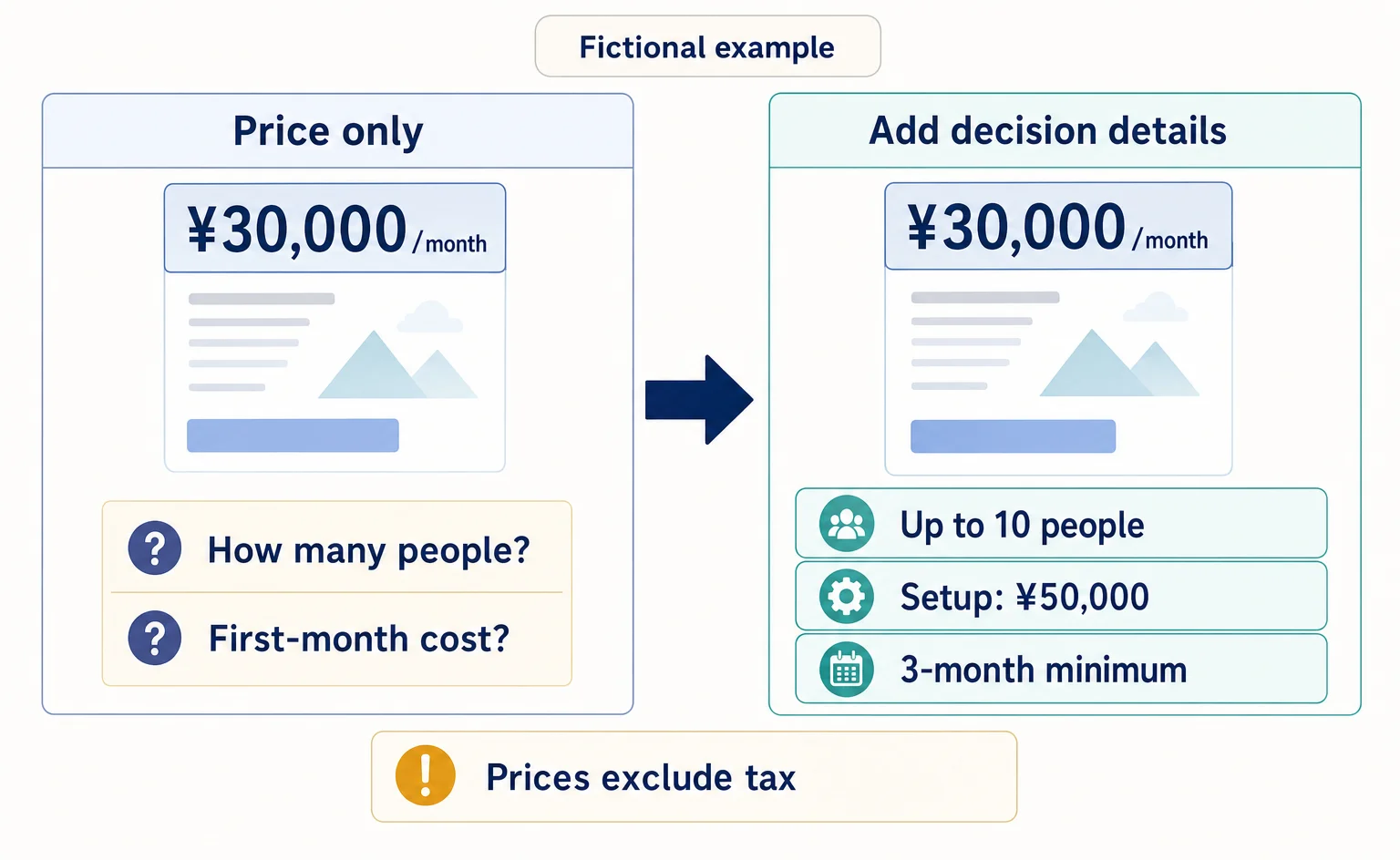
Before Adding More AI-Focused Articles: Five Questions Your Pricing Page Should Answer
Getting visits but few inquiries for your business service? Use this worksheet and a fictional before-and-after example to review what pricing includes, extra charges, cost calculations, contract terms, and what happens after someone applies.
Published
Case studies and research
B2B AI Search: Review Existing Pages Before Adding New Articles
Before adding articles for AI search, B2B companies can find gaps in existing pages and choose to keep, correct, combine, or create. This guide uses a case study and worked examples, and shows how Search Console’s generative AI report can help narrow down pages.
Published
AIO and AI search
Ranking First but Not Cited by AI? How Query Fan-Out Works
Query fan-out is a technique in which AI may run several related searches to answer one question. Learn why a first-place page may not be cited, which related questions your pages should answer, and what you can observe in Search Console and Bing.
Published