How to Choose an LLMO/AIO Agency and What to Check Before Signing
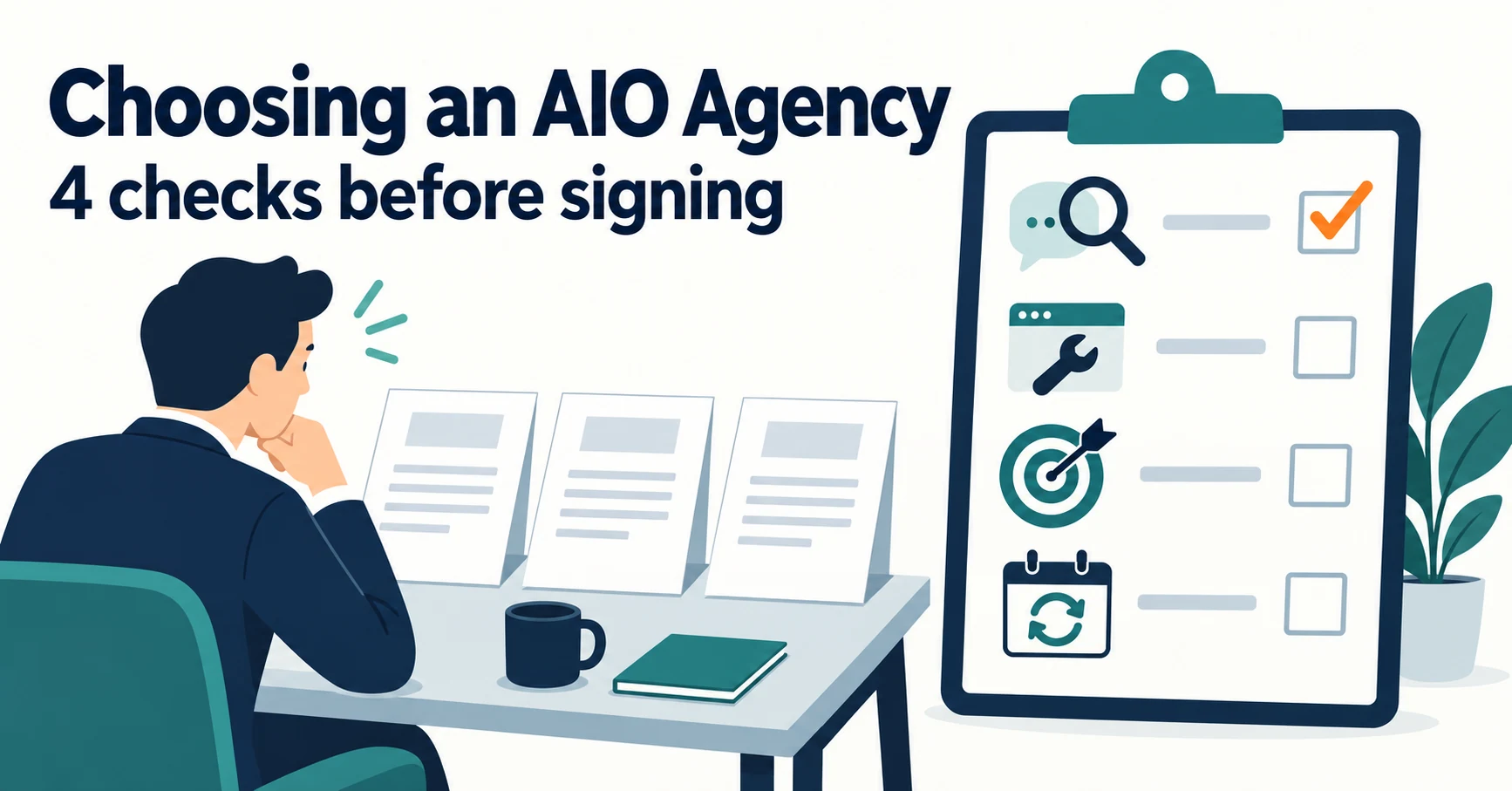
Compare AIO and LLMO agencies by how they measure, what they fix, how they define results and whether reports can be repeated—not by labels or headline numbers. Includes a question list to send before signing and proposals worth questioning.
Compare LLMO and AIO agencies on four things rather than labels or headline results: how they check AI, who fixes what, what counts as a result, and whether they can report the same way each month. Ask about these four points before signing and put the answers side by side.
Three proposals arrive. All say they will “get you chosen by AI,” and you cannot tell them apart. Instead of the wording in the proposals, find out the actual work and how it will be checked.
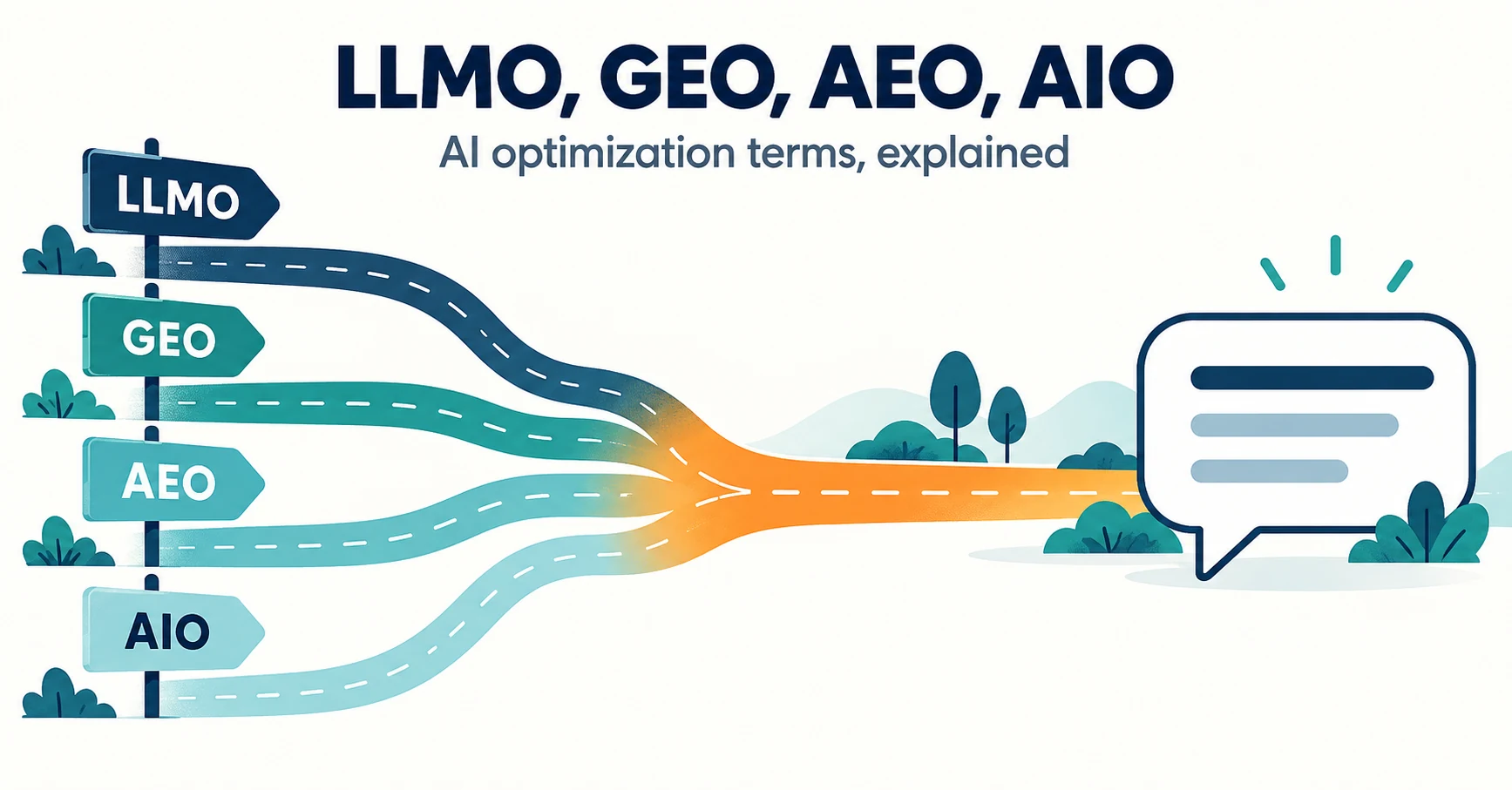
LLMO and AIO refer to efforts to be recommended in answers from ChatGPT, Google AI Overviews and similar services. See LLMO, GEO, AEO and AIO: Understanding AI Optimization Terms for the differences.
Four Criteria for Comparing AIO and LLMO Agencies
When comparing agencies, use the same four criteria. They show how each will handle your request better than company names or past figures.
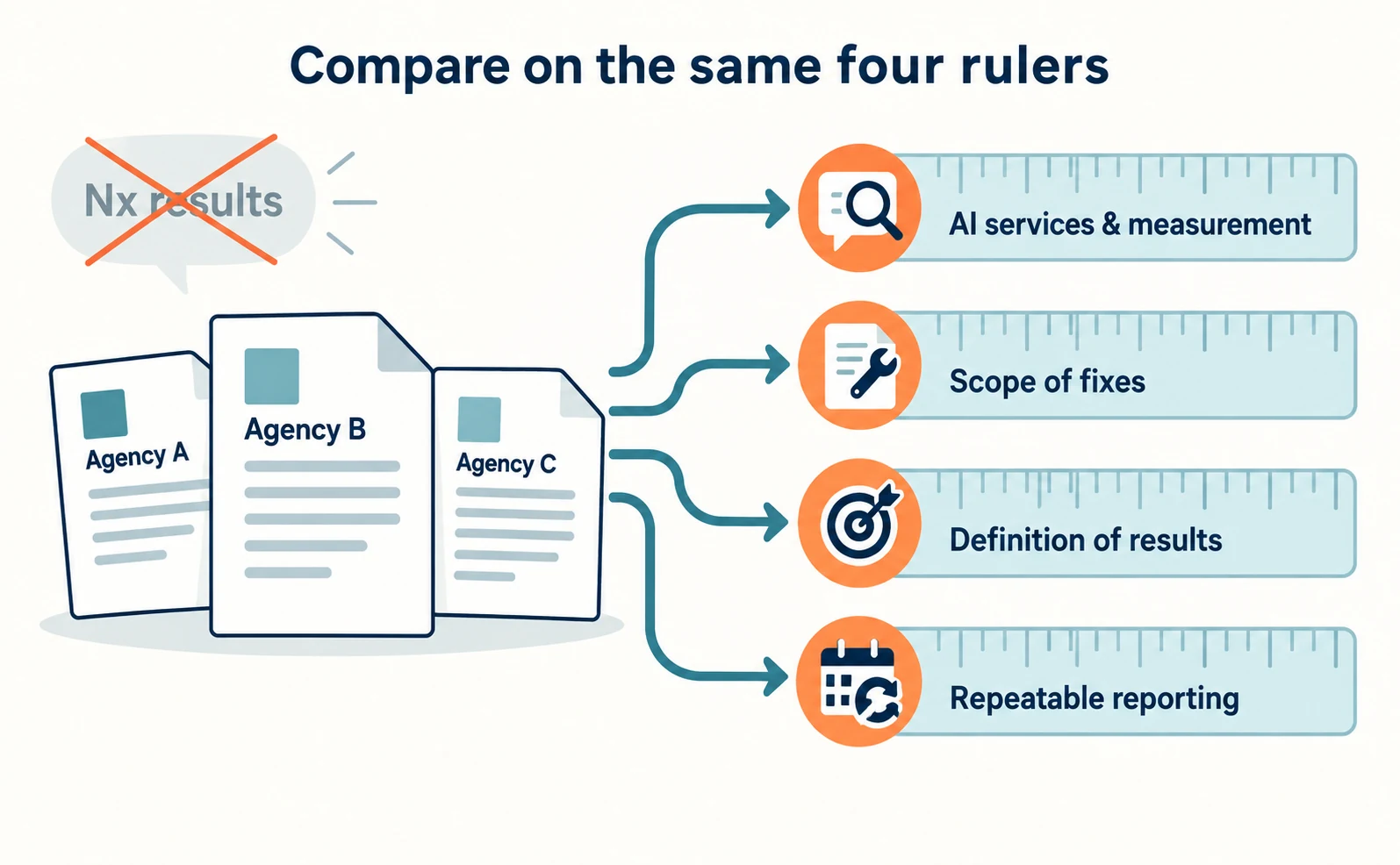
| Criterion | What to ask | A clear answer (example) |
|---|---|---|
| AI services and measurement | Which AI, which questions, how many times | 10 questions in ChatGPT and AI Overviews, 4 times a month each |
| Scope of fixes | Proposals only, or drafting and publishing too | Drafts for up to 2 pages a month; you publish |
| Definition of results | What counts as success | Share of answers with a link to your official site |
| Repeatable reporting | Can months be compared the same way | Question text and full answers attached monthly |
The right-hand column is an illustrative example created for this article. Different answers are fine; look for answers that are specific and checkable later.
Checking Measurement: How Often and Which AI
Check measurement by asking whether the agency will disclose the question text, the AI services, the number of runs per question, and how failed runs are handled. AI answers can differ each time for the same question, so a single check cannot tell a lucky appearance from a consistent one.
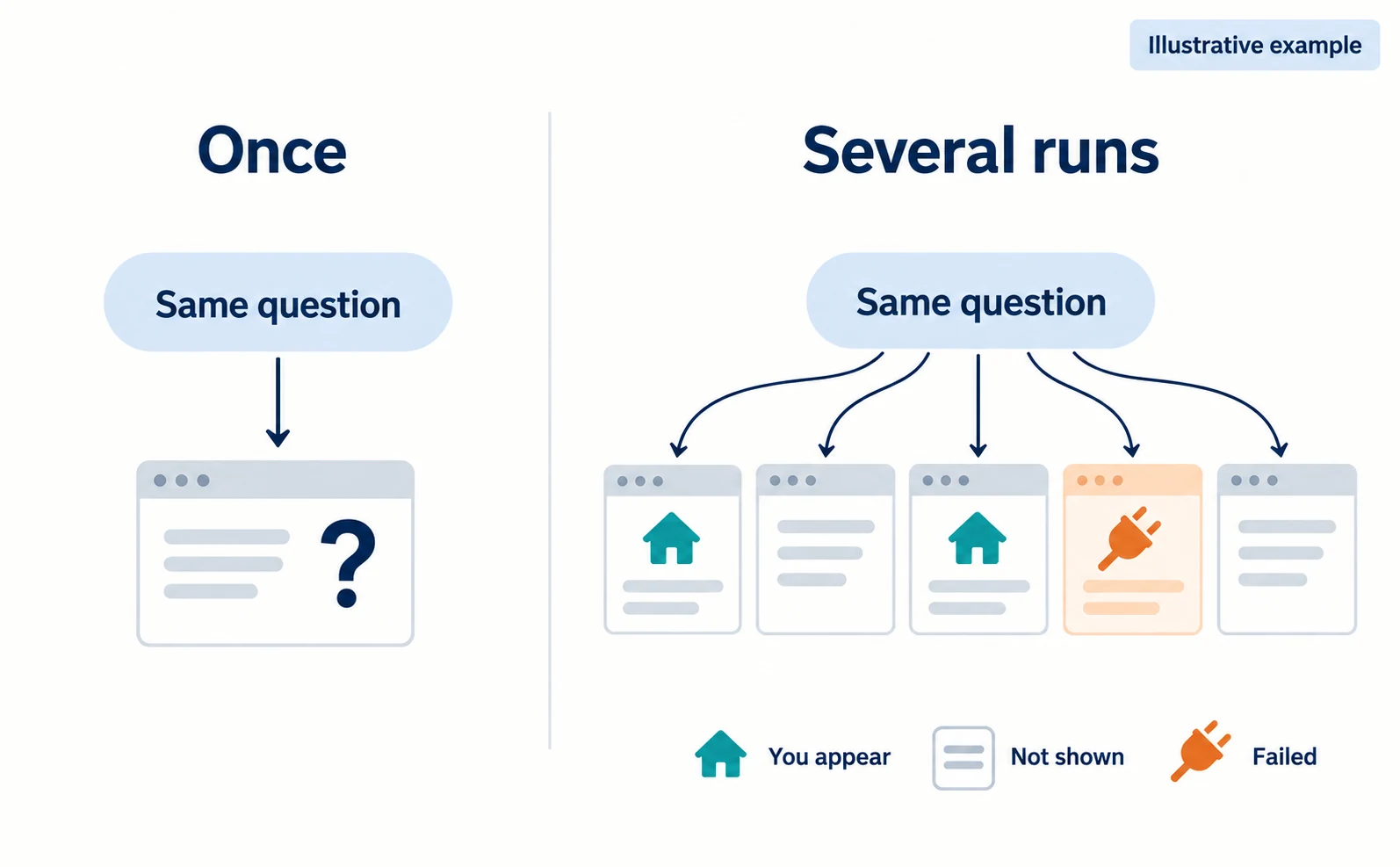
Google explains that AI Overviews and AI Mode may use different models and techniques, so their answers and links differ.[1] If a proposal just says “measured on Google,” ask which one.
There is official data you can check yourself. Search Console’s generative AI report for Search shows how often your pages appeared in AI Overviews and AI Mode, by page, country, device and date.[3][4] Generative AI features in Google Discover have a separate report.[3] It rolled out to all sites worldwide on August 31, 2026.[3] Sites with few impressions may not see the report.[4]
Bing Webmaster Tools shows how often and which pages were cited in Copilot and Bing AI answers.[6] Citation Share is the percentage of all citations shown for a specific grounding query (the phrase AI used to find supporting sources) that point to your site. It is an observational metric—not a ranking or traffic share—and does not reveal competitor domains.[5] It uses a different denominator from a citation rate that counts how many answers out of those checked cited you, so do not treat the two as the same number. The feature began rolling out as a preview when it was announced in June 2026.[5]
You can ask an agency: “Can you report your own measurements alongside this official data?” When you know where numbers come from, you can check reports internally.
Checking Proposals: Tactics to Question
Google says no special files or special structured data are required to appear in AI Overviews or AI Mode.[1] For proposals like these, ask about the purpose and basis before deciding.
| Proposal | Question to ask back |
|---|---|
| Adding llms.txt gets you chosen by AI | Which AI reads it, and how will you check the effect? |
| AI-specific markup is required | Which official documentation is this based on? |
| Add 10 articles every month | Which question does each article answer? |
| Rewrite the opening of cited pages | Can you save answers before and after and compare them? |
Structured data describes a page to search services and must match what visitors see.[2] Maintaining it with your content makes sense, but if it is presented as guaranteeing citations, ask for the basis.
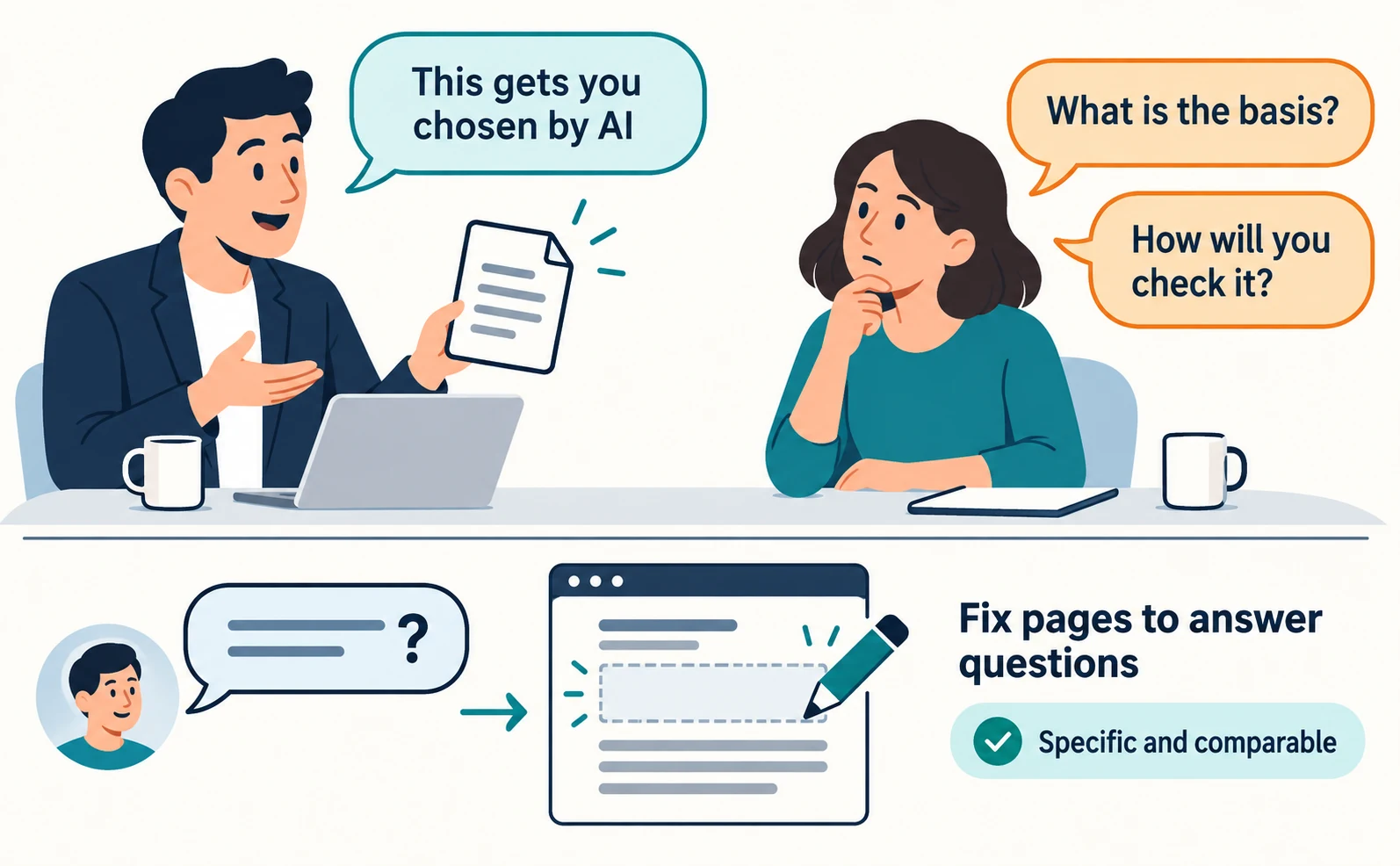
Conversely, proposals to collect customer questions and fix pages that lack answers fit the fundamentals Google lists.[1] The more specific a proposal is about what to change, the easier it is to compare.
How to Read Guarantees and Timelines
Google says that even when requirements are met, appearing in search or AI features is not guaranteed.[1] If a proposal promises “you will definitely appear in AI,” confirm in writing what the guarantee means.
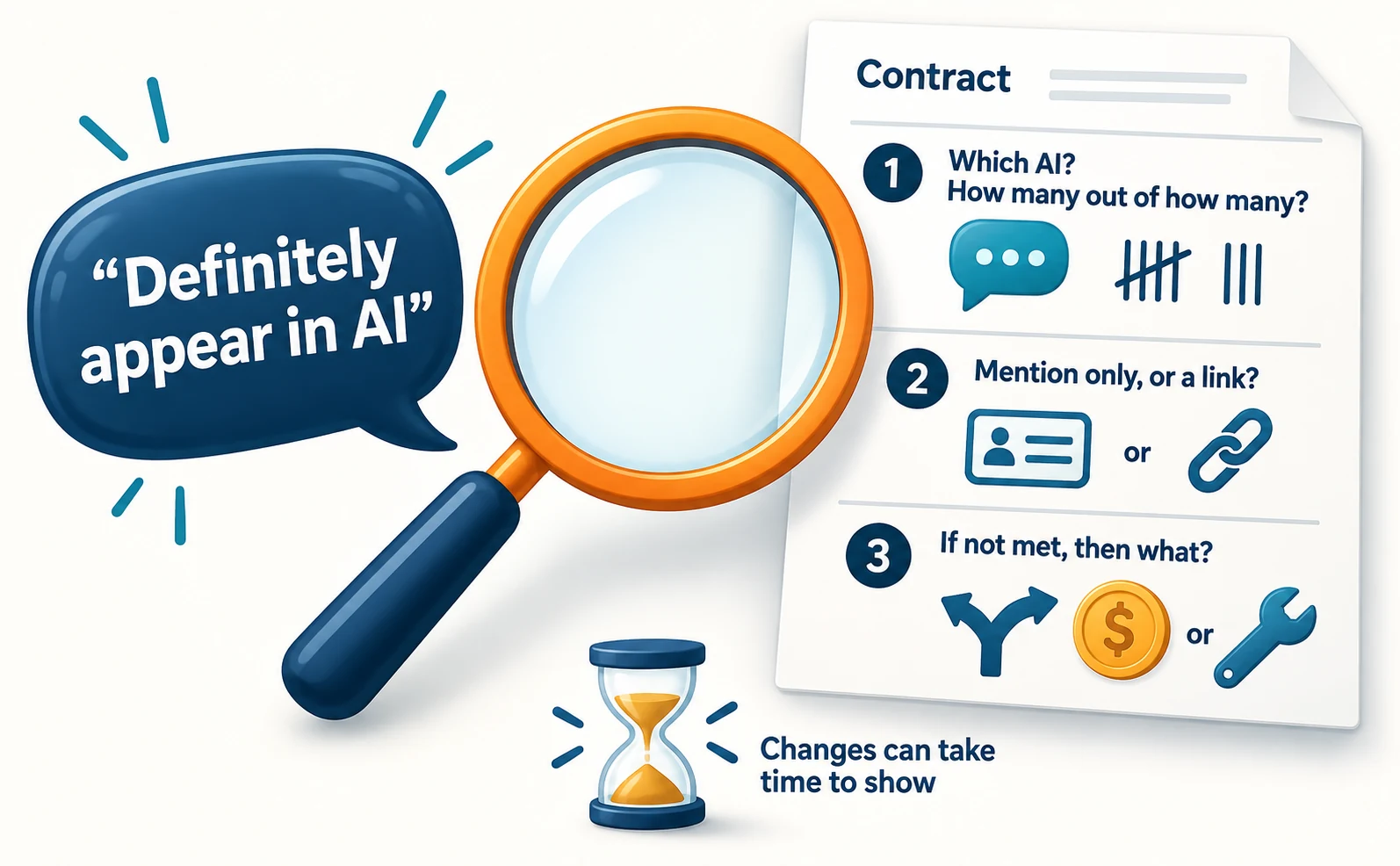
Check these three points:
- Which AI, which questions, and how many appearances out of how many checks count as meeting the guarantee.
- Whether a mention is enough or a link to your official site is required.
- What happens if the condition is not met, such as a refund or extra work.
Be careful with timelines too. Google says it can take several days to several months for pages to be recrawled after changes.[1] If told “results in one month,” ask which AI and what change that refers to, and the basis for the period.
Choosing a Local Agency or Working Online
Whether to choose a nearby agency depends less on location than on whether you need face-to-face meetings, whether they know your industry, and whether their hours suit yours.
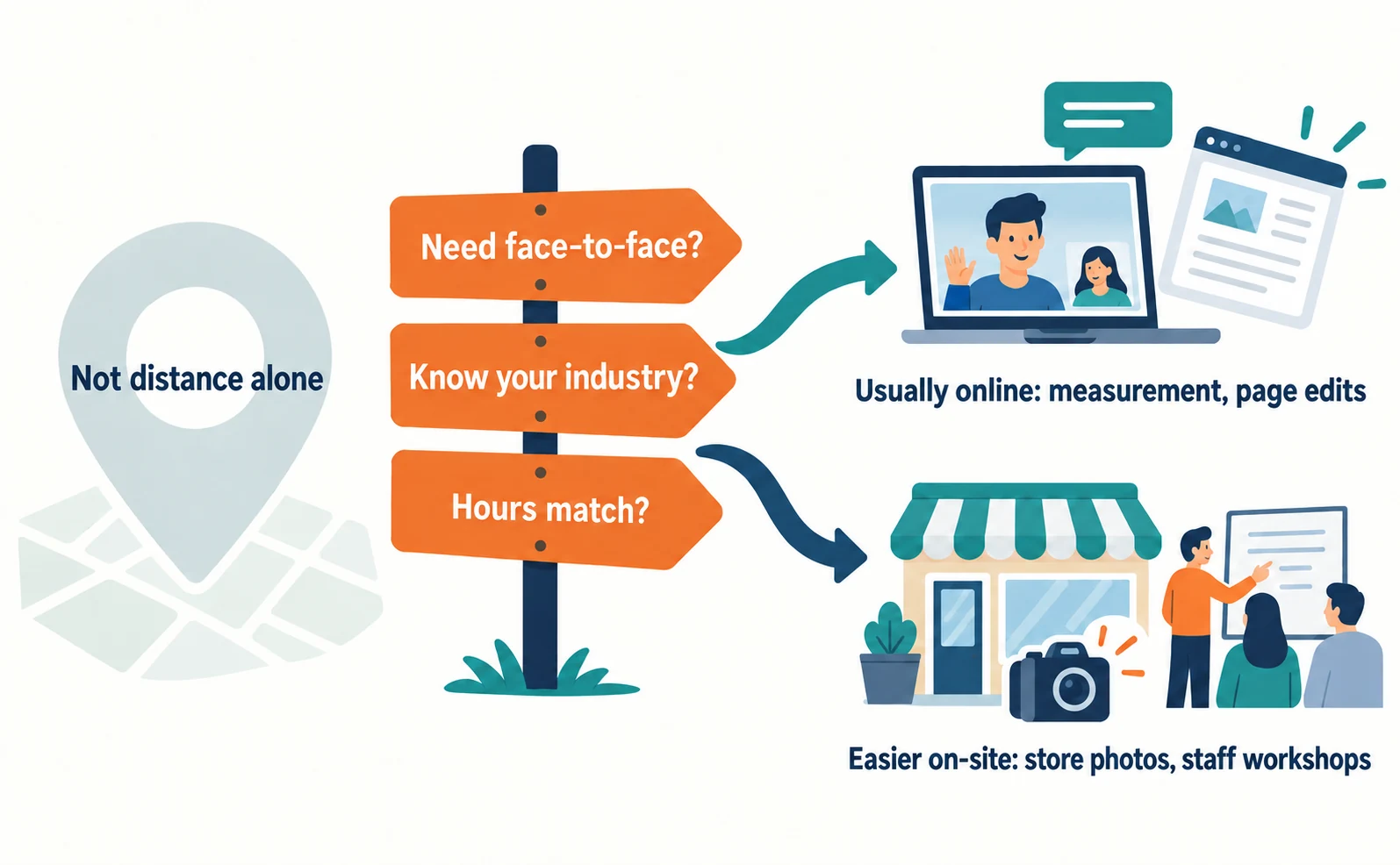
Measuring AI answers and editing pages can usually be done online. If you need on-site photography or workshops for staff, an agency that can visit may be easier to work with.
For stores and local businesses, map listings matter too. Google lists keeping Business Profile information up to date among the fundamentals.[1] Rather than local knowledge alone, check whether reviewing these listings is included in the work.
Questions to Send Before Signing
Here are the four criteria turned into 10 questions you can send to candidates. Recording the answers in the table below shows how agencies differ.
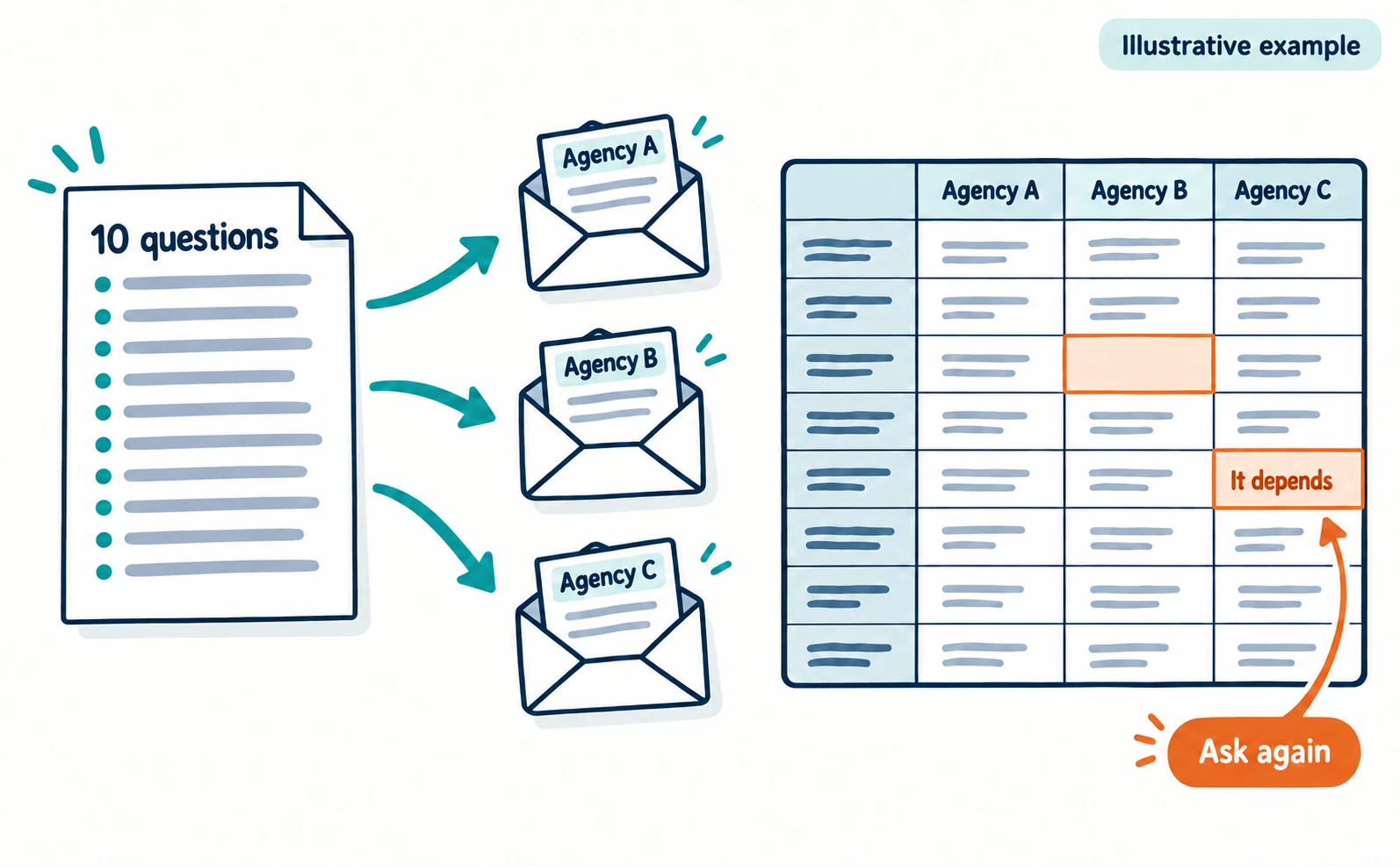
- Which AI services will you check? Do you separate Google AI Overviews and AI Mode?
- How many questions, and who chooses and approves them?
- How many times is each question asked per measurement?
- How do you count runs where the connection to the AI fails?
- Will you save and share full answers and cited URLs?
- Are page edits proposals only, or do they include drafting and publishing?
- What counts as a result, and which numbers will you report?
- Can you report alongside Search Console and Bing Webmaster Tools data?
- If you propose llms.txt or special markup, what is the basis?
- What are the contract length, setup fee and cancellation terms?
| Question | Agency A | Agency B | Agency C |
|---|---|---|---|
| 1 AI services | |||
| 2–4 Questions and runs | |||
| 5 Saved answers | |||
| 6 Scope of edits | |||
| 7–8 Results and reports | |||
| 9 Basis for tactics | |||
| 10 Contract terms |
If an agency leaves many blanks or says “it depends,” ask again for specifics. The completed table also works as a briefing for your manager. To understand where you stand before asking, start with a review of your published pages using the free AIO check.
FAQ
- Q. Can I ask my SEO agency to handle LLMO too?
- Yes. Google says normal SEO fundamentals apply to its AI features. Still, confirm separately how they will measure and report AI answers.
- Q. Is it a problem to hire an agency outside my area?
- Measurement and page edits can usually be done online. Decide based on the need for face-to-face meetings, industry knowledge and matching hours.
- Q. Can I trust a promise that I will definitely appear in AI?
- Google does not guarantee appearance. Confirm in writing which AI and how many appearances out of how many checks count, and what happens if it is not met.
Sources
- [1] AI features and your website (Google) — accessed 2026-09-23
- [2] Introduction to structured data markup in Google Search (Google) — accessed 2026-09-23
- [3] Introducing Search Generative AI performance reports in Search Console (Google) — accessed 2026-09-23
- [4] Generative AI performance report (Search) (Google) — accessed 2026-09-23
- [5] New AI Visibility Insights in Bing Webmaster Tools: Intents, Topics, Citation Share, Compare (Microsoft Bing) — accessed 2026-09-23
- [6] Introducing AI Performance in Bing Webmaster Tools Public Preview (Microsoft Bing) — accessed 2026-09-23
About the author
Shogo MizushimaCEO of kairos Inc. / AgentSignal Developer
Develops AgentSignal, a tool for measuring AI crawler visits and AI-referred traffic, and diagnosing AIO readiness. Writes about measurement and practical improvements for AI search using observed data.
Related articles
AIO and AI search
LLMO, GEO, AEO and AIO: Understanding AI Optimization Terms
LLMO, GEO, AEO and AIO are names for work that helps AI answers find your company. Learn what GEO and AEO mean, how GEO differs from local map optimization, where the terms overlap, and how to compare proposals that use different names.
Published
AIO and AI search
What Is LLMO? How It Differs from SEO and Why Some Say It Is Pointless
LLMO is the work of helping answers from ChatGPT and other AI find and accurately describe your company. Learn how it differs from SEO, why some call it pointless, how E-E-A-T relates, how to measure results and what to do in the first month.
Published
AIO and AI search
Do You Need llms.txt? What It Can Do and What to Check Before Adding It
llms.txt is a list of links to public pages you want AI to read. Learn whether AI search requires it, how it differs from robots.txt, when it helps, how to write it, and how to set it up and check it in WordPress and other platforms.
Published