AI-referred signups up 37%: how OpusClip made AIO measurement continuous
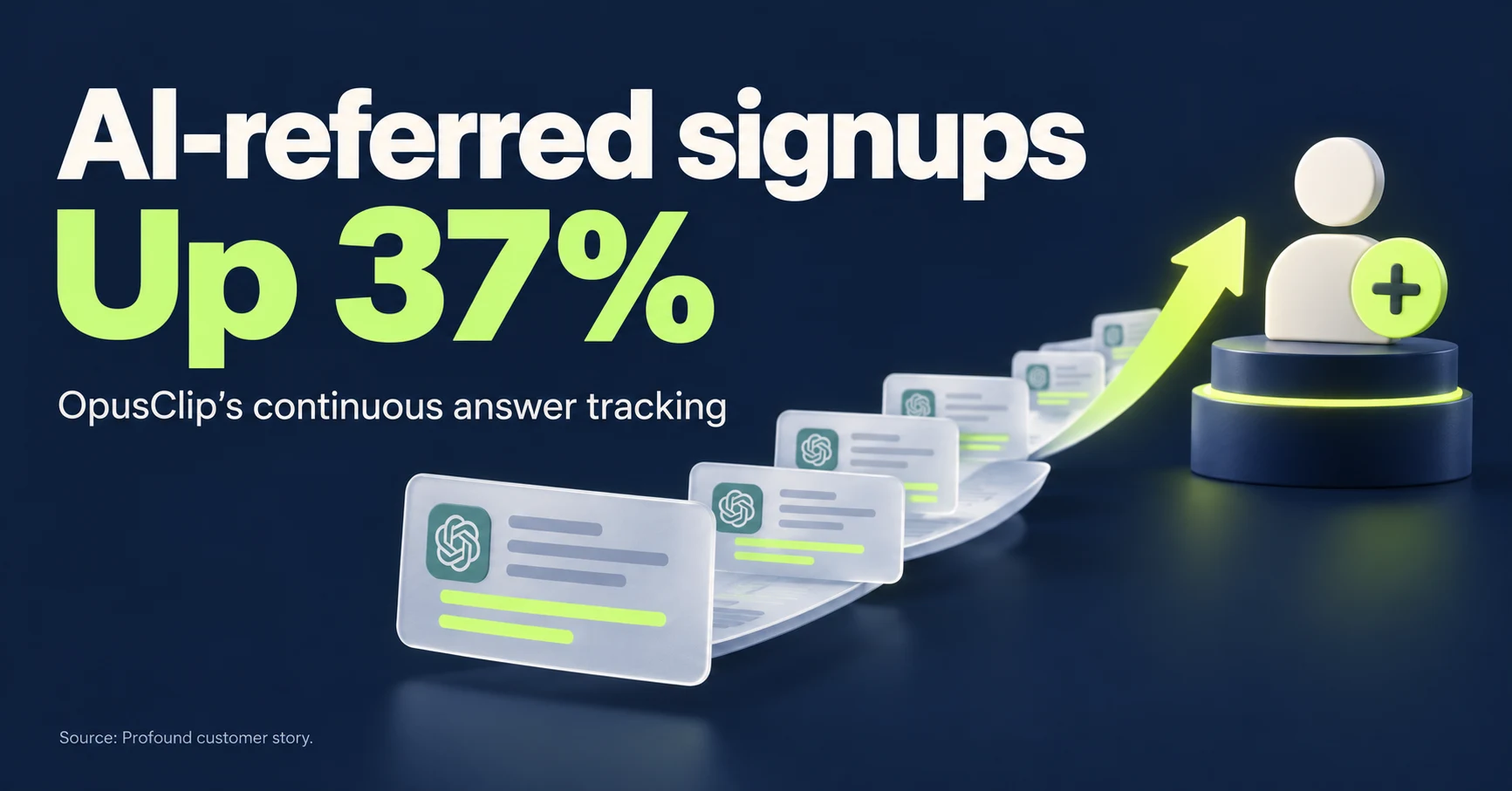
OpusClip reported 37% more AI-referred signups and 20% more traffic. The team combined seven-day rolling averages with human checks of AI answers.
Your company appears when you ask ChatGPT a question today, then disappears tomorrow. That alone is a weak basis for judging whether a content edit worked.
OpusClip’s customer story reports a 37% increase in AI-referred signups. The useful operational change was moving from occasional checks toward a continuing record of answers that could inform page improvements. Profound’s case study
The case illustrates how to make AI search optimization less dependent on impressions from individual answers.
OpusClip’s results: 37% more signups and visibility above 45% are different metrics
Reported AI-referred signups increased 37%, while AI-driven traffic increased 20%. Visibility for the core focus reportedly moved from roughly 30% to above 45% in 30 days. Profound’s case study

Illustration: Observe signups, visits, and AI mentions separately.
Signups are not revenue. Visibility measures presence in monitored AI answers, not a signup conversion rate.
The vendor-published story does not isolate the effect of one article edit. Keep citations and registrations as separate outcomes when adapting the process.
Occasional manual prompts did not provide a consistent answer history
Occasional manual checks made it difficult to compare questions and answers over time. OpusClip moved toward continuously recording answers. Profound’s case study

Illustration: Move from a one-off answer check to a dated, comparable record.
Manual questioning still has uses, including developing a question set and reading actual responses. The issue is whether conditions remain comparable.
A question about shortening videos and one about Japanese subtitles test different needs. Preserve the question, AI service, language, date, and cited URL together.
New articles and existing-page improvements retained human review
OpusClip combined new content with improvements to existing pages and retained human review. Profound’s case study

Illustration: A person checks the substance of both new and revised content.
As an editorial recommendation, assign recorded questions to existing pages first.
| Page condition | Next action |
|---|---|
| The answer is buried | Improve the heading and order |
| A feature is described without conditions | Add supported formats, limits, and plan requirements |
| No relevant page exists | Decide whether a separate explanation is needed |
For an illustrative video tool, “supports subtitles” leaves questions about languages, editing, and export formats unanswered.
Even when AI drafts the text, a product owner should verify those details. Readability and factual correctness require separate checks.
Using seven-day rolling averages and sharing results across teams
The company reportedly reviewed seven-day rolling averages and shared insights with product, engineering, and co-marketing colleagues. Profound’s case study

Illustration: A seven-day rolling average shifts its window by one day. Keep signup records separate.
A seven-day rolling average uses the seven days ending on each observation date. It differs from a fixed Monday-to-Sunday weekly average.
It can help you examine a trend instead of treating one appearance as success. However, changing the monitored question set substantially also changes the comparison.
Share the question, cited page, and relevant explanation alongside the chart so the next person knows what to improve.
Try it yourself: track citations and registrations alongside a rolling average
Begin by recording answers to a stable question set for seven days and calculating a daily mention rate. This is a suggested internal observation method, not a claim about Profound’s metric formula.
For example, inspect ten answers each day and record the share mentioning your company. On day seven, average the first seven days; on day eight, average days two through eight. Retain the answer count if daily sample sizes vary.
| Record | Comparison |
|---|---|
| AI answers | Mentions and cited URLs for the same questions |
| Page edits | Change date and explanation revised |
| Signups | Registrations observably attributed to AI traffic |
If mentions rise without registrations, review whether the cited page answers the question and makes signup conditions clear.
Start by keeping questions and URLs consistent. That provides a practical basis for deciding what to change next.
FAQ
- Q. Is a rolling average the same as a weekly average?
- No. A seven-day rolling average uses the seven days ending on each date, shifting the window daily.
- Q. Does 37% more signups mean 37% more revenue?
- No. Registration growth and revenue growth are different outcomes.
Sources
- [1] Profound’s case study — accessed 2026-09-26
About the author
Shogo MizushimaCEO of kairos Inc. / AgentSignal Developer
Develops AgentSignal, a tool for measuring AI crawler visits and AI-referred traffic, and diagnosing AIO readiness. Writes about measurement and practical improvements for AI search using observed data.
Related articles
AIO and AI search
Airbyte reported a $100,000 ChatGPT-originated deal: the content changes behind its AIO work
Airbyte reported one $100,000 contract originating from ChatGPT. The team analyzed over 500 prompts and revised content into direct answers, lists, and steps.
Published
AIO and AI search
AI-referred inquiries up 51%: Arizona College of Nursing’s local AIO approach
Arizona College of Nursing reported 51% more AI-referred enrollment inquiries and 26% more visits in 90 days. The team examined questions across 24 markets and developed tuition comparisons and local FAQs.
Published

AIO and AI search
LLM-attributed traffic up 82%: Aleph’s one-theme-a-month content approach
Aleph reported 82% more LLM-attributed traffic and citation share rising from 1.5% to 5.3% over two months. The team selected one monthly theme and developed feature-specific buyer guides.
Published