From fifth to second: One Identity’s external-citation approach to LLM optimization
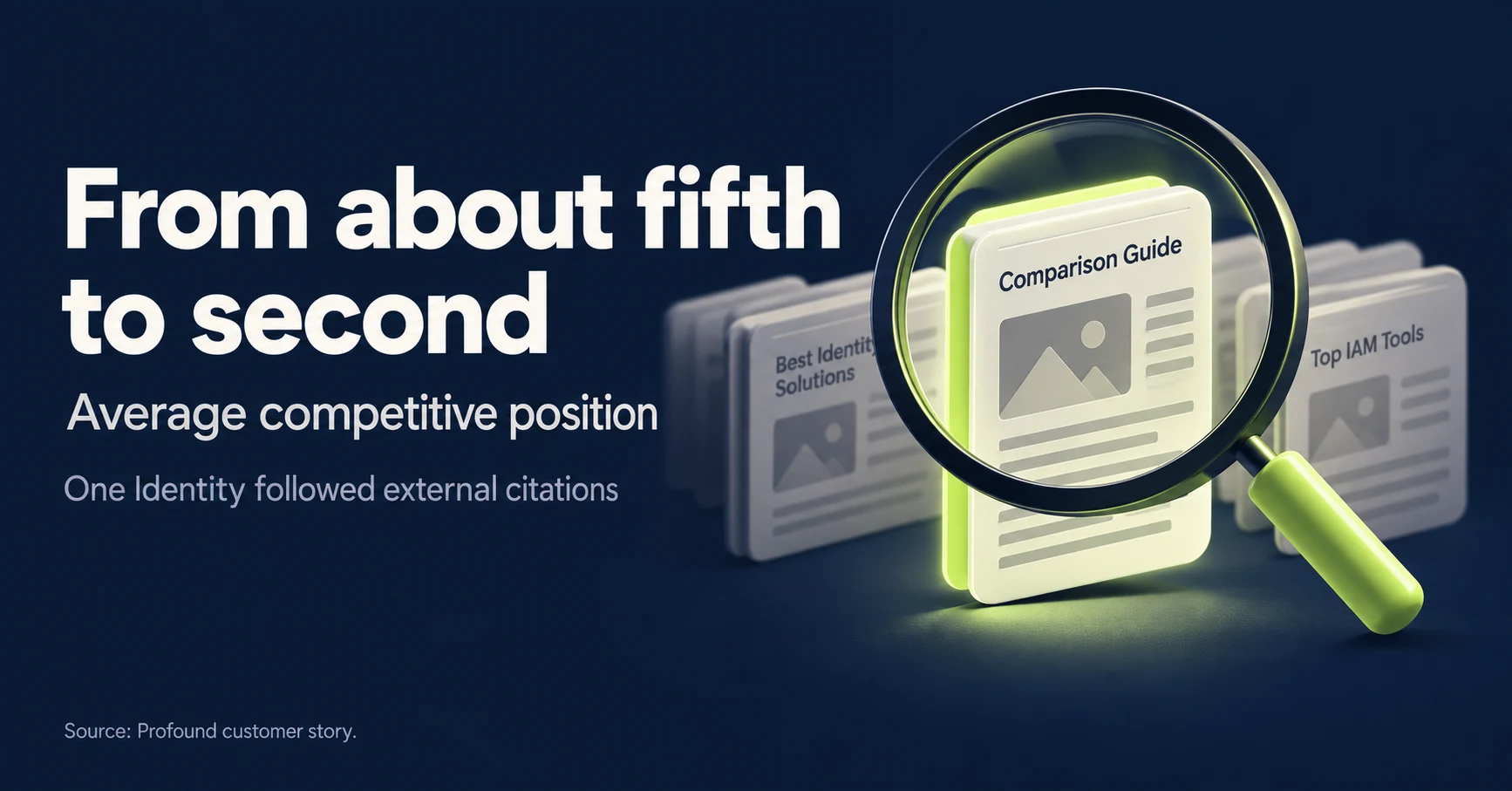
One Identity reported its average competitive position in AI improving from approximately fifth to second. The team examined third-party comparison pages cited in AI answers.
You improve your own website, but AI keeps citing outdated comparison pages. In that situation, it is useful to investigate the external sources supporting the answers too.
One Identity reportedly improved its average competitive position from approximately fifth to second. Its work included reviewing cited external articles and engaging their publishers. Profound’s case study
The case considers LLM optimization beyond a company’s own site.
What One Identity’s move from fifth to second and 30% visibility increase mean
The move from approximately fifth to second concerns average positioning against the selected competitors. The story also reports a 30% visibility increase in one quarter. Profound’s case study

Illustration: Distinguish competitive positioning in AI from placement inside an external article.
This is not Google search ranking. It is also separate from first- or second-position placements within publishers’ comparison articles.
These vendor-reported figures do not demonstrate higher revenue or more contracts. Start by identifying which questions and sources lead to the recommendations.
Using 90 days of citations to select external comparison pages for outreach
One Identity used a 90-day view of citations to identify external comparison pages for publisher outreach. Sponsored placements were part of the activity. Profound’s case study

Illustration: Review recurring external citations over a defined period and distinguish sponsored placements.
An appearance in an external article is not automatically an independent endorsement. Distinguish factual corrections, editorial coverage, and paid placement.
For your own company, first look for outdated prices or incorrect specifications. An official source can support a concrete correction request.
A vendor-authored Active Directory comparison also supported the work
The company also created an Active Directory management tools comparison on its own site. Profound’s case study
The current One Identity comparison describes multiple tools and places its own Active Roles product first. It is a vendor-authored comparison, not an independent ranking.
The current page may differ from the version used during the case period. Review its decision criteria rather than imitating its ordering.
Build a time-bounded list of external pages cited for your questions
Create a list of external pages cited in answers to a stable question set. This is our proposed workflow.

Illustration: Open cited pages and compare their claims with current, verified company facts.
| Field | What to record |
|---|---|
| Question and date | Conditions under which the answer appeared |
| Cited URL | The article, not just the domain |
| Description of your company | Capabilities, audience, or pricing |
| Difference from official evidence | Outdated, incorrect, or missing information |
| Placement type | Editorial, advertising, or unknown |
A fixed window such as 90 days helps distinguish recurring citations from one-off observations. It does not mean waiting 90 days before requesting a factual correction.
When contacting a publisher, identify the exact passage and official evidence. Keep buying a placement separate from correcting inaccurate information.
Check paid-placement disclosure and track AI position separately from visits
For paid placements, ask the publisher about advertising disclosure and link treatment. Google recommends rel="sponsored" for paid links and also accepts nofollow. Google’s link-attribute guidance

Illustration: Identify advertising and qualify paid links while tracking AI positioning and visits separately.
Those attributes do not promise increased AI visibility. Evaluate advertising placement and changes in AI answers separately.
Record the external page’s update date, average AI position, citations, and visits to your site independently. A prominent sponsored listing should not become a claim of a higher position across AI systems.
Start by reading three external pages cited for your main product and checking whether their facts are correct.
FAQ
- Q. Is fifth to second a Google ranking change?
- No. It is reported average competitive positioning in AI, separate from search rankings and publisher placement.
- Q. Is all external coverage independent evaluation?
- No. Sponsored placements were included; distinguish editorial coverage, corrections, and advertising.
Sources
- [1] Profound’s case study — accessed 2026-09-26
- [2] One Identity comparison — accessed 2026-09-26
- [3] Google’s link-attribute guidance — accessed 2026-09-26
About the author
Shogo MizushimaCEO of kairos Inc. / AgentSignal Developer
Develops AgentSignal, a tool for measuring AI crawler visits and AI-referred traffic, and diagnosing AIO readiness. Writes about measurement and practical improvements for AI search using observed data.
Related articles
AIO and AI search
Airbyte reported a $100,000 ChatGPT-originated deal: the content changes behind its AIO work
Airbyte reported one $100,000 contract originating from ChatGPT. The team analyzed over 500 prompts and revised content into direct answers, lists, and steps.
Published
AIO and AI search
AI-referred inquiries up 51%: Arizona College of Nursing’s local AIO approach
Arizona College of Nursing reported 51% more AI-referred enrollment inquiries and 26% more visits in 90 days. The team examined questions across 24 markets and developed tuition comparisons and local FAQs.
Published
AIO and AI search
AI-referred signups up 37%: how OpusClip made AIO measurement continuous
OpusClip reported 37% more AI-referred signups and 20% more traffic. The team combined seven-day rolling averages with human checks of AI answers.
Published