What Is Mastercard Agent Connect? From Product Discovery to Purchase
Learn how Mastercard Agent Connect links merchants with participating shopping AI services, how it differs from Shopping Agent and Agent Pay, and which availability and contract conditions remain unconfirmed for businesses in Japan. Reviewed September 14, 2026.
Having an external AI service introduce your products and help shoppers complete a purchase: Mastercard Agent Connect is a framework that connects participating merchants, AI services, payment providers and others to support this kind of shopping. By bringing these connections together, it aims to reduce the work merchants need to do to build a separate integration with each partner.[1][3]
When Japanese online retailers compare contract options, they need to distinguish between AI shopping assistance on their own sites, product connections to external AI services, and payment security. Understanding each role and its conditions of use helps separate the capabilities a business needs from the questions it must get answered before signing a contract.
Sources reviewed: September 14, 2026. This article compares the September 9 announcement with the official product pages. Agent Connect is described as rolling out first in the United States. The three sources reviewed do not confirm general availability for independent ecommerce businesses in Japan.[1][3]
1. AI assistance on your own site and connections to external AI serve different roles
An AI agent, as used here, is AI that carries out tasks such as shopping at a person's request. Mastercard's materials use several similar names, but they support different parts of a merchant's work.
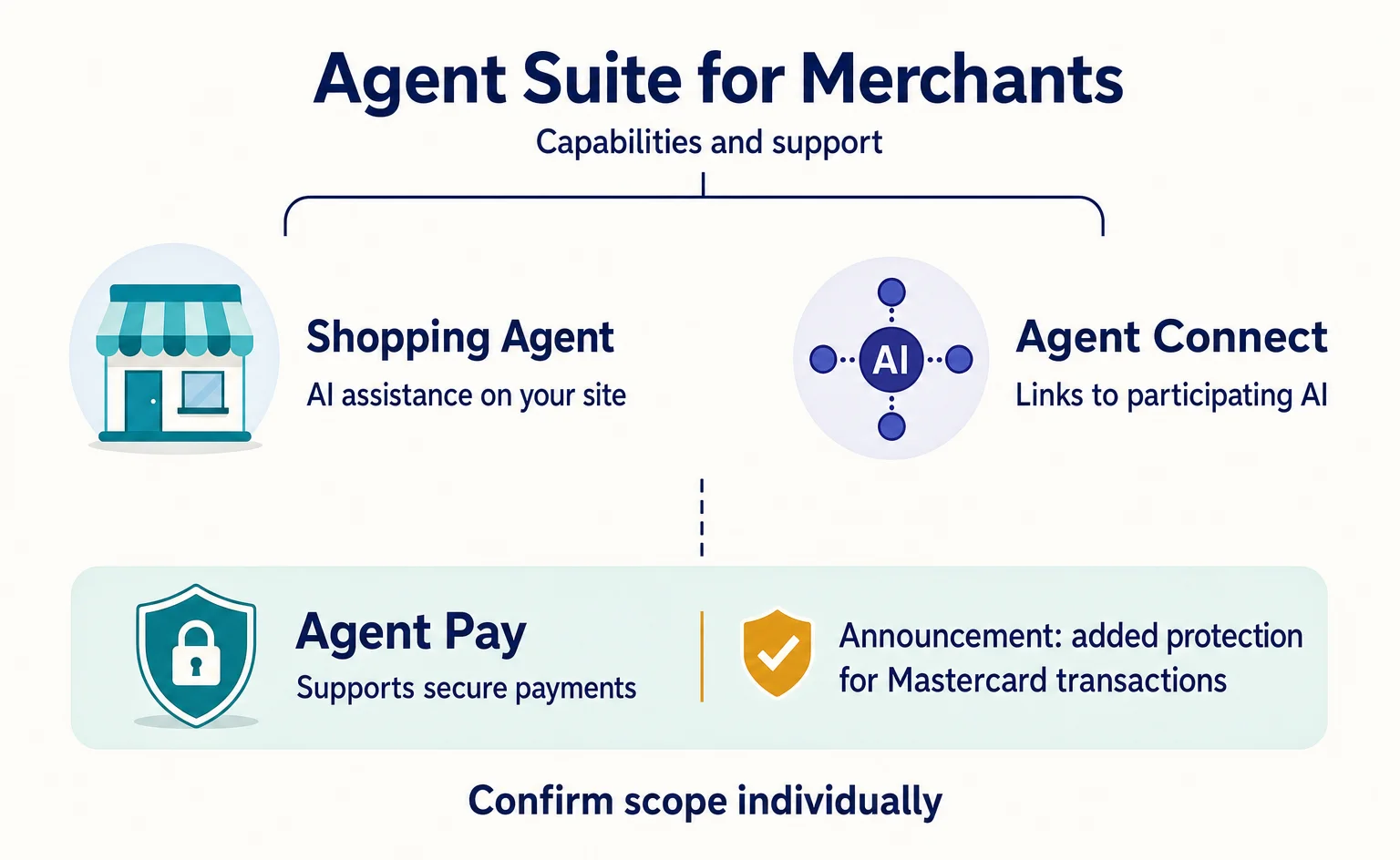
Agent Suite for Merchants is a collection of capabilities and support offerings that help merchants use AI. It is described as bringing together Shopping Agent for a merchant's own site and Agent Connect for connections to external AI. There is no need to think of the Suite as the name of another, separate shopping AI.[2][3]
Shopping Agent provides AI shopping assistance within a merchant's website or app. For example, it is designed to help visitors discuss what they need a product for, compare products, and change the items they plan to buy. This is a different role from introducing products to people outside the store's own site.[2]
Agent Connect links merchants with supported external AI shopping services. It supports a flow in which people who have not yet visited a merchant's site find and buy products through the AI they normally use. Its scope is participating connections; it does not guarantee that products will appear in every AI service.[1][2][3]
Agent Pay supports payment security. The September 9 announcement describes it as providing additional protection for Mastercard transactions so that purchases can proceed securely in line with the buyer's authorization. It is neither a channel for introducing products nor the store's own AI shopping assistant.[1]
For example, if your goal is to help site visitors choose products, Shopping Agent is the relevant scope to compare. If you want to sell to people using external AI, Agent Connect's supported connections are a basis for your decision. Even though the names belong to the same product family, check the scope of the offering rather than assuming a single contract includes everything.
2. Follow one water bottle from discovery to order
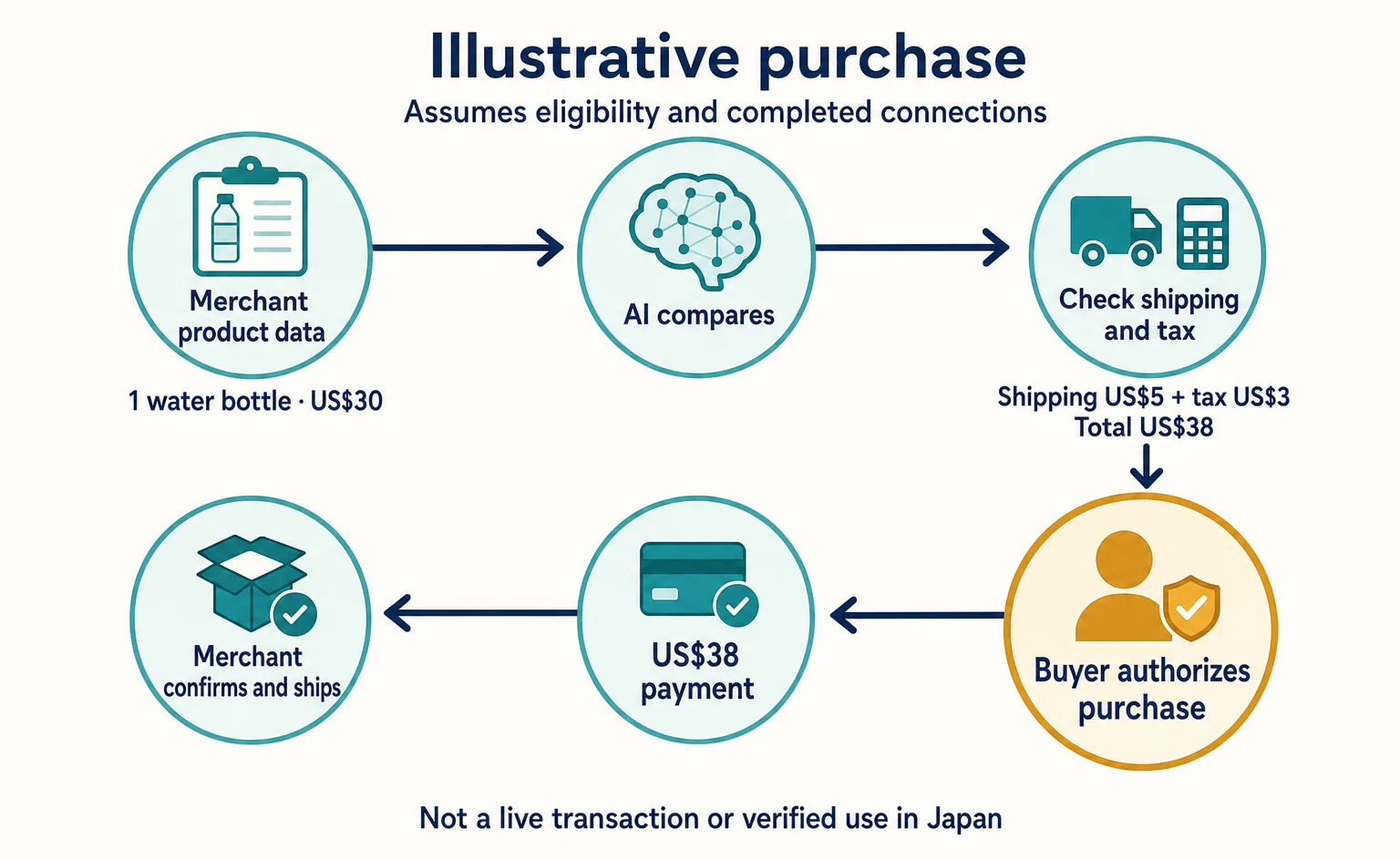
The following is an illustrative example. It assumes that the merchant, external AI service, payment provider and other participants meet the participation requirements in a supported region and have completed the necessary connections. It is not an example of verified use by a store in Japan. The product and prices are also fictional. When evaluating the service, substitute your own products' prices, stock levels and shipping conditions.
A buyer asks an external AI service: “Find me one leak-resistant water bottle for commuting, for no more than US$40 including shipping and tax.” Suppose a stainless steel water bottle priced at US$30 becomes a candidate. At the point it is introduced, neither the total payment including shipping nor permission to buy has been finalized.
Discover the product and compare it with the buyer's requirements
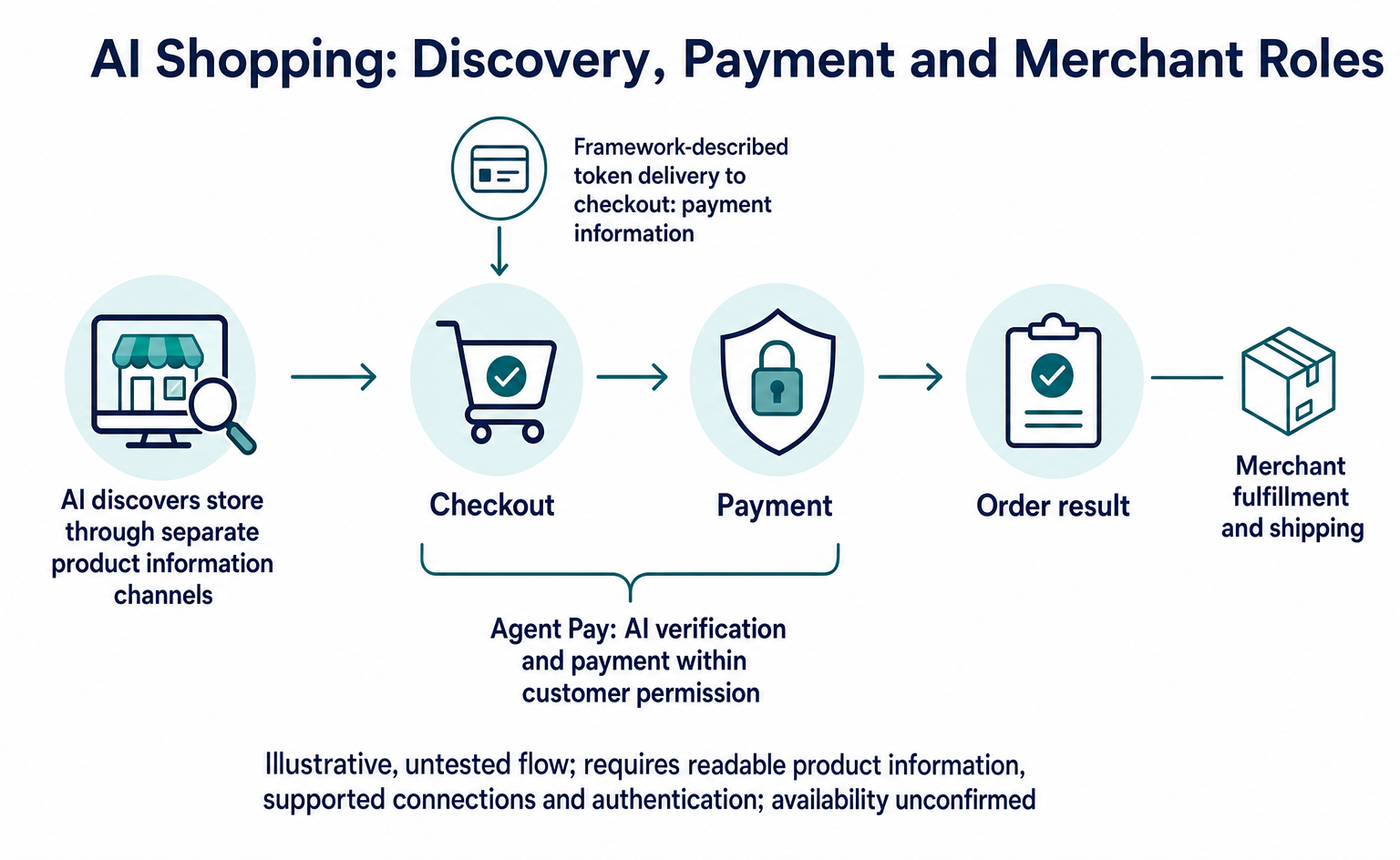
The external AI learns about products from a catalog the merchant has authorized it to access. Here, a catalog means a collection of product information, such as names, descriptions, prices and stock availability. Agent Connect is described as supporting the route through which participating AI services access this information.[1][3]
In the water bottle example, the external AI receives the merchant's product information, compares it with the buyer's intended use and budget, and presents a candidate. Even if the AI can introduce the bottle, that does not mean it has verified insulation performance or delivery dates that are not listed. For merchants, the information they provide affects how their products are described.
The conditions for accessing current prices and stock also need attention. An API, or application programming interface, is a way for systems to exchange information. The product page explains that real-time access to changing product information requires the AI to query the catalog through an API. Simply establishing a connection does not mean every AI response will always be up to date.[3]
Check shipping and tax, then obtain the buyer's authorization
Next, the external AI checks the final price and delivery conditions for the one shortlisted bottle through connections with the merchant and other relevant parties. The official explanation covers not only the product price but also tax, shipping charges and the conditions for fulfilling the order. In this example, assume the product costs US$30, shipping is US$5 and tax is US$3, bringing the total to US$38.[1][3]
The buyer is then assumed to review the one bottle, the US$38 total and the delivery conditions, and authorize the purchase. This example does not treat a request to find a product as unconditional permission to buy it. The official announcement likewise assumes transactions authorized by the buyer.[1]
If the final total were instead US$41, it would exceed the original budget. Before signing a contract, merchants should check whether a purchase can be stopped and the buyer asked to confirm again when such changes occur. The sources reviewed do not verify the specific behavior of automatic stopping or reconfirmation.
The merchant still has order-handling work after payment
Once the buyer authorizes the purchase, the proposed approach is for participating AI services, payment providers and providers supporting the purchase process to work together, using the information needed for secure payment to complete the transaction. Agent Connect's role is to support that coordination. In the water bottle example, this is the stage at which the authorized US$38 payment proceeds.[1][2]
After that, confirming the bottle order, shipping it and handling returns should be treated as the merchant's work. The Agent Connect product page explains that the merchant remains the seller.[3] Where buyers can check the status of orders, returns and refunds is a question to resolve before contracting.
Completing payment and delivering the bottle are two different completion points. When comparing connections, merchants need to check not just payment capabilities but also how orders reach their business and who handles stock shortages and returns. Assess the specific division of work and responsibility against the contract terms.
3. The aim is to reduce work per connection, not eliminate product management
Agent Connect's intended benefit is to reduce the burden of building and maintaining separate integrations for each external AI service. Merchants can consider a setup that connects them with multiple participating partners through a single connection point. However, completing the connection work once does not mean ongoing operational work disappears.[1][3]
If the bottle's price is reduced or it goes out of stock, the merchant's product information changes too. The work of consolidating connections and the work of maintaining accurate product information need to be estimated separately. The official explanation also states that merchants retain control over pricing, shipping, customer relationships and selling rules.[1][3]
Merchants are described as being able to choose which AI shopping services they participate in. The comparison should cover not only the total number of connections but also whether they include services that reach the regions and customers the merchant wants to sell to. Until you confirm that products can be introduced and purchased through your intended AI service, you cannot finalize its assessment as a new sales channel for your business.[1]
For more on the roles of payment services and merchants, see {{related:mastercard-agent-pay-merchant-role}}.
4. Separate availability in Japan from future capabilities
A rollout starting in the United States is not an announcement that Japanese businesses can sign up immediately. Some companies named in the announcement are described as planning or considering use. A company's name appearing in the announcement is not enough to conclude that a connection through that company is already operating in Japan.[1][3]
The product page also mentions an option for eligible merchants to participate without writing code. However, the reviewed sources do not establish those eligibility criteria or whether an independent Japanese online store would qualify. Support for multiple connection methods is also described as a future capability, not as confirmation that every method is already supported.[3]
The sources differ in how they describe payment coverage. The September 9 announcement describes transactions using secure payment information from different card networks—the networks through which card payments are processed—and links Agent Pay's additional protection to Mastercard transactions. The Agent Connect product page, however, refers to Agent Pay capabilities in connection with other card networks as well. These three sources do not establish the scope of capabilities available for other networks' cards, so that needs to be checked individually.[1][3]
The materials reviewed here are an announcement and product overviews. They do not include REST API specifications—technical implementation documents defining where systems send requests and which data they send—or procedures for issuing authentication credentials, the information used to authorize a connection. Pricing, eligibility for Japanese businesses, setup in a real account and live transactions have not been verified either.
For that reason, this article does not provide API code or a procedure from application through production launch. A mention of an API is not the same as confirmation of connection specifications or eligibility that readers can actually use.
5. Use an inquiry to establish the conditions for considering a contract
The official contact information is the starting point for checking whether your Japanese business is eligible. The contact information on the official Agent Suite for Merchants page—not approval of an application to use the service includes a “Speak with our team” invitation to contact a representative. This is not an application process in which submitting an inquiry grants approval to use the service.[2]
The person evaluating a contract can make the discussion more specific by preparing the company name, the online store's URL, sales countries and shipping destinations, the ecommerce service and payment provider currently used, and the desired external AI service. This is preparation suggested by this article, not a list of required fields on the official form. The reviewed materials do not show the destination page's input fields, whether login is required, or the screen displayed after submission.
The first question to ask is: “Can an independent ecommerce site operated by a Japanese company use Agent Connect?” If your business is eligible, check whether both product integration and purchase processing through your preferred external AI service are included, along with the start date and costs. Selling to the United States does not, by itself, establish that you meet the participation requirements.
Returning to the bottle example, specific questions include: “Where do stock and shipping information come from?” “Is the buyer asked to confirm again if the total changes?” and “Where are orders and returns handled after payment?” The answers help you assess the work your business needs to prepare beyond connection costs and how operational responsibilities are divided. The milestone for moving on to contract comparisons is not sending an inquiry, but receiving answers that establish the conditions applicable to your business.
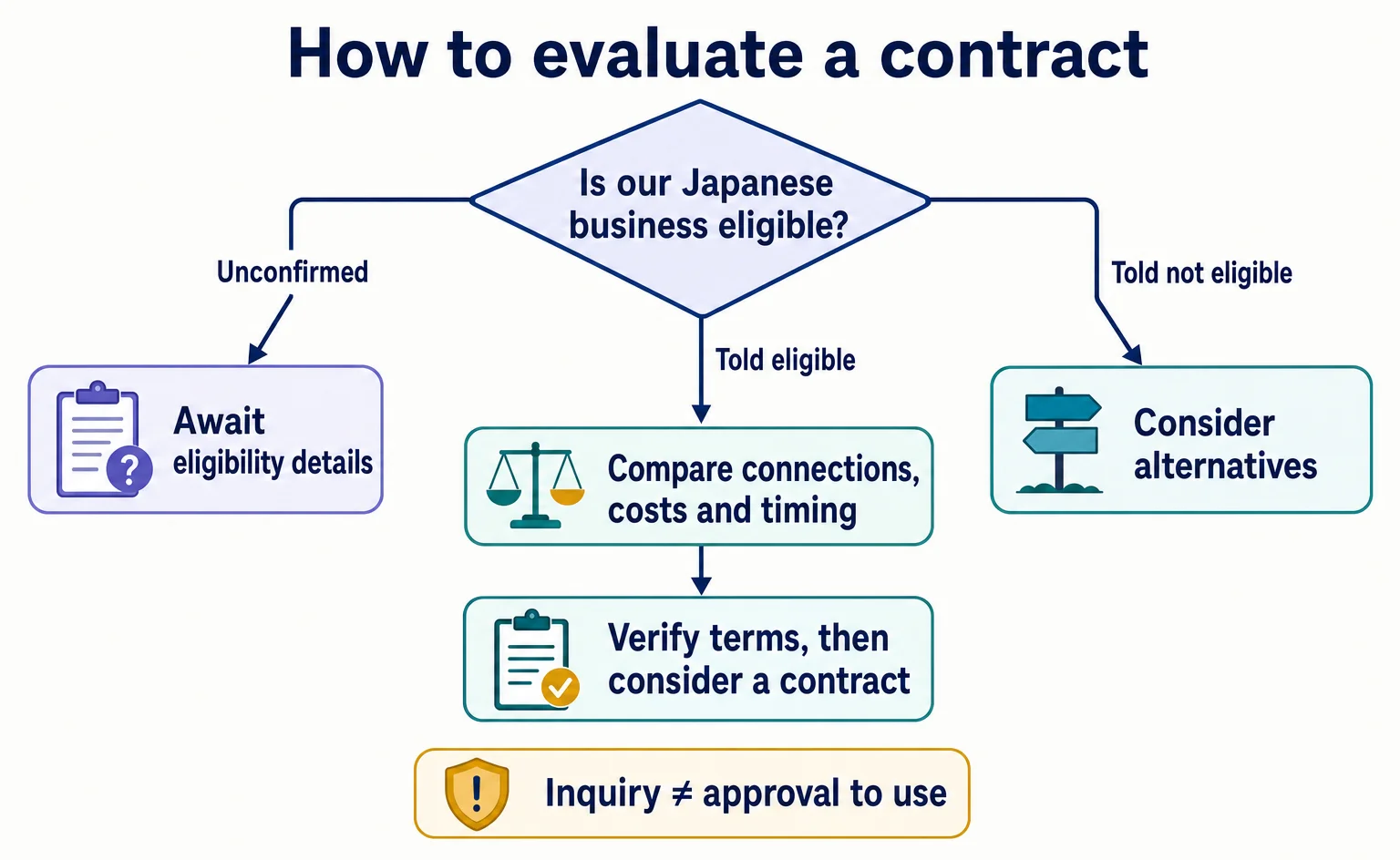
For merchants looking to add sales channels through external AI, Agent Connect is a framework worth comparing. But when choosing a connection for immediate use in Japan, you first need answers on whether your Japanese business is eligible, whether it connects to your preferred AI, and whether the work after purchase can also be handled. While those conditions remain unknown, stay at the information-gathering stage rather than calculating contract benefits based on expected product placement or sales.
FAQ
- Q. What work does Mastercard Agent Connect aim to reduce?
- It aims to reduce the burden of building and maintaining a separate integration for each external AI service. It describes a setup in which participating AI services, merchants, payment providers and others work together through one connection point. It does not guarantee product placement in every AI service.[1][3]
- Q. How do Shopping Agent and Agent Connect differ?
- Shopping Agent provides AI assistance with finding products and completing purchases within a merchant's own site or app. Agent Connect links merchants with supported external AI shopping services, supporting product discovery through purchase.[2][3]
- Q. Can an independent Japanese online store use it immediately?
- The three sources reviewed on September 14, 2026 do not confirm general availability or specific eligibility requirements for independent ecommerce businesses in Japan. The official explanation describes a rollout starting in the United States. Rather than concluding that it cannot be used in Japan, businesses should inquire about eligibility under their own circumstances.[1][3]
- Q. Does it support cards other than Mastercard?
- The September 9 announcement describes transactions using secure payment information from different card networks and links Agent Pay's additional protection to Mastercard transactions. The product page, however, mentions Agent Pay capabilities in connection with other card networks as well. Taken together, these materials do not establish the scope of capabilities available for other networks' cards.[1][3]
- Q. Can I connect it myself using a public API?
- The product page explains that accessing current product information requires queries through an API, a way for systems to exchange information. However, the three sources reviewed do not include specific REST API request destinations, data fields to send, or procedures for issuing authentication credentials. This article does not treat a self-service connection route or an operational API as verified.[1][2][3]
- Q. Does contacting the team through the official page start access to the service?
- “Speak with our team” on the official page is an invitation to contact a representative, not approval to use the service. Compare contracts after receiving answers about your eligibility, desired connections, start date and costs. The destination page's input fields and post-submission screen have not been verified.[2]
Sources
- [1] Mastercard gives merchants a simpler way to build, connect and scale AI-powered shopping experiences (Mastercard) — accessed 2026-09-14
- [2] AI powered commerce solutions | Mastercard | Mastercard Global (Mastercard) — accessed 2026-09-14
- [3] Mastercard Agent Connect | Agentic Commerce Network | Mastercard US (Mastercard) — accessed 2026-09-14
About the author
Shogo MizushimaCEO of kairos Inc. / AgentSignal Developer
Develops AgentSignal, a tool for measuring AI crawler visits and AI-referred traffic, and diagnosing AIO readiness. Writes about measurement and practical improvements for AI search using observed data.
Related articles
AI shopping and booking
What Is Mastercard Agent Pay? AI Payments and the Merchant’s Role
Learn how Mastercard Agent Pay supports AI payments, how it differs from product listings, and how it relates to AP4M. Based on official materials reviewed as of September 10, 2026, with unconfirmed eligibility conditions for merchants in Japan clearly identified.
Published
AI shopping and booking
How to List Products on ChatGPT: From ACP Product Integration to Orders
A step-by-step guide to applying for product integration, sending and updating product data, and directing shoppers to checkout. Learn when order APIs are needed, how to test version 2026-04-17, and which features were available or still proposed as of September 10, 2026.
Published
AI shopping and booking
51% of US consumers use AI shopping tools. How much has product selection changed?
That does not mean AI placed 51% of orders. It is the share of US consumers who reported using at least one AI-powered shopping tool during the past month.
Published