LLMO case study: JDM reports 34% agency revenue growth. What did it sell to clients?

Learn from JDM’s reported 34% agency revenue growth: how to define LLMO research, page-edit deliverables, costs and monthly client reporting.
What changes when an SEO agency turns AI search optimization into a client service?
In Profound's customer story, Jordan Digital Marketing reports a 34% revenue increase as its AEO offering attracted new business. This is the agency's revenue, not a 34% increase in a client's AI-attributed sales.[1]
The practical question is how observations become work a client can use. A dashboard is only one part of that process.
This guide covers the published case, then proposes a one-client pilot, page-edit brief, cost calculation and proposal template. Those practical examples were created for this article; they are not JDM's unpublished contracts or internal procedures.
JDM's reported 34% revenue increase from AEO services
Read the agency's business results separately from the outcomes observed for individual clients.
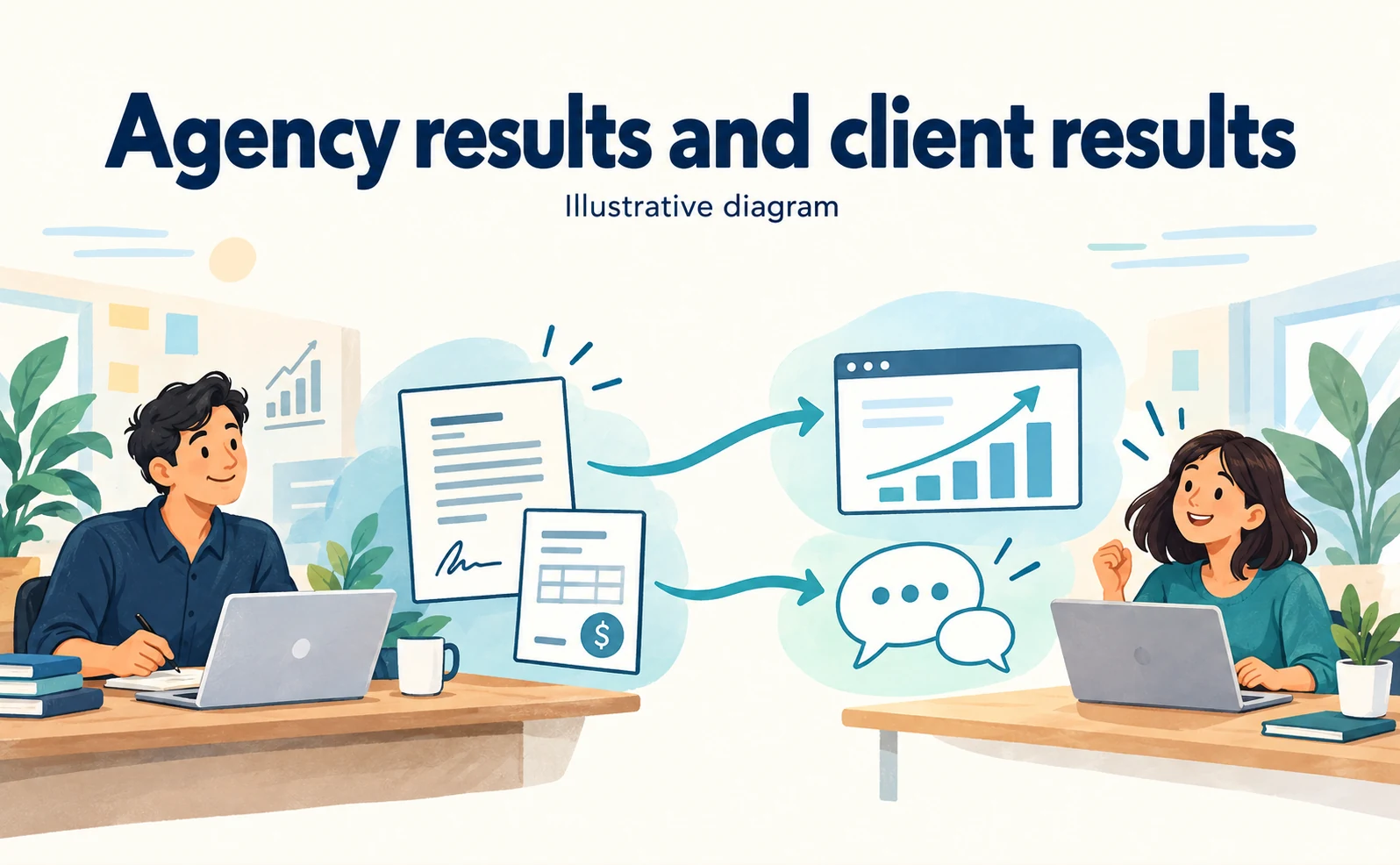
What kind of agency is JDM?
JDM provides SEO and other marketing services. Profound describes its move to investigate how client brands appear in AI answers as search behavior changes.[1]
For an agency, this adds another client question: does an AI assistant recommend the business when someone asks about relevant products or services?
An answer needs defined conditions. Record the AI service, prompt and observation date instead of simply reporting whether a brand appeared. Without those conditions, the next month's result is hard to compare.
What do 34% revenue growth and roughly doubled profit mean?
Profound reports a 34% increase in JDM's revenue and an approximately twofold increase in profit associated with its AEO business. Absolute amounts and detailed comparison periods are not disclosed.[1]
Those figures are not a forecast for another agency. Pricing, existing relationships, staff experience and software costs can differ substantially.
Track the revenue from a service alongside the cost of delivering it. More billings do not guarantee proportionate profit growth if research and revision cycles also expand. Log research, editing, review and reporting time during a pilot to improve the next estimate.
A client's visibility rising from 0% to 80% is a different result
The story also describes visibility reaching 80% from zero for a relevant client prompt. This is not an average across every client or every question, and it is separate from the agency's revenue result.[1]
Keep client outcomes in their own report. Agency wins do not establish that a client's enquiries increased.
If a citation appears but traffic is unconfirmed, state that distinction: citation observed, traffic unconfirmed, enquiries not measured. This makes the next measurement task visible rather than hiding it inside one growth percentage.
Define AEO and LLMO by the work included
This article uses LLMO to describe work that helps accurate business information be understood and referenced in AI answers. JDM's source calls its offering AEO.
A service label is not a complete scope. Answer monitoring alone is different from research, writing, publication and follow-up measurement.
Under the label, list the actual tasks: define questions, record answers and citations, prepare page edits, check publication and report observations. A client should understand what it receives and what its own team must do.
How JDM developed its AI search service
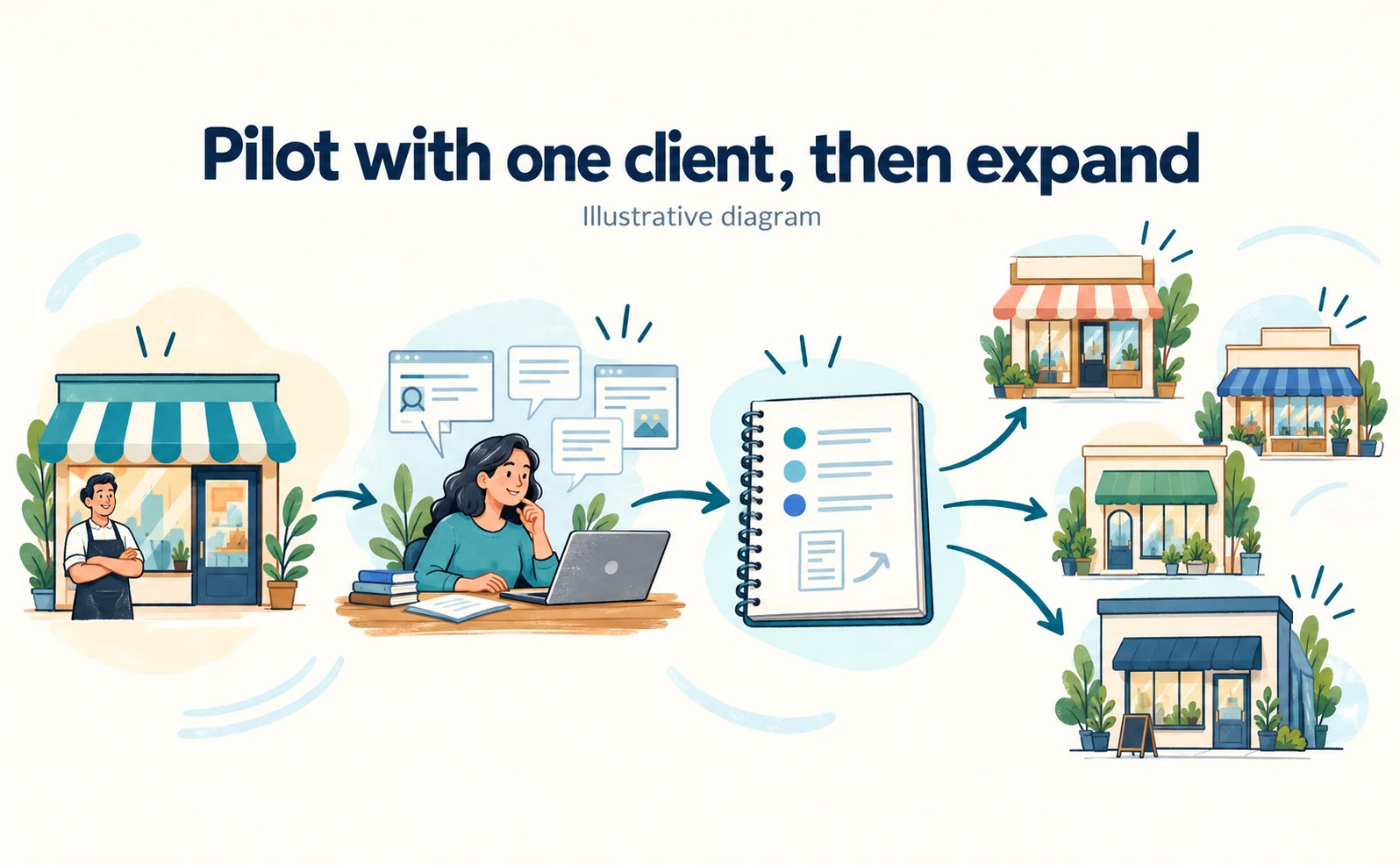
The published account describes a one-client pilot, investigation of cited content and customer questions, and expansion into a broader offering.[1] The practical suggestions below are this article's interpretation.
Start with one existing client and a defined scope
JDM piloted Profound with one client before expanding. The source does not disclose the pilot's duration, staffing or internal profitability criteria.[1]
For another agency, a one-client pilot can test whether research fits its existing delivery process. Choose a client with accessible product information, a person who can verify facts and a clear route to publishing changes.
Limit the initial scope to one product family or service. Research without a publication owner will not test the complete improvement workflow.
Investigate the pages AI cites
The case describes reviewing cited blog posts, product pages and buying guides.[1]
For a pilot, open the cited page instead of stopping at a domain list. A pricing page and an independent comparison may supply very different information about the same company.
Record the URL, title, question addressed and missing information on the client's page. Summarize the gap in original language rather than copying large portions of another publisher's text. Also check that the citation resolves to a live page.
Use customer questions to choose content topics
JDM connects research into AI questions with content planning.[1] Another agency can begin by collecting questions from the client's sales and support teams.
For an illustrative booking service, questions could cover supported business types, importing existing reservations and managing staff calendars. These are hypothetical examples, not measured query volumes.
Map each question to an existing answer URL or a documented gap. If a page already provides a good answer, improving its clarity or discoverability may be more useful than creating a duplicate article.
Integrate AEO with existing SEO delivery
The source describes AEO becoming part of JDM's SEO service.[1]
An established agency can identify shared work, such as checking product facts and reviewing published links, while pricing genuinely additional tasks explicitly.
AI answer observation and explanations of visibility versus traffic may require new processes. Do not leave that work as an undefined free extra.
Keep traditional search measures and AI answer observations separate even when the delivery team is shared. They should not be combined into one improvement rate.
A practical one-client LLMO pilot
The following workflow is an original proposal for agencies. It is not a reconstruction of JDM's private operations.
Select one offer and one desired next action
Confirm the offer being promoted and the destination the customer should reach: an enquiry form, booking page or purchase flow.
Gather current, publishable information about prices, specifications and conditions, and identify the person who can verify it.
| Decision | Fictional example |
|---|---|
| Offer | Business booking service A |
| Reader | A store manager evaluating adoption |
| Next action | Read the service page and request a consultation |
| Fact owner | Product lead |
| Publication owner | Web team |
Replace the examples with real names and URLs. If the scope is too broad, narrow it to one use case or customer type.
Define the questions to investigate
Organize questions around use, comparison and adoption conditions. Every question should have a reason for inclusion.
For the example booking service, questions could concern multiple locations, staff-specific schedules or importing a spreadsheet. Ask the sales team whether these resemble real purchasing concerns.
Add the intended reader, relevant page and point to check to each question. If using keyword research, distinguish Google search volume from AI prompt volume.
Record changes to the question set. Rewording a prompt until it produces a favorable answer is not evidence of sustained improvement.
Save answers and citation URLs
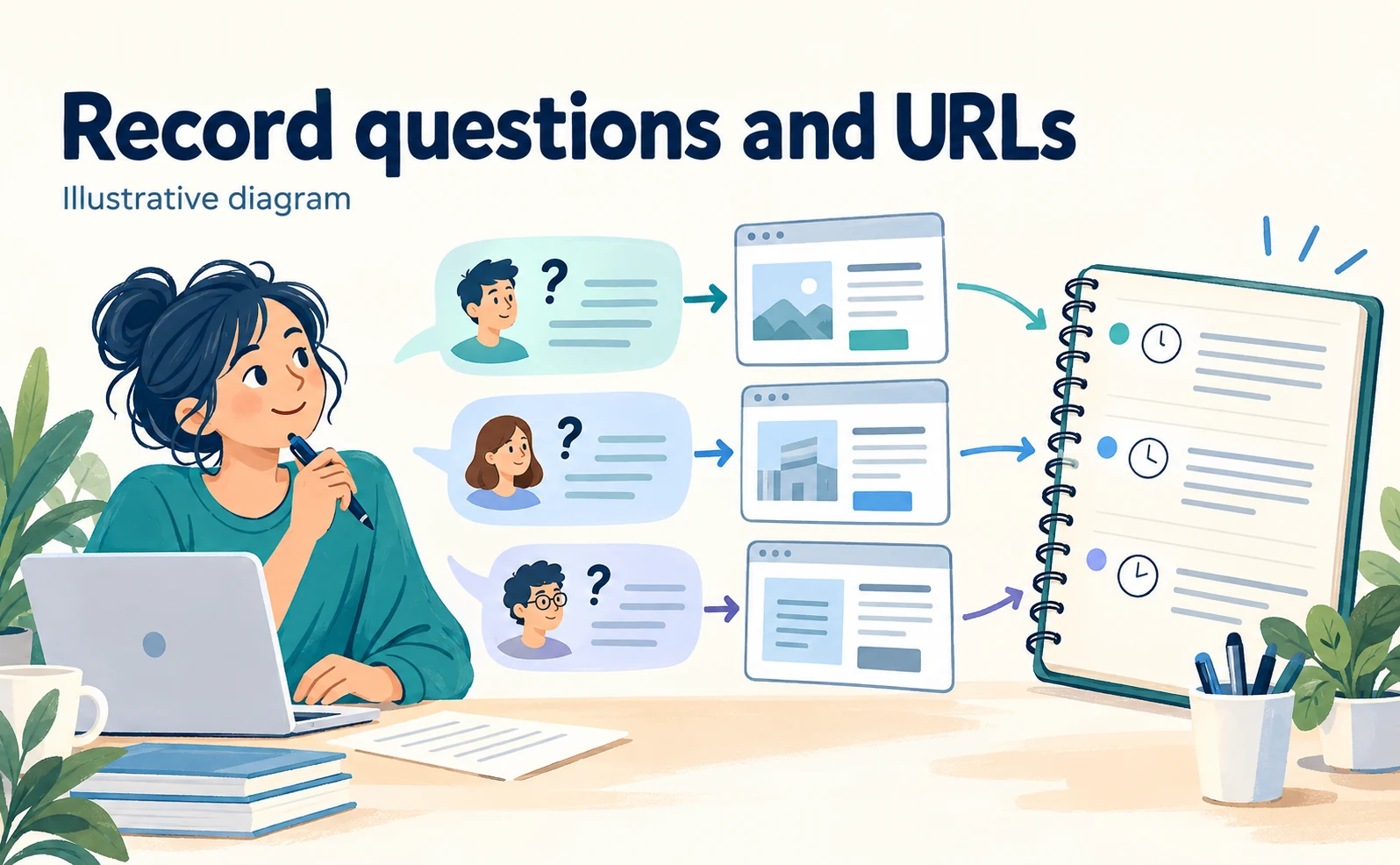
Record the service, displayed model name, exact question, time, relevant settings, answer and citation URLs. If a model name is not shown, record that rather than guessing.
A simple folder structure might be client-a/2026-10-01/q01.txt, accompanied by a spreadsheet with these fields:
Question ID / Service / Displayed model / Observation time / Exact prompt
Brand mention / Citation URL / Saved answer path / Reviewer / Notes
One answer is not a market-wide visibility rate. Define repeat checks and preserve the history. Public business information and generic purchasing questions are usually sufficient to start; client secrets are not needed for this exercise.
Define what completes the pilot
Completion should cover delivery, not just a favorable AI answer. Agree on a recorded question set, selected improvement pages, an edit brief, publication checks and a final report.
Include dates when the client must provide information or approve copy. Separate waiting time from agency labor so delays can be explained.
At the end, ask whether the client can use the materials to choose its next edit. If the report only describes a score, the page targets or proposed changes may still be missing.
Turn LLMO research into page edits
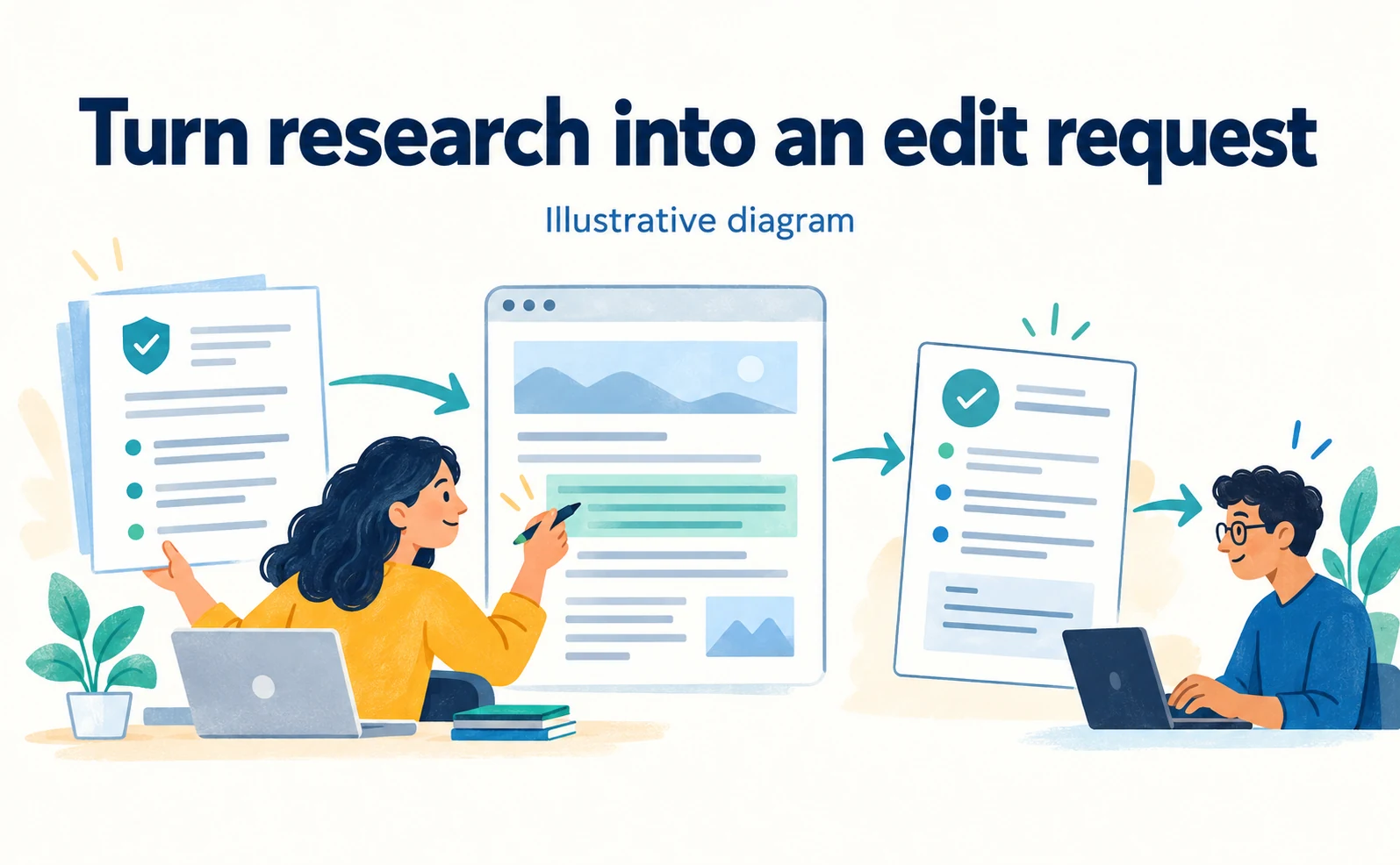
A usable analysis identifies a page and a concrete change. Build an edit request from verified client information.
Check whether the client's page answers the question
Open the page for each investigated question. Note where the answer appears and whether relevant conditions are stated.
For example, “supports business growth” does not answer whether a booking service supports separate staff calendars at multiple locations. A verified specification may supply the needed detail.
Classify the result as answered, incomplete, outdated or unconfirmed. That is more actionable than simply calling a page weak.
If an answer appears only inside an image, check whether a visitor can read it comfortably. Prioritize information that people can understand on the page.
Compare the information on cited competing pages
Compare questions and evidence, not distinctive wording. Look for relevant information about use cases, audiences, terms, specifications, dates and sources.
A feature appearing on a competing page is not a reason to add it to the client's copy. Likewise, do not invent a customer story because another company publishes one.
Use verified features or clearly identified hypothetical examples where actual public case studies are unavailable. An AI citation also does not establish that every statement on the cited page is correct; check underlying official evidence.
Write a one-page edit brief
Include the target URL, question, current gap, proposed change, supporting evidence and reviewer.
| Field | Fictional booking-service example |
|---|---|
| Target | Store-management feature page |
| Question | Can each store manage separate staff schedules? |
| Gap | The page only says schedules can be managed |
| Change | Explain management units and permission conditions |
| Evidence | Current product specification |
| Owners | Product lead verifies; web team publishes |
If supplying draft copy, include only verified facts. Put open questions in a separate review field instead of hiding them behind vague language.
Specify the post-publication checks too: text, headings, tables and destination links.
Recheck the published answer and links
Confirm the website update before investigating AI responses. A correct draft in an editor is not proof of publication.
Open the public URL, locate the changed answer and follow relevant links. Check tables and image text on a phone.
Then repeat the agreed AI observations. An unchanged answer does not immediately establish that the content edit failed. Publication and incorporation into an AI response are different events.
Record the publication date separately from the AI observation time. If an answer changes, report the observation without assigning the entire change to one edit.
Define LLMO fees and deliverables
Price the actual scope, including writing, review cycles and publication where applicable. These examples explain estimation; they are not market rates or JDM's prices.

Separate initial research from ongoing work
Initial work may include understanding the offer, gathering evidence, designing questions and checking measurement. That workload may not recur every month.
Ongoing delivery can include repeated observations, new questions, page edits and reporting. Reusable records may reduce preparation time.
| Scope | Example tasks | Example deliverables |
|---|---|---|
| Initial | Discovery, question design, baseline | Research log, URL map, work plan |
| Monthly | Rechecks, edit briefs, reporting | Change log, proposed edits, report |
| Separately scoped | Major page builds or implementation | Agreed designs, copy or code |
Name separately priced work before it becomes an assumption on either side.
Estimate software costs and human time
Separate software costs from research, editing, review and coordination. Collecting answers does not eliminate fact-checking or client communication.
For an illustrative calculation, allow four hours for research, six for editing and four for review and reporting: fourteen hours total. At an assumed internal estimating rate of ¥5,000 per hour, labor is ¥70,000 before allocated software and other costs.
These are hypothetical inputs, not market prices. Compare estimated and actual time during the pilot. If approval cycles take longer than research, improve evidence collection or reviewer assignment before simply increasing output.
Assign writing, review and publication
Name the writer, factual reviewer and publication owner. One person can hold several roles, but the stages should remain explicit.
For a copy-only engagement, confirm who will publish and when. If publication is included, scope permissions, display checks and a reversal process.
“Please review” is too vague if different people are expected to check facts, wording and links. Assign those checks deliberately, and identify the approved version by a filename or version timestamp.
Distinguish deliverables from observed outcomes
Delivering an agreed research log and edit brief is different from guaranteeing a particular AI recommendation.
Google explains that meeting the requirements for its AI search features does not guarantee inclusion.[2] This should not be generalized into undocumented rules for other providers, but it rules out treating Google eligibility as a placement guarantee.
Define delivered work in one part of the proposal and measurement of citations, visits and enquiries in another. If the client's goal is more enquiries, confirm how those will be measured; delivering research alone does not establish that goal was achieved.
Monthly reporting and decisions about expansion
Review client outcomes and agency delivery economics separately. Both matter when deciding whether to expand the service.

Track client visits and enquiries
Record AI answer observations, site visits and enquiries in separate fields. Preserve “not measured” where evidence is unavailable.
A cited page and traffic from the same AI service do not necessarily identify the same question or person. Avoid forcing an individual-level connection the data does not support.
For reporting ideas, see the Rough Country guide to AI traffic and revenue. End the report with a specific next page improvement rather than only a list of metrics.
Review agency revenue and profit separately
For delivery economics, record contract revenue alongside direct costs and actual labor. More engagements can increase pressure on the team before they increase profit.
Break time into setup, answer review, writing, client communication and publication. That helps identify opportunities for better templates or clearer responsibilities.
Standardize formats and procedures, not client-specific facts. Reusing another client's answers will not help when the products and questions differ. Evaluate both client usefulness and a sustainable delivery process.
Set conditions for adding questions and articles
Before expanding, check whether current work reaches publication. More drafts will not solve an approval backlog.
Useful reasons to add content include a new product, a recurring sales question or an uncovered use case. State the new answer the page will provide rather than producing a paraphrase of existing content.
| Proposed addition | Check first |
|---|---|
| Question | Relevance and evidence for an answer |
| Article | Difference from existing pages |
| AI service | Audience relevance and observable conditions |
| Work volume | Review and publication capacity |
Update responsibilities and fees when the scope changes.
What belongs in the first proposal?
Start with a clear scope and deliverables:
Purpose: the offer, intended buyer and decision to support
Scope: AI services, questions and pages
Initial work: baseline, question-to-URL map and edit brief
Monthly work: repeat checks, change log and reporting
Owners: factual review, writing, publication and approval
Fees: initial, recurring, separately scoped work and software
Measurement: citations, visits and enquiries
Completion: what is delivered and how it is checked
After drafting, check whether the client can explain its own next steps. Include deadlines for source material and approvals.
The practical lesson is a complete service: research, edits, publication and reporting. Pilot that process with one client, measure the real work involved and then decide how to expand.
FAQ
- Q. Does the 34% increase refer to client revenue?
- No. It is the reported increase in JDM’s agency revenue. Client visibility metrics concern a different subject.
- Q. What can an LLMO service deliver?
- A defined question set, dated response and citation records, page-level edit requests, implementation ownership and follow-up findings are practical deliverables suggested in this article.
- Q. How should LLMO service costs be separated?
- Distinguish initial research, recurring monitoring, content production, implementation and tool fees. Compare quantities and review frequency as well as price.
- Q. Does the case justify guaranteeing AI inclusion?
- No. Agree on work, deliverables, measurement conditions and review procedures rather than treating one reported case as a guarantee.
Sources
- [1] How Jordan Digital Marketing grew revenue by 34% with Profound (Profound) — accessed 2026-09-30
- [2] AI features and your website (Google Search Central) — accessed 2026-09-30
About the author
Shogo MizushimaCEO of kairos Inc. / AgentSignal Developer
Develops AgentSignal, a tool for measuring AI crawler visits and AI-referred traffic, and diagnosing AIO readiness. Writes about measurement and practical improvements for AI search using observed data.
Related articles

AIO and AI search
AIO case study: Rough Country reports 71% more AI referral traffic. How did it measure revenue?
Explore Rough Country’s reported 71% increase in AI referrals and $22,700 in year-to-date AI revenue, with a practical GA4 measurement and reporting workflow.
Published

AIO and AI search
AIO case study: Mito Red Light reports 200% growth in monthly AI revenue. Improve product information first
Understand Mito Red Light’s reported 200% monthly AI revenue growth, then improve product descriptions, specifications and FAQs with a Shopify review workflow.
Published
AIO and AI search
How to Build LLMO Comparison Pages: 1840 & Co's Reported 0% to 11% AI Visibility
Examine 1840 & Co's reported AI visibility result, then build a comparison page with consistent criteria, documented evidence, and repeatable observation.
Published