Cloudflare Pay Per Use explained: when AI content use can generate revenue

Understand Cloudflare Pay Per Use beta, how reported AI content use differs from crawling and referrals, and the terms publishers should check.
An AI answer can draw on an article without sending its reader to the publisher. The work gets used, but the visit that could generate advertising revenue or an inquiry may never happen. On September 30, 2026, Cloudflare announced the beta of Pay Per Use, a proposed way to pay publishers for agreed uses of their content.
An AI buyer offers terms, a publisher chooses whether to participate, and eligible use can earn payment. It does not automatically collect money from every AI service that references a page. Cloudflare’s announcement
This guide separates content use, website visits and received payments, then provides practical worksheets for evaluating an offer. We checked the public documentation on October 8, 2026. We have not joined an individual program or verified earnings.
Paying when AI search uses an article

Under Pay Per Use, the buyer proposes what it will pay for and at what price. The publisher decides whether those terms work. Treating it as an automatic payment for any AI citation would lead to the wrong expectations.
Start by asking whether a participating buyer wants your content and whether you can accept the proposed use. A large volume of crawler traffic is not, by itself, a count of billable uses.
Separate payment for crawling from payment for use
Cloudflare also offers Pay Per Crawl, which charges for content retrieval. That measures a different event from downstream use. Cloudflare’s Pay Per Crawl documentation
A page might be retrieved once and consulted repeatedly, or retrieved repeatedly to check for changes. Retrieval and use therefore need not match. This is why a report saying that bots visited frequently cannot establish expected usage revenue.
| Event to understand | Record to examine | Number it cannot replace |
|---|---|---|
| An AI crawler requested a page | Server or crawler records | Uses in AI answers |
| Content was used for an agreed purpose | The program’s usage report | Human article views |
| Someone visited the website | Website analytics | Usage payments |
| A payment arrived | Settlement or payment records | An unconfirmed earnings estimate |
This is a suggested internal classification, not a reproduction of the Cloudflare dashboard.
Publishers choose which terms to accept
Look beyond the company name to the proposed purpose and scope. An offer to inform search answers raises different questions from an offer to incorporate material into another product.
If a buyer presents several programs, do not assume that accepting one permits every possible use. Keep the name, version and date of the terms you reviewed so colleagues can understand the decision later. This is a recordkeeping suggestion, not an interpretation of any particular contract.
Who records what in Pay Per Use?

Cloudflare describes a process in which buyers report usage and Cloudflare handles aggregation, billing and publisher payments. Reports are supplied by buyers; the system is not described as monitoring every AI answer on the internet to discover unreported use. Usage reporting and settlement
Separate those reports from the traffic your own systems observe. Different totals do not automatically contradict one another. Adding them, or treating one as the missing portion of another, creates confusion unless the events being counted are defined first.
The buyer’s usage records
The published reporting example includes a timestamp, the source URL and an event ID. Questions for a publisher include whether the program and period are correct, whether unfamiliar URLs appear, and how corrections are identified.
An event ID does not establish that publishers can export every record or reproduce every use. Check which fields are visible, which exports are available, and what information can be used when raising a discrepancy.
Rather than reporting only that a number looks low, record the buyer, reporting period, displayed value and date the issue was noticed. Also identify whether the screen shows an estimate or a finalized record. These details make the question easier to investigate.
Reported uses and received payments are different records
Cloudflare describes monthly aggregation and payment. Specific receiving conditions still need to be checked when participating. The date you see usage and the date money arrives should not be treated as the same event.
In an internal monthly report, use separate columns for reported use, the status of the amount and payment confirmation. Leave an unresolved amount marked as awaiting confirmation instead of calculating an unsupported figure. The following is a worksheet, not actual earnings or a Cloudflare interface.
| Period and buyer | Reported use | Amount status | Payment confirmation |
|---|---|---|---|
| Enter the reviewed scope | Record the displayed total and check date | Estimate / confirmed / unknown | Not checked / date checked |
Compare the terms before participating

Before comparing prices, write down what is being provided, how it can be used and how the result can be checked. These are questions for your own review. They are not a list of controls guaranteed to exist in the dashboard.
| Item | Question to resolve |
|---|---|
| Buyer and program | Which company and product will use the material? |
| Content scope | Is the whole domain covered, and are pages excluded? |
| Purpose | How do the terms treat search, answers and training? |
| Billable unit | What counts as one paid use? |
| Reports and corrections | When can records be checked, and how are disputes raised? |
| Receiving payment | Where are currency, fees and payment conditions stated? |
| Ending participation | What happens to later use and outstanding settlement? |
Do not fill unanswered fields with assumptions. An explicit unresolved question is more useful to the next person reviewing the arrangement. Refer questions about permission and contractual scope to the people responsible for those matters in your organization.
Content scope and permitted purposes
Material hosted on your domain may have different underlying permissions. Photographs supplied by a third party, licensed diagrams and republished articles deserve their own checks.
Select a small group of candidate articles and list the text, photographs, charts and external data they contain. Record who created each component and the conditions under which it is published. This does not decide whether additional use is permitted, but it provides the information needed to ask the right person.
Also distinguish using an article to inform a search answer from using it to train a model. Compare the actual proposed purpose with your existing content policy, rather than assuming that all AI uses have the same permission requirements.
Price, reporting and what happens after leaving
Prices cannot be compared sensibly if the unit being priced differs. First align the definition of a use, the reporting period and the treatment of corrections. If the definition remains unclear, resolve the question before completing a revenue model.
When an offer is denominated in a foreign currency, retain the original amount and currency. Put any yen conversion used for internal comparison in a separate column, with its date and exchange rate. This keeps the comparison distinct from the contractual currency and actual amount received. We have not verified a program price, so this guide provides no invented dollar rate or projected yen earnings.
Read the terms governing the end of participation as well. The ability to leave a program does not, on its own, establish when previously stored material is removed or when outstanding amounts are paid.
Evaluate referrals and usage fees separately

An article can serve more than one purpose. It may help a prospect understand a service, answer an existing customer’s question or share original research. Those roles call for different measures of value.
Before ranking articles by potential usage fees, decide which kinds of material belong in the evaluation. Content intended to attract inquiries and content offered as a product in its own right may require different records and decisions.
Website visits are not downstream AI use
Your website analytics observes activity that reaches your site. If a reader receives an AI answer without opening its link, there is no corresponding human visit to your article. A crawler request, meanwhile, is not proof that the material later appeared in an answer.
One possible monthly review structure is to keep human search traffic, AI crawling and reported paid usage in separate tables. Align the time periods and identify the source system for each number. That makes the figures easier to explain without implying that they measure the same event.
For the practical steps involved in checking referrals, see our guide to AI traffic and conversions in GA4. Additional visits and usage payments should not be counted as the same outcome.
Record the work needed to maintain your articles
List the ongoing work involved in keeping candidate content useful: interviews, data updates, chart revisions and specialist review. Even without a finalized cost estimate, a named owner and an update frequency provide a useful basis for comparison.
For an original research article, record how often it is updated, the inquiries it supports and the conditions attached to reused materials. An article containing substantial third-party material may need a permissions review before any revenue estimate. These are selection examples, not predictions that a particular article type will earn more.
After participation begins, record the work spent checking reports and resolving questions alongside the income. Use comparable records over time before deciding whether to continue, rather than relying on an encouraging or disappointing first observation.
What publishers in Japan can confirm today

The public material we checked on October 8, 2026 describes Pay Per Use as a beta. It did not establish that every Japanese publisher can participate on identical terms, or provide a verified list of current offers and prices for each account. Available functionality must be distinguished from future ambitions.
Cloudflare discussed experiments with usage-based payment in July as well. Companies named in that earlier announcement should not be treated as a list of buyers currently selectable in every account. The July announcement
Check whether the relevant offer appears in the dashboard
The announcement directs publishers to Monetize → Pay Per Use. If the relevant offer is available in your account, review its buyer, purpose and price, then complete your comparison worksheet. We did not enroll an account or configure payments while producing this guide.
If the item is absent, do not enable a different charging feature as a substitute. Ask Cloudflare about beta eligibility. Your domain, operating region, type of content and the menus currently visible provide useful context; credentials and payment details do not belong in a public inquiry.
Record access to the menu, confirmation of participation terms, and observed usage or payments as separate milestones. Opening a dashboard is not evidence that monetization has succeeded.
Record existing allow and block rules
Participation terms and crawler access should be checked with the people managing the site. The Pay Per Crawl documentation says that WAF or Bot Management blocking overrides its charging feature. That statement should not be generalized into a complete description of Pay Per Use processing.
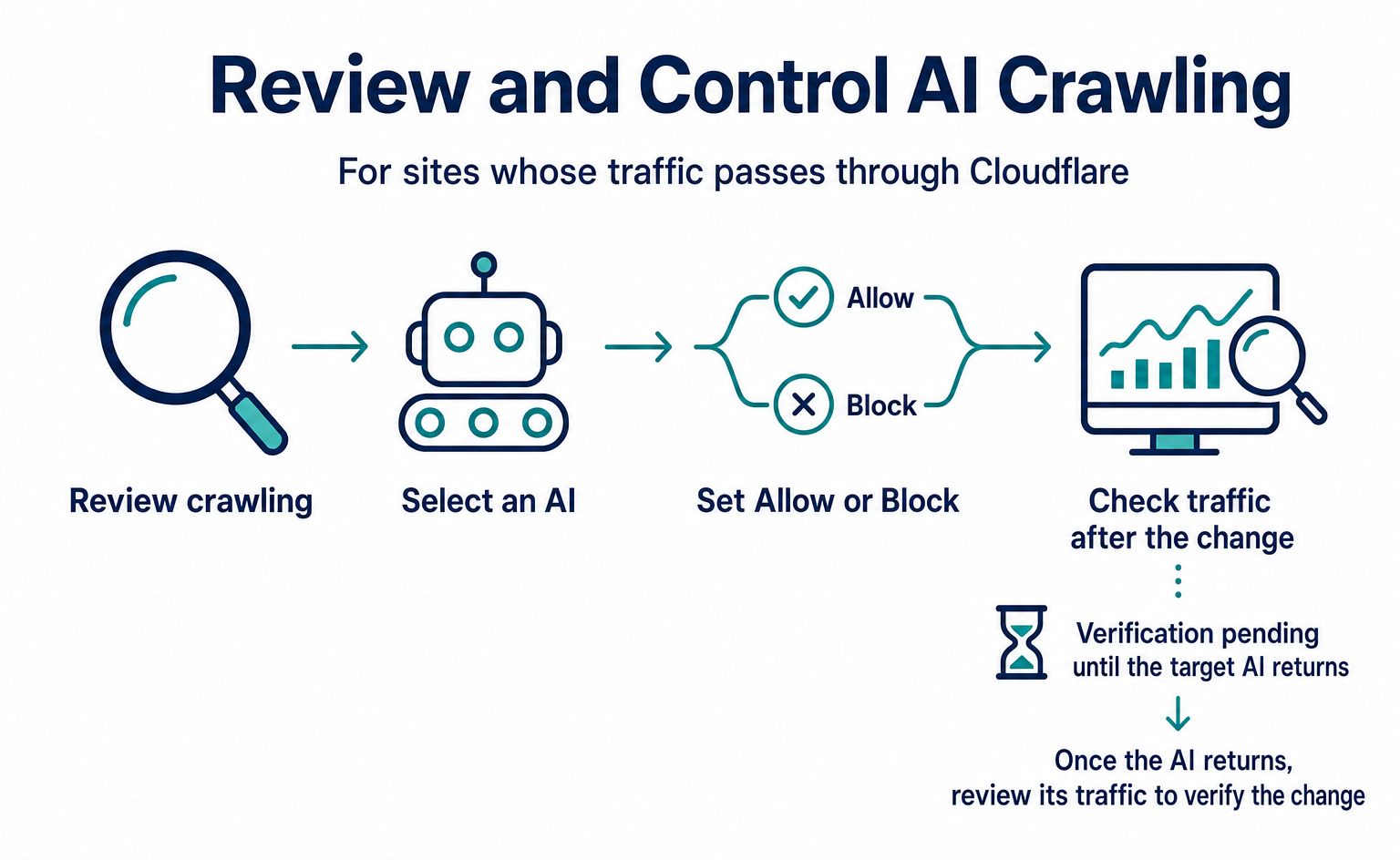
Record the rules currently applied to the relevant domain and ask the administrator or provider whether they are compatible with the proposed program. Considering monetization does not require disabling bot protections wholesale. Our Cloudflare crawler control guide explains how to review access and restrictions.
A useful first step is to identify candidate articles, assemble their permissions information and prepare a terms comparison. Once an actual offer is available, keep access, reported usage and received payments separate when deciding whether the arrangement suits your publication.
FAQ
- Q. Does every AI citation generate a payment?
- No. Payment concerns agreed uses within a participating program, not automatic collection from every AI citation.
- Q. How is it different from Pay Per Crawl?
- Pay Per Crawl charges for retrieval. Pay Per Use concerns agreed downstream use, which need not match retrieval counts.
- Q. Can every Japanese publisher join immediately?
- The public material checked on October 8, 2026 did not establish eligibility or prices for every Japanese publisher. Check the relevant account offer or contact Cloudflare.
- Q. Can website analytics establish paid use?
- Website traffic and buyer-reported use measure different events. Keep human visits, crawling, paid use and received payments separate.
Sources
About the author
Shogo MizushimaCEO of kairos Inc. / AgentSignal Developer
Develops AgentSignal, a tool for measuring AI crawler visits and AI-referred traffic, and diagnosing AIO readiness. Writes about measurement and practical improvements for AI search using observed data.
Related articles
Measurement and site improvement
How to Monitor and Control AI Crawling with Cloudflare
Learn how to use Cloudflare AI Crawl Control to monitor AI crawlers and allow or block each one. Covers free-plan detection and reporting periods, Security/Crawlers label differences, and what to check when access fails even with Allow.
Published

Measurement and site improvement
What Is AI Traffic? How to Check It in GA4 and Read the Results
AI traffic means visits that arrive through links in AI answers. Learn how to check it with GA4’s AI Assistant channel, and how to read it separately from Search Console’s generative AI report and Bing’s Citation Share.
Published

AIO and AI search
Multilingual LLMO: checking language, pricing and availability beyond translation
Go beyond translation in multilingual LLMO: check eligibility, billing currency, language URLs, AI answers, and ownership with a paired-page checklist.
Published