Airbyte reported a $100,000 ChatGPT-originated deal: the content changes behind its AIO work
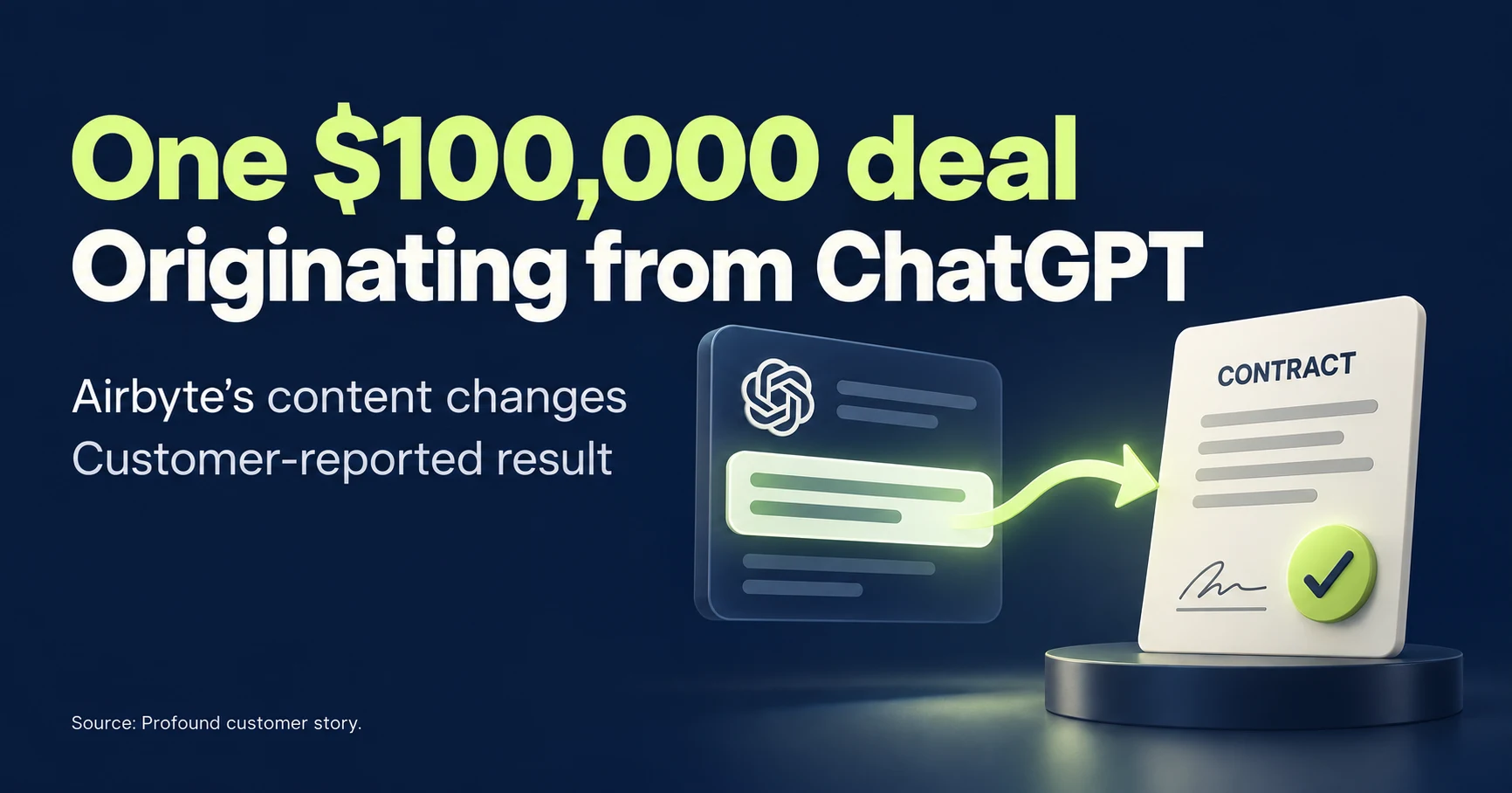
Airbyte reported one $100,000 contract originating from ChatGPT. The team analyzed over 500 prompts and revised content into direct answers, lists, and steps.
Can appearing in an AI answer lead to an actual contract? That is a reasonable question to ask before investing in AI search optimization.
An Airbyte marketer publicly reported a $100,000 contract originating from ChatGPT, saying the customer had not previously heard of the company. The marketer’s post
This was one contract, not monthly revenue. The amount is approximately ¥15.8 million using an illustrative rate of ¥158 per US dollar, rather than a current exchange rate or the contract’s settlement rate.
Here, we look at the content changes reported in the case and how to apply the underlying idea to one product page. AI search optimization means improving how accurately AI search and answer services can describe your business.
Airbyte’s three reported results: ChatGPT visibility, overall visibility, and one $100,000 contract
The case combines changes in AI visibility with a contract originating from ChatGPT. The supporting platform, Profound, reports the following results. Profound’s Airbyte case study
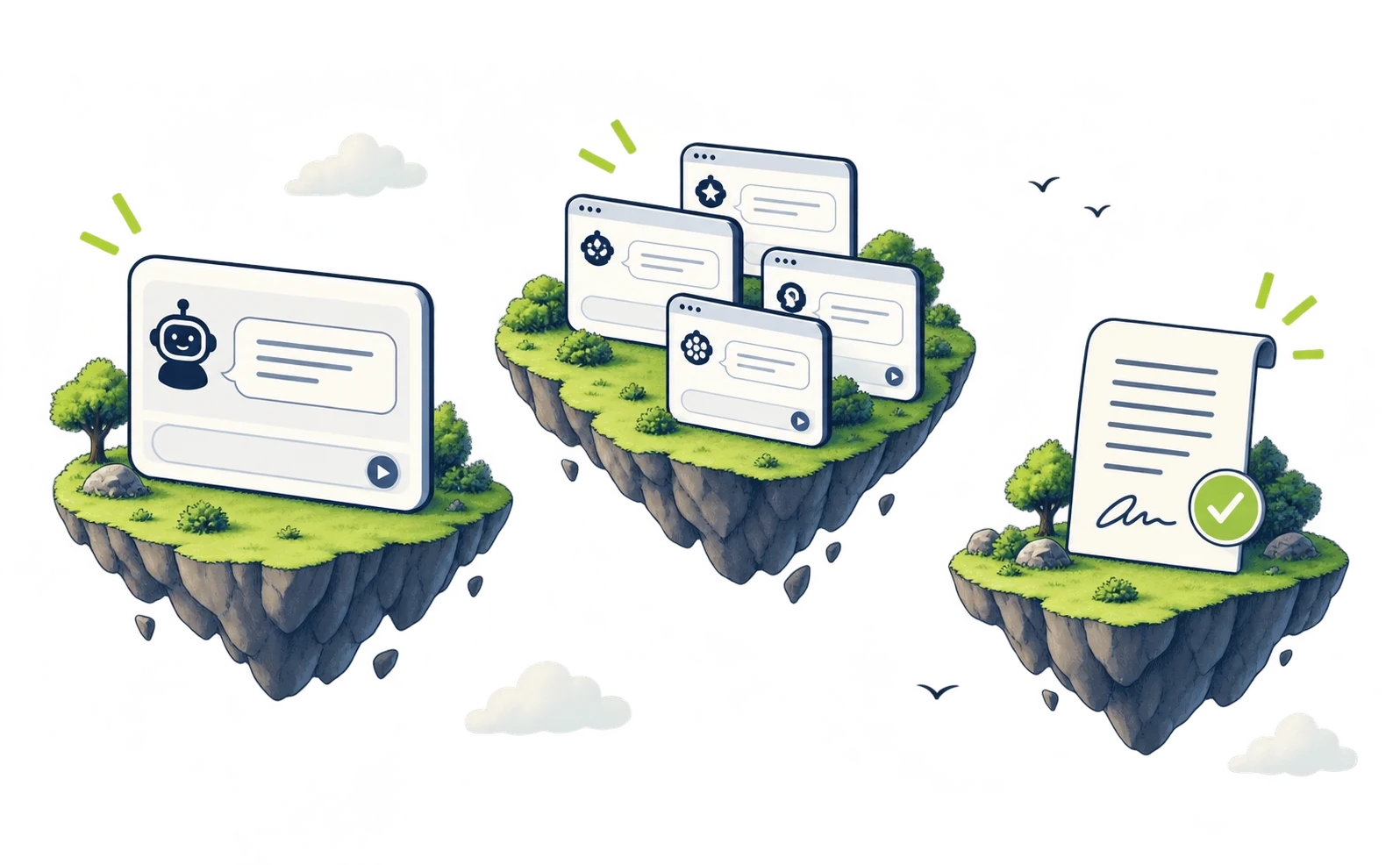
Illustration: Separate ChatGPT visibility, cross-platform visibility, and a contract.
| Measure | Reported result |
|---|---|
| ChatGPT visibility | 9% to 26% in one week |
| Visibility across AI platforms | 16% increase |
| ChatGPT-originated contract | One $100,000 deal in July 2025 |
Visibility describes how prominently a company appears in the answers being monitored. It is different from the proportion of website visitors or a sales conversion rate.
The source does not establish how much each individual change contributed to the contract. It therefore does not demonstrate that rewriting a page will produce a $100,000 deal.
The practical question is what the team investigated and which explanations it improved.
The starting point: more than 500 questions, grouped by topic and country
Airbyte examined over 500 prompts across ChatGPT, Perplexity, Google AI Overviews, and Copilot. It grouped questions by topic and country and reviewed mentions, citations, and competitors. Profound’s case study

Illustration: Group customer questions by topic and country, then map them to answer pages.
You do not need to collect 500 questions before starting. Begin by pairing questions customers ask before signing up with the pages that should answer them.
For example, a business software company could create the following table. These are illustrative questions, not Airbyte’s actual prompts.
| Example customer question | Page that should answer it | Detail to review |
|---|---|---|
| What can I move from my current service? | Migration guide | Supported and unsupported data |
| Can I get support in Japanese? | Support page | Languages and opening hours |
| Does it work with my accounting software? | Integration page | Supported products, method, and required plan |
This turns a broad concern—“AI does not mention us”—into a specific content task, such as explaining which data can be migrated.
If availability differs by country, preserve that condition in the question. An answer based on overseas features may be wrong for a customer in Japan.
Making the answer accessible: direct explanations, lists, steps, and server-rendered content
Airbyte reports rewriting content into direct answers, lists, and steps, while removing unnecessary prose. Its work also included server-side rendering, contributor information, customer evidence, and updated documentation. Profound’s case study
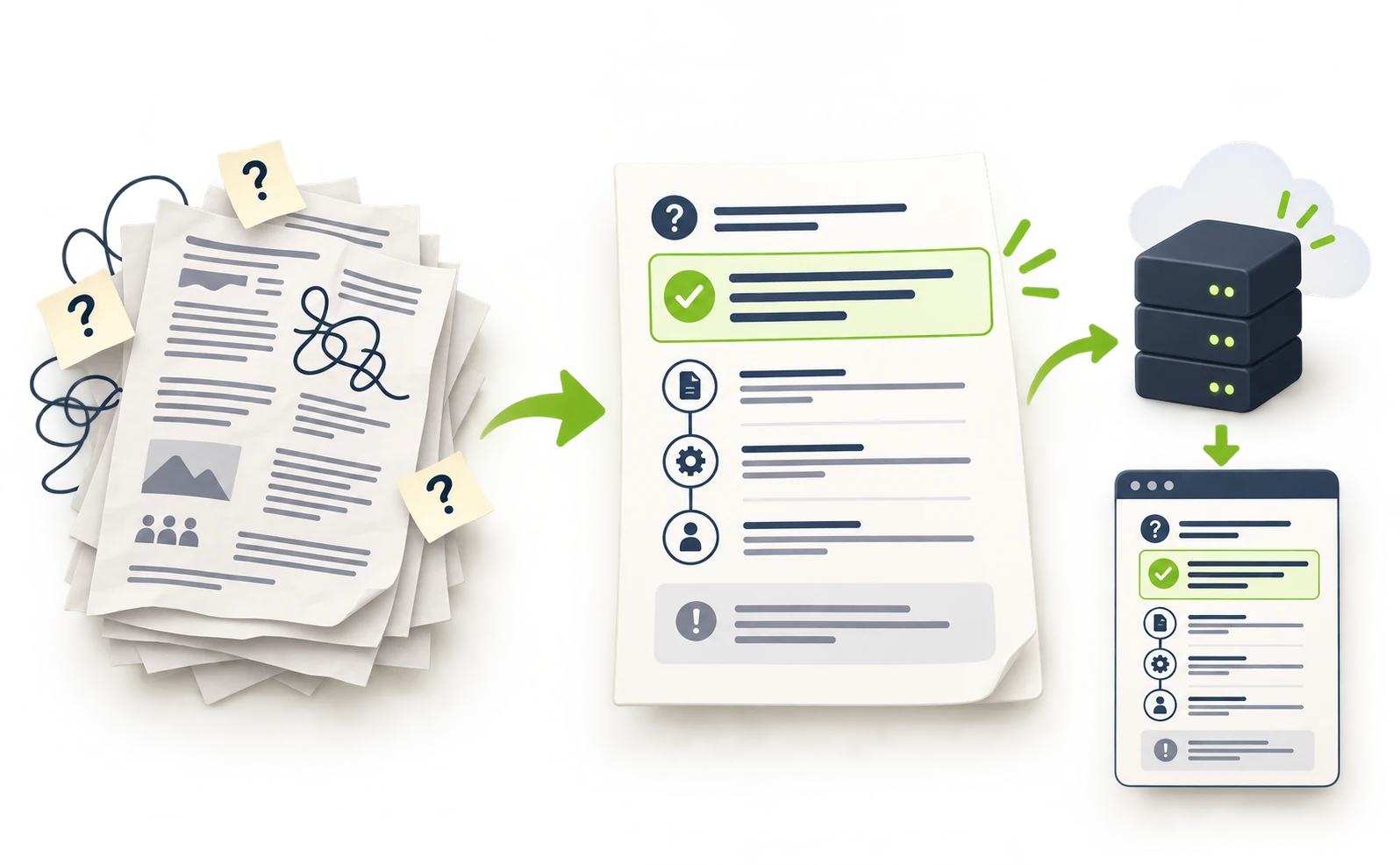
Illustration: Put the answer below the question, organize the steps, and make the text accessible.
A useful starting point for a writer is to place the answer directly below the question. Check whether a section titled “Can I migrate my data?” starts with a company introduction instead.
Illustrative version before editing
We provide a broad range of solutions to support our customers’ business transformation.
Illustrative version after editing
You can import customer names and email addresses from a CSV file. Previous attachments cannot be imported. You need administrator permissions to run the import.
This is a fictional service example. Replace it with your verified capabilities and conditions.
The revised version explains what can be moved, what cannot, and which permission is required. The purpose of concise writing is to make the answer easier to find while preserving useful information.
Treat schema.org and llms.txt as reported actions, not proven causes
The case also reports implementing schema.org structured data and llms.txt. It does not isolate the effect of either implementation. Profound’s case study
Keep implementation changes and measured outcomes in separate columns when reviewing your own work. That makes it easier to distinguish what you changed from what you observed.
Try it on one page: check the retrieved content and put the answer first
Start with a product page you regularly send to prospective customers. The following is our editorial recommendation based on the case.

Illustration: Keep AI answers, visits, inquiries, and contracts in separate records.
- Choose one recent customer question that the page should answer.
- Open the public page and check whether the answer and its conditions can be read together.
- Place the answer directly below the relevant heading, followed by exceptions and necessary steps.
- After publishing, check whether the heading and answer are present in the retrieved page content.
In Google Search Console, inspect the URL and run a live URL test. “View tested page” provides access to the returned HTML and rendered page. Google’s URL Inspection documentation
This checks retrieval by Google’s inspection tool. It does not verify retrieval by every AI service or inclusion in an AI answer. If the explanation is missing, give your developer the URL and the exact passage that should be present so they can investigate how the page is rendered.
Keep visibility, visits, inquiries, and contracts separate
After editing, separately record whether AI mentioned the business, someone visited, an inquiry arrived, and a contract was signed.
| Record | Information to retain |
|---|---|
| AI answer | Question, service, observation date, mention, and cited URL |
| Visit | Observable referral source and landing page |
| Inquiry | Count, relevant page, and the customer’s stated discovery source |
| Contract | Closing date, value, and related inquiry record |
Keep an analytics referral and a customer saying “I found you through ChatGPT” as distinct evidence. Unknown visits do not need to be assigned to AI.
Record the edited URL and change date too. You can then look back at what changed around the time inquiries increased.
Begin by making one customer question answerable from your own page. Then track where, between the AI answer and the eventual contract, you observe a change.
FAQ
- Q. Is the $100,000 figure monthly revenue?
- No. It is one reported ChatGPT-originated contract, not monthly revenue.
- Q. What should I edit first?
- Choose one recurring customer question and place its verified answer and conditions below the relevant heading.
Sources
- [1] The marketer’s post — accessed 2026-09-26
- [2] Profound’s Airbyte case study — accessed 2026-09-26
- [3] Google’s URL Inspection documentation — accessed 2026-09-26
About the author
Shogo MizushimaCEO of kairos Inc. / AgentSignal Developer
Develops AgentSignal, a tool for measuring AI crawler visits and AI-referred traffic, and diagnosing AIO readiness. Writes about measurement and practical improvements for AI search using observed data.
Related articles
AIO and AI search
AI-referred inquiries up 51%: Arizona College of Nursing’s local AIO approach
Arizona College of Nursing reported 51% more AI-referred enrollment inquiries and 26% more visits in 90 days. The team examined questions across 24 markets and developed tuition comparisons and local FAQs.
Published
AIO and AI search
AI-referred signups up 37%: how OpusClip made AIO measurement continuous
OpusClip reported 37% more AI-referred signups and 20% more traffic. The team combined seven-day rolling averages with human checks of AI answers.
Published
AIO and AI search
LLM-attributed traffic up 82%: Aleph’s one-theme-a-month content approach
Aleph reported 82% more LLM-attributed traffic and citation share rising from 1.5% to 5.3% over two months. The team selected one monthly theme and developed feature-specific buyer guides.
Published