What Is an AI Search Engine? Key Services Businesses Should Check and How to Choose
An AI search engine answers questions in text and links to the pages it relied on. Learn how Google AI Overviews, ChatGPT search, Perplexity and Bing differ, and which to check first when reviewing how your business is presented, based on what official sources confirm.
An AI search engine is a search service that answers questions in text and links to the web pages it used as evidence. In this article, the term covers Google’s AI Overviews and AI Mode, ChatGPT search, Perplexity, Bing and Copilot. Businesses need to check two things: the answer text and the cited sources attached to it.
As an illustration, imagine a PR manager at a training company. They are asked, “How does AI describe our company?” and are unsure which AI to check first.
What Is an AI Search Engine? How It Differs from Regular Search
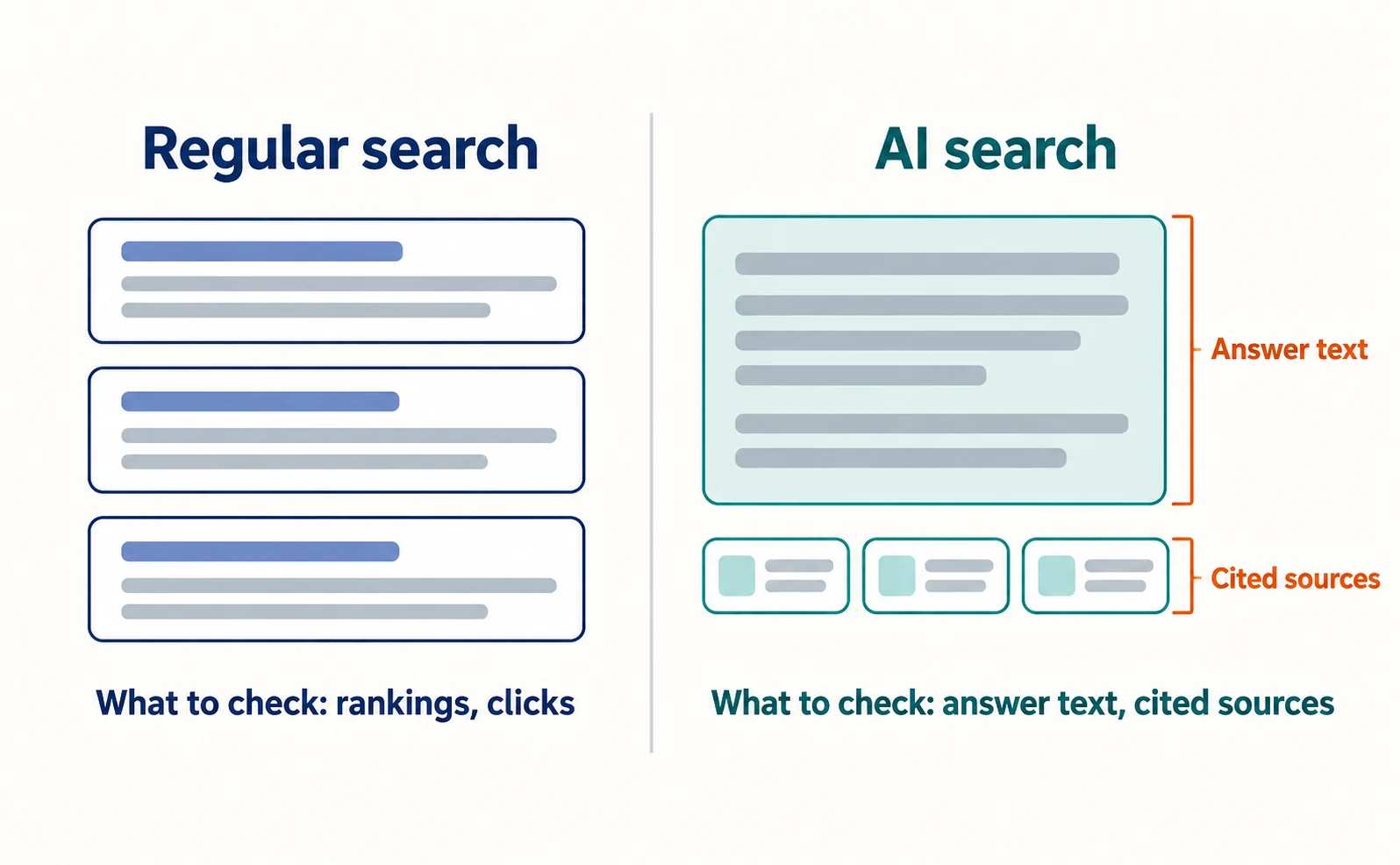
Regular search lists page links; AI search summarizes an answer in text and then adds supporting links. So what businesses check expands beyond rankings to the answer text and cited sources.
Google’s AI Overviews and AI Mode may run multiple related searches to build a response and show links to supporting pages. This is called “query fan-out” [1].
For example, if someone asks how to choose new-hire training, the AI may also look up related information such as price and format, then combine it into one answer. A page that is not first in regular search may still be shown as supporting evidence.
| Point | Regular search | AI search |
|---|---|---|
| What appears | A list of page links | A text answer with citation links |
| What businesses check | Rankings, clicks | How they are described, cited sources |
| How results change | Over time and by conditions | Answers and citations vary even for the same question |
Key AI Search Services Businesses Should Check
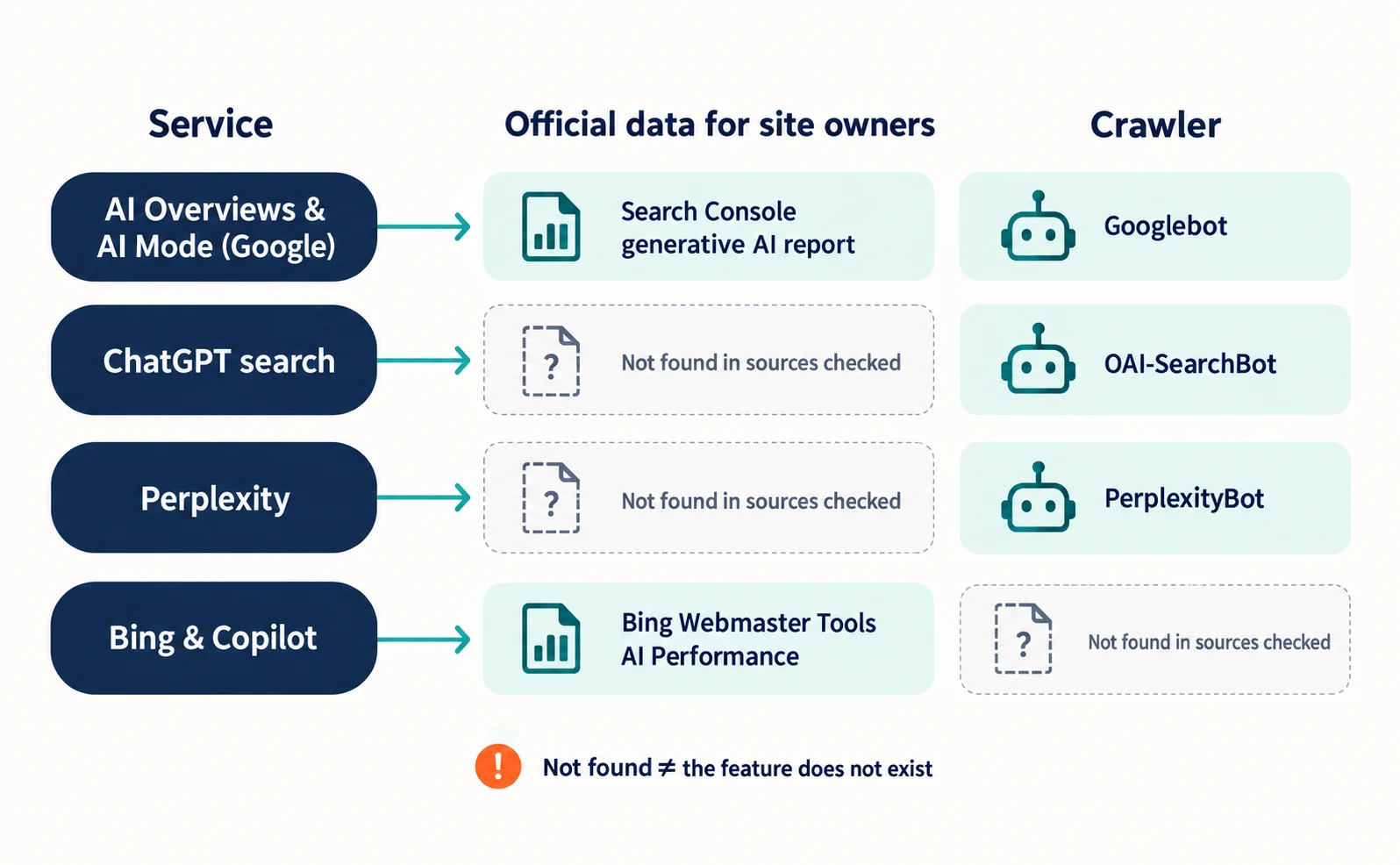
Comparing services by provider, citation links, official data available to site owners and the name of the crawler that reads pages makes the differences clear.
| Service | Provider | Citation links | Official data for site owners | Crawler name |
|---|---|---|---|---|
| AI Overviews and AI Mode | Links to supporting pages [1] | Search Console generative AI report [2] | Googlebot (shared with regular search) [1] | |
| ChatGPT search | OpenAI | Citations and Sources list [4] | Not described in the official sources checked | OAI-SearchBot [3] |
| Perplexity | Perplexity | Surfaces and links websites in results [5] | Not described in the official sources checked | PerplexityBot [5] |
| Bing and Copilot | Microsoft | Citations in AI answers [6] | AI Performance in Bing Webmaster Tools [6] | Not described in the official sources checked |
| Gemini | Not described in the official sources checked | Not described in the official sources checked | Google-Extended controls training and grounding use [1] |
“Not described” does not mean the feature does not exist. It means we could not find it in the official sources checked for this article.
AI Overviews and AI Mode in Google Search
Both are features inside Google Search, and regular SEO fundamentals apply. You can check part of their performance in the Search Console generative AI report.
Google says there are no additional requirements or special files needed to appear in AI features. Pages must be indexed and eligible to show a snippet, and inclusion is not guaranteed [1]. AI Mode is available in Japan and in Japanese, among other countries and languages [7].
The two features may use different models and techniques, so the links shown can vary [1]. The Search Console generative AI report shows impressions for both by page and country [2].
ChatGPT Search and Perplexity
The crawler settings to check are OAI-SearchBot for ChatGPT and PerplexityBot for Perplexity. Both are separate from training settings.
OpenAI treats OAI-SearchBot (search) and GPTBot (training) as independent settings. Blocking GPTBot does not remove you from ChatGPT search if OAI-SearchBot is allowed. OpenAI says robots.txt changes can take about 24 hours to take effect for search [3]. ChatGPT’s help explains that results are ranked using multiple factors and placement is not guaranteed [4].
PerplexityBot is used to surface and link websites in Perplexity results and is not used to crawl content for AI model training. Perplexity-User, which fetches pages at a user’s request, generally ignores robots.txt [5].
For details on crawler settings, see How AI Crawlers Differ.
Bing and Copilot
Citation Share in Bing Webmaster Tools is the percentage of all citations shown for a specific grounding query that point to your site. It is not a ranking or traffic share.
Microsoft offers an AI Performance report in Bing Webmaster Tools showing where your content is cited in AI answers across Copilot, Bing and select partners. In June 2026, Citation Share and other features were added in preview. It is an observational metric that does not show competitor domains [6].
How to Choose Which AI Search Services to Monitor
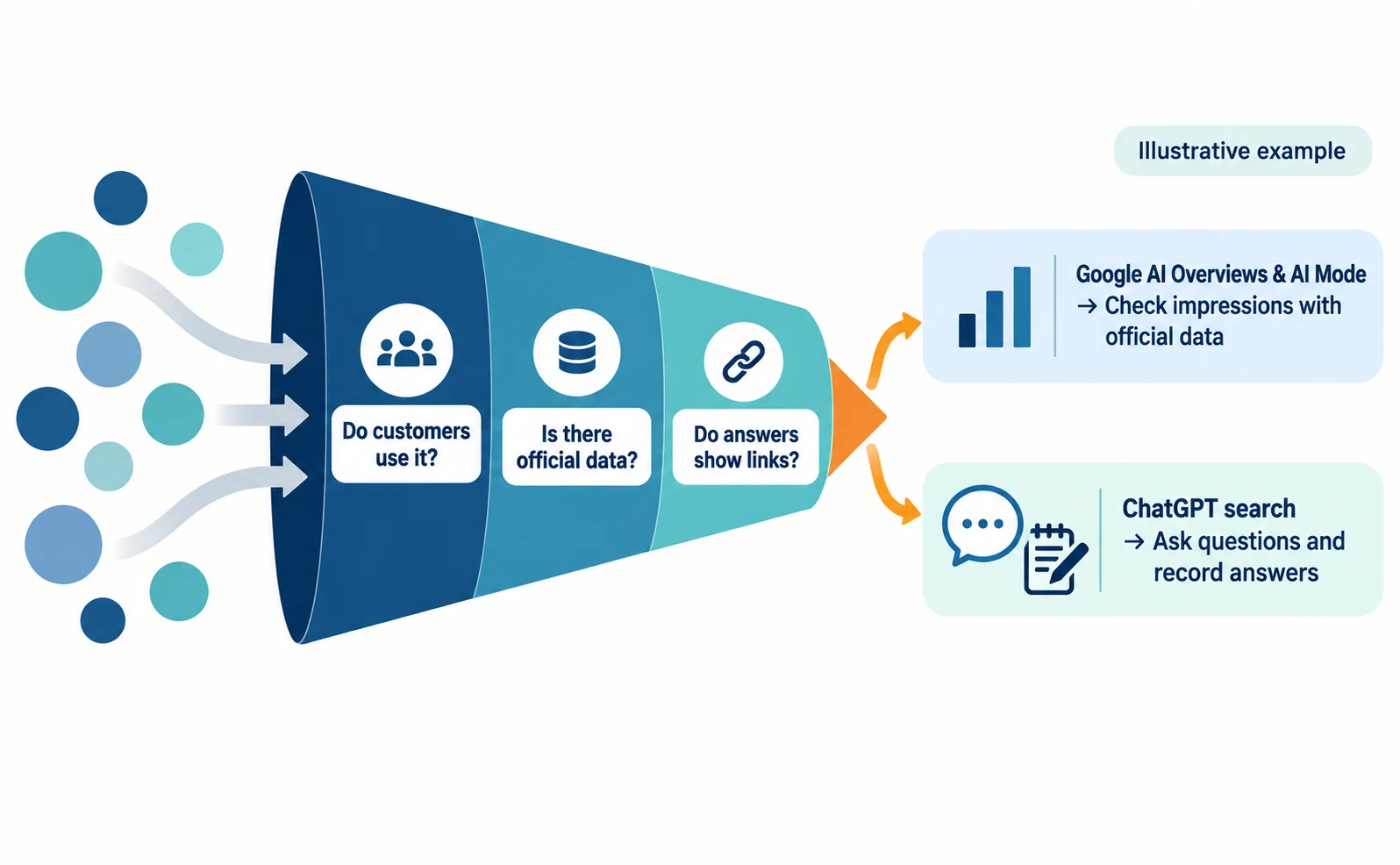
You don’t need to monitor everything at once. Prioritize by three questions: do customers use it, is there official data, and do answers show links?
| Criterion | How to check | Higher priority when |
|---|---|---|
| Do customers use it? | Services customers mention in inquiries or sales calls | Customers name it |
| Is there official data? | The official data column in the table above | You can verify numbers from your side |
| Do answers show links? | Ask a question and check the links | Links can lead to visits |
In the training company example (illustrative), if customers mentioned ChatGPT and Google, start with Google’s AI Overviews and AI Mode plus ChatGPT search. Use official data to check Google impressions, and ask ChatGPT questions and record the answers.
Record Results Separately for Each AI Search Service
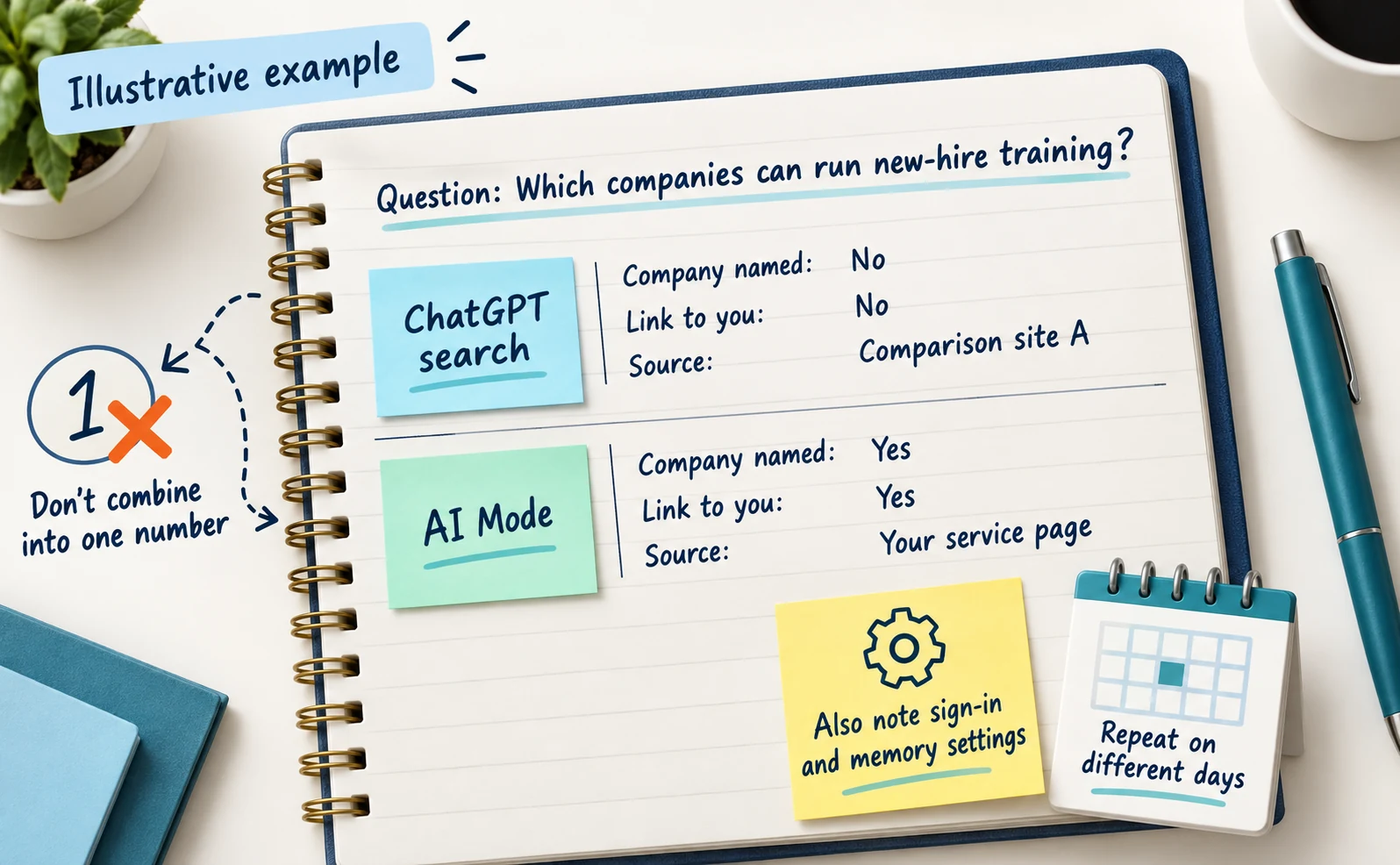
Do not combine results from multiple AIs into one number; record each service separately. Services may rely on different pages.
| Date and time | Service | Question | Company named? | Link to you? | Main cited source |
|---|---|---|---|---|---|
| Sept 23, 10:00 | ChatGPT search | Which companies can run new-hire training? | No | No | Comparison site A |
| Sept 23, 10:00 | AI Mode | Which companies can run new-hire training? | Yes | Yes | Your service page |
This table is an illustrative example. ChatGPT may use approximate location and enabled memories in searches, so also note your sign-in status and memory settings [4]. Recording the same question on several days helps you tell whether a result was a one-off.
What AgentSignal Can and Cannot Check
AgentSignal’s AI citation rate feature sends the same questions to ChatGPT, Gemini, Perplexity and Claude and records whether your site was cited. Claude is available on paid plans only.
This feature does not check the actual AI Overviews or AI Mode screens in Google Search. Results from asking Gemini are not the same as what appears in Google’s AI Overviews. Check Google Search appearances in the Search Console generative AI report [2].
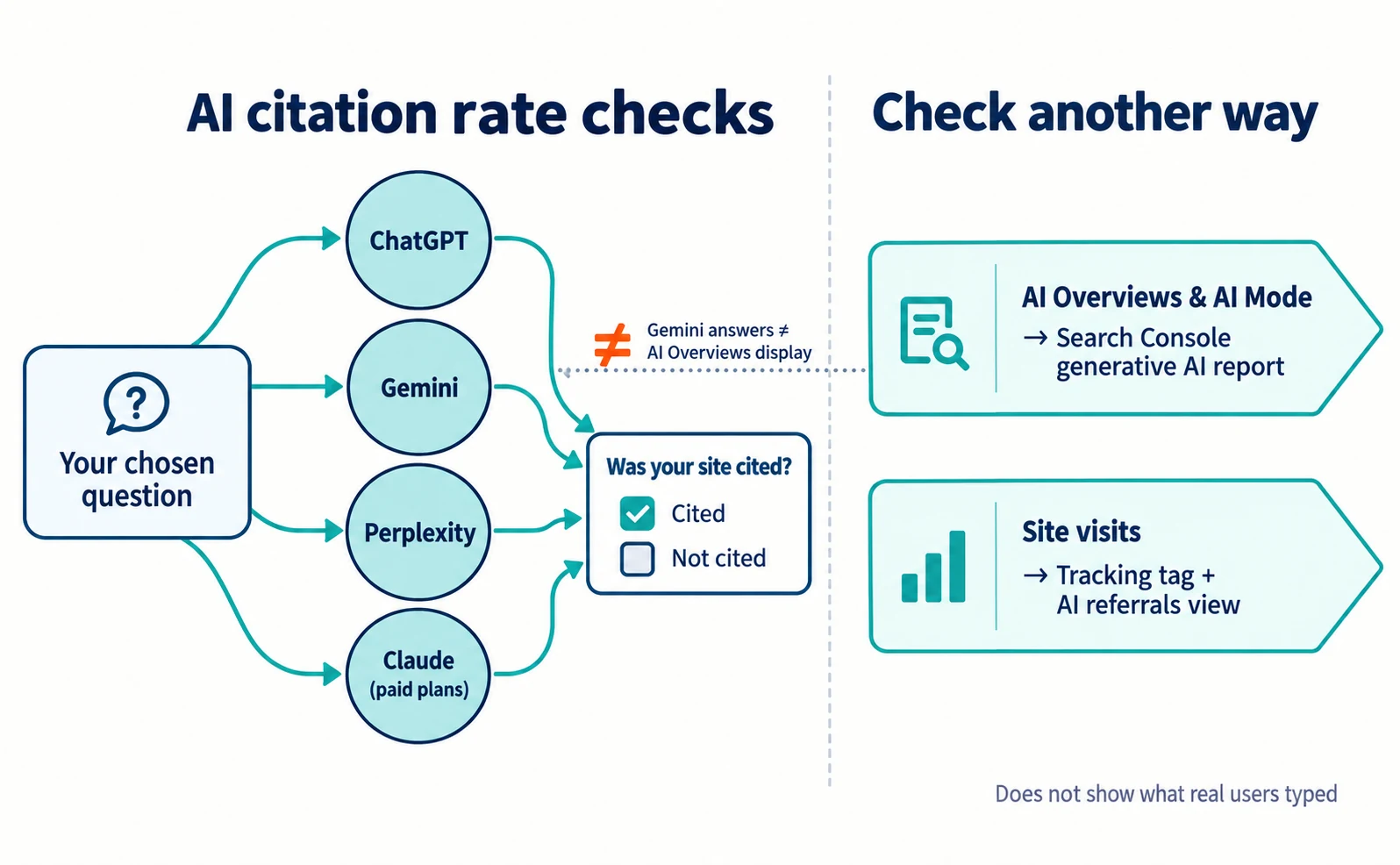
The citation rate records answers to the questions you choose; it does not reveal what real users typed. To see visits to your site, install the tracking tag and use the AI referrals view. See How to Use AI Optimization for the steps.
FAQ
- Q. Are AI Overviews and Gemini the same?
- No. AI Overviews is a feature inside Google Search. Results from asking Gemini may not match what appears in AI Overviews.
- Q. Do I need to check every AI search service?
- No. Start with two or three services, chosen by whether customers use them, whether official data exists and whether answers show links.
- Q. Is Bing’s Citation Share the same as search ranking?
- No. Citation Share is an observational metric showing your share of citations for a specific query, not a ranking or traffic share.
Sources
- [1] AI features and your website (Google Search Central) — accessed 2026-09-23
- [2] Introducing Search Generative AI performance reports in Search Console (Google Search Central Blog) — accessed 2026-09-23
- [3] Overview of OpenAI crawlers (OpenAI) — accessed 2026-09-23
- [4] Searching the web with ChatGPT (OpenAI) — accessed 2026-09-23
- [5] Perplexity Crawlers (Perplexity) — accessed 2026-09-23
- [6] New AI Visibility Insights in Bing Webmaster Tools: Intents, Topics, Citation Share, Compare (Microsoft Bing) — accessed 2026-09-23
- [7] Get AI-powered responses with AI Mode in Google Search (Google Search Help) — accessed 2026-09-23
About the author
Shogo MizushimaCEO of kairos Inc. / AgentSignal Developer
Develops AgentSignal, a tool for measuring AI crawler visits and AI-referred traffic, and diagnosing AIO readiness. Writes about measurement and practical improvements for AI search using observed data.
Related articles
Measurement and site improvement
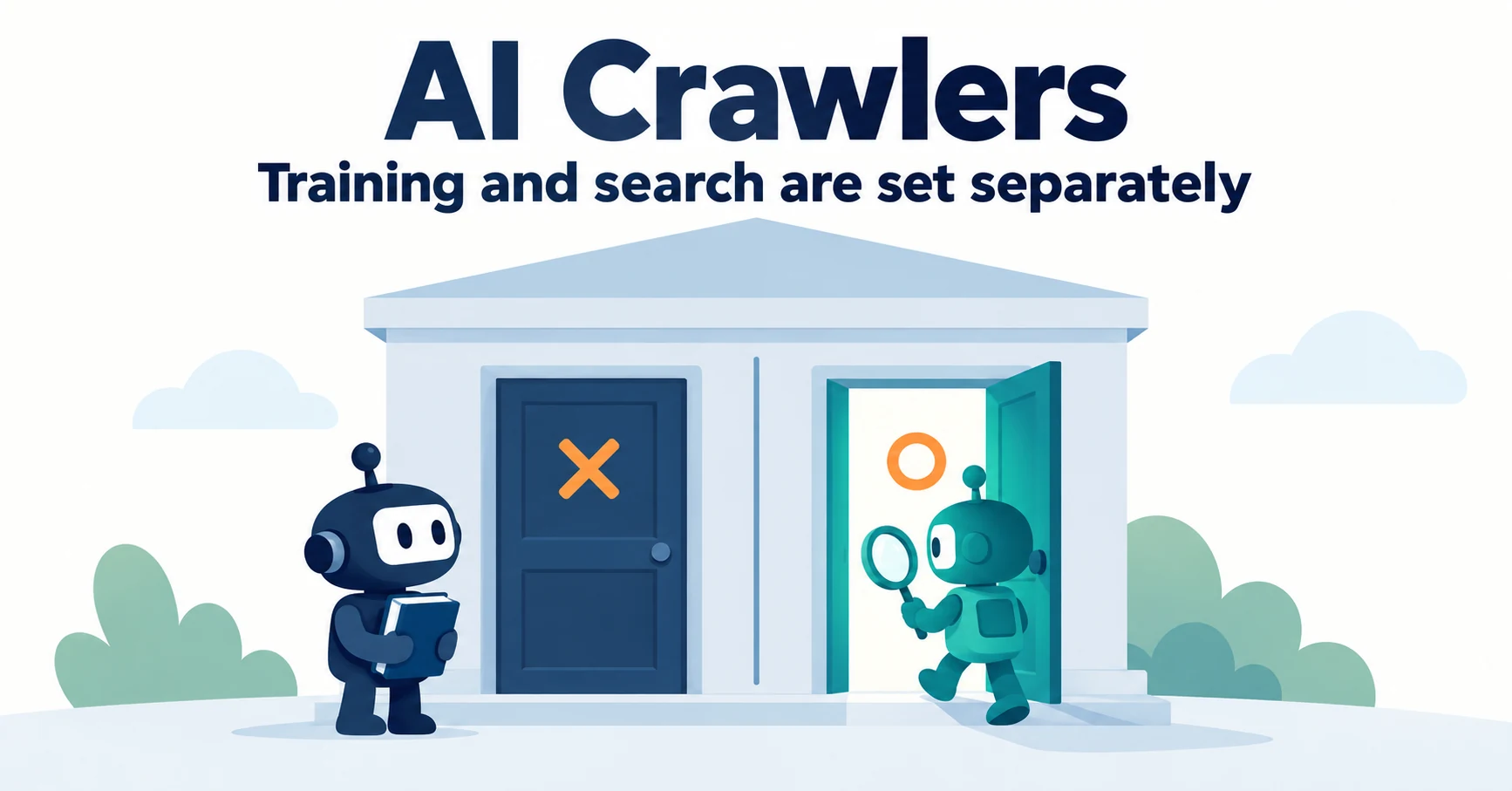
What Are AI Crawlers? Why Blocking GPTBot Doesn’t Remove You from ChatGPT Search
AI crawlers are programs AI companies use to read public web pages. Learn how GPTBot differs from OAI-SearchBot, how Google-Extended works, why visits can continue after a robots.txt block and how to choose settings by purpose.
Published
AIO and AI search
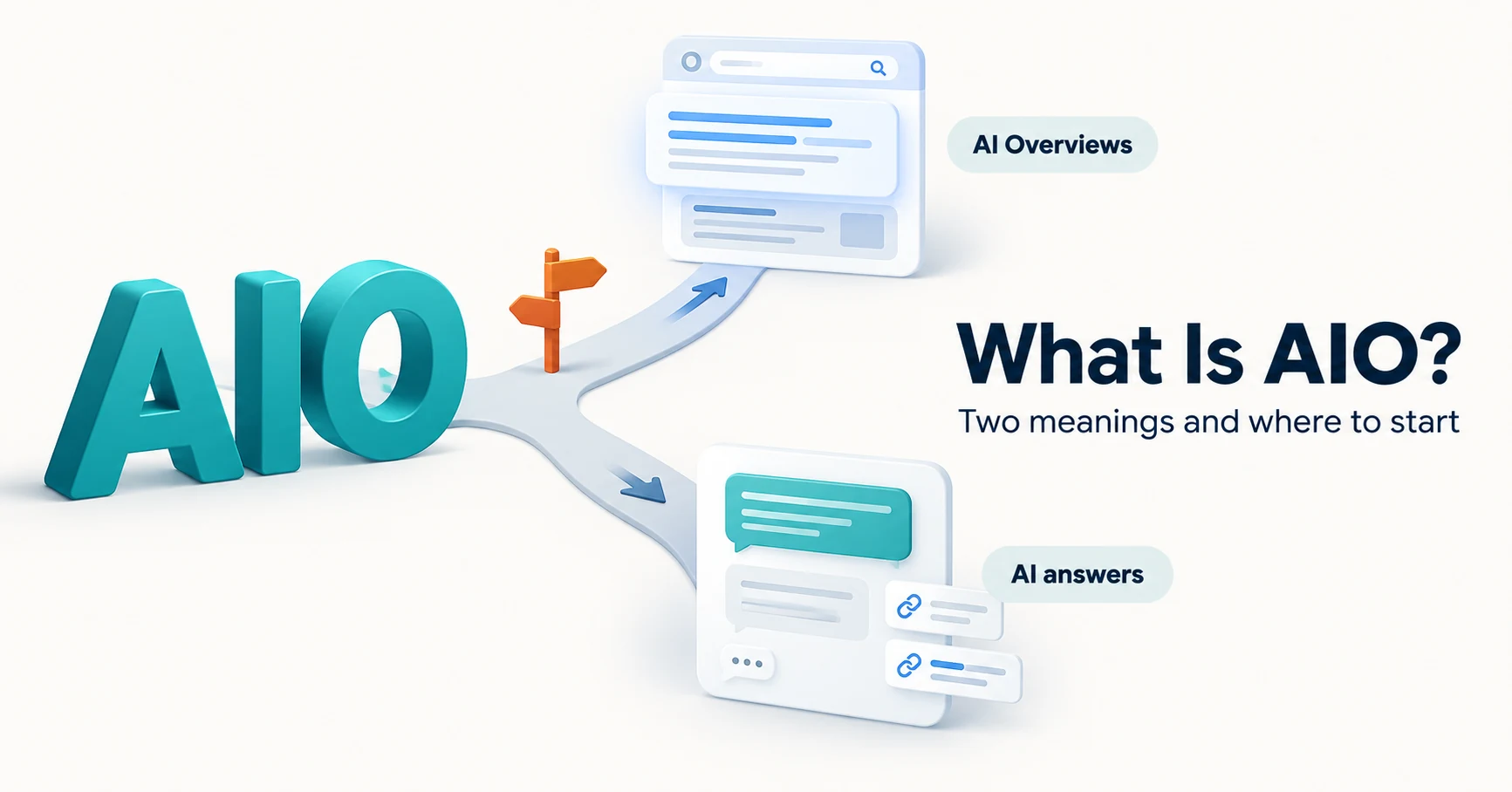
What Is AIO? Its Two Meanings and Where to Start with AI Optimization
AIO has two meanings: work to get your company featured in AI answers, and Google Search’s AI Overviews. Learn how it relates to SEO, what to confirm in a proposal, what Search Console and Bing reports show, and your first tasks.
Published
AIO and AI search
Airbyte reported a $100,000 ChatGPT-originated deal: the content changes behind its AIO work
Airbyte reported one $100,000 contract originating from ChatGPT. The team analyzed over 500 prompts and revised content into direct answers, lists, and steps.
Published