What Is UCP for AI Shopping? What E-Commerce Teams Should Check First
Learn how Universal Commerce Protocol (UCP) lets AI purchase products, what information it shares, and what e-commerce teams in Japan should check before joining Google’s UCP implementation, based on official January 2026 announcements.
The era of “AI shopping” is approaching: AI will find, compare, and ultimately buy products on our behalf. An experience much like having a capable personal assistant do your shopping is becoming a reality.
Supporting this new shopping experience is Universal Commerce Protocol (UCP), whose development is led by Google and others in collaboration with industry leaders [1, 2]. To be honest, when I first heard the term, I thought, “Another new technology?” But this is a change that e-commerce businesses cannot afford to ignore.
In short, UCP is a “shared language” that lets AI work smoothly with e-commerce sites, from product discovery through checkout and order management [1]. What should e-commerce teams in Japan check now to enable customers to buy their products through AI? Based on official materials published in January 2026, this article explains how UCP works and the requirements for adopting Google’s UCP implementation.
Main Takeaways
- AI shopping is moving from “finding” to “buying”: AI will be able to do more than suggest products. Through UCP, it will be able to complete purchases [1].
- UCP is a shared language connecting e-commerce and AI: It provides standard procedures that let AI understand product details, prices, stock availability, and payment methods, then complete transactions [1, 2].
- Google’s UCP implementation requires preparation: Listing products in Google Merchant Center and following the UCP integration guide are the main requirements for participating in Google’s AI shopping experience [1].
- It reduces friction for customers: UCP lets AI assistants use customers’ existing payment information, such as Google Pay, to make purchases smoother [1].
1. The Difference Between AI Finding and Buying Products
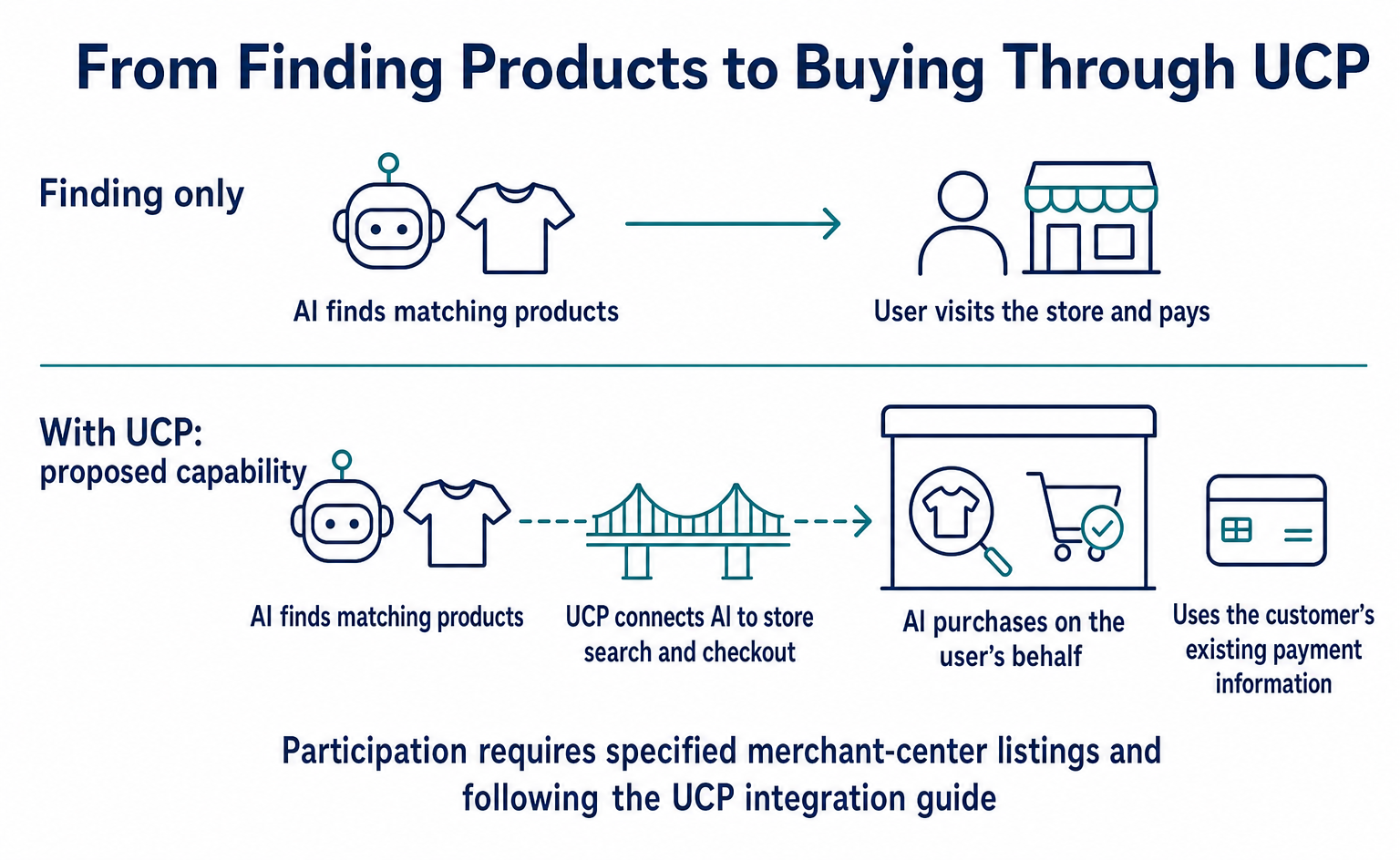
Until now, AI has mainly provided information in response to users’ questions. For example, if you ask it to “find a lightweight suitcase for a trip,” it might suggest several options. With UCP, AI will be able to go a step further and make purchases on your behalf [1].
This addresses a problem with AI shopping to date. It is like choosing a destination on a map, then turning back because you cannot find the signs when you arrive. Even if AI finds a product, the user still has to visit the e-commerce site and pay for it. UCP aims to remove that friction [1].
UCP creates a clear “language” that lets AI assistants, such as AI Mode in Google Search and the Gemini app, connect securely and consistently to an e-commerce site’s backend systems, including product search and cart checkout [1]. This allows AI to evolve from an information provider into an “agent” that acts on the user’s behalf.
In our day-to-day work, we are also seeing more cases where people search for a brand by name to verify what AI has told them. UCP adds another option after that verification: having AI make the purchase directly.
2. The Shopping Procedures Shared Through UCP
UCP defines a “shared language” and the basic building blocks of functionality for interactions between AI and e-commerce sites [1]. This enables smooth transactions between consumer-facing interfaces, businesses, and payment providers [1]. Specifically, it standardizes the sequence from discovering product information to adding items to a cart, checking out, and managing orders [1].
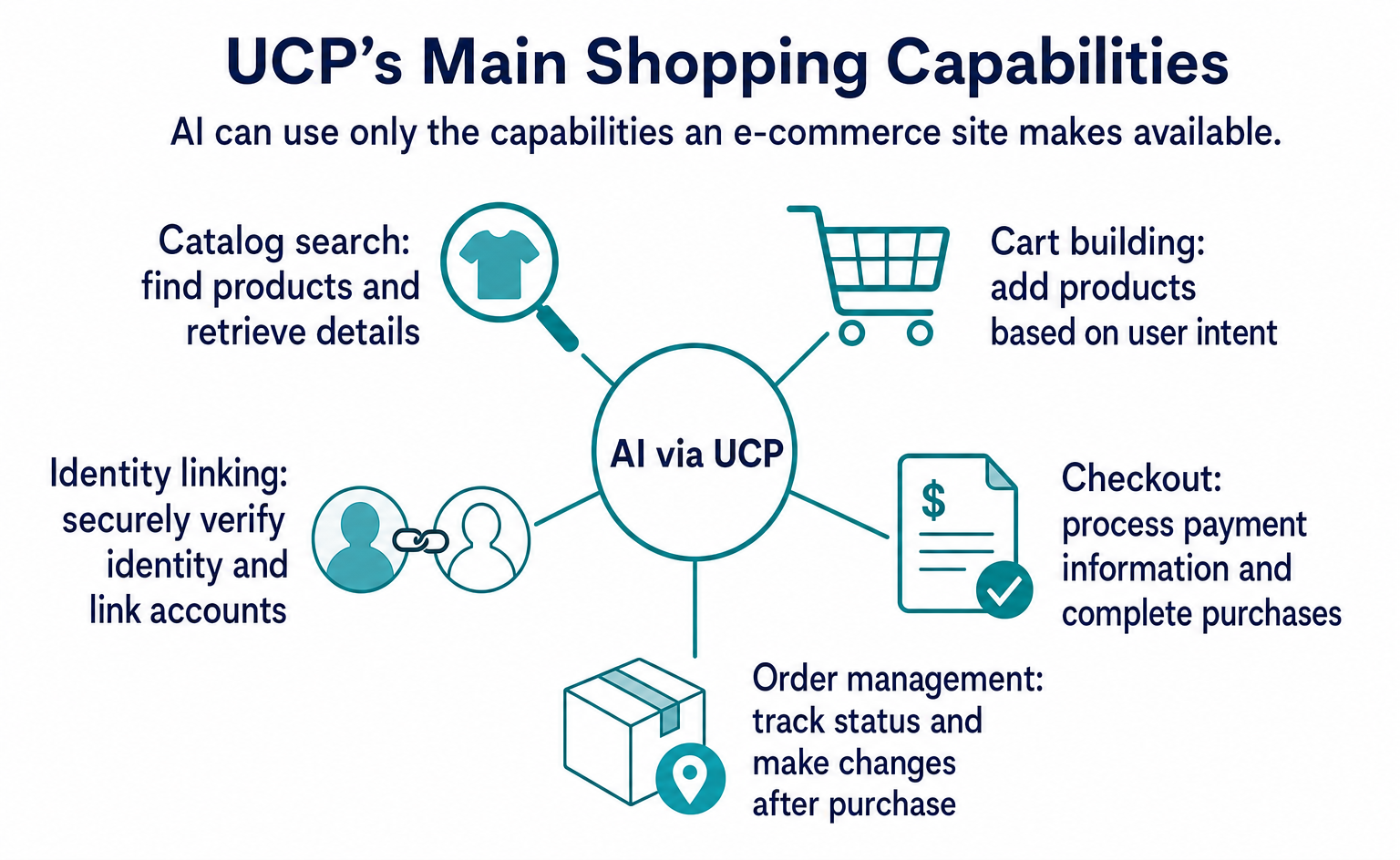
UCP provides the following main functions [2].
- Catalog Search and Lookup: AI searches an e-commerce site’s product catalog and retrieves detailed information [2].
- Cart Building: AI adds products to a cart based on the user’s intentions [2].
- Identity Linking: It securely verifies the user’s identity and links accounts [2].
- Checkout: It processes payment information and completes the purchase [2].
- Order Management: It enables users to track order status and make changes after a purchase [2].
These functions are defined as “capabilities” that an e-commerce site makes available to AI through UCP [1]. For example, if a site makes its checkout capability available, AI can complete checkout directly on that site. Extensions, such as applying discounts, are also supported [1].
UCP is designed to work with existing retail infrastructure and is compatible with Agent Payments Protocol (AP2) [1]. This supports secure payments by AI agents [1]. It also offers flexible integration options for businesses, including APIs, Agent2Agent (A2A), and Model Context Protocol (MCP) [1].
To be candid, our company has experienced this “N x N integration bottleneck” in the past. UCP aims to bring these complex connections together at a single integration point, helping the entire e-commerce ecosystem adopt AI faster [1].
3. Requirements for Participating in Google’s UCP Implementation
UCP is an open standard that does not depend on any single vendor. Google has built its first reference implementation, offering a new shopping experience that lets consumers buy directly from eligible businesses within conversational experiences such as AI Mode in Google Search and Gemini [1].
E-commerce teams in Japan need to consider several requirements before participating in Google’s implementation.
1. Use a Google Merchant Center Account
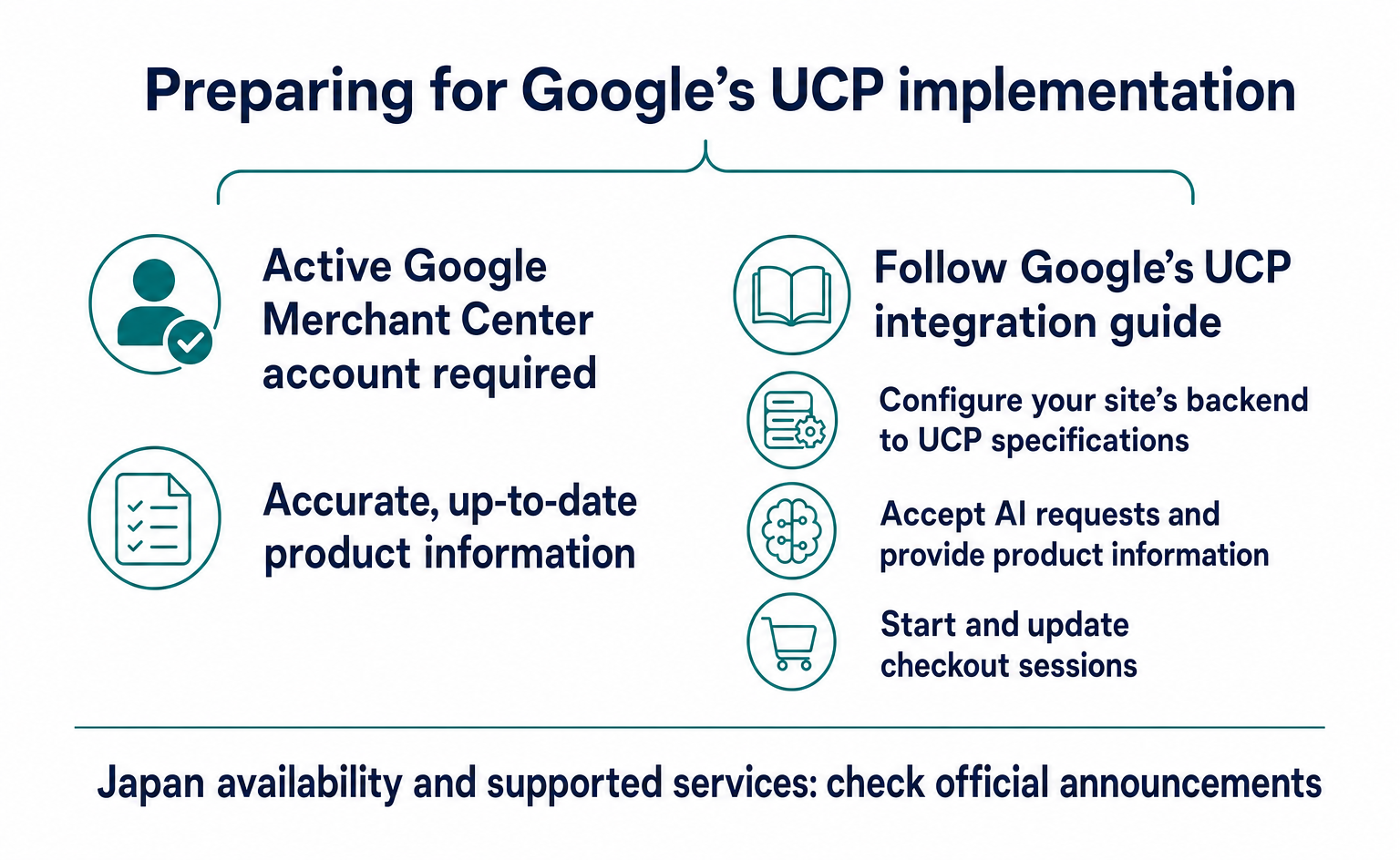
An active Google Merchant Center account is required to participate in Google’s UCP implementation [1]. Merchant Center is a tool for supplying product information to Google so that products can appear in search results, Shopping ads, and other placements. Accurate, up-to-date product information in Merchant Center is essential for AI to identify your products correctly and include them in the shopping experience.
2. Follow the UCP Integration Guide
Once your Merchant Center account is ready, you need to make your e-commerce site compatible with UCP by following Google’s UCP integration guide [1]. This includes configuring the site’s backend to make product information, checkout functions, and other capabilities available to AI according to UCP specifications. In practical terms, your site’s server must be ready to accept requests from AI, provide product information, and start and update checkout sessions.
3. Check Availability and Supported Services in Japan
As its name, Universal Commerce Protocol, suggests, UCP aims to be a universal protocol. However, you need to watch official announcements to learn when Google’s implementation will become available in Japan and which services will support it. So far, shopping experiences in AI Mode in Google Search and the Gemini app have been mentioned [1].
To avoid confusion, UCP is simply a “shared language.” E-commerce teams decide whether their businesses will participate in Google’s AI shopping experience. Still, given the possibility that consumers may shift toward buying through AI, it is important to gather information and prepare early.
Tasks to Start Tomorrow
Here is how to turn the information above into practical work.
- Check your Google Merchant Center account: First, confirm that your company’s Merchant Center account is active and that its product information is accurate and up to date. Update anything that is missing or outdated.
- Read the official UCP documentation: Read
ucp.devand UCP-related articles on the Google Developers Blog to learn more about the specifications and future developments. - Begin internal discussions: Discuss how AI shopping could affect your business, along with the advantages and disadvantages of adopting Google’s UCP implementation.
- Assess your current position with AgentSignal’s AI optimization features: Check how often AI currently cites your site and whether it sends traffic to it. This helps you understand how AI currently views your site and provides important indicators before adopting UCP.
Frequently Asked Questions (FAQ)
Q1: Will AI stop finding my products if I do not support Google’s UCP implementation?
A1: UCP is a protocol that lets AI complete purchases on users’ behalf. Not supporting Google’s UCP implementation does not mean AI will be unable to find your products. However, support matters if you want Google’s AI assistants to offer an experience that goes beyond product recommendations and proceeds directly to purchase [1]. Because purchases handled by AI offer users considerable convenience, this could become a competitive advantage in the future.
Q2: What technical knowledge is needed to adopt UCP?
A2: UCP is integrated through APIs and SDKs, so basic web development knowledge, including REST APIs and JSON, is required [1]. In particular, development work is needed to connect your e-commerce site’s backend systems with UCP specifications. Google provides developer documentation and sample code to guide this work.
Q3: Can Google’s UCP implementation be used in Japan right away?
A3: Google has released the first reference implementation of UCP and announced that it enables shopping experiences in AI Mode in Google Search and the Gemini app [1]. However, further official announcements are needed to confirm the launch timing and supported services in Japan. For now, the focus should be on gathering information and preparing.
Q4: How much does it cost to adopt Google’s UCP implementation?
A4: UCP itself is an open-source standard, so there is no fee to use the protocol [1]. However, costs include development work to make your e-commerce site compatible with Google’s UCP implementation, operating Merchant Center, and integrating existing systems. Actual costs vary widely depending on the size of your e-commerce site and the complexity of its existing systems.
Conclusion
We are approaching an era in which AI will not just provide information but also buy products on our behalf. Universal Commerce Protocol (UCP) provides a shared foundation for this new AI shopping experience.
- UCP provides a “shared language” between AI and e-commerce sites, covering the full process from product discovery to checkout and order management [1].
- E-commerce teams in Japan should check their product listings in Google Merchant Center and read the official UCP documentation to understand the requirements for adopting Google’s UCP implementation [1].
- Supporting Google’s UCP implementation could reduce friction for customers and expand business opportunities in future AI-driven shopping experiences [1].
This change could significantly reshape how e-commerce sites attract visitors and serve customers. Start gathering information and preparing now for the coming era of AI shopping.
Sources
[1] Google Developers Blog. "Under the Hood: Universal Commerce Protocol (UCP)". JAN. 11, 2026. https://developers.googleblog.com/under-the-hood-universal-commerce-protocol-ucp/ (Accessed 2026-09-08) [2] UCP.dev. "Universal Commerce Protocol". https://ucp.dev/ (Accessed 2026-09-08)
FAQ
- Q. Will AI stop finding my products if I do not support Google’s UCP implementation?
- UCP is a protocol that lets AI complete purchases on users’ behalf. Not supporting Google’s UCP implementation does not mean AI will be unable to find your products. However, support matters if you want Google’s AI assistants to offer an experience that goes beyond product recommendations and proceeds directly to purchase [1]. Because purchases handled by AI offer users considerable convenience, this could become a competitive advantage in the future.
- Q. What technical knowledge is needed to adopt UCP?
- UCP is integrated through APIs and SDKs, so basic web development knowledge, including REST APIs and JSON, is required [1]. In particular, development work is needed to connect your e-commerce site’s backend systems with UCP specifications. Google provides developer documentation and sample code to guide this work.
- Q. Can Google’s UCP implementation be used in Japan right away?
- Google has released the first reference implementation of UCP and announced that it enables shopping experiences in AI Mode in Google Search and the Gemini app [1]. However, further official announcements are needed to confirm the launch timing and supported services in Japan. For now, the focus should be on gathering information and preparing.
- Q. How much does it cost to adopt Google’s UCP implementation?
- UCP itself is an open-source standard, so there is no fee to use the protocol [1]. However, costs include development work to make your e-commerce site compatible with Google’s UCP implementation, operating Merchant Center, and integrating existing systems. Actual costs vary widely depending on the size of your e-commerce site and the complexity of its existing systems.
Sources
- [1] Under the Hood: Universal Commerce Protocol (UCP) (Google Developers Blog) — accessed 2026-09-08
- [2] Universal Commerce Protocol (UCP.dev) — accessed 2026-09-08
About the author
Shogo MizushimaCEO of kairos Inc. / AgentSignal Developer
Develops AgentSignal, a tool for measuring AI crawler visits and AI-referred traffic, and diagnosing AIO readiness. Writes about measurement and practical improvements for AI search using observed data.
Related articles
AI shopping and booking
51% of US consumers use AI shopping tools. How much has product selection changed?
That does not mean AI placed 51% of orders. It is the share of US consumers who reported using at least one AI-powered shopping tool during the past month.
Published
AI shopping and booking
Same AI, different doors: why Amazon blocked Muse while Shopify offers a connection
Amazon has reportedly blocked Meta's AI agent, Muse. Meanwhile, Shop's official help lists Muse as an example of a supported AI platform.
Published
AI shopping and booking
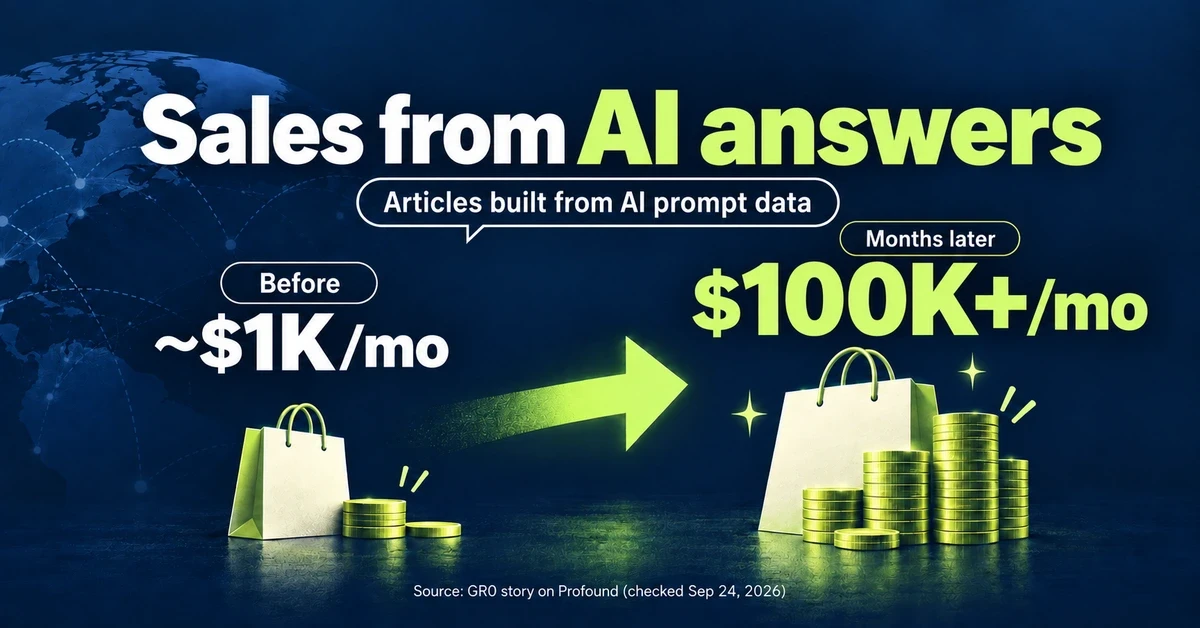
From about $1K to over $100K a month: What did an overseas brand write to grow sales from AI search?
GR0 reports that a beauty and wellness brand's monthly sales through AI answers grew from about $1,000 to over $100,000 within months. The brand chose article topics based on AI prompt data. Here is the case in brief, plus three steps to check your own product pages.
Published