48% AI visibility: Kiteworks matched customer questions to three content formats
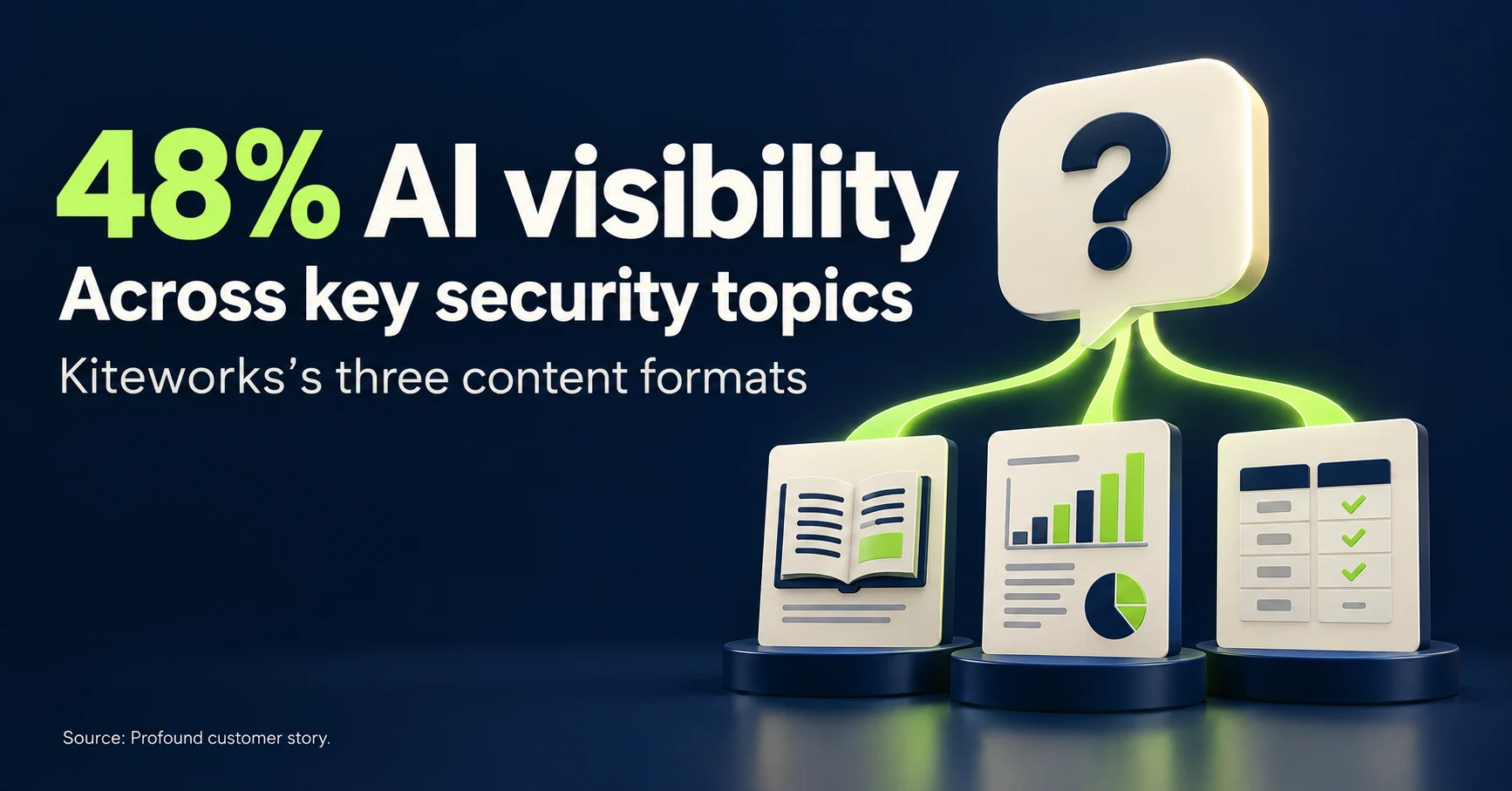
Kiteworks reported 48% AI visibility across key security and compliance topics after five months. Its content included practical guides, trend reports, and vendor comparisons.
Specialist products invite detailed questions. Buyers need to know whether a service fits their conditions and how it differs from alternatives, not simply whether it is “secure.”
Kiteworks reportedly reached 48% AI visibility across key themes by developing content from customer questions. Profound’s case study
The practical LLM optimization question is which article format best conveys your expertise.
What Kiteworks’s 48% AI visibility figure covers
The 48% figure concerns key compliance and cybersecurity topics monitored for Kiteworks, reported after five months of work. Profound’s case study

Illustration: Read visibility within the monitored security topics, not across the entire market.
It does not mean appearing in 48% of every AI query worldwide. The full question set and detailed calculation method are not disclosed.
AI presence, visits, and inquiries are separate measures. This is a supporting vendor’s report of visibility in specialist topics, not a revenue result.
Customer questions led to practical guides, trend reports, and vendor comparisons
The content types included practical guides, trend reports, and vendor comparisons, informed by customer questions and internal expertise. Profound’s case study

Illustration: Match task questions with guides, update questions with reports, and buying questions with comparisons.
For your own program, choose a format according to the reader’s decision. The following is our editorial framework.
| Reader’s question | Suitable format | Essential information |
|---|---|---|
| How do I do this? | Practical guide | Prerequisites, sequence, and completion check |
| What changed? | Trend or update report | Date, affected users, and previous behavior |
| Which should I choose? | Vendor comparison | Consistent criteria, limits, and evidence |
A question does not require all three formats. A product list will not answer someone trying to understand a specification change.
How to interpret an eightfold increase in daily content output
Daily content output reportedly increased about eightfold. That does not establish an eightfold increase in revenue or productivity. Profound’s case study
In specialist fields, decide who verifies facts and how content is updated alongside how quickly it is written. More outdated articles do not improve the buyer’s decision.
Match questions in your specialist field with the right article format
Select one question from sales or support and collect the evidence needed to answer it. This is our proposed exercise.

Illustration: A fictional access-revocation question leads to conditions, steps, and a verification method.
For a fictional business file-sharing service, “Can I revoke access after sending a file?” suits a practical guide.
- Confirm the plan, permissions, and operating conditions with the product owner.
- Explain revocation in the order the reader performs it.
- Show how to verify that access has stopped.
- State any limits, such as files already downloaded.
This is not a statement of Kiteworks functionality. Replace the example with your own verified behavior.
If regulations or standards are relevant, verify the source version and jurisdiction and have the responsible specialist review the explanation.
Track AI presence, visits, and inquiries separately after publication
After publication, record answers to the selected question, article visits, and inquiries separately.

Illustration: Separate citations, visits, and inquiries to diagnose the stage that needs attention.
| Observation | What to inspect next |
|---|---|
| Citations without many visits | How the answer uses the page |
| Visits without inquiries | Conditions, limitations, and next steps |
| Outdated information persists | Cited sources and update status |
These are hypotheses for investigation, not automatic diagnoses.
Choose a format that fits one real question and turn specialist knowledge into an actionable answer. That is the practical process to take from the case.
FAQ
- Q. Does 48% visibility cover all AI questions?
- No. It concerns key monitored compliance and cybersecurity topics.
- Q. Do I need all three formats?
- No. Choose the format that fits the reader’s task, update question, or purchase decision.
Sources
- [1] Profound’s case study — accessed 2026-09-26
About the author
Shogo MizushimaCEO of kairos Inc. / AgentSignal Developer
Develops AgentSignal, a tool for measuring AI crawler visits and AI-referred traffic, and diagnosing AIO readiness. Writes about measurement and practical improvements for AI search using observed data.
Related articles
AIO and AI search
Airbyte reported a $100,000 ChatGPT-originated deal: the content changes behind its AIO work
Airbyte reported one $100,000 contract originating from ChatGPT. The team analyzed over 500 prompts and revised content into direct answers, lists, and steps.
Published
AIO and AI search
AI-referred inquiries up 51%: Arizona College of Nursing’s local AIO approach
Arizona College of Nursing reported 51% more AI-referred enrollment inquiries and 26% more visits in 90 days. The team examined questions across 24 markets and developed tuition comparisons and local FAQs.
Published
AIO and AI search
AI-referred signups up 37%: how OpusClip made AIO measurement continuous
OpusClip reported 37% more AI-referred signups and 20% more traffic. The team combined seven-day rolling averages with human checks of AI answers.
Published