AIO and LLMO for Real Estate Agencies: Start from Property and Area Questions
People searching for a home may ask AI about neighborhoods and procedures more than individual listings. Sort the questions by type, see which ones your own pages can answer, and learn how to write area pages and check your current visibility.
AIO and LLMO for a real estate agency start with sorting the questions people ask AI and improving the area and procedure pages your business can answer well. Keeping your company details consistent in page text also reduces misunderstandings when you are recommended.
Suppose you ask AI, “Which neighborhoods near X Station are good for families?” and only property portals come up. Your team knows the area better, so why are you missing? This article is for web staff at local brokerage and property management firms in Japan. It explains how to think about the problem and how to check. Information is current as of September 23, 2026.
AIO and LLMO are the work of helping AI answers describe your business accurately.
Types of Questions People Ask AI When Looking for Property
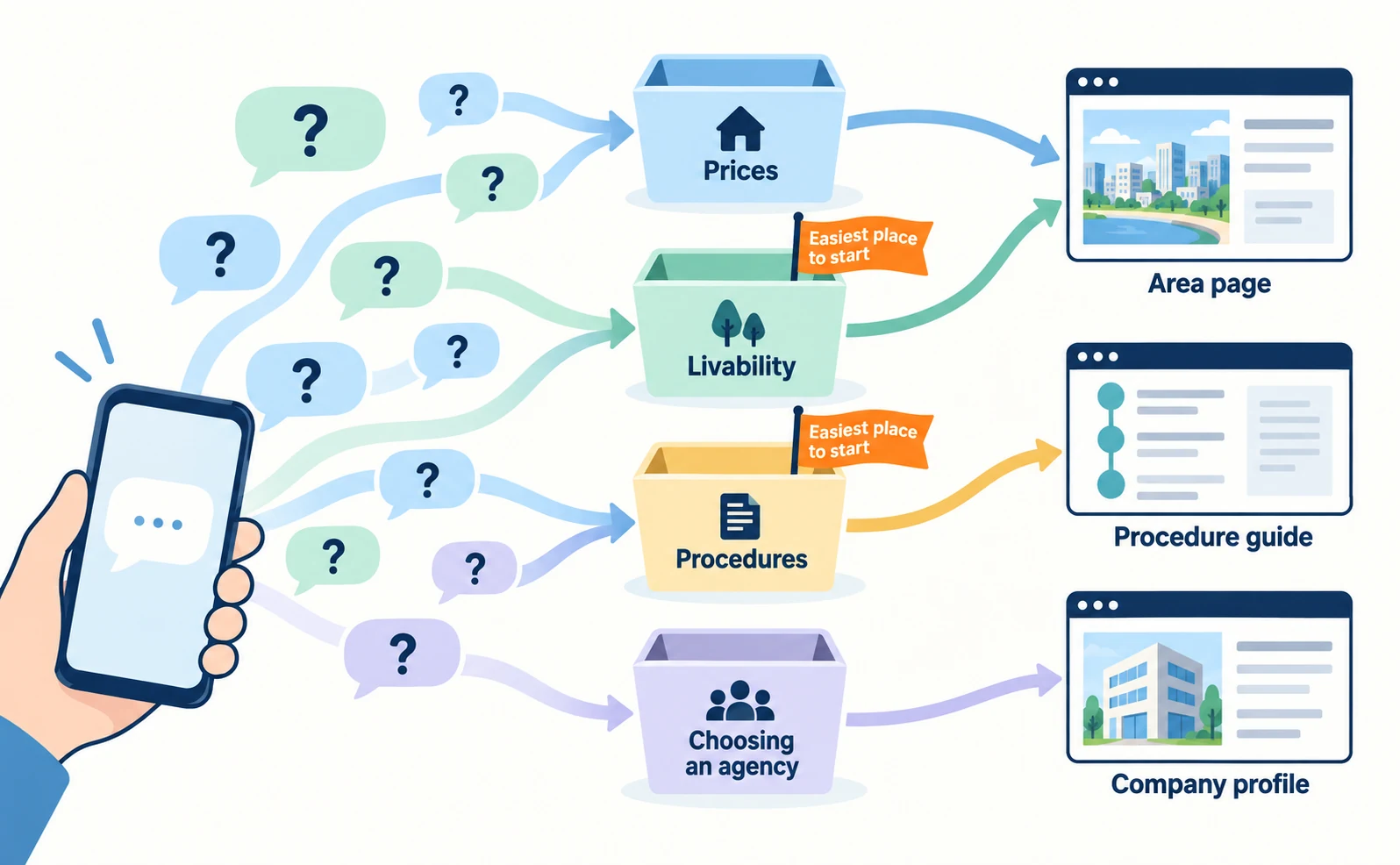
Questions people ask AI fall into four types: prices, livability, procedures and choosing an agency. Sorting them shows which questions your pages can answer easily and which they cannot.
| Question type | Example | Easy for you to answer? | Page for the answer |
|---|---|---|---|
| Prices | What is the rent for a 2LDK near X Station? | Yes, with public data | Area page |
| Livability | Is X town good for families? | Yes, if you have local deal experience | Area page |
| Procedures | What do initial rental costs include? | Yes | Procedure guide |
| Choosing an agency | Which firms in X city can manage my property? | Possibly, if your company details are accurate | Company profile |
Of the four, procedures and livability are what clients ask you every day. Writing those answers down is the easiest place to start.
How Property Listings Relate to AI Answers
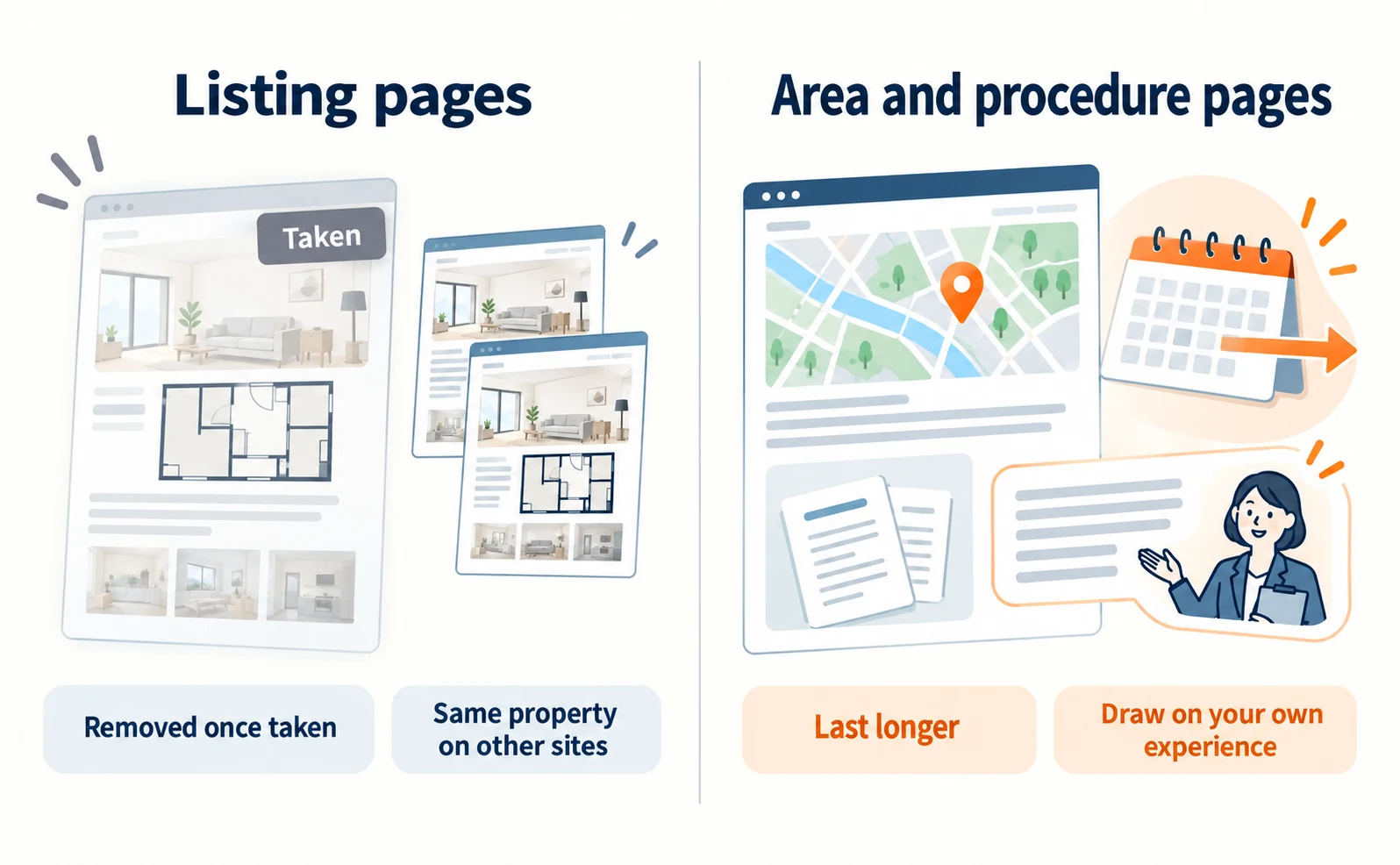
Official documentation does not confirm whether individual listing pages are used in AI answers. So consider your area and procedure pages first, rather than listings that change quickly.
Google says there are no additional technical requirements for AI Overviews or AI Mode. Pages must be indexed and eligible for a snippet, and inclusion is not guaranteed [1].
A listing is removed once the property is taken. The same property often appears on portals too, so your page is not necessarily the one chosen. Area and procedure explanations, by contrast, last longer and can draw on your own experience.
This does not mean listings do not matter. Describe layouts and facilities in text, not only images. If you use structured data, match it to what is visible on the page [2].
Build Pages That Answer Area Questions
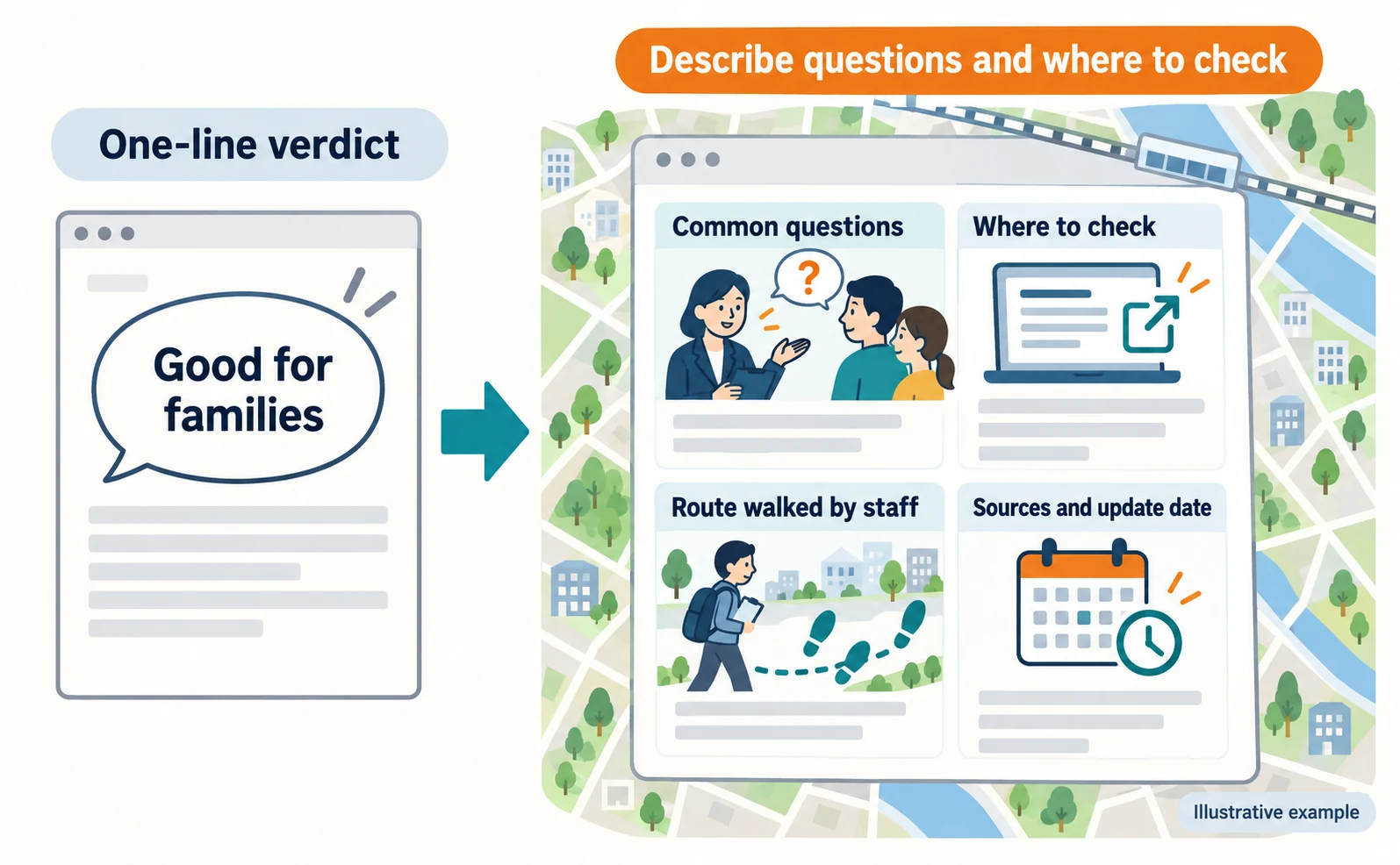
On area pages, write facts you have confirmed through your own deals and answers to common enquiries, with sources and update dates. A generic town introduction will not stand out from other sites.
Here is an example structure for a fictional area page, for illustration.
| Example heading | What to write |
|---|---|
| Typical rents in X town | Public data with its date, plus trends in your own listings (with count and period) |
| Common questions from families | Real enquiries and the sources you point clients to |
| Walking from the station | Route details your staff checked on foot |
| How to check disaster risks | Links to public hazard-information sites |
Rather than simply saying “good for families,” describe what people ask and what you advise them to check. That is more useful for decision-making.
When you include subjective views, make clear whose they are. Check with the person responsible for advertising compliance in your company about what claims are acceptable.
Cautions When Writing Prices and Figures
Always give the source and date for price figures. The Ministry of Land, Infrastructure, Transport and Tourism’s Real Estate Information Library shows price information such as transaction prices and official land prices [3].
Here is an example (the figure is fictional).
Land transactions in X town averaged about ¥300,000 per square meter (checked in the Real Estate Information Library in September 2026; period as shown on the site). In transactions we brokered in 2025, …
Keep public data and your own estimates in separate paragraphs or table columns. Mixing them makes it unclear, to readers and AI alike, which figure is which. When you update a figure, update the check date as well.
Keep Company Details, License and Address Consistent in Page Text
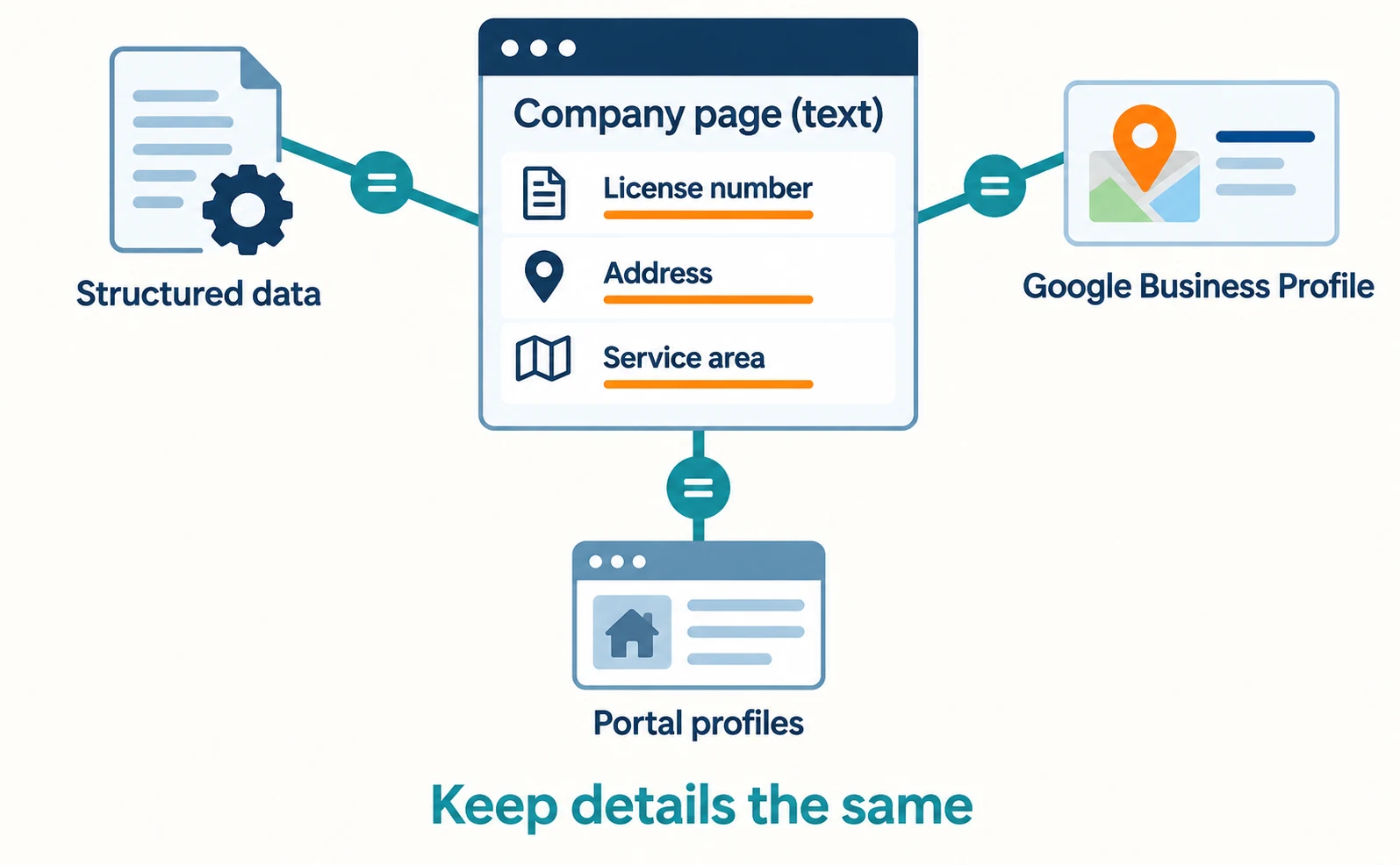
Put your real estate brokerage license number, address and service area as text on your company profile page. If you use structured data, make it match this text.
Google says structured data describes the content of that page and should not include information users cannot see [2]. Also check that your company name and address are written the same way on your company page, Google Business Profile and portal profiles.
For how to avoid being confused with a company of the same name, see how to align company details and official links.
Record Your Current State and Recheck After Improvements
Record answers and cited links for questions that include area names, and track portal citations in a separate column.
First, pick about five questions across the four types. Ask them in ChatGPT, AI Mode in Google Search and similar services, and record them like this.
| Date | AI | Question | Your page cited | Portal cited | Error |
|---|---|---|---|---|---|
| (enter) | ChatGPT | X town, families, livability | No | Portal A | — |
| (enter) | AI Mode | Rental initial costs breakdown | Procedure guide | No | — |
When a portal is cited, check whether your own listings appear on that portal. If your properties are shown through the portal, count that as a separate outcome.
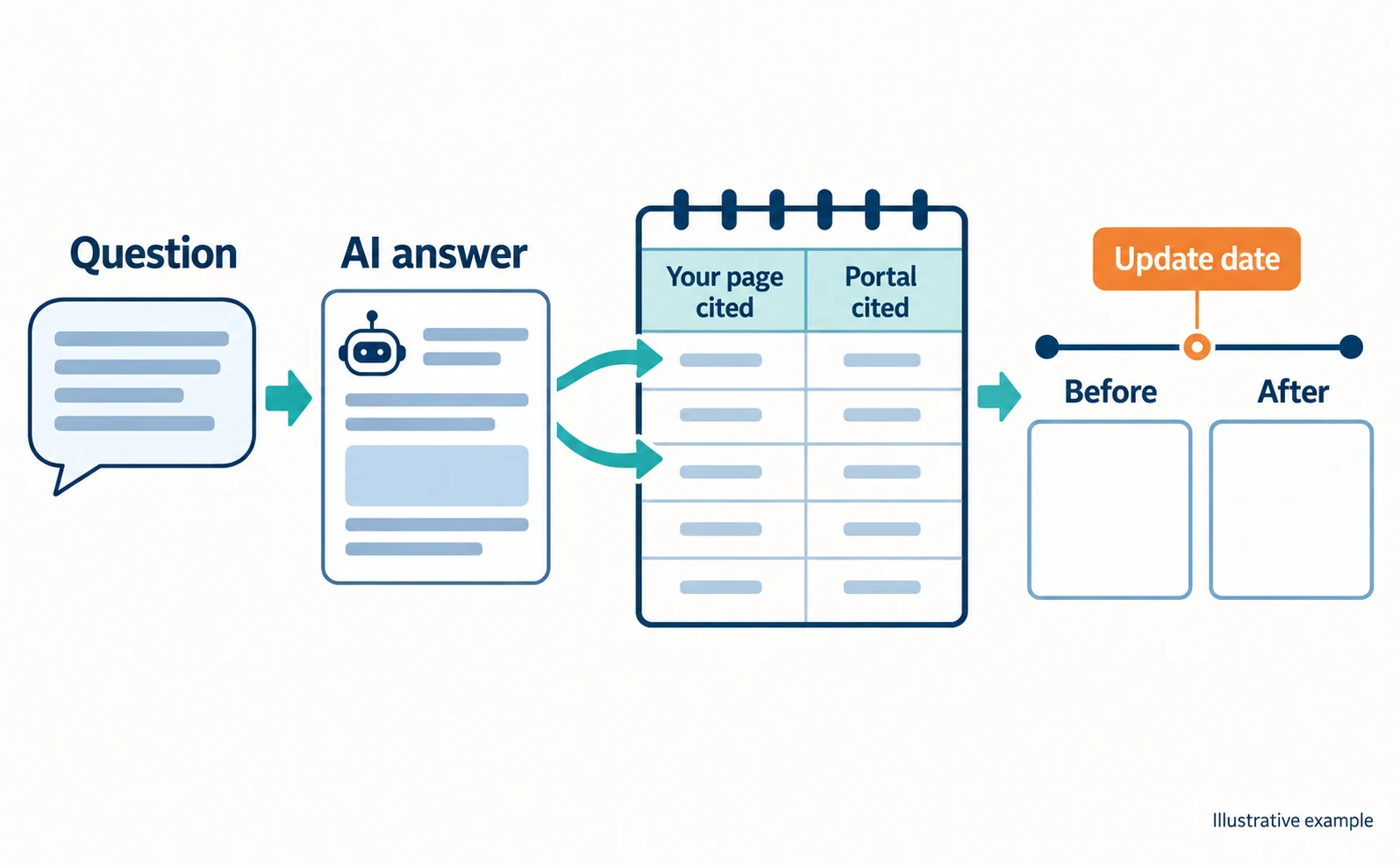
For Google, the Search Console generative AI report shows impressions per page [4]. Record the dates you publish or update area pages, and compare impressions before and after.
If the numbers rise, you cannot be sure the page change alone caused it. Look at both your question records and impressions to choose the next page to improve. For designing questions, see what LLMO is.
FAQ
- Q. What if AI keeps citing property portals?
- First check whether your listings appear on that portal. Then write area advice and procedure explanations that portals do not cover well on your own pages. Record portal citations and your own page citations in separate columns.
- Q. Do listing pages need structured data?
- Google says no special structured data is needed to appear in AI features. If you use it, match it to the layout and price visible on the page, and do not add information users cannot see.
- Q. Can I publish market price figures?
- Yes, with the source and date. Use public data such as the Real Estate Information Library, and keep your own estimates in separate paragraphs or columns.
Sources
- [1] AI features and your website (Google Search Central) — accessed 2026-09-23
- [2] Introduction to structured data markup in Google Search (Google Search Central) — accessed 2026-09-23
- [3] Real Estate Information Library (Ministry of Land, Infrastructure, Transport and Tourism (Japan)) — accessed 2026-09-23
- [4] Generative AI performance report (Search) (Google Search Console Help) — accessed 2026-09-23
About the author
Shogo MizushimaCEO of kairos Inc. / AgentSignal Developer
Develops AgentSignal, a tool for measuring AI crawler visits and AI-referred traffic, and diagnosing AIO readiness. Writes about measurement and practical improvements for AI search using observed data.
Related articles
AIO and AI search
What Is LLMO? How It Differs from SEO and Why Some Say It Is Pointless
LLMO is the work of helping answers from ChatGPT and other AI find and accurately describe your company. Learn how it differs from SEO, why some call it pointless, how E-E-A-T relates, how to measure results and what to do in the first month.
Published
AIO and AI search
What Is Organization Structured Data? Aligning Company Details and Official Links
Mistaken for a same-name company, or your site name and authors don’t show correctly? Align your company overview and official links, then describe them with Organization, WebSite and author structured data, and check the results after publishing.
Published

AIO and AI search
What Is AIO? Its Two Meanings and Where to Start with AI Optimization
AIO has two meanings: work to get your company featured in AI answers, and Google Search’s AI Overviews. Learn how it relates to SEO, what to confirm in a proposal, what Search Console and Bing reports show, and your first tasks.
Published